
2027 Toyota Land Cruiser vs Hyundai Palisade XRT Pro SUV
Compare the 2027 Toyota Land Cruiser and Hyundai Palisade XRT Pro for off-road capability, towing, price, and family SUV features.
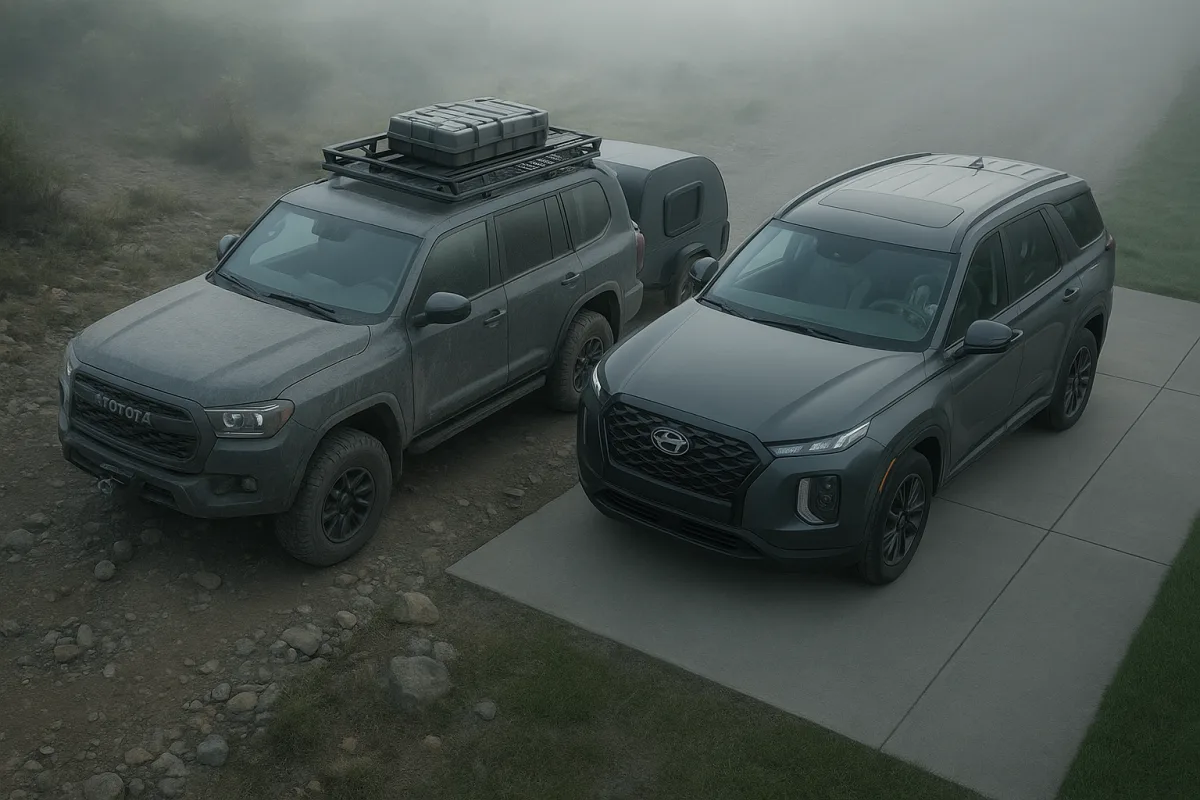
The decision: Toyota Land Cruiser or Hyundai Palisade XRT Pro?
You are looking at two very different ideas of an adventure SUV. The 2027 Hyundai Palisade XRT Pro starts at $51,820, including Hyundai’s $1,650 destination charge, while the Toyota Land Cruiser begins around the $60,000 mark in 1958 trim. [1]
That Hyundai price excludes taxes, title, registration, dealer accessories, financing, and any dealer markup. Those can move the out-the-door number substantially, especially on a new trim positioned as the rugged version of a popular family SUV. [1]
Our choice is the Land Cruiser, with an important qualification. We would buy the Toyota only if you will use its hardware, tow regularly, travel rough roads, or intend to keep it through the warranty and into its higher-mileage years.
The Palisade XRT Pro may prove to be the better value for a family that wants the look, clearance, and confidence of an off-road package without regularly leaving pavement. Hyundai has not established enough detailed capability information here to call it the better buy yet.
| Criteria | 2027 Toyota Land Cruiser | 2027 Hyundai Palisade XRT Pro AWD |
|---|---|---|
| Starting price | The 1958 trim is reported at around $60,000, while a loaded Land Cruiser can approach $70,000. | $51,820 including $1,650 destination. Taxes, registration, dealer options, and financing are extra. [1] |
| Layout | Two-row SUV on Toyota’s truck architecture. | Detailed seating and cargo figures are not established here. |
| Engine and transmission | 2.4-liter turbocharged i-FORCE MAX hybrid four-cylinder, eight-speed automatic, 326 hp and 465 lb-ft. [[2]](https://www.toyota.com/landcruiser/features/mechanical_performance/f68/ "2027 Toyota Land Cruiser Specifications | Toyota.com") |
| Drive system | Full-time four-wheel drive with electronically locking differentials. [[2]](https://www.toyota.com/landcruiser/features/mechanical_performance/f68/ "2027 Toyota Land Cruiser Specifications | Toyota.com") |
| Off-road equipment | Crawl Control, Multi-Terrain Select, and available front stabilizer disconnect. [[2]](https://www.toyota.com/landcruiser/features/mechanical_performance/f68/ "2027 Toyota Land Cruiser Specifications | Toyota.com") |
| Ground clearance | Nearly 9 inches is reported for the current vehicle. | A verified figure is not established here. |
| Towing | Up to 6,000 pounds. [[2]](https://www.toyota.com/landcruiser/features/mechanical_performance/f68/ "2027 Toyota Land Cruiser Specifications | Toyota.com") |
| Road use | Truck-based character, a noisier highway demeanor, and a hybrid four-cylinder that lacks the old V8 Land Cruiser’s sound and smoothness. | Road impressions and detailed specifications are not established here. |
| Long-term ownership case | Toyota reputation and a large aftermarket help, but model-specific reliability and maintenance data for the 2027 hybrid remain unavailable. | Lower entry price, but there is no model-specific long-term cost or reliability record yet. |
| Our pick | The better choice for actual trail use, towing, and long-term modification. | Wait for full specifications unless its price and family-oriented layout are your overriding priorities. |
Why the Land Cruiser wins this comparison
Toyota gives you the stuff that cannot be added later with cosmetic accessories. The 2027 Land Cruiser has a 2.4-liter turbo-hybrid powertrain rated at 326 horsepower and 465 lb-ft, an eight-speed automatic, full-time four-wheel drive, and locking differentials. [2]
Its 6,000-pound towing capacity is healthy for this size of SUV. It is still nowhere near a full-size pickup’s capability, though, so do not buy one expecting Chevrolet Silverado 1500 or GMC Sierra 1500 trailer ratings. [2]
The Land Cruiser’s trail equipment is also properly focused. Crawl Control, Multi-Terrain Select, and the available front stabilizer disconnect address low-speed traction and wheel articulation, which matter far more off pavement than a dark grille or all-terrain-looking tire sidewalls. [2]
Savagegeese found the current Land Cruiser capable and appealing in the way old-fashioned Toyota trucks often are. It looks purposeful, has physical controls, and benefits from an enormous aftermarket, so you can buy tires, armor, recovery gear, and camping hardware without inventing solutions.
There are costs to that character. The current truck is noisier than a Lexus GX, does not ride especially well, and its turbocharged hybrid four-cylinder lacks the relaxed sound and response buyers remember from V8 Land Cruisers.
The packaging also deserves a close look before signing. Savagegeese reports limited center-console storage and a cargo floor compromised by the hybrid battery, a detail that will matter every day if you carry a dog crate, stroller, recovery kit, or bulky grocery load.
The four-cylinder is not weak. With 465 lb-ft available, it is torque-forward in low gears and should work well when the transfer case is engaged. [2] But it is not a charismatic engine, and it does not deliver impressive fuel economy when driven hard.
We would avoid a nearly $70,000 Land Cruiser unless its added equipment directly serves your use. The reported $60,000-ish 1958 trim makes more sense, leaving room in the budget for high-quality tires, a proper hitch setup, and the maintenance reserve every new turbo-hybrid deserves.
Where the Palisade XRT Pro could make more sense
The Palisade XRT Pro’s known advantage is its price. At $51,820 including destination, it undercuts even the reported entry point of the Land Cruiser by roughly $8,000 before taxes, accessories, and dealer charges enter the conversation. [1]
That is enough money to cover years of insurance difference, winter tires, a roof box, family trips, or a substantial down payment reduction. It is also enough that Hyundai needs to publish convincing details before you pay Toyota money for the XRT Pro badge.
The Palisade belongs in the same family-focused conversation as the Kia Telluride X-Pro. CarScoops found the Telluride’s cabin especially strong, citing logical physical climate controls, accessible drive and terrain settings, useful storage, and room for tall adults in its first two rows.
The Telluride X-Pro brings an electronic limited-slip differential, 9.1 inches of ground clearance, extra suspension travel, all-terrain tires, a skid plate, and front and rear recovery points. Its turbocharged 2.5-liter four-cylinder makes 274 horsepower and 311 lb-ft through an eight-speed automatic.
CarScoops recorded 18.6 mpg over 175.5 miles in the Telluride X-Pro, close to its 19-mpg combined EPA rating. It returned 24.1 mpg in a separate careful highway drive, beating its 22-mpg highway rating, but that was not a towing or trail test.
The point is not that the Palisade is the same vehicle as the Telluride. It is that Hyundai and Kia are competing hard in the family-adventure category, where cabin ergonomics, third-row access, ride comfort, and usable cargo space can outweigh rock-crawling hardware.
Until Hyundai provides the Palisade XRT Pro’s ground clearance, tow rating, tire specification, differential strategy, and cargo details, we would not call it a Land Cruiser substitute. It may be a cheaper and more comfortable alternative for many buyers, but those are different promises.
The broader SUV picture: capability is splitting into niches
The 2027 Jeep Recon EV is the upcoming electric off-roader for buyers who want removable doors, an open roof, serious acceleration, and dirt capability. Its dual motors make 670 horsepower, and Car and Driver recorded 3.5 seconds to 60 mph.
Its range is the bigger ownership issue. The Recon Moab is EPA-rated at 222 miles, while the Overland is rated at 240, but Car and Driver managed only 160 miles in its 75-mph highway test of the Moab.
That makes the Recon compelling as a local trail vehicle with dependable home charging. It is less convincing for long interstate drives to remote trailheads, especially if you are towing, carrying roof gear, driving in cold weather, or depending on a sparse charging network.
The 2028 Subaru Getaway points in the opposite direction. Subaru’s largest EV SUV has three rows, standard dual-motor AWD, 420 horsepower, a claimed 300-plus-mile range with its 96-kWh battery, and a 3,500-pound tow rating.
It should suit a family that wants an electric road-trip vehicle and has charging at home. Its weak point is familiar EV towing math: the quoted range will fall significantly when pulling a trailer, and its tow rating trails the Kia EV9’s 5,000-pound maximum.
At the inexpensive end, the 2027 Buick Envista is not an off-road option at all. It is a front-wheel-drive small crossover with a 137-hp turbocharged 1.2-liter three-cylinder, and Car and Driver measured a slow 9.3-second run to 60 mph.
The Envista works for a buyer who values a quiet commuter, 30-mpg EPA combined economy, and room for four adults. It falls down the moment you need all-wheel drive, serious passing power, ground clearance, or a vehicle that can support an outdoors-heavy routine.
At the other financial extreme, Ferrari’s Purosangue Handling Speciale remains a fascinating outlier. Savagegeese reports the package adds $26,700, bringing its tested example to roughly $460,000, for a four-seat V12 vehicle that behaves more like a lifted Ferrari than an SUV.
Its revised damper programming reduces roll by 10 percent in the firmer modes while retaining a comfortable setting. That is a remarkable driving experience, but not an off-road proposition and not a realistic ownership alternative to the SUVs above.
Nissan’s hot Sentra is still only a concept
The Nissan Sentra Spec V concept shown at the 2026 SEMA show is exactly the sort of car enthusiasts have wanted Nissan to build. Its modified 2.0-liter turbocharged engine reportedly makes more than 310 horsepower at the wheels on 91-octane gas.
It also has a six-speed manual from a Juke Nismo RS, GT-R Nismo brakes, coilovers, 19-inch wheels, 265-section Yokohama AD09 tires, Recaro seats, and a very conspicuous GT-R-derived rear wing. As a SEMA build, it has the right ingredients.
Do not shop for it as a 2027 Sentra N. Nissan has not announced a production Sentra N, pricing, warranty terms, service intervals, EPA economy figures, or availability for this Spec V concept.
If you want a real high-performance compact sedan now, the Hyundai Elantra N is the known quantity. Its turbocharged 2.0-liter engine produces 276 horsepower and nearly 290 lb-ft, and it is available with a manual transmission. [3]
The Elantra N has physical climate controls, adjustable drive settings, an electronic limited-slip differential, strong front seats, and an engine that pulls toward its nearly 7,000-rpm redline. The weak spots are firm ride quality, no rear air vents, and no wireless Apple CarPlay with its larger screen.
Who each option suits
Choose the Toyota Land Cruiser if you need a real two-row off-road SUV, plan to tow up to 6,000 pounds, want locking differentials and low-speed trail systems, or expect to build the vehicle around tires and accessories. Buy the lower-priced 1958 if you can, and avoid paying $70,000 for equipment you will not use.
Choose the Hyundai Palisade XRT Pro if its lower entry price and family-SUV mission appeal more than Toyota’s truck hardware. Wait until Hyundai publishes full specifications, then compare its tow rating, ground clearance, tires, cargo arrangement, and drivetrain hardware against the Land Cruiser before committing.
Choose the Kia Telluride X-Pro if your priority is three-row family comfort with credible light-trail equipment. It is the better answer for school runs, road trips, and occasional dirt roads, but its fuel economy and long-term powertrain record deserve attention once warranty coverage ends.
Choose the Jeep Recon EV if you can charge at home and your off-road trips stay within its real range. Its performance is startling, but Car and Driver’s 160-mile highway result makes it a poor fit for frequent long-distance travel.
Choose the Elantra N, not a hypothetical Sentra N, if you want a hot compact sedan you can actually buy. The Nissan Spec V concept is promising, but the Elantra N is the confirmed product with known performance hardware and a production warranty.
Frequently Asked Questions
What are the key differences between the 2027 Toyota Land Cruiser and Hyundai Palisade XRT Pro?
The 2027 Toyota Land Cruiser is a two-row SUV built on truck architecture with a 2.4-liter turbocharged hybrid engine, full-time four-wheel drive, and advanced off-road hardware. It starts around $60,000 and offers a 6,000-pound towing capacity. The Hyundai Palisade XRT Pro starts lower at $51,820 but lacks published detailed specifications on engine output, towing, and off-road capability, making a direct comparison difficult.
Which 2027 SUV is better for off-road use, the Land Cruiser or Palisade XRT Pro?
The Toyota Land Cruiser is better suited for off-road use with verified features like Crawl Control, Multi-Terrain Select, electronically locking differentials, and an available front stabilizer disconnect. The Palisade XRT Pro is marketed as trail-oriented but does not yet have established off-road equipment details or capability figures.
What is the towing capacity of the 2027 Toyota Land Cruiser?
The 2027 Toyota Land Cruiser has a towing capacity of up to 6,000 pounds. This is solid for a mid-size SUV but less than full-size pickups like the Chevrolet Silverado 1500 or GMC Sierra 1500.
Is the Hyundai Palisade XRT Pro a good family SUV with off-road features?
The Palisade XRT Pro may be a good choice for families wanting the look and some off-road confidence of a rugged SUV without regularly going off pavement. However, detailed capability and equipment information is not yet available to fully assess its off-road features.
What off-road equipment does the 2027 Toyota Land Cruiser have?
The Land Cruiser includes Crawl Control, Multi-Terrain Select, and an available front stabilizer disconnect to enhance low-speed traction and wheel articulation. It also features full-time four-wheel drive with electronically locking differentials, which support serious off-road driving.
How we researched this
This article was assembled from 4 video sources across 2 channels, 4 published articles, 3 cited references.
Nothing here is based on hands-on testing. Where a figure or finding appears, it belongs to the source cited beside it, and the writing says so rather than implying otherwise. Every source is listed below so you can check it.
Sources
Ferrari Purosangue Handling Speciale | V12 Hot Hatch, savagegeese
2026 Toyota Land Cruiser | A Truck for End Times, savagegeese
We Need to Talk About the Hyundai Elantra N...and This TCR Edition!, The Fast Lane Car
Nissan Finally Built The Hot Sentra We've All Been Waiting For!, The Fast Lane Car
2028 Subaru Getaway, Car and Driver
2027 Kia Telluride X-Pro Review: The Looks Get Your Attention, The Cabin Wins You Over, CarScoops
2027 Jeep Recon EV, Car and Driver
2027 Buick Envista, Car and Driver
Hyundai Palisade Price in 2026: MSRP, Trims & Real-World Cost
Watch New and Upcoming SUVs and Off-Road Vehicles on Youtube
Also from the sources
Related Articles
2027 Off-Road and 4x4 Vehicles Comparison: Defender vs Ram
Compare 2027 off-road and 4x4 vehicles including the Land Rover Defender and Ram Power Wagon diesel for towing, performance, and ownership.
Jeep Wrangler Rubicon vs Family SUVs
Compare Jeep Wrangler Rubicon with Hyundai Palisade and Honda Pilot for off-road capability, clearance, maintenance, and real-world use.
Off-Road and AWD Family Vehicles Comparison
Compare off-road and AWD family vehicles like the Toyota Sienna Woodland and Honda Passport TrailSport for performance, ownership, and driving needs.
Military-Inspired Off-Road SUVs
Explore military-inspired off-road SUVs like the Ford Bronco Filson, Defender Wolf II, and Land Cruiser with insights on ownership and performance.