
2027 Off-Road and 4x4 Vehicles Comparison: Defender vs Ram
Compare 2027 off-road and 4x4 vehicles including the Land Rover Defender and Ram Power Wagon diesel for towing, performance, and ownership.
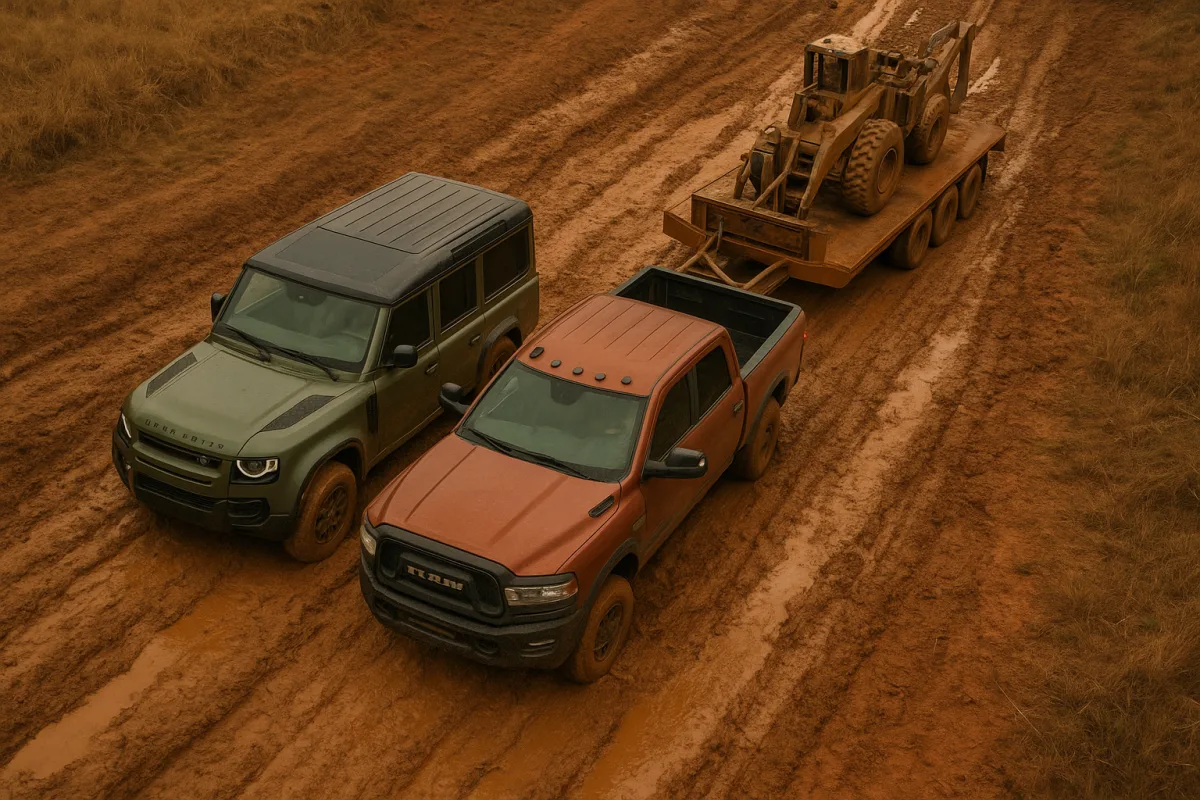
The decision: 2027 Ram 2500 Power Wagon diesel or 2027 Land Rover Defender?
This is not really a fight between two equivalent vehicles. The 2027 Ram 2500 Power Wagon diesel is a heavy-duty pickup that happens to have lockers and low range. The 2027 Land Rover Defender is a family-sized luxury 4x4 designed to make difficult terrain feel less difficult.
The choice is therefore straightforward. If the priority is pulling a large horse trailer, equipment trailer or fifth-wheel to a remote site, choose the Ram. If the priority is driving one vehicle to work, through winter weather and down rough trails without treating every trip as a truck exercise, choose the Defender.
I have not driven either vehicle, and neither has accumulated enough owner mileage to support useful claims about routine repair costs or known failures. The judgement here rests on the published specifications, the available reporting, and The Fast Lane Car’s comparative roller tests of the Defender, Wrangler and 4Runner systems.
There is also a timing problem with the Ram. Car and Driver has published instrumented results for a 2027 Power Wagon diesel, but the independent research brief says the truck had not yet been released as of September 2026 and that real-world fuel economy data was unavailable. Treat any early consumption result as provisional rather than as ownership evidence.
Head-to-head comparison
| Criterion | 2027 Ram 2500 Power Wagon diesel | 2027 Land Rover Defender |
|---|---|---|
| Starting price | Around $88,470 including destination is the current expectation, before options, taxes, finance charges and dealer additions.[[1]](https://www.cars.com/articles/2027-ram-power-wagon-diesel-combines-off-road-capability-with-stump-pulling-torque-519908/?utm_source=openai "2027 Ram Power Wagon Diesel Combines Off-Road Capability With Stump-Pulling Torque | Cars.com") |
| Intended job | Heavy towing, payload, long-distance work and access to rough sites. | Daily family transport, mixed-weather travel and technical off-road use without a trailer-heavy workload. |
| Engine | 6.7-liter Cummins High Output turbodiesel inline-six, 430 hp and 1,075 lb-ft.[[1]](https://www.cars.com/articles/2027-ram-power-wagon-diesel-combines-off-road-capability-with-stump-pulling-torque-519908/?utm_source=openai "2027 Ram Power Wagon Diesel Combines Off-Road Capability With Stump-Pulling Torque | Cars.com") |
| Four-wheel-drive layout | Part-time system with low range, front and rear locking differentials, and a disconnecting front anti-roll bar. | Full-time four-wheel drive, center differential, low range and Terrain Response programming. |
| Driver involvement | The driver must select four-wheel drive and should not use locked 4WD on dry pavement. | Usually leave it in automatic operation, allowing the vehicle to manage torque distribution and locking functions. |
| Serious trail hardware | Front and rear lockers remain, but the diesel loses the factory winch and Articulink front control arms. | Strong electronic traction management and automatic center and rear locking action, but less straightforward manual control. |
| Clearance and angles | Diesel ground clearance is 13.2 inches, roughly an inch less than the gasoline Power Wagon, with reduced approach and breakover angles.[[1]](https://www.cars.com/articles/2027-ram-power-wagon-diesel-combines-off-road-capability-with-stump-pulling-torque-519908/?utm_source=openai "2027 Ram Power Wagon Diesel Combines Off-Road Capability With Stump-Pulling Torque | Cars.com") |
| Towing | Near-20,000-pound towing capability, plus the first Power Wagon availability of fifth-wheel towing equipment.[[1]](https://www.cars.com/articles/2027-ram-power-wagon-diesel-combines-off-road-capability-with-stump-pulling-torque-519908/?utm_source=openai "2027 Ram Power Wagon Diesel Combines Off-Road Capability With Stump-Pulling Torque | Cars.com") |
| On-road character | Large, heavy and truck-like. Early Car and Driver reporting describes slow steering response and a firm ride on high-pressure all-terrain tires. | More suited to ordinary roads, poor weather and long journeys, although long-term running costs remain unknown. |
| Fuel and operating cost | No validated released-model economy data. Diesel fuel, a 31-gallon tank, large tires and HD-truck consumables will not make it cheap to run. | No 60,000-mile cost data in the supplied research. Expect premium-vehicle servicing and tyres to matter more than brochure fuel figures. |
| Ownership risk | New diesel-Power-Wagon combination, so no established failure pattern or resale record exists. | Updated engines and trims mean previous Defender ownership data is only partly relevant. |
| Best buyer | Owner who genuinely needs a heavy-duty pickup and wants real lockers for access roads, snow, mud and job sites. | Owner who needs one vehicle to handle family life, winter roads and serious recreational off-roading. |
1. Price and what the sticker really buys
The Ram’s expected starting price is around $88,470 including destination, according to the independent research brief drawing on Cars.com and Kelley Blue Book reporting.[1] That is not a cheap work truck, and it is not the whole cost.
The Cummins diesel itself is a $12,995 upgrade, while towing technology, camera packages, bed equipment and luxury trim can move the number much higher.[1] Finance interest, insurance, diesel exhaust fluid, tyres, registration and fuel are separate costs.
The Defender’s price is not included in the supplied material, so it would be dishonest to invent one. Buyers should price the exact 90, 110 or 130 body style, then compare insurance and service-plan terms rather than assuming the entry price tells the whole story.
Neither sticker includes accessories such as recovery boards, a roof rack, trailer brake controller upgrades, off-road training, winter tyres or an aftermarket winch. Those costs matter more than many buyers expect, particularly when the vehicle will actually leave pavement.
2. Four-wheel drive in the real world
This is where the Defender makes the more persuasive everyday case. The Fast Lane Car’s roller testing found that the Defender’s full-time system pulled cleanly from low-traction situations in automatic mode, with the vehicle deciding when to lock its center and rear differentials.
That matters on mixed surfaces. A driver can leave home on dry pavement, encounter slush, cross a muddy access road and return to asphalt without stopping to think through transfer-case settings. That convenience is not laziness, it is useful in changing conditions.
The Ram takes the old-school heavy-duty approach. It has a part-time transfer case and no center differential, so engaging four-wheel drive on dry, high-grip pavement can cause driveline binding. Its lockers and disconnecting anti-roll bar are excellent tools, but the driver must use them appropriately.
For a skilled owner, manual engagement is not a flaw. It offers predictability and direct control. For an owner who will use the vehicle in rain, snow and patchy ice every week, the Defender’s automatic response is simply more convenient.
3. Off-road hardware, and the diesel compromise
The diesel Ram still has the important equipment: front and rear electronic locking differentials, low range and a disconnecting front anti-roll bar. It remains much more capable off pavement than an ordinary 2500 pickup.
But the diesel conversion has real costs. The factory winch disappears because the turbocharger intercooler occupies the space, and the Articulink front control arms fitted to the gasoline Power Wagon are omitted.[1] Those arms help reduce binding at full suspension compression.
The diesel also sits lower. At 13.2 inches, its ground clearance is about an inch below that of the gasoline Power Wagon, and its approach and breakover angles are reduced.[1] This is the rare case where the more expensive engine produces a less capable off-road truck.
The Defender relies more on electronics than on obvious mechanical theatre. The Fast Lane Car found its automatic locking and brake-based traction responses extremely quick in roller tests. That is useful on rock, loose climbs and uneven trails, particularly for drivers who do not want to manage lockers manually.
The Defender’s weakness is that its automatic systems do not give the driver the same direct sense of control as the Ram’s locker switches. Some experienced off-road owners will prefer choosing the configuration themselves, especially when positioning a large vehicle around obstacles.
4. Towing, payload and the road between trails
Here the Ram wins without qualification. The Cummins produces 430 hp and 1,075 lb-ft, with towing capability near 20,000 pounds and payload close to 3,000 pounds.[1] It can also be equipped for fifth-wheel towing, a first for the Power Wagon.
That capability changes what the Power Wagon is for. It can haul a substantial trailer to a trailhead, ranch, construction site or remote property, then use low range and lockers when the access road turns unpleasant. The Defender cannot replace that role.
The trade-off is size and weight. Early Car and Driver figures list the truck at 8,340 pounds, and the publication reports that it rides like the HD pickup it is. Its recirculating-ball steering is not a recipe for relaxed precision on narrow lanes.
Car and Driver also averaged 15 mpg and saw 19 mpg at a steady 75 mph in its early diesel Power Wagon test. Because the independent brief says released-model real-world data is not yet available, regard those figures as a useful warning, not a settled ownership average.
The Defender is the better vehicle if the journey to the trail is mostly motorway, city streets or twisting secondary roads. Its basic architecture is better aligned with daily transport, even if the updated 2027 range loses its supercharged V8 and the OCTA’s output drops to 532 hp.[2]
5. Where the Jeep, Ford and Toyota fit
The Jeep Wrangler remains the choice for buyers who want the most traditional recreational 4x4 experience. The Fast Lane Car’s Wrangler testing showed that its automatic four-wheel-drive setting can help in slippery conditions, while its Rubicon specification adds the front locker the non-Rubicon vehicle lacked.
Its limitations are equally familiar. The same testing found its traction-control response slower than the Toyota and Land Rover systems when lockers were not engaged. Wrangler pricing was not supplied in the research, so confirm current model-year pricing before treating it as the budget alternative.
The Ford Bronco belongs on the shortlist for buyers wanting Wrangler-style trail ability with a more modern daily-driver feel. The Fast Lane Car comparison included a Bronco Raptor, but the supplied excerpt does not provide enough result detail to rank its system honestly against the others.
The Toyota 4Runner TRD Pro is the less flashy answer for buyers who prefer a conventional part-time system. Its 33-inch Toyo tyres and TRD-tuned FOX QS3 adjustable shocks are useful hardware, and Toyota’s low-range programming performed impressively in The Fast Lane Car’s roller tests.
Its compromise is the lack of automatic four-wheel drive in TRD Pro specification. The Fast Lane Car found the driver must manually select 4HI when rear-wheel drive loses traction, although Toyota’s low-range traction control, terrain selection and rear locker then worked very effectively.
The available research does not provide a 2027 price for the Bronco, Wrangler or 4Runner. That omission matters. A buyer should compare actual local transaction prices, insurance, finance rates and required accessories, not merely assume that the smaller SUVs cost less to own.
6. Maintenance and 60,000-mile reality
There is no responsible way to write a known-failures guide for these 2027 updates yet. The Ram diesel Power Wagon is a new combination, while the Defender’s engine and model changes mean earlier ownership reports cannot be carried over without qualification.
For the Ram, the sensible ownership budget should include diesel fuel, diesel exhaust fluid, fuel filters, oil changes, transmission and axle service, and expensive load-rated tyres. Towing and slow off-road work add heat and wear, which tend to shorten fluid and brake-life expectations.
For the Defender, confirm service intervals, warranty duration, roadside-assistance terms and the cost of extended coverage before ordering. Its full-time system and electronics are impressive, but complexity does not become cheap merely because the dashboard makes it easy to use.
Neither model has meaningful 2027-specific depreciation data. Historical Ram 2500 figures are not a reliable forecast for a diesel Power Wagon, and the updated Defender’s market position may be affected by its revised engines and emissions-driven deletion of the supercharged V8.[2]
Who each option suits
Choose the 2027 Ram 2500 Power Wagon diesel if your off-road trips start with a genuinely heavy trailer. It suits contractors, ranch owners and trailer users who need fifth-wheel capability, huge torque and locked-axle access after the pavement ends. It falls down as a daily driver because it is enormous, costly to fuel and less capable off road than the gasoline Power Wagon in a few important hardware details.
Choose the 2027 Land Rover Defender if you want one 4x4 for wet-road commuting, family use, snow, gravel, ruts and challenging weekend trails. It suits drivers who value automatic traction management and road usability over maximum towing. It falls down for buyers who need heavy-duty pickup capacity or who want simple, manually controlled mechanical hardware.
Choose the Jeep Wrangler if removable doors, compact trail dimensions and traditional four-wheel-drive character matter more than refinement. It suits the recreational off-roader who will select Rubicon hardware where front-locker capability is required. It falls down on-road and, without the right trim, its electronic traction response is less polished than the Defender’s or 4Runner’s.
Choose the Ford Bronco if the target is a modern, trail-oriented alternative to the Wrangler. It suits buyers wanting serious off-road intent without stepping into a heavy-duty truck. Its exact price and model-specific comparison result were not supplied here, so do not assume a Bronco Raptor represents every Bronco.
Choose the Toyota 4Runner TRD Pro if you value Toyota’s conventional approach, strong low-range calibration and durable-looking off-road hardware. It suits drivers happy to select four-wheel drive themselves. It falls down in variable winter conditions because the TRD Pro lacks the automatic 4WD setting that makes the Defender, Bronco and some Wrangler versions easier to live with.
Frequently Asked Questions
What are the key differences between the 2027 Ram 2500 Power Wagon diesel and the 2027 Land Rover Defender?
The 2027 Ram 2500 Power Wagon diesel is a heavy-duty pickup designed primarily for heavy towing and payload, featuring a 6.7-liter Cummins diesel with 430 hp and 1,075 lb-ft torque. It has a part-time 4WD system with front and rear lockers and a disconnecting front anti-roll bar. The 2027 Land Rover Defender is a family-sized luxury 4x4 with a full-time 4WD system that automatically manages torque distribution and locking, suited for mixed weather and technical off-road use without heavy towing demands.
Which 2027 off-road vehicle is better for heavy towing?
The 2027 Ram 2500 Power Wagon diesel is the better choice for heavy towing, with near-20,000-pound towing capacity and availability of fifth-wheel towing equipment. The Land Rover Defender is not designed for very heavy fifth-wheel or commercial trailer duty.
How does the full-time 4WD system of the 2027 Land Rover Defender work?
The Defender’s full-time four-wheel-drive system uses a center differential, low range, and Terrain Response programming to automatically manage torque distribution and locking functions. Drivers usually leave it in automatic mode, allowing the vehicle to react to changing conditions without manual intervention.
What are the ownership costs and risks of the 2027 Ram Power Wagon diesel?
There is no meaningful 60,000-mile maintenance, failure-rate, or resale data yet for the 2027 Ram Power Wagon diesel since it is a new model. Fuel economy data is also unavailable, but diesel fuel, a large fuel tank, heavy-duty tires, and truck consumables suggest operating costs will be high. Financing may require higher credit scores and substantial down payments, but specific details are not publicly available.
How we researched this
This article was assembled from 1 video source, 3 published articles, 2 cited references.
Nothing here is based on hands-on testing. Where a figure or finding appears, it belongs to the source cited beside it, and the writing says so rather than implying otherwise. Every source is listed below so you can check it.
Sources
Jeep Wrangler vs Ford Bronco vs Toyota 4Runner vs Land Rover Defender: What's the BEST 4x4 System? — The Fast Lane Car
Ram 2500 Power Wagon Diesel Tested: They Said It Couldn’t Be Done — Car and Driver
View Exterior Photos of the 2027 Ram 2500 HD Power Wagon — Car and Driver
View Interior Photos of the 2027 Ram 2500 HD Power Wagon — Car and Driver
2027 Ram Power Wagon Diesel Combines Off-Road Capability With Stump-Pulling Torque | Cars.com
Watch New and Updated Off-Road and 4x4 Vehicles on Youtube
Related Articles
Off-Road and AWD Family Vehicles Comparison
Compare off-road and AWD family vehicles like the Toyota Sienna Woodland and Honda Passport TrailSport for performance, ownership, and driving needs.
GM 8.3-Liter Duramax Diesel Engine for 2027 Heavy-Duty
Explore GM's 8.3-liter Duramax diesel engine specs, torque, and impact on 2027 Silverado HD and Sierra HD heavy-duty trucks.
Military-Inspired Off-Road SUVs
Explore military-inspired off-road SUVs like the Ford Bronco Filson, Defender Wolf II, and Land Cruiser with insights on ownership and performance.
Jeep Wrangler Rubicon vs Family SUVs
Compare Jeep Wrangler Rubicon with Hyundai Palisade and Honda Pilot for off-road capability, clearance, maintenance, and real-world use.