
Exotic Car Ownership and Modifications
Explore exotic car ownership and modifications, including costs, challenges, and real-world examples of high-performance exotic cars.
The quick list
- Best overall: McLaren 750S-based DDE 750 Absolute, for the buyer who wants a dramatic custom look but still intends to drive the car regularly.
- Best value: 2006 twin-turbo Lamborghini Gallardo project, for a capable owner with diagnosis money, workshop access and tolerance for a very uncertain first bill.
- Best for track use: Adam LZ’s four-rotor Supra, for a funded drift programme rather than a road-car buyer.
- Best evidence of high-mileage reality: McLaren 600LT, for owners deciding whether a used Longtail is manageable with a proper specialist relationship.
- Best no-compromise hypercar: Czinger 21C V Max, for collectors who can accept a $2.36 million entry price and factory-led maintenance. [6][7]
The question is not which of these cars makes the biggest number. It is whether you want a road-going exotic you can actually use, a discounted project with an unknown history, a purpose-built drift weapon, or a hypercar whose ownership model is still largely unproven.
None of these should be treated as a conventional buying recommendation based on personal road testing. The useful evidence comes from the owners and builders featured by EmeliaHartford, DailyDrivenExotics, Adam LZ, Shmee150 and Vehicle Virgins, plus the available market and manufacturer research.
Comparison table
| Option | Price evidence | Layout and role | What the sources reveal | Ownership trade-off |
|---|---|---|---|---|
| 2006 twin-turbo Lamborghini Gallardo | $60,000 asking in EmeliaHartford’s feature, versus roughly $139,823 median 2026 Gallardo asking price and $115,500 fair-market estimate for normal examples [[4]](https://carsearch.pro/market/gallardo/?utm_source=openai "Lamborghini Gallardo Price Guide 2026 — Values, Prices & Market Data | CarSearch.Pro") | Rear-wheel-drive V10, aftermarket twin turbos | Cranks but will not start, suspected bricked Syvecs ECU, aged tyres and years of previous intervention |
| McLaren 750S-based DDE 750 Absolute | Base-car and modification cost not disclosed | Mid-engined twin-turbo V8 road car, widebody conversion | Cat-back exhaust only mechanically, while bodywork, wheels and trim are extensively changed | Better chance of usability than a high-power build, but modifications narrow resale and insurance options |
| Adam LZ four-rotor Supra | Build cost not disclosed | Front-engined drift car, four-rotor engine and heavily revised suspension | More than 100 hp gained during development, but throttle wiring and exhaust fitment interrupted testing | Requires competition-level fabrication, tuning and spares support |
| McLaren 600LT | Purchase price not disclosed | Mid-engined 3.8-litre twin-turbo V8 Longtail | 42,298 miles, smoke concern, complicated oil-check procedure and 79 stored faults, mostly inactive battery-voltage related | A specialist can make ownership viable, but deferred maintenance is false economy |
| Czinger 21C V Max | Approximately $2.36 million [7] | Central tandem seating, hybrid 2.88-litre twin-turbo V8 | 1,250 hp, 691 lb-ft, claimed 253 mph, and only 80 total 21Cs across derivatives [7] | Factory-trained servicing and unknown long-term cost data |
The abandoned Gallardo: cheap purchase, expensive uncertainty
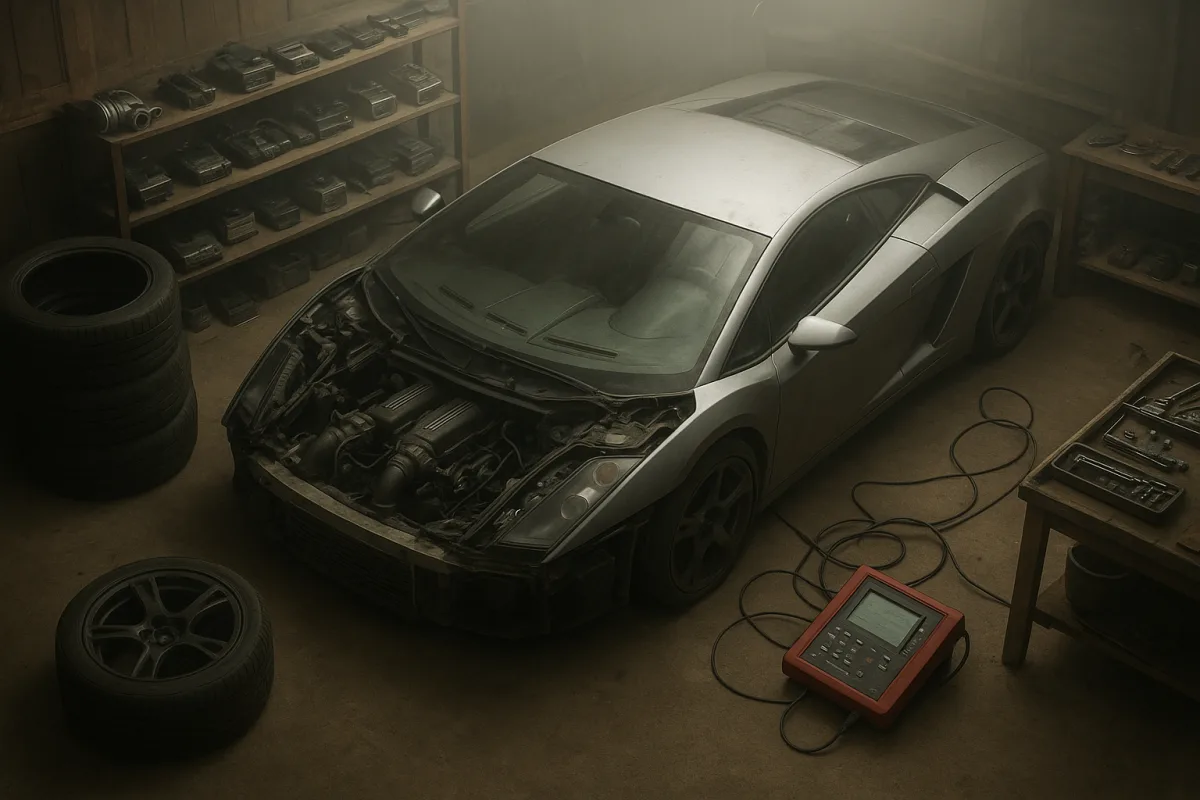
EmeliaHartford’s featured project is a 2006 pre-LP Lamborghini Gallardo with rear-wheel drive, a stock-bottom-end 5.0-litre V10 and an aftermarket twin-turbo system. Its seller says he paid $65,000 and offered it on at $60,000 after failing to solve its no-start issue.
That sounds compelling beside a 2026 Gallardo median asking price of about $139,823. The comparison is misleading unless the car starts, drives, stops properly and has credible documentation, because the market figure applies to functioning cars rather than abandoned modified examples. [4]
The immediate problem is that it cranks but does not fire. Previous owners reportedly suspected an incorrectly handled jump-start had damaged the Syvecs engine-management system, while the car had already passed through multiple hands and sat for years.
Electrical diagnosis is not just a matter of bolting in a computer. ECU work requires diagnosis, repair or replacement, then programming, and published Lamborghini ECU costs span roughly $150 to $600 for repair, around $230 for some used older units, and more than $3,400 for newer OEM parts. [1]
Those figures are useful only as brackets, not a quote for this Gallardo. An aftermarket-turbo car with an unfamiliar standalone ECU, unknown calibration and possible wiring changes can cost far more than the controller itself to make dependable.
The visible basics are just as important. EmeliaHartford’s inspection found cracked 2016-date-code tyres, exposed intake placement in the wheel wells and no wheel liners, meaning wet-weather driving could throw water toward the intakes. Those are not collector-car details, they are immediate ownership decisions.
A standard Gallardo is already specialist-car territory. Add forced induction, a stock bottom end, unknown turbo sizing and unclear installation history, and the low buy-in becomes a contingency fund question rather than a bargain.
Resale is another uncomfortable part of the arithmetic. General exotic-car modification research suggests heavily modified examples can lose 20 to 40 percent of value relative to suitably comparable standard cars, largely because the buyer pool worries about reliability, warranty and workmanship. [2][3]
That does not prove this specific twin-turbo Gallardo is worth less than a standard car. It does mean nobody should budget on recovering the cost of repairs, paint correction, ECU work and recommissioning when it is time to sell.
The 750S conversion: modify appearance before power
DailyDrivenExotics takes the opposite approach with its McLaren 750S-based DDE 750 Absolute. It is a prototype styling conversion inspired by the Koenigsegg Jesko Absolute, using Rift replacement panels, AL13 forged wheels, carbon discs, a satin-black paint-protection-film finish and bespoke rear fins.
The price of the donor McLaren, conversion, PPF and one-off wheel package is not disclosed. That matters, because this is not a cheaper alternative to a hypercar in the ordinary ownership sense, only a less expensive route to similarly aggressive visual language.
The sensible detail is mechanical restraint. Despite the widebody and carbon addenda, DailyDrivenExotics says the car remains mechanically stock apart from a cat-back exhaust, while the active rear wing is retained and the owner intends to drive it before escalating the project.
That is a much more defensible plan than immediately pursuing the stated possibility of 1,300 wheel horsepower. The channel explicitly frames the decision as a response to reliability trouble with an earlier modified McLaren 720 GTR, which is the lesson many builds ignore.
The trade-off is that extensive cosmetic modification still has consequences. Buyers may like the look, but insurers, finance providers and future purchasers may not value the parts as the owner does, particularly where original body panels have been replaced. [2][3]
For a financed 750S, costs begin before the modifications. Specialist-insurance estimates put annual McLaren 750S premiums at roughly $7,000 to $11,000, while performance-car finance commonly expects around 20 percent down from borrowers with strong credit. Those figures do not guarantee coverage for a widebody car. [2]
The four-rotor Supra: a race programme, not a weekend toy
The four-rotor car is not an RX-7, despite the rotary association many readers will make. Adam LZ’s featured machine is a Supra developed for drifting, with a four-rotor engine, revised intake and header combinations, and a chassis that had not yet received the same attention as the powertrain.
The channel reports gains of more than 100 horsepower compared with its previous outing, but avoids publishing a final figure in the supplied material. More useful is the drivability report: below roughly 6,000 rpm it felt broadly familiar, while above that point it hit a much harder power band.
That tells you this is not a linear, relaxed road-car package. Its usable performance depends on staying in a narrow operating window, using clutch kicks when revs fall, and accepting a drivetrain character chosen for spectacle and drift control rather than traffic or touring.
The suspension work is equally revealing. The team changed anti-squat settings, lowered the car to improve control-arm angles and chased off-throttle side bite, only to discover that changing one inaccessible bolt required cutting it because the subframe would otherwise need removal.
Then came a throttle problem that looked like a mapping issue. A wire trapped beneath the throttles limited opening to 35 percent, proving again that a bespoke build can lose most of its performance through a small installation detail.
There is no disclosed total build price, insurance cost or conventional service schedule. That is not a gap to fill with guesses. It is a warning that four-rotor ownership requires a builder, fabricator, tuner, spare-parts plan and a budget for development laps.
The 600LT at 42,298 miles: the useful McLaren reality check
Vehicle Virgins’ McLaren 600LT is the counterweight to the newest 750S project. Bought in 2019 and shown at 42,298 miles, it developed smoke from the exhaust after an oil change, prompting concern that turbo seals might be failing.
The diagnosis had not reached that conclusion in the supplied footage, so it would be wrong to call it a turbo failure. The important point is that on a high-mileage, twin-turbo Longtail, smoke deserves prompt specialist inspection rather than internet certainty.
The oil service procedure alone is a reminder that simple jobs are not always simple. The 600LT uses 0W-40 oil, lacks a dipstick and requires the engine to reach temperature before the oil-status menu can be checked, followed by a 40-second 2,000-rpm procedure.
The scan result also needs context. The car showed 79 stored faults, but the workshop described most as inactive battery-voltage history rather than current defects. That is not ideal, but it is different from 79 active failures.
There is a constructive lesson in the oil-filter comparison. The featured specialist cut open an inexpensive lookalike filter and found less filter material than the OEM item, arguing that saving roughly $200 on a critical service part was not worth the risk.
The Czinger 21C V Max: extraordinary specification, no ownership history
Shmee150’s first-drive account of the Czinger 21C V Max makes clear how different this is from the modified cars. It has tandem central seating, two 2.1-kWh battery packs beside the occupants, a single-clutch transmission and a hybrid system built around a 2.88-litre twin-turbo V8.
Czinger’s current published specification gives the V Max 1,250 hp and 691 lb-ft from that V8 and two 268-hp electric motors. The listed top speed is 253 mph, with 0-60 mph in 2.0 seconds and a 9.2-second quarter-mile at 156.9 mph. [7]
The V Max favours low drag over the high-downforce 21C configuration. Shmee150’s account describes its road character as unusually approachable in its electric-oriented Street setting, then much more forceful in Sport and Track modes as electric torque and combustion power combine.
The actual ownership question has no satisfying public answer yet. Only 80 21Cs are planned across the range, and public reporting has not produced meaningful data on common mechanical failures, routine bills or high-mileage examples. [7]
Czinger’s own repair guidance stresses trained personnel and pre-drive checks. That is reasonable for a 1,250-hp low-volume hybrid hypercar, but it means owners should assume factory-led support, specialist transport and limited independent repair options. [6]
Who each option suits
The abandoned twin-turbo Gallardo suits an experienced project buyer who can absorb a total loss on the first repair attempt. It does not suit someone stretching to own a Lamborghini, because the purchase price may be the smallest number attached to it.
The DDE 750 Absolute suits a buyer who values visual individuality but wants to preserve the donor car’s basic factory powertrain. It is the most sensible custom direction here, provided every modified part is declared to the insurer and documented for resale.
Adam LZ’s four-rotor Supra suits a drift team, content creator or highly committed amateur with established workshop support. It does not suit a buyer seeking predictable road miles, normal servicing or easy insurance.
The 42,298-mile McLaren 600LT suits an informed used-exotic buyer who has found a respected independent specialist before buying. It is a reminder to buy records, battery condition, diagnostic history and preventative maintenance, not merely carbon trim and low headline price.
The Czinger 21C V Max suits the collector who wants a genuinely rare, factory-supported technical statement and can tolerate unknown long-term costs. Its $2.36 million price excludes the practical burden of specialist logistics, servicing and the risk inherent in very limited production. [6][7]
Frequently Asked Questions
What are the challenges of owning a modified exotic car?
Modified exotic cars often present challenges such as uncertain mechanical and electrical reliability, especially when aftermarket components like standalone ECUs are involved. Owners may face expensive diagnosis and repairs, limited specialist support, and difficulties with insurance and resale due to warranty voidance and a smaller buyer pool.
Is buying a twin-turbo Lamborghini Gallardo project a good value?
The twin-turbo Lamborghini Gallardo project priced around $60,000 can seem like a bargain compared to median market values near $140,000, but it carries significant risks. The car may require costly electrical diagnosis, ECU repair or replacement, and tyre renewal before it becomes usable, making the initial price misleading without factoring in these expenses.
What maintenance issues arise with high-performance exotic cars?
High-performance exotics often need specialist servicing, as seen with the McLaren 600LT’s complex oil-check procedures and stored electrical faults. ECU repairs can be costly and time-consuming, and deferred maintenance can lead to expensive problems. Factory-trained personnel and pre-drive checks are especially important for hypercars like the Czinger 21C V Max.
How do modifications affect exotic car resale value?
Modifications typically reduce resale value by 20–40% and limit the potential buyer pool due to concerns about reliability and warranty coverage. While customizations may enhance performance or appearance, they often narrow insurance options and complicate valuation compared to stock vehicles.
What makes the McLaren 750S-based DDE 750 Absolute a sensible modified exotic?
The McLaren 750S-based DDE 750 Absolute balances dramatic visual modifications with mechanical conservatism by avoiding extreme power increases that previously caused reliability issues. This approach improves the likelihood of regular usability compared to more aggressively modified exotics, though it still narrows resale and insurance options.
How we researched this
This article was assembled from 5 video sources across 5 channels, 7 cited references.
Nothing here is based on hands-on testing. Where a figure or finding appears, it belongs to the source cited beside it, and the writing says so rather than implying otherwise. Every source is listed below so you can check it.
Sources
I bought an Abandoned Twin Turbo Lamborghini for Cheap w one huge issue... — EmeliaHartford
It's Here! I Can Finally Reveal My NEW Dream Car! — DailyDrivenExotics
We Put the New 4 Rotor Setup to the Test — Adam LZ
My FIRST DRIVE in the CZINGER 21C VMAX! — Shmee150
Everything Wrong With My 42,000 Mile Mclaren 600LT — Vehicle Virgins
ECU Repair Cost in 2026 (Full Price Breakdown) – CarComputerExchange.com
Should I Modify My Exotic Car? Complete Modification Guide for 2026 | Automonitor
Exotic Car Modifications & Protection: What Adds Value and What Doesn’t
Lamborghini Gallardo Price Guide 2026 — Values, Prices & Market Data | CarSearch.Pro
2026 Lamborghini Temerario Value: $440,000 | Price History & Sales | DriveIndex
Watch High-Performance and Exotic Car Ownership and Modifications on Youtube
Also from the sources
Related Articles
High-Performance Car Builds
Explore high-performance car builds, comparing drift setups, exotic mods, costs, and ownership challenges in this detailed guide.
High-Performance Exotic Car Ownership
Explore high-performance exotic car ownership costs, maintenance, modifications, and financing to make informed decisions about your dream vehicle.

Exotic Car Ownership Experience: Challenges and Insights
Explore the exotic car ownership experience, including maintenance, modifications, insurance, and financing for high-performance vehicles.

Hypercar Ownership Challenges
Explore hypercar ownership challenges, costs, and maintenance insights for McLaren P1, SSC Tuatara, and Lamborghini Gallardo owners.