
Modern Performance Car Engine Tuning
Explore modern performance car engine tuning, including airflow, intake runners, exhaust collectors, and rotary engine maintenance insights.
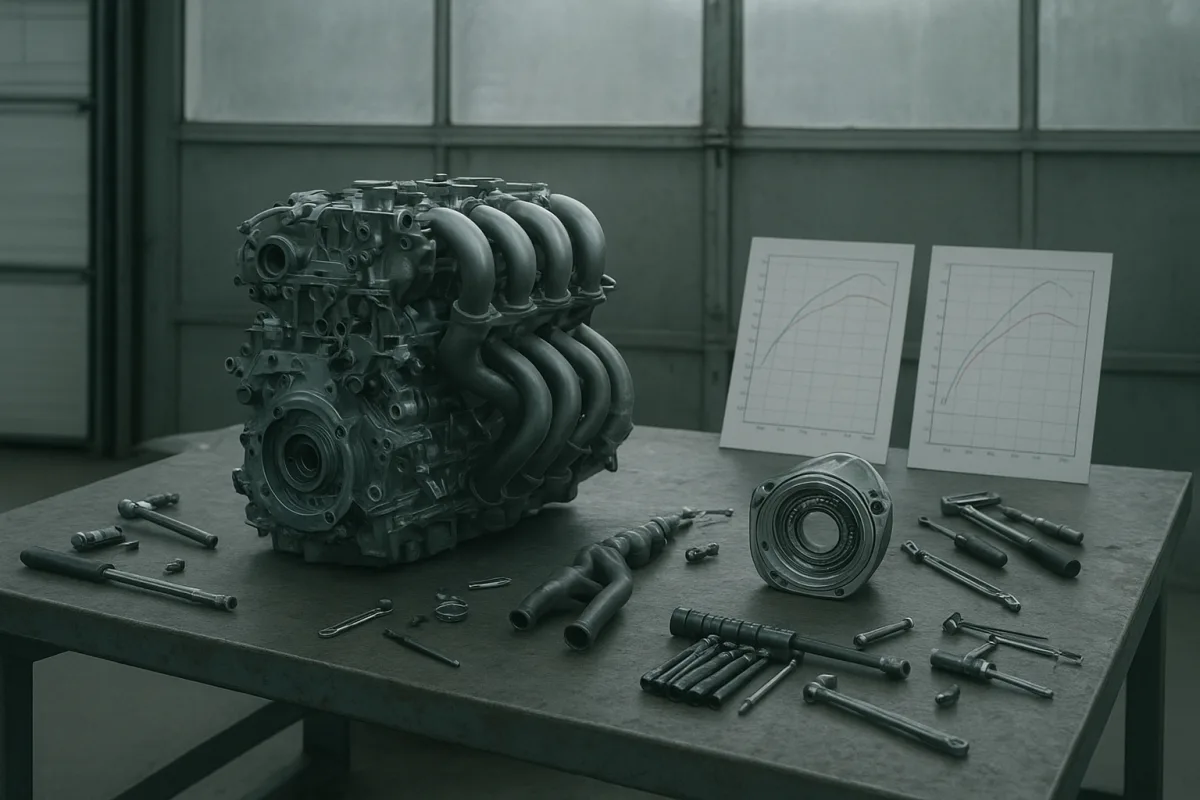
The useful number is not peak horsepower
The common thread linking a four-rotor drift car, GM’s LS V8 family and Toyota’s proposed MR2 is not simply horsepower. It is airflow management, specifically how an engine is encouraged to fill its cylinders, or rotor chambers, across the rev range.
That sounds like workshop folklore until you look at the choices engineers and builders make. Bigger ports, shorter intake runners, larger collectors and freer exhausts can all increase peak flow, yet each can also remove torque where the car spends most of its time.
For a road car, that missing middle matters more than the headline dyno pull. A car that loses 20 lb-ft at 3,500 rpm but gains 15 hp near redline may look improved on a graph, while feeling slower leaving a junction.
I have not driven Adam LZ’s four-rotor Supra, nor Toyota’s current mid-engine development mule. The useful lesson from the Adam LZ channel’s iterative testing is nevertheless familiar to anyone who has lived with modified cars: parts do not work independently.
What intake runner length actually changes
An intake runner is not merely a pipe connecting a throttle body to an inlet port. Every time an intake port opens and closes, it creates pressure waves that move back and forth through that runner.
If a returning pressure wave arrives at the inlet port at the right moment, it helps pack more air into the engine. More trapped air permits more fuel, and therefore more torque, assuming ignition timing, fuel delivery and cooling are sufficient.
Longer runners generally tune that effect for lower engine speeds. Shorter runners move the useful resonance higher in the rev range, where there is less time between intake events and a shorter path better matches the pressure-wave timing.
That is why a short-runner manifold can make an engine feel sharper near its upper limit while hollowing out the middle. It is not magic and it is not automatically an upgrade, it is a decision about where the engine earns its power.
Adam LZ’s channel described precisely that trade-off when revisiting a short-runner intake for the four-rotor Supra. The expectation was more upper-rpm power at the sacrifice of torque, and the team considered returning to a longer, intermediate-length runner afterward.
That is a more honest development path than bolting on the physically largest intake available. In a drift car held high in the rev range, giving away some lower-speed torque can be acceptable, but it changes clutch work, gearing and throttle response.
The same compromise is why factory inlet systems often look less dramatic than aftermarket ones. A road manufacturer needs cold starts, emissions compliance, noise control, part-throttle response and a broad torque band, rather than one impressive dyno peak.
Why the small changes in the four-rotor did not matter
The Adam LZ channel first removed an approximately eighth-inch mismatch at the intake transition, then tested the setup repeatedly. The result was effectively no meaningful power gain, despite a cleaner transition that ought to reduce local turbulence.
That is not a failed experiment. It shows scale matters. A small lip can be worth correcting during fabrication, especially if it cannot hurt flow, but it is unlikely to outweigh runner tuning, throttle area or a restrictive exhaust system.
The same testing found the carbon airbox retained similar peak output but lost a little mid-range power. Removing the filter inside the box made negligible difference, while ECU volumetric-efficiency readings supported the observation that mid-range airflow had fallen.
An airbox is still not automatically a bad choice. On a stationary dyno, its shape may disturb flow or draw warm under-bonnet air. At a drift event with the bonnet shut, ducting and separation from exhaust heat can matter more.
This is where internet arguments become unhelpful. A dyno is excellent for back-to-back component work, but it does not reproduce heat soak, vehicle speed, ram-air effects, tyre load, gear changes or the time spent waiting on a start line.
The four-rotor’s later track test also exposed a much more basic issue. A wire trapped beneath the throttle mechanism meant the throttles were opening only about 35 percent, which initially resembled a fuelling or calibration fault in the driver’s seat.
That is modified-car ownership in miniature. Before buying a different fuel pump, injectors or ECU map, verify mechanical throttle travel, boost reference routing, grounds, sensor readings and exhaust joints. Fault-finding is usually cheaper than parts-swapping.
The exhaust collector is part of the intake system
The next major variable on the Adam LZ four-rotor is collector choke diameter. The builder was advised that a 3.5-inch choke could be too large, with a proposed 2.5- to 2.75-inch size potentially improving scavenging.
Scavenging is the exhaust-side version of intake tuning. When exhaust gas exits a port quickly enough, the low-pressure wave behind it can help pull remaining exhaust gas out and begin drawing fresh charge toward the inlet.
A collector that is too large can slow the gas and weaken that low-pressure signal. One that is too small becomes a restriction at high rpm, raising back pressure and heat. The useful diameter depends on flow, port timing and intended rpm.
That is why an exhaust cannot be specified properly from displacement alone. A 6.2-litre pushrod V8, a 2.0-litre turbo four and a peripheral-port four-rotor move air in very different pulses, at different speeds, with different exhaust temperatures.
The research brief correctly warns against attaching a verified output number to this particular four-rotor Supra. Its post-modification dyno result has not been publicly confirmed, despite the channel describing large gains during its development work. [10]
Rotary power has a maintenance cost
Four-rotor engines produce an unusual sound and compact packaging, but they do not escape the old rotary ownership maths. Apex seals ride against the housing surfaces, and those seals depend on oil injection for lubrication. [5]
That required lubrication is why rotary engines consume oil as part of normal operation. The research brief puts typical top-up intervals between 1,000 and 3,000 miles, although a hard-driven, heavily modified engine can demand closer attention. [5][7]
Heat is the more expensive enemy. High rotor speed, combustion temperatures and the housing’s geometry make cooling-system condition critical. Overheating can accelerate housing and rotor wear, distort sealing surfaces and turn a running engine into a rebuild candidate. [5][6]
Independent estimates place ordinary rotary maintenance around $1,000 to $2,500 annually, with rebuilds often costing $3,000 to $6,000. Severe failures can exceed $10,000, before considering transport, tuning or the cost of lost track time. [6][7]
Fuel use is similarly difficult to ignore. Reports commonly place multi-rotor consumption around 10 to 15 mpg or worse, meaning a four-rotor drift car should be budgeted like a large V8 race car, not a light Japanese coupe. [12]
Why LS engines remain the practical alternative
Jalopnik’s modern GM small-block ranking covers seven familiar Gen III and Gen IV engines: LS1, LS2, LS6, LS3, LS7, LSA and LS9. It ranks them by factory horsepower, from the 345-hp LS1 to the 638-hp LS9.
The LS1 was the 5.7-litre starting point, fitted to the 1997 C5 Corvette with 345 hp. Later C5 examples received 350 hp, while the higher-spec 2001 to 2004 Corvette Z06 used the related LS6.
The LS6 shared 5.7 litres but gained revised heads and a more aggressive camshaft, producing up to 405 hp. The LS2 moved to 6.0 litres and made 400 hp, then appeared beyond the Corvette in cars including the CTS-V and Trailblazer SS.
The LS3 is often the best all-round ownership answer. Its 6.2 litres, rectangular-port heads and factory 430-hp rating combine uncomplicated port injection with enormous parts availability, and independent LS-versus-LT reporting still identifies it as a strong value choice. [8]
The LS7 is the special naturally aspirated option, a dry-sump 7.0-litre unit making 505 hp. It is not the cheap route, but it offers large displacement, immediate response and factory engineering that a cammed truck-engine conversion does not replicate. [8]
The LSA and LS9 show what forced induction changed. The LSA’s supercharged 6.2 litres produced up to 580 hp in the Camaro ZL1, while the Corvette ZR1-exclusive LS9 used a larger blower and upgraded hardware for 638 hp.
Those rankings are useful history, but they do not tell a buyer what an engine swap costs. Used LS engines can be found around $800 to $2,000, while rebuilt long-blocks commonly run $3,500 to $7,000. [9]
The expensive items are the ones omitted from marketplace adverts: accessory drives, ECU and harness, sump clearance, mounts, transmission adaptor, clutch, cooling package, propshaft, fuel system and a properly quiet exhaust. An $1,200 LS can become a $10,000 installation quickly.
Toyota’s MR2 makes the same airflow question relevant
Toyota’s proposed GR MR2 is not yet a showroom product, and it should not be discussed as one. Reporting from Road & Track, Paul Tan Automotive News and Carscoops places the mid-engine project in engineering development, with production expected around 2030. [1][2][3]
The important correction is power. The G20E is a new 2.0-litre turbocharged inline-four expected to make about 400 PS, or roughly 395 hp, in road trim, while the development target mentioned for racing is up to 500 PS, or 493 hp. [2][3]
That contradicts the popular 600-hp MR2 claim. Toyota has shown a mid-engine GR Yaris M Concept development car, but a racing mule is not a production specification, and no market price or final equipment list exists. [1][3]
Toyota’s reported plan is mid-engine AWD, intended to improve traction and reduce the front-tyre workload that can create understeer. [3] Whether it feels like a traditional rear-drive MR2 will depend heavily on torque split, differential calibration and throttle mapping.
A turbocharged four makes the intake and exhaust question more complicated, not irrelevant. The turbocharger uses exhaust energy to compress intake air, so turbine sizing, boost control, intercooling and exhaust back pressure all influence where the engine makes torque.
Toyota’s current range shows the likely space such a car could occupy. The 2027 GR86 starts at $31,500 with 228 hp and suits drivers prioritising lightness and involvement over straight-line pace. [4]
The 2026 GR Corolla costs $40,520, makes 300 hp from its 1.6-litre turbo triple and suits buyers needing four doors and all-weather traction. The 2026 GR Supra is $58,300, with a 382-hp turbocharged inline-six for buyers wanting the mature grand-tourer option. [4]
Those are manufacturer starting prices, not ownership totals. Tax, insurance, fuel, tyres, finance and servicing sit outside them, and the future MR2 has no published price at all. Treat any current figure for it as speculation, not a buying plan.
Frequently Asked Questions
How does intake runner length affect engine performance?
Intake runner length influences the timing of pressure waves that help fill the engine’s cylinders. Longer runners generally enhance torque at lower engine speeds by tuning these waves for slower revs, while shorter runners shift this effect to higher RPMs, improving upper-range power but often reducing mid-range torque. This trade-off affects where the engine produces its usable power rather than simply increasing peak horsepower.
Why is peak horsepower not the best measure of engine performance?
Peak horsepower shows the maximum output at a specific engine speed but does not reflect the torque available where the engine spends most of its time, such as mid-range RPMs. Usable torque across the rev range, influenced by factors like intake runner length, exhaust collector size, and throttle calibration, better indicates real-world performance and drivability.
What are the maintenance challenges of rotary engines?
Rotary engines face issues such as apex seal wear, which leads to oil leaks and power loss, and accelerated rotor and housing wear due to high-speed operation. They consume oil frequently (every 1,000–3,000 miles), have cooling challenges that risk overheating, and generally have poor fuel economy. Maintenance costs are higher than piston engines, with annual expenses between $1,000 and $2,500 and rebuilds costing several thousand dollars.
How does exhaust collector size influence engine torque?
Exhaust collector size affects scavenging, the process where low-pressure waves help pull exhaust gases out and draw fresh air in. A collector that is too large can slow exhaust gases and weaken scavenging, reducing torque, while one that is too small restricts flow at high RPM. Proper sizing balances these effects to optimize torque across the engine’s operating range.
What tuning factors impact usable torque in performance cars?
Usable torque depends on intake runner length, exhaust collector size, throttle opening, and engine calibration. These factors interact to determine how effectively the engine fills its cylinders and expels exhaust gases, shaping torque delivery across the rev range rather than just peak power output. Small changes like intake port matching or airbox design often have negligible effects compared to these major variables.
How we researched this
This article was assembled from 3 video sources across 2 channels, 1 published article, 12 cited references.
Nothing here is based on hands-on testing. Where a figure or finding appears, it belongs to the source cited beside it, and the writing says so rather than implying otherwise. Every source is listed below so you can check it.
Sources
We Put the New 4 Rotor Setup to the Test — Adam LZ
Toyota Exec Confirms New Mid-Engine Sports Car, But It Might Take 5 Years
The Mid-Engine MR2 Is Going AWD, And Toyota’s Racing It To Prove It Works | Carscoops
Rotary Engine Reliability Issues and How to Resolve Almost All of Them - MotorBiscuit
Are Rotary Engines Reliable? The Truth Behind Mazda's Spinning Triangle - Daily Car Tips
Rotary Engines Why Are They Underperforming? - Repair Made Simple
Can a 4-Rotor Engine Be Built? How Much HP, Cost & Use Cases
Watch Modern Performance Cars and Engine Developments on Youtube
Also from the sources
Related Articles
Holden Monaro Barra Engine Build and 4 Rotor Supra Exhaust
Explore the Holden Monaro Barra engine build process and four rotor Supra exhaust testing, covering fitment, brakes, costs, and performance insights.

Mat Armstrong Overcomes Lamborghini Revolto Technical Challenges on Epic Journey
Mat Armstrong faces technical challenges driving his Lamborghini Revolto across the country, dealing with a crash code and hybrid battery issues. Despite struggles, the team perseveres, using innovative solutions to overcome obstacles on their journey to Monaco.

Race Against Time: Rebuilding a GT3 RS for Mr. JWW in 24 Hours
Mat Armstrong races against time to rebuild a damaged GT3 RS for Mr. JWW after a Nurburgring mishap. The team tackles airbag deployment, a blown dash, and a pyro fuse issue, aiming for a 24-hour turnaround. Follow their high-stakes journey of automotive restoration.

Reviving a Lamborghini Revoltto: Overcoming a Power Cut-Off
Mat Armstrong's Lamborghini Revoltto undergoes a £425,000 transformation but remains unstartable due to a crash-induced power cut-off. The team attempts a workaround by addressing the battery management system issue, successfully installing a new battery to revive the car.