
Electric SUV Software Updates: Features and Ownership Impact
Explore electric SUV software updates, including RivianOS 2 and Volvo EX60 features, and how they affect performance and ownership.
The quick list
Best overall: Volvo EX60 P10 AWD, for families wanting a premium, sensibly sized SUV with strong range, quick charging and a price that has not escaped reality.
Best performance luxury SUV: Porsche Cayenne Electric, for buyers who want Cayenne pace and road presence, can afford six-figure purchase costs, and accept that running costs will follow.
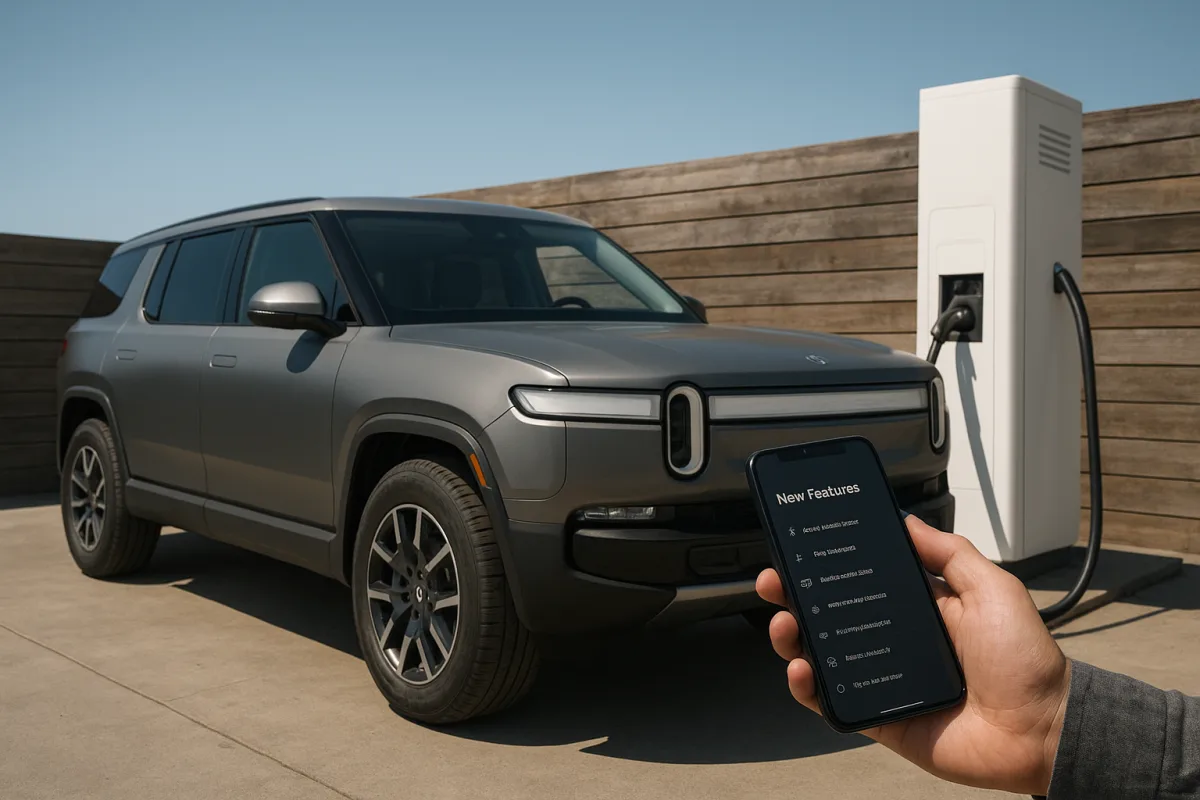
Best existing-owner upgrade: Rivian R1S and R1T with RivianOS 2, for current owners who want a newer-feeling interface without trading a perfectly serviceable vehicle.
Best bargain only: 2026 Toyota bZ, for drivers able to lease cheaply or buy after depreciation has done the painful part for the first owner.
Best reminder to keep supervising: Tesla with FSD Supervised, for drivers interested in advanced assistance, but not for anyone treating software capability as a substitute for attention.
The decision is not really about acceleration
The reader choosing between these vehicles is usually not asking which one reaches 60 mph first. They are deciding whether to spend roughly $60,000, $110,000 or more on an SUV that must handle school runs, motorway trips, charging stops and software changes for years.
That makes the Volvo EX60 and Porsche Cayenne Electric more closely related than their prices suggest. Both are new-generation premium EVs with 800-volt electrical systems, rapid DC charging claims and enough performance to make their petrol predecessors feel dated.
The Rivian R1S and R1T are different cases. They are established vehicles receiving a substantial over-the-air update, not new SUVs competing directly for a first purchase. Yet that matters, because retained software support is part of residual value.
Toyota’s revised bZ sits at the opposite end of the argument. The Savagegeese channel found substantial improvements in the 2026 car, including a heat pump, battery preconditioning and an 11 kW onboard AC charger, but still questioned whether the vehicle is competitive at normal retail pricing.
Comparison table
| Option | Price cited | Size and layout | Range and charging | Ownership trade-off | Best suited to |
|---|---|---|---|---|---|
| Volvo EX60 P6 Electric | From $60,595 [1] | Five-seat midsize SUV | Up to 307 miles EPA, 83 kWh battery, 10 to 80 percent in about 16 minutes on a 350 kW charger [1] | Rear-drive entry model, deliveries begin in 2027 [1] | Drivers who value range and comfort more than maximum power |
| Volvo EX60 P10 AWD | From $62,145 [1] | Five-seat midsize SUV | Up to 330 miles EPA, 95 kWh battery, 10 to 80 percent in about 16 minutes on a 400 kW charger [1] | Best balance, but real range will vary materially | Families needing all-wheel drive and regular longer trips |
| Volvo EX60 P12 AWD | Price not announced | Five-seat midsize SUV | Up to 400 miles EPA, 117 kWh battery, 10 to 80 percent in about 19 minutes on a 400 kW charger [1] | Expected for 2027, so it cannot yet be costed properly [1] | Buyers willing to wait for the longest-range EX60 |
| Porsche Cayenne Electric | From $109,000 [5] | Large five-seat luxury SUV | 800-volt EV, exact real-world range depends heavily on specification | High purchase, insurance, tyre and repair exposure | Buyers stepping out of a high-spec Cayenne or similar luxury SUV |
| Porsche Cayenne S Electric | From $126,300 [5] | Large five-seat luxury SUV | Rapid-charging architecture, lease example is about $1,870 monthly for 39 months with $10,859 due at signing [5] | Lease terms are examples, not a national ownership cost | Company-car users and affluent lessees |
| Porsche Cayenne Turbo Electric | From $163,000 [5] | Large five-seat luxury SUV | 1,139 hp, 0 to 60 mph in 2.4 seconds, 162 mph top speed [6] | Performance hardware will not make tyres, brakes or insurance cheaper | Buyers who want extreme performance in an SUV |
| Rivian R1S | Vehicle price not supplied in the sources | Three-row electric SUV | RivianOS 2 update is free to eligible Gen 1 and Gen 2 vehicles [[3]](https://electrek.co/2026/09/04/rivian-rivianos-2-software-update-r1-r2/?utm_source=openai "Rivian rolls out RivianOS 2, unifying software across R1 and R2 | Electrek") | Software improves, hardware does not |
| Rivian R1T | Vehicle price not supplied in the sources | Electric pickup with enclosed front trunk | RivianOS 2 update is free to eligible Gen 1 and Gen 2 vehicles [[3]](https://electrek.co/2026/09/04/rivian-rivianos-2-software-update-r1-r2/?utm_source=openai "Rivian rolls out RivianOS 2, unifying software across R1 and R2 | Electrek") | Useful long-term software support, but monitor updates |
| 2026 Toyota bZ | Roughly $36,000 base, around $40,000 for front-drive Plus, about $45,000 AWD, according to Savagegeese | Five-seat crossover SUV | About 70 to 74 kWh battery in the better front-drive model, 11 kW AC charging, heat pump and battery preconditioning | Depreciation remains the concern | Cheap lease users or patient used buyers |
Volvo EX60: the sensible new premium EV
The 2026 Volvo EX60 P10 AWD is the one most people should start with. It costs $62,145 in Electric Plus form and $68,745 as an Electric Ultra, leaving a modest gap between a well-equipped mainstream premium SUV and a six-figure Porsche. [1]
Volvo lists up to 330 miles of EPA range for the P10 AWD on 20-inch wheels. That qualifier matters, because larger wheels, cold weather, motorway speeds, roof boxes and a full cabin can each take a noticeable bite from an EV’s useful range. [1]
The P10 has a 95 kWh battery and Volvo claims a 10 to 80 percent DC charge in about 16 minutes when connected to a 400 kW charger. That is excellent on paper, but owners should plan journeys around chargers capable of delivering that power. [1]
The lower-priced P6 uses an 83 kWh battery, rear-wheel drive and has an EPA estimate of up to 307 miles. It starts at $60,595, so the P10 AWD’s $1,550 premium looks unusually reasonable for more range and all-wheel drive. [1]
The future P12 AWD is the headline car, with 671 hp, a claimed 3.9-second 0 to 60 mph time and an EPA estimate of up to 400 miles. Volvo has not announced a price, however, and deliveries are expected in 2027. [1]
That unresolved price matters more than the 671 hp figure. Some reports have cited figures as high as 503 miles for the P12, but the defensible figure is Volvo’s EPA estimate of up to 400 miles, still dependent on wheel choice and conditions. [1][2]
Carwow’s road assessment is useful for the everyday details a brochure skips. It praised the EX60’s seats, rear-seat accommodation, flat floor, interior materials and practical storage, while identifying several touchscreen-led irritations and rear windows that do not fully lower.
The same Carwow review noted a problem familiar to modern safety systems, inaccurate speed-limit recognition. That is not a reason to reject the car, but it is a reason to try the driver-assistance controls before signing paperwork.
Volvo’s cabin appears better thought through than many screen-first interiors, with physical stalks for wipers and a dedicated steering-wheel control to disable the speed warning. Still, phone controls and many other functions live in the central display.
Porsche Cayenne Electric: very quick, very expensive
The Porsche Cayenne Electric is not a rival for the EX60 in any straightforward financial sense. The base model starts at $109,000, the Cayenne S Electric at $126,300 and the Turbo Electric at $163,000 before options, taxes, registration and dealer fees. [5]
Those are vehicle prices only. They do not include home-charger installation, insurance, finance interest, replacement tyres, charging or the cost of repairing a large luxury SUV after a minor collision, which can be substantial with EV-specific structural and sensor parts.
Porsche’s performance improvements over the combustion Cayenne are not subtle. Car and Driver reports the Turbo Electric has 1,139 hp and reaches 60 mph in 2.4 seconds, versus 541 hp and 4.9 seconds for the cited ICE Turbo comparison. [6]
That is entertaining, but it raises the question of what matters at 60,000 miles. A Turbo Electric may need fewer routine engine-related services than a petrol Cayenne, yet its tyres, suspension components, premium brakes and insurance will not be inexpensive.
There is no dependable 2026 model-specific maintenance or insurance comparison between the electric Cayenne and petrol versions. General EV industry trends suggest potentially lower routine maintenance but insurance premiums often 10 to 20 percent higher, depending heavily on location and driver profile.
A published Cayenne S Electric lease example is about $1,870 per month for 39 months with $10,859 due at signing. Treat that as an illustration of the financial tier, not a promise, since credit profile, mileage allowance, region and dealer incentives change the actual deal. [5]
RivianOS 2: the update that makes keeping your car easier
Rivian’s 2026.31 update began rolling out on September 4, 2026 and moves first- and second-generation R1S SUVs and R1T pickups to RivianOS 2. That is the same underlying software platform used by the newer R2. [3]
For an early R1 owner, this is more meaningful than fresh graphics. It reduces the usual fear that an expensive EV will feel old simply because a newer model gets a better interface, navigation system and app integration.
The update brings revised controls, a reworked settings menu, universal search, refreshed driver displays and Google Maps and Waze-derived alerts for police presence and speed cameras. Eligible Connect+ users also gain a weather app and app-based trip planning changes. [3]
Hardware differences remain. Second-generation R1 models and the R2 use Unreal Engine 5 graphics, while first-generation R1 vehicles stay on Unreal Engine 4 so older hardware remains responsive. That is a sensible limitation rather than an attempt to disguise old hardware as new. [3]
No major first-generation R1S or R1T issues had been reported by early September 2026, but blind faith is never wise. A November 2023 Rivian update reportedly left some infotainment systems unusable, so owners should ensure they have time and connectivity before updating. [4]
Software is improving, not taking over driving
Tesla’s FSD Supervised provides a useful counterpoint to Rivian’s more conventional software update. An InsideEVs report following a Tesla through Brussels found the system handled several difficult situations well, including moving aside for approaching police.
It also selected a wrong lane, proceeded through an illegal manoeuvre and required driver intervention near the airport. That is exactly why FSD Supervised remains a driver-assistance feature requiring continuous attention, not a reason to stop evaluating the road yourself.
The important buying lesson is broader than Tesla. Software can improve route planning, charging confidence, infotainment and driver assistance after purchase. It cannot add physical sensors, more battery capacity, better crash repairability or a more comfortable suspension.
Who each option suits
The Volvo EX60 P6 suits the buyer who wants a premium EV without paying for unnecessary power. It is likely to work best with home charging and mostly normal family travel, while the P10 AWD is the stronger all-round recommendation.
The Volvo EX60 P12 AWD suits the buyer who can wait until 2027 and accepts that its price remains unknown. Its range and performance are promising, but it is not yet a financially comparable alternative to the P10.
The Porsche Cayenne Electric suits buyers already comfortable with high-end Porsche ownership costs. It makes sense for those who want a large, fast luxury SUV and regard the purchase price, lease payment and consumables as part of the package.
The Rivian R1S suits existing owners who need family space and value a manufacturer continuing to support older vehicles. The R1T suits owners who need a pickup layout, front trunk and electric utility, but both remain long-term software propositions rather than cheap transport.
The 2026 Toyota bZ suits a buyer offered a genuinely low lease payment, or someone shopping used once depreciation has lowered the entry price. Its upgrades make it more credible, but they do not erase the stronger alternatives available at similar money.
Tesla’s FSD Supervised suits the driver who understands that the word supervised is the important one. It can reduce workload in some situations, but no current assistance package should be treated as a substitute for a switched-on driver.
Frequently Asked Questions
What are the latest software updates available for electric SUVs?
The latest notable software update is RivianOS 2, which began rolling out on September 4, 2026, for first-generation Rivian R1S and R1T models. This update unifies the software across Rivian’s vehicle generations and offers a newer-feeling interface. However, owners are advised to wait a few days after release to monitor reports, as Rivian has experienced disruptive update failures in the past.
How do software updates improve electric SUV performance and charging?
Software updates like RivianOS 2 primarily enhance the user interface and vehicle software experience rather than directly boosting physical performance or charging speeds. While the article does not specify performance or charging improvements from software alone, ongoing software support is important for maintaining vehicle functionality and residual value over time.
Should I install RivianOS 2 on my Rivian R1S or R1T?
Existing Rivian R1S and R1T owners are recommended to install RivianOS 2 once it becomes available for their vehicle. However, it is sensible to wait a few days after the rollout to watch owner reports due to Rivian’s history of some disruptive software-update failures. Installing the update can provide a more modern interface without needing to trade the vehicle.
What software features come with the 2026 Volvo EX60?
The article does not provide detailed information about specific software features included with the 2026 Volvo EX60. It highlights hardware specifications such as battery size, range, and charging capabilities but does not elaborate on software functions or updates.
How do software updates affect electric SUV ownership costs?
While the article does not provide specific cost figures related to software updates, it notes that software support is a factor in residual value and ownership experience. Disruptive software updates can cause inconvenience, and reliable updates help maintain vehicle usability and potentially reduce long-term costs associated with repairs or replacements.
How we researched this
This article was assembled from 2 video sources across 2 channels, 3 published articles, 9 cited references.
Nothing here is based on hands-on testing. Where a figure or finding appears, it belongs to the source cited beside it, and the writing says so rather than implying otherwise. Every source is listed below so you can check it.
Sources
Toyota's Worst Effort Gets Updated — savagegeese
Rivian Just Made The R1S And R1T Feel A Whole Lot Newer For Free — InsideEVs
Your First-Gen Rivian R1 Just Got The Same Software As A Brand-New R2 — CarScoops
Here’s How Tesla FSD Handles Europe’s Tight City Streets — InsideEVs
I took the Volvo EX60 and BMW iX3 on 400-mile road trips - and range anxiety is officially dead
Rivian rolls out RivianOS 2, unifying software across R1 and R2 | Electrek
A software update bricked Rivian infotainment systems | TechCrunch
Best Porsche Cayenne Electric Deals, Incentives, and Rebates for September 2026
Porsche Reveals 2026 Cayenne Electric with 1139-HP Turbo Model
Porsche Cayenne Electric makes public debut at Icons of Porsche - Porsche Newsroom USA
Watch Electric SUV and EV Software Updates on Youtube
Also from the sources
Related Articles

2027 Electric SUVs: Volvo EX60, Porsche Cayenne & EV Tech
Explore 2027 electric SUVs like the Volvo EX60 and Porsche Cayenne, plus key EV tech advances and ownership insights.
2027 Porsche Cayenne Electric Charging and Performance EVs
Explore the 2027 Porsche Cayenne Electric's 400 kW charging, performance specs, and what it means for real-world EV ownership and driving.
2027 SUVs and Trucks Updates
Explore key updates on 2027 SUVs and trucks including Ford Ranger, BMW X5, Kia Sorento PHEV, and Volvo EX60 EV. Get insights on features and ownership.
Lucid Air Recall Software Update: Fire Risk Explained
Learn how the Lucid Air recall software update reduces fire risk and what owners must do to stay safe with their affected vehicles.