
Classic Car Restomods: Unique Restored and Modified Classics
Explore classic car restomods, comparing restored originals and modernized classics with insights on ownership, maintenance, and usability.
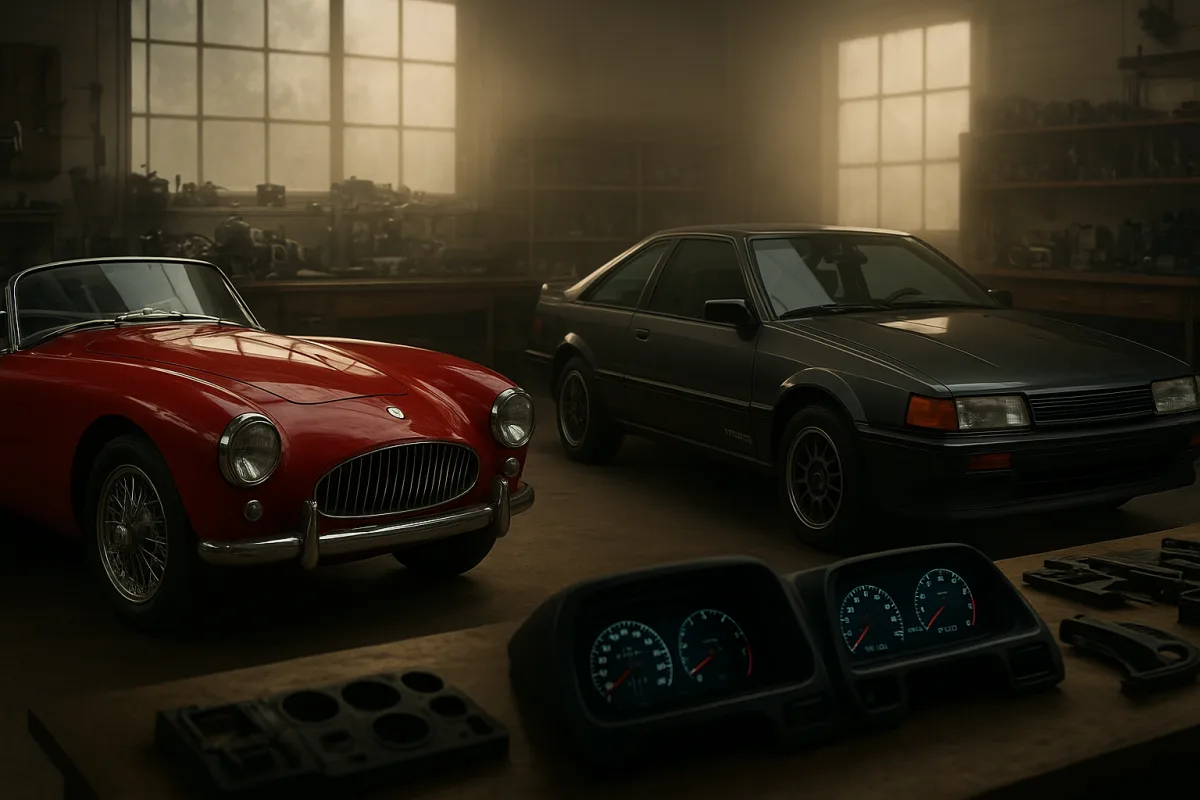
The quick list
- Best overall: Larry Chen’s featured 1985 Porsche 930 GT, for the owner who wants an old 911 Turbo character with genuinely useful modern changes.
- Best collector piece: Petrolicious’s hand-painted 1956 Ferrari 500 TR, for the buyer building a historically serious collection rather than seeking regular road mileage.
- Best value: Usual Suspects Garage’s BMW E28/E30 digital dash, for BMW owners wanting a reversible-looking interior update without rebuilding an entire car.
- Best for originality: Petrolicious’s Ferrari 500 TR restoration approach, for owners who consider authentic livery and research part of the car’s value.
- Best for daily usability: The 930 GT from Larry Chen, for an enthusiast who wants air conditioning, reclining seats and a car intended to be driven to work.
The real choice here is not between three cars at the same price point. It is between preserving a historically significant racing car, re-engineering an old turbocharged Porsche for regular use, or updating the information interface in a BMW classic.
That distinction matters because “restored” and “restomodded” are often used loosely. A Ferrari with painstakingly recreated period livery asks you to protect its history. A 930 Turbo with lighter carbon parts and modern air conditioning asks you to use it. A BMW digital dash alters the cabin experience without necessarily changing the car beneath it.
I have not owned or driven any of these examples. The judgements here rest on the build details shown by Petrolicious and Larry Chen, reporting from The Drive, and the ownership-cost research cited throughout.
Comparison table
| Option | What it is | Price or cost indication | Layout and practical size | Main appeal | Main trade-off |
|---|---|---|---|---|---|
| Petrolicious 1956 Ferrari 500 TR | Historically styled, hand-lettered restoration of an open racing Ferrari | £3,286,753 was a 2020 value-guide baseline, around $4.2 million at the brief’s conversion, not a confirmed 2026 market price. [[1]](https://www.theclassicvaluer.com/cars/ferrari/500-tr?utm_source=openai "Ferrari 500 TR For Sale & Price Guide - £3,286,753 | TCV") | Two-seat open racing-car format, built around competition rather than luggage or comfort | Period accuracy, rarity and provenance |
| Larry Chen 1985 Porsche 930 GT | 3.3-litre 930 Turbo restomod with carbon parts, revised weight distribution and electric air conditioning | Build price not disclosed. Routine 930 maintenance averages $2,000 to $3,000 annually. [[5]](https://repasimotorwerks.com/blog/porsche-930-turbo-maintenance-guide?utm_source=openai "Porsche 930 Turbo Maintenance Guide | Repasi Motorwerks") | Rear-engined, rear-drive 911 Turbo coupe with usable cabin amenities | A more usable, more balanced interpretation of the 930 |
| Usual Suspects Garage BMW E28/E30 digital dash | Plug-and-play digital instrument-cluster replacement in development for BMW 5 Series and 3 Series classics | Target price is $1,300 including a control knob, according to The Drive. | Fits behind the standard E28 or E30 cluster housing, rather than adding a tablet-style screen | Modern information display with an installation intended to be removable | No published durability, technical-specification or resale data yet |
The historically faithful route: Petrolicious’s 1956 Ferrari 500 TR
Petrolicious’s featured 1956 Ferrari 500 TR is the furthest thing here from an inexpensive old-car project. Its appeal is that it treats restoration as historical reconstruction, including reproducing the car’s racing graphics through research rather than applying a modern interpretation.
The sign painter and restoration team studied period photographs to refine the placement of the markings, attempting to reproduce how the car appeared when it raced in 1956. That is important because on a serious collector Ferrari, the livery is not simply decoration.
The work used oil-based enamel, close in character to the period material, although modern paint avoids the lead pigments used historically. Petrolicious describes a two-year process before the hand-painting stage, which gives some idea of how little of this work is quick cosmetic preparation.
A 2020 Ferrari 500 TR value-guide figure of £3,286,753 provides a useful starting point, but not a current asking price or an assured sale result in 2026. [1] With cars this rare, chassis history, originality, race provenance, restoration documentation and matching components can move the number dramatically.
The restoration bill deserves separate treatment from the value of the completed car. A concours-level restoration of a rare classic commonly runs from $100,000 to $200,000 or more, with parts availability and starting condition determining whether that estimate holds. [2]
This is therefore not the car for somebody comparing weekend running costs or considering a first classic. The right buyer is paying for a specific object, its history and the quality of the restoration record, not merely for a small Italian sports car.
Before purchase, verify what is original, what was remade, who performed each stage of restoration and how the livery is supported by photographs or archival evidence. A beautifully hand-painted car is still only as credible as its underlying provenance file.
The usable restomod: Larry Chen’s 1985 Porsche 930 GT
The 1985 Porsche 930 Turbo featured by Larry Chen starts with a familiar 930 problem: immense personality, but rear-biased weight distribution and a late, forceful turbo response. The owner’s answer was not to turn it into an unrecognizable track special.
Instead, the stated aim is an OEM-plus 930 with character, retaining air conditioning, reclining seats and enough civility to serve as a daily-driven car. That is a more honest restomod brief than chasing a headline output figure.
The original 3.3-litre flat-six remains 3.3 litres. The builder says the factory output was claimed at roughly 340 horsepower, while the retained Bosch K-Jetronic CIS fuel system limits the modified engine to about one bar of boost.
Its K27 7200-based hybrid turbo, revised fuel distributor, warm-up regulator, CDI, cams and tuning are intended to sharpen the whole package rather than turn it into a modern 911. The owner also made engine-bay carbon pieces to replace original fiberglass components prone to cracking.
Weight saving is concentrated at the rear, where it can alter the 930’s balance rather than simply lower the total number. Larry Chen’s feature reports a claimed 1,350 kg standard weight and a target of less than 1,000 kg for the finished project.
There is a caution here. The transcript’s stated current vehicle-weight figure appears incomplete or implausible, so it is safer to treat the under-one-tonne figure as the builder’s target, not a verified final kerb weight.
The strongest modern change may be the air conditioning. The original compressor was removed from the rear, while a Classic Retrofit electric system and a front-mounted condenser seek to improve cooling and shift mass forward.
That conversion required custom ducting, 911-style headlights with integrated indicators, revised auxiliary lamps and 3D-printed parts. It is clever work, but it also means future troubleshooting depends on documentation and the availability of bespoke components.
Routine ownership still follows 930 realities. Research cited in the brief puts annual maintenance at $2,000 to $3,000, major services at $1,500 to $3,000, and turbocharger replacement at $4,000 to $6,000 at roughly 40,000 to 60,000 miles. [5]
An engine rebuild is a different category again, commonly estimated at $25,000 to $35,000 around 60,000 to 80,000 miles. [5] Those intervals are broad planning figures, not a guarantee that every engine will fail on schedule.
Original Porsche parts can be expensive and increasingly limited, while aftermarket alternatives may lower the invoice but vary considerably in fit and quality. [7] That is particularly relevant to a custom 930, where a future owner needs to know exactly whose parts were used.
The reversible approach is a genuine advantage. The builder says no permanent modifications were made, and that principle usually helps protect value if original components accompany the car. Reversibility does not guarantee resale value, but it limits the risk of alienating a future originality-minded buyer. [3]
The small-scale modernization: Usual Suspects Garage’s BMW digital dash
The BMW option from Naples, Florida specialist Usual Suspects Garage is not a restomod in the same financial universe as the Ferrari or Porsche. It is a targeted interior modification for E28 5 Series and E30 3 Series owners.
The Drive reports that the system is intended to fit behind the original-style instrument-cluster housing and to install as a plug-and-play unit. Its developer is targeting $1,300 for a full kit, including a separate control knob and wireless update capability.
That control knob sounds like a minor point until you picture operating a touchscreen through an E30 steering wheel. The idea is to retain a purposeful driver-oriented layout rather than add a generic rectangular display where analog gauges once sat.
The planned cluster uses multiple displays, including circular elements, with features such as a shift light and trip-reset control. An E30 version returned to development after screens were found that could fit its housing, while the E28 was the initial focus.
The important limitation is timing. The Drive reported that a final shippable product was not expected until the following year, and there are no public detailed specifications for display longevity, sensor compatibility, boot time or long-term support.
That means it cannot fairly be compared with BMW’s current Panoramic iDrive hardware, which is fully integrated into current production vehicles and runs on BMW Operating System X. The classic-car dash is a small independent project solving a different problem entirely.
For an E28 or E30 owner, the sensible questions are less about screen count and more about reversibility, wiring changes, failure support and insurer acceptance. Keep the original cluster, photograph the installation and ask your insurer before fitting it.
There is no direct evidence showing how this particular dashboard changes resale value or premiums. General modification practice suggests that a removable upgrade with original parts retained is less risky than irreversible wiring or dashboard surgery, but that remains case-specific. [3]
Regulations, insurance and the costs beyond the parts list
The Ferrari’s restoration is mainly an authenticity problem. The Porsche is an engineering, insurance and compliance problem. The BMW dash is principally a fitment, documentation and support problem.
For any restomod, specialist agreed-value insurance is worth investigating rather than assuming a normal classic policy will understand a modified car. Such policies can cost more, but they are better suited to a car whose replacement value exceeds standard book estimates. [8]
Emissions compliance needs particular care on the Porsche. EPA and CARB rules can make emissions-control tampering costly, with potential fines of roughly $6,000 per component cited in the research brief, even as 2026 policy developments may ease some repair and compliance burdens.
Safety inspections can also be difficult when a classic gains modern electrical, braking, lighting or restraint-related hardware. Ask a local specialist about registration and inspection requirements before spending money, because the supplied research does not establish a universal road-legal route.
Who each option suits
Choose the Petrolicious 1956 Ferrari 500 TR approach if you are a serious collector commissioning or assessing a historically accurate restoration. It suits an owner for whom original details, documentary proof and craftsmanship outweigh regular use, cost predictability or convenience.
Choose Larry Chen’s 1985 Porsche 930 GT approach if you want to keep the old 930’s rear-engined, turbocharged character while making it more tolerable in real traffic and warmer climates. It suits a well-funded enthusiast who accepts specialist maintenance and detailed record-keeping.
Choose Usual Suspects Garage’s BMW E28/E30 digital dash if your classic BMW is fundamentally sound and you want better information access without committing to a complete restomod. It suits the owner willing to wait for final product details, preserve the original instruments and confirm insurance terms first.
Frequently Asked Questions
What is the difference between a restored classic car and a restomod?
A restored classic car, such as the 1956 Ferrari 500 TR, is rebuilt to period-correct specifications with attention to historical accuracy and provenance. A restomod, like the 1985 Porsche 930 GT, incorporates modern components and usability improvements—such as air conditioning and lighter materials—while retaining the car’s original character. Restorations focus on preservation, whereas restomods emphasize usability and updated performance.
How much does it cost to maintain a restomod classic car?
Routine maintenance for a restomod like the 1985 Porsche 930 Turbo typically costs between $2,000 and $3,000 annually. Major services can range from $1,500 to $3,000, with turbocharger replacements costing $4,000 to $6,000 every 40,000 to 60,000 miles, and engine rebuilds around $25,000 to $35,000 every 60,000 to 80,000 miles. OEM parts tend to be expensive and limited, so aftermarket parts may be used to reduce costs.
What are the benefits of owning a restomod versus a fully restored classic?
Restomods offer greater daily usability and modern comforts, such as air conditioning and improved weight distribution, making them more practical for regular driving. Fully restored classics prioritize historical authenticity and provenance, often appealing to collectors who value originality over convenience. Restomods also tend to be more engaging to drive, while restored classics may have limited practicality.
Which classic cars are popular choices for restomods?
The 1985 Porsche 930 Turbo is a notable example of a restomod, featuring modernized components like carbon parts and electric air conditioning while maintaining its original turbocharged engine. Additionally, BMW E28 and E30 models are popular for digital instrument cluster upgrades that modernize the cabin experience without extensive mechanical changes.
How do reversible modifications affect classic car value?
Reversible modifications that preserve original parts help minimize negative impacts on resale value. Owners are advised to keep removed original components and consider agreed-value specialist insurance policies to manage resale, inspections, and emissions compliance challenges. This approach is particularly important for restomods, where extensive changes might otherwise complicate valuation and legal compliance.
How we researched this
This article was assembled from 2 video sources across 2 channels, 3 published articles, 8 cited references.
Nothing here is based on hands-on testing. Where a figure or finding appears, it belongs to the source cited beside it, and the writing says so rather than implying otherwise. Every source is listed below so you can check it.
Sources
One Shot: Hand-Painting a 1956 Ferrari 500 TR — Petrolicious
This 930 Mixes Old School w/ Modern Touches — Larry Chen
Tesla Cybercab Isn’t Just Missing a Steering Wheel. It Doesn’t Even Have Brake Lines — The Drive
The Dodge Durango Gets Darker For 2027 With New Paint — Motor1
This Independent BMW Mechanic Built a Cooler Digital Dash Than BMW Itself — The Drive
How Much Does a Classic Car Restoration Cost (September 2026) Complete Guide
Do Aftermarket Parts Affect Your Car’s Actual Cash Value? - LegalClarity
What Owning a Restomod Actually Costs: Maintenance, Running Costs, and Resale
Watch Unique and Restored Classic Cars and Restomods on Youtube
Also from the sources
Related Articles
Rare Exotic Car Ownership: Stories, Costs, and Restorations
Explore rare exotic car ownership stories, restoration costs, and maintenance insights for models like Ferrari, Porsche, and Toyota Supra.
Classic Car Ownership and Restoration
Explore classic car ownership and restoration with insights on the 1966 Pontiac GTO, Acura Integra 40, and Jaguar D-Type restorations.
Used and Classic Car Market Highlights: Key Models and Costs
Explore used and classic car market highlights, including top models, ownership costs, and buying tips for enthusiasts and collectors.
Affordable Used Cars Buying Guide
Explore our affordable used cars buying guide with practical tips on ownership costs, maintenance, financing, and choosing the right vehicle for your