
Classic Car Ownership and Restoration
Explore classic car ownership and restoration with insights on the 1966 Pontiac GTO, Acura Integra 40, and Jaguar D-Type restorations.
The quick list
- Best overall: 1966 Pontiac GTO Tri-Power, for the buyer who wants a classic they can maintain, insure and actually use without museum-level obligations.
- Best value: 1986 Acura Integra 40 by Honda Racing Corporation, for the enthusiast looking for an affordable philosophy to copy in a first-generation Integra project.
- Best for analogue driving: Jaguar XKD 531 D-Type restoration, for the serious collector who values period-correct racing history and physical driver involvement over usability.
- Best for provenance: Jaguar XKD 522 D-Type restoration, for the collector drawn to a documented, historically exact recreation of a specific 1955 racing appearance.
The real choice here is not between four cars in the usual sense. It is between four levels of commitment: a classic muscle car that can still be driven regularly, a modified 1980s hatchback concept, and two historically important racing Jaguars.
I have not driven or owned any of these particular cars. The ownership judgments here rest on the restoration evidence presented by Hagerty, savagegeese and Petrolicious, plus the available market research, rather than a launch-event impression or a speculative road test.
Comparison table
| Option | Era and basic layout | Price or market position | Size and practicality | What makes it appealing | Main ownership trade-off |
|---|---|---|---|---|---|
| 1966 Pontiac GTO Tri-Power | Front-engine, rear-wheel-drive midsize coupe, 389ci V8, four-speed manual | Hagerty Good-condition estimates: about $45,133 for a 360-hp Tri-Power. Motor Guild reports a roughly $52,000 median sale price over 12 months. [[1]](https://motorguild.co/values/pontiac/gto/1966?utm_source=openai "Cash Offers for Collector & Muscle Cars | Motor Guild") | Full-size by modern coupe standards, with real rear seating and a conventional trunk | Familiar mechanicals, strong parts support relative to exotic classics, usable road-car format |
| 1986 Acura Integra 40 by HRC | Front-engine, front-wheel-drive three-door hatch, rebuilt D16A1 four-cylinder, five-speed manual | No public sale price. This is a Honda Racing Corporation anniversary project, not a production model | About 2,315 lb in standard first-generation form, compact and easy to store | Light weight, direct controls and a replicable project-car formula | Old-car parts hunting, state-specific modification rules, no modern safety systems |
| Jaguar XKD 522 D-Type | Front-engine, rear-wheel-drive sports-racer, 268-hp Jaguar XK engine | No disclosed asking price. Comparable D-Type values sit in the multi-million-dollar collector category | Purpose-built racer, not practical transport | Factory-red provenance, 1955 Carroll Shelby race connection, forensic restoration | Enormous restoration and insurance exposure, heat, noise and limited road usability |
| Jaguar XKD 531 D-Type | Front-engine, rear-wheel-drive sports-racer, Jaguar XK engine | No disclosed asking price. Its value rests heavily on history and authenticity | Purpose-built racer with minimal comfort or weather protection | 1956 California racing and Von Dutch pinstriping history | Demanding to drive, difficult to preserve, and unsuitable for casual mileage |
Prices need context. A GTO valuation is the car itself, not a guarantee that its first year of ownership will be cheap. A D-Type’s lack of a published price does not mean it is merely expensive, it means the transaction is private, specialist and likely shaped by provenance more than an ordinary price guide.
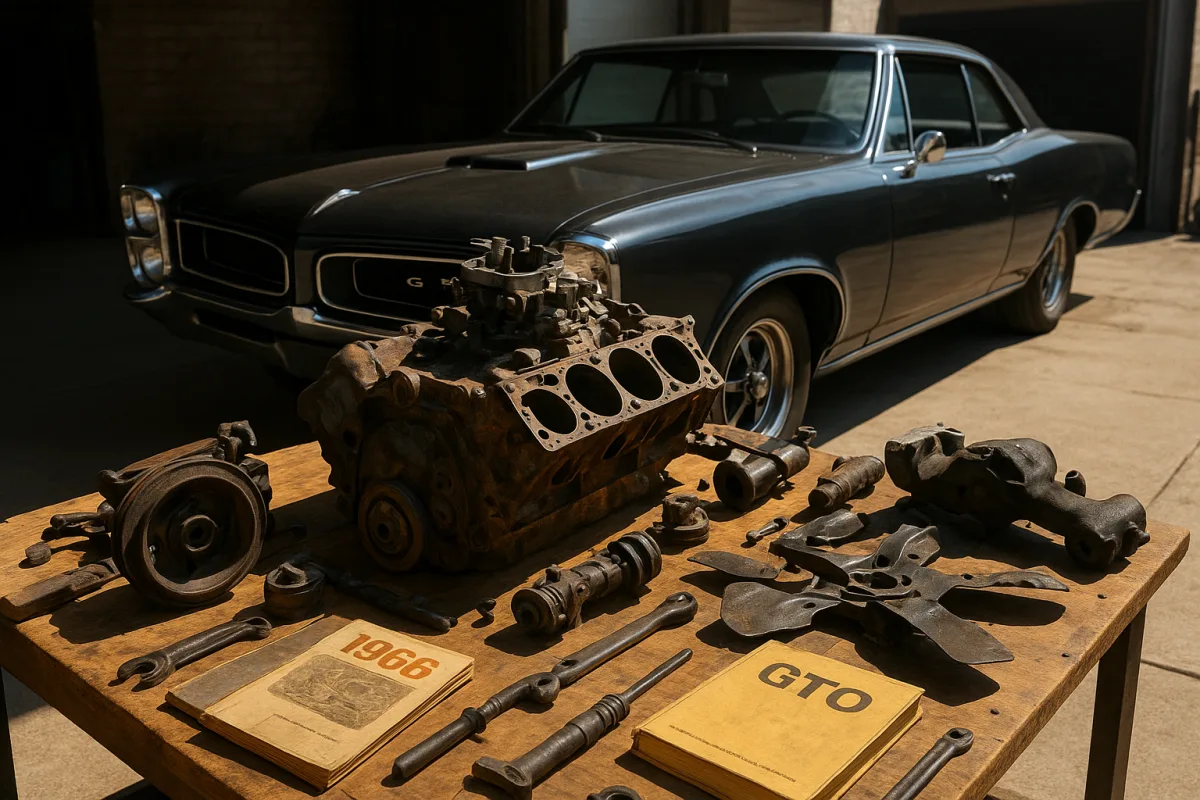
The sensible classic: 1966 Pontiac GTO Tri-Power
The 1966 Pontiac GTO from Hagerty’s Driveway Finds series is the most recognisable ownership proposition here. It is a factory Tri-Power car with Pontiac’s 389ci V8, three carburettors, a four-speed Hurst shifter and a quoted original output of 360 hp.
That specification matters because the Tri-Power version carries a meaningful value premium over the more common 335-hp four-barrel GTO. The research brief places Good-condition values around $45,133 for the Tri-Power, against roughly $31,067 for a 335-hp four-barrel example.
Those guide figures do not set the whole market. A 335-hp GTO sold through Mecum in January 2026 for $46,200, while Motor Guild reports a median sale price of about $52,000 over the last 12 months and annual appreciation of 7.1 percent. [1]
The Hagerty car’s appeal is its originality rather than its polish. It retains its original documentation, including window sticker, build sheet, owner’s material, insurance paperwork and dealer information. On a car where reproductions are plentiful, that paperwork can matter as much as bright paint.
However, the Hagerty episode is also a useful warning against buying the story instead of inspecting the car. The GTO had sat for approximately 25 years according to the programme’s premise, although one later comment referred to 13 years, so the exact lay-up period is unclear.
Its brake pedal initially went straight to the floor. The engine turned over and showed oil pressure, but compression varied, with one cylinder reported at around 70 psi while another reached 120 psi. That is not a verdict on every 389, it is a reminder that a running engine is not automatically a road-ready engine.
For a dormant GTO, assume tyres, brake hydraulics, fuel system, cooling system, ignition components and fluids need attention before regular use. The fact that the parking brake held and the gearbox linkage moved is encouraging, but neither replaces a full inspection.
General classic-GM maintenance estimates of $500 to $1,000 annually are only a starting point, not a credible all-in budget for a freshly revived Tri-Power car. Original components can be hard to source, and inflation has made even ordinary mechanical work dearer than old enthusiasts remember. [2]
Insurance deserves separate planning. Average US car-insurance premiums were reported at $2,098 per year in August 2026, though agreed-value classic cover varies sharply with storage, mileage restrictions, driving record and declared value. [3] The right policy for a documented GTO is not necessarily the cheapest policy.
The revival you cannot simply order: Acura Integra 40
The Acura Integra 40 featured by savagegeese is easy to misunderstand. It is not a 2026 showroom revival with a price list and warranty. It is Honda Racing Corporation USA’s reworked 1986 first-generation Integra, created to mark Acura’s 40th anniversary.
That distinction makes it more interesting for a project-minded buyer. The HRC car suggests what a thoughtfully updated original Integra can be, without pretending that modern dampers, polyurethane bushes and electronics transform it into a new car.
The basis is a first-generation 1986 Integra with the D16A1 engine, a unit specific to the first roughly three years of the model. HRC rebuilt it but retained stock mechanical specification, adding coil-on-plug ignition in place of the distributor.
Its original five-speed gearbox was rebuilt and fitted with a limited-slip differential. The car retains stock torsion bars and rear beam arrangement, but uses Tein dampers, polyurethane suspension bushes, manual brakes, modern pads and depowered stock steering.
That recipe makes sense because it addresses age and feel rather than chasing numbers. Savagegeese characterises the result as around 120 hp, manually steered and manually braked, with little mass and a strong sense of direct mechanical response.
The brief rightly warns against overstating the suspension changes. Stiffer bushes and adjustable Tein dampers strongly suggest sharper responses than tired factory rubber and old dampers, but there are no published geometry figures, spring rates or back-to-back test data proving a specific handling gain.
This is the smallest and least financially intimidating route into the article’s retro appeal, but only because an ordinary first-generation Integra is not the same thing as the HRC build. You would need to buy a donor, source period-specific parts and decide how far to modify it.
Modification legality is state-dependent. Suspension changes do not usually affect emissions compliance by themselves, but ride height, safety inspections, racing seats, harnesses and cages can trigger state requirements. California’s rules are particularly relevant if engine or exhaust work enters the picture.
The attraction is not speed. It is a car that asks the driver to manage momentum, braking and gear selection. For someone accustomed to modern cars filtering steering, throttle and braking inputs, that can be more revealing than another 500-hp weekend toy.
The collector’s end of the scale: Jaguar XKD 522 and XKD 531
The two Jaguar D-Types shown by Petrolicious are not merely old racing cars. They are separate historical documents, restored around different moments in their lives. That makes their comparison about authenticity, not lap times or option lists.
Jaguar designed the D-Type as a Le Mans weapon, using disc brakes, dry-sump lubrication, a stressed monocoque centre section and a four-speed all-synchromesh gearbox. Petrolicious describes the 268-hp example as sufficiently powerful because the car is light and exceptionally focused.
XKD 522 has perhaps the more conventional collector narrative. It was one of two factory-red D-Types, delivered to West Coast Jaguar distributor Charles Hornburg, displayed at the Los Angeles Auto Show, then raced at Palm Springs by Carroll Shelby.
Its later life was messier. It was raced extensively, survived a building fire, changed colours, received a Chevrolet 327 V8 and was damaged in 1964. Tom Grassroots bought it in 1971 and accumulated original Jaguar parts for a restoration he did not complete.
The current restoration aimed to return XKD 522 to its appearance on December 4, 1955, including its red paint and the details of Shelby’s period race livery. That is why small items such as aircraft-style Oddie locking nuts matter, even though they offer no convenience advantage.
XKD 531 suits the buyer who values American cultural history within a British racing car. Its first owner, Jack Douglas, repainted it yellow after an early accident, and custom artist Von Dutch used pinstriping to emphasise the D-Type’s inherently asymmetrical bodywork.
That asymmetry was not decoration. The engine installation, bonnet bulge, louvers, mirror cowling and head fairing all gave the D-Type an offset shape. The Von Dutch treatment turned a technical necessity into a period-correct visual statement.
Neither D-Type is for relaxed road use. Petrolicious notes that the cars run hot, have no fan, wander on bias-ply tyres and need speed to stay cool. A driver must remain fully engaged, which is exactly the point for some collectors and an immediate disqualifier for others.
No reliable, D-Type-specific annual maintenance figure is available, and it would be misleading to borrow costs from a modern Jaguar. What is clear is that values are extremely high and volatile: a 1955 D-Type sold for $21.8 million in October 2025, demonstrating both collector demand and the financial stakes involved.
Who each option suits
The Hagerty 1966 Pontiac GTO Tri-Power suits the buyer who wants a car with history but still wants to take friends to a show, carry luggage and understand the repair bill. Buy the best documented, least altered car possible, then keep a recommissioning reserve.
The HRC Acura Integra 40 suits the hands-on enthusiast who wants to recreate an idea rather than buy a collector object. Start with a structurally sound first-generation Integra, retain the useful simplicity, and be realistic about parts availability and local modification rules.
Petrolicious’s Jaguar XKD 522 suits the collector for whom forensic authenticity is the experience. Its appeal lies in restoring a precise 1955 identity, including factory colour, period hardware and the Shelby-linked racing story, not in adding miles cheaply.
Petrolicious’s Jaguar XKD 531 suits the collector who sees competition cars as cultural objects as well as machines. Its yellow paint and Von Dutch pinstriping make it the more visually expressive choice, but it demands the same serious preservation mindset as any genuine D-Type.
Frequently Asked Questions
What are the ownership challenges of a 1966 Pontiac GTO Tri-Power?
Owning a 1966 Pontiac GTO Tri-Power involves budgeting beyond the purchase price for recommissioning, scarce original parts, and specialist work. The car may require attention to tyres, brake hydraulics, fuel and cooling systems, ignition components, and fluids before regular use, especially if it has been dormant for years. Maintenance costs can be significant, and originality premiums add to the complexity.
How does the Acura Integra 40 by HRC differ from a new retro car?
The Acura Integra 40 by HRC is a one-off anniversary build rather than a new production retro car. It serves as a template for a light, analogue project rather than a ready-made purchase, emphasizing involvement and a replicable project-car philosophy rather than modern production features or convenience.
What does restoring a Jaguar D-Type involve and who is it for?
Restoring a Jaguar D-Type involves extensive, forensic work focused on maintaining provenance and authenticity over convenience or comfort. These restorations are aimed at serious collectors who value period-correct racing history and physical driver involvement, accepting high restoration and insurance costs as part of ownership.
What maintenance costs should I expect for classic cars like the GTO?
General classic GM maintenance estimates range from $500 to $1,000 annually as a starting point, but freshly revived cars often require more costly and specialized care. Insurance premiums for classic cars vary widely and are often higher due to rarity and repair costs. Parts availability can be a challenge, with original components scarce and sometimes expensive to replace.
How do classic cars like the Jaguar D-Type compare in driving experience?
Classic cars like the Jaguar D-Type demand concentration and physical involvement from the driver before delivering enjoyment. They prioritize historic authenticity and racing heritage over usability, comfort, or predictable running costs, making them quite different from more conventional classic cars like the GTO.
How we researched this
This article was assembled from 3 video sources across 3 channels, 4 cited references.
Nothing here is based on hands-on testing. Where a figure or finding appears, it belongs to the source cited beside it, and the writing says so rather than implying otherwise. Every source is listed below so you can check it.
Sources
Untouched and all original! 1966 Tri-Power Pontiac GTO saved after sitting 25 years | Driveway Finds — Hagerty
Acura Integra 40 | Bringing Back the 80s — savagegeese
Toms Cars: Jaguar XKD 522 & XKD 531 — Petrolicious
Watch Retro and Classic Car Revivals and Stories on Youtube
Also from the sources
Related Articles
Rare Exotic Car Ownership: Stories, Costs, and Restorations
Explore rare exotic car ownership stories, restoration costs, and maintenance insights for models like Ferrari, Porsche, and Toyota Supra.

Mercedes-AMG CLE 646 Ownership
Explore Mercedes-AMG CLE 646 ownership, including performance, maintenance, costs, and the driving experience of this exclusive V8 coupe.

Exploring Gunther Works: Crafting $1.8M Air-Cooled Porsches
Explore Gunther Works' $1.8M air-cooled Porsches crafted in Southern California. Discover the meticulous rebuild process, high-performance 830hp engine, and exquisite carbon components. Dive into the legacy of the iconic 993 chassis and the artistry behind over 50 handcrafted masterpieces.

Discover RMC Miami: Paradise for High-Performance Modified Cars
Explore RMC Miami, a paradise for modified tuner cars led by Danny Lima. From JDM to European speed machines, RMC offers meticulously curated, high-performance vehicles for enthusiasts worldwide.