
Supercar Drag Race Comparison and Ownership Insights
Compare top supercars in drag races with insights on performance, quarter mile times, and ownership costs for informed buying decisions.
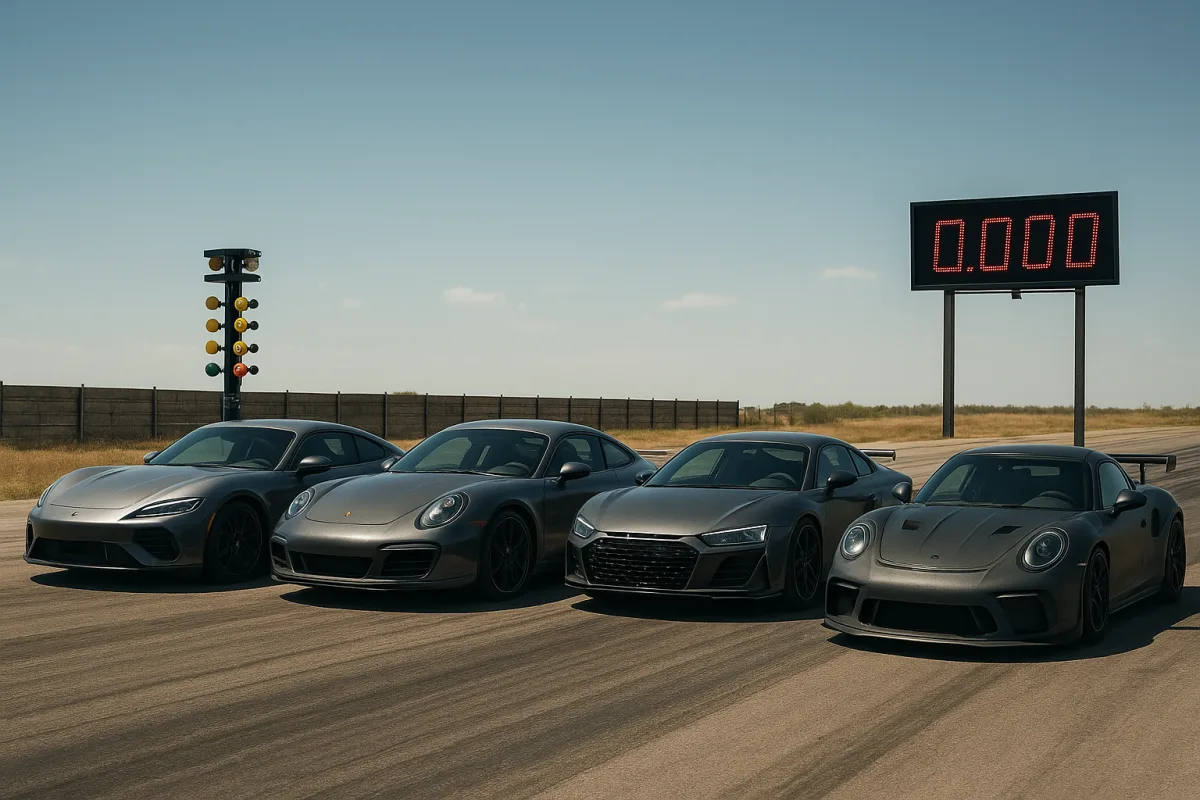
The quick list
Best overall: Porsche 911 Turbo S, for the buyer who wants the most repeatable straight-line performance without abandoning everyday usability.
Best value: Chevrolet Corvette Z06, for the driver who wants 8,500rpm drama and supercar pace, while accepting a less polished launch and cabin experience.
Best analogue supercar: Lamborghini Huracán Performante, for someone who wants a compact V10, four-wheel drive and a proven 10.6-second quarter-mile result from carwow.
Best custom-project base: McLaren 750S, including the DailyDrivenExotics 750 Absolute, for an owner prepared to budget beyond the purchase price for bespoke work, maintenance and depreciation.
Best luxury four-door: Ferrari Purosangue, for buyers who need four seats and a V12, and can absorb fuel, tax and running costs that make the list price look optimistic.
Best for small spaces: BMW M2 drift car, for track or drift use only, not for someone needing road-car refinement, predictable traction or ordinary insurance.
Best electric wildcard: Lotus Eletre Hybrid, for buyers attracted to huge claimed output and practical SUV proportions, but willing to wait for independent performance evidence.
The drag-race question is really an ownership question
The obvious question is which car wins a quarter mile. The useful question is what sort of supercar you can live with once the launch-control novelty fades, the tyres are worn and the first large invoice arrives.
That distinction matters here because these cars are not close substitutes. The Corvette Z06 and 911 Turbo S are performance coupes, but they reach similar acceleration territory by entirely different routes.
The Huracán Performante is an older, smaller V10 supercar with four-wheel drive. The Ferrari Purosangue is a four-door V12 grand tourer on stilts, while the Lotus Eletre Hybrid is a heavy electrified SUV.
Then there is the DailyDrivenExotics McLaren 750 Absolute. That is not a factory McLaren variant. It is a standard McLaren 750S converted with a Rift wide-body kit, bespoke wheels, paint-protection-film wrap and cosmetic details inspired by the Koenigsegg Jesko Absolut.
The carwow 1,100hp BMW M2 is even further from a showroom comparison. It is a Red Bull drift car with a single-turbo S58 straight-six, rear-wheel drive and a five-speed sequential gearbox. It is not an alternative to a road-going Huracán.
Comparison table
| Option | Price cited in sources | Layout and size character | Output cited | Quarter-mile evidence | Ownership trade-off |
|---|---|---|---|---|---|
| Chevrolet Corvette Z06 | Not stated in supplied sources | Mid-engine, rear-wheel-drive two-seat coupe | 670hp, 460 lb-ft | 10.59 sec at 131 mph, The Fast Lane Car | Wonderful engine, but rear-drive launches and consumables need consideration |
| Porsche 911 Turbo S, 2021 | Not stated in supplied sources | Rear-engine, four-wheel-drive 2+2 coupe | 640hp, 590 lb-ft | 11.1 sec at about 130 mph, The Fast Lane Car | Best consistency, but purchase and maintenance costs remain Porsche-supercar level |
| Lamborghini Huracán Performante | Not stated in supplied sources | Mid-engine, four-wheel-drive two-seat coupe | 640hp, 600Nm | 10.6 sec, carwow | Older platform, but compact V10 appeal and strong launch traction |
| McLaren 750S / DailyDrivenExotics 750 Absolute | 2026 750S from $365,100 coupe, $386,700 Spider [[2]](https://marquecars.com/price-history/mclaren-750s?utm_source=openai "McLaren 750S depreciation & price history | Marque") | Mid-engine, rear-wheel-drive two-seat coupe | Standard-car output not stated in supplied sources | No measured quarter-mile figure supplied |
| Ferrari Purosangue | About $433,686 US MSRP [4] | Front-mid V12, four-wheel drive, four-door GT | 725hp, 716Nm | 11.3 sec at 124 mph independently recorded [1] | 12 mpg EPA combined, plus serious emissions and tax exposure [4] |
| Lotus Eletre Hybrid | Not stated in supplied sources | Electrified performance SUV, four-wheel drive | Claimed 952hp, 935Nm | No independent results yet | Claimed output is not a verified buying reason |
| BMW M2 Red Bull drift car | Not stated, custom competition car | Front-engine, rear-wheel-drive drift car | 1,100hp, 1,200Nm | 10.6 sec, carwow | Built to break traction, not to make road ownership easy |
| Audi e-tron GT, 2023 | $40,000-$50,000 used, according to The Fast Lane Car | Four-wheel-drive electric four-door | 522hp with launch control | 11.8 sec, The Fast Lane Car | Strong used value, but 5,000lb mass changes tyre and brake demands |
| Porsche 911 Turbo, 2010 | $100,000 paid by The Fast Lane Car’s featured owner | Rear-engine, four-wheel-drive 2+2 coupe | 500hp, 480 lb-ft | 12.08 sec, The Fast Lane Car | An older turbocharged performance car, not a cheap alternative to a new Turbo S |
Prices above are vehicle prices where the supplied material provides them. They do not include tax, registration, finance, insurance, fuel, tyres, servicing, transport, optional equipment or, in the McLaren’s case, the undisclosed cost of the custom conversion.
Corvette Z06 versus Porsche 911 Turbo S
The Fast Lane Car’s comparison is useful because it shows why power figures are only the beginning. The 2021 Porsche 911 Turbo S has 640hp and 590 lb-ft from its 3.8-litre twin-turbo flat-six.
The C8 Corvette Z06 counters with 670hp from its naturally aspirated V8, weighs 3,500lb in the featured test and revs to 8,500rpm. Its torque figure is only 460 lb-ft, which is the meaningful difference when the race moves beyond the launch.
At altitude, on an unprepared airstrip, the Z06 recorded 10.59 seconds at 131mph. That is a remarkable result, and it makes the Corvette the more emotionally persuasive choice for drivers who value engine response and sound.
The Porsche ran 11.1 seconds at roughly 130mph in the same feature, though the filmed test conditions and launch procedures were not identical enough to turn that into a universal ranking. The bigger point is how effortlessly the Turbo S builds speed.
The Corvette gets moving immediately, while the Porsche’s turbocharged engine needs a moment in rolling races before it delivers its full shove. Once it does, the 911’s acceleration looks less like a sports car and more like a very expensive software problem.
For ownership, the Z06 is the more distinctive answer. Its flat-plane-crank V8 is the reason to buy it, not because it beats every Porsche in every condition. The Turbo S is the rational answer for someone who values traction, bad-weather ability and repeatability.
Why the Huracán Performante still makes sense
The Lamborghini Huracán Performante is no longer the newest thing, but carwow’s tests explain why it has staying power. Its 5.2-litre naturally aspirated V10 makes 640hp and 600Nm, drives all four wheels and weighs just under 1.5 tonnes.
That combination gave it a 10.6-second standing quarter mile in carwow’s race against the purpose-built BMW M2 drift car. The modified BMW reached the same elapsed time, but the Lamborghini won by the narrowest margin.
It is tempting to conclude that the BMW’s 1,100hp makes it the better performance buy. That misses the point. The M2 was designed to spin its rear tyres, had a sequential gearbox and needed careful throttle use just to make a respectable launch.
The Huracán is the opposite proposition. Its launch control and four-wheel-drive system turn a normal driver’s inputs into a repeatable start. It also stopped far more convincingly in carwow’s 100mph brake test, because a drift car’s lightweight brakes serve a different job.
Price was not supplied for either example, so it would be misleading to invent a used-market figure. The sensible conclusion is that the Huracán is the road car, while the M2 is a specialist competition build with unknown insurance and financing implications.
Modified-car insurance is particularly difficult to price honestly. The available research finds that performance modifications commonly raise premiums by 20 to 50 per cent, and specialist cover for declared custom parts may be necessary. [3]
McLaren 750 Absolute, image versus long-term arithmetic
DailyDrivenExotics’ 750 Absolute is visually compelling, but buyers should separate the underlying McLaren 750S from the one-off additions. The build uses a Rift wide-body conversion, AL13 forged wheels, a satin-black protective-film finish and prototype rear fins.
The car remains mechanically standard apart from a cat-back exhaust, according to DailyDrivenExotics. That restraint is sensible. The channel explicitly says it intends to prioritise reliability before pursuing the 1,300-wheel-horsepower target discussed for a future build.
A standard 2026 McLaren 750S starts at $365,100 as a Coupe or $386,700 as a Spider. [2] Used examples are reported at roughly $325,000 to $400,000, depending on mileage, condition and specification. [2]
The less enjoyable number is residual value. Research cited by Marque estimates a 750S retains about 65 per cent of MSRP after one year, 48 per cent after three years and 38 per cent after five years. [2]
That does not mean every 750S will follow that curve. It means a buyer should not treat a custom wide-body kit as guaranteed value protection. Bespoke modifications can narrow the eventual buyer pool even when the workmanship is good.
Budget for insurance of roughly $7,000 to $14,000 annually in Miami, tyre sets at $2,000 to $3,000, and brake replacement around $10,000 to $16,000. A six-year or 36,000-mile major service is estimated at $5,000 to $8,000. [4]
DailyDrivenExotics’ separate 720 GTR project is a warning about highly modified McLarens, not proof that every 720S or 750S is unreliable. The channel documented metallic debris in its engine oil filter, leaks and wastegate-actuator difficulties after extensive modifications.
Independent ownership research does not identify a widespread engine or gearbox failure epidemic in the McLaren 720S. More typical concerns are sensor faults, infotainment glitches and hydraulic-suspension leaks, which can cost $5,000 to $18,000 to rectify. [5]
Ferrari Purosangue and Lotus Eletre Hybrid, power is not the whole story
The Ferrari Purosangue makes the case for a fast, usable V12 four-seater. carwow quoted 725hp and 716Nm from its 6.5-litre naturally aspirated engine, transmitted through four-wheel drive and an eight-speed automatic gearbox.
Independent testing gives the Purosangue a 0-60mph time of 3.2 seconds and an 11.3-second quarter mile at 124mph. [1] Those are properly quick numbers for a 2.1-tonne luxury car, but fuel and taxes are unavoidable parts of the deal.
US MSRP is approximately $433,686 and EPA combined economy is 12mpg. [4] In France, its 393g/km CO2 rating can trigger an €80,000 ecological malus, taking the effective price to around €523,245. [4]
The Lotus Eletre Hybrid, as described by carwow, claims 952hp and 935Nm from two electric motors plus a 2.0-litre turbocharged petrol engine. It is also said to weigh 2.6 tonnes, a substantial penalty over the Ferrari.
Its filmed result against the Ferrari and Huracán is interesting but not enough to establish a verified performance ranking. There are no independent 0-60mph or quarter-mile results for the 2026 Eletre Hybrid as of September 2026.
That matters because high output does not automatically equal useful performance. The Lotus may be hugely rapid, but buyers should wait for repeatable independent figures, charging and fuel-use data, and real-world ownership evidence before treating it as the default choice.
Who each option suits
Chevrolet Corvette Z06: the buyer who wants the most vivid engine here, serious measured acceleration and a car that feels special before the road reaches legal speeds. It suits an enthusiast willing to work with rear-drive traction limits.
Porsche 911 Turbo S: the buyer who values repeatable pace over theatre. Its four-wheel-drive traction, turbocharged torque and compact 911 packaging make it the easiest car here to use quickly, frequently and without organising a perfect road surface.
Lamborghini Huracán Performante: the driver who wants an old-school naturally aspirated V10 but does not want to give up four-wheel-drive launches. It is the compact, focused two-seat choice rather than a practical grand tourer.
McLaren 750S or DailyDrivenExotics 750 Absolute: the owner who accepts that the 750 Absolute is a visual customisation programme, not a factory hypercar bargain. It suits someone prepared for depreciation and five-figure consumable bills.
Ferrari Purosangue: the buyer who genuinely needs four seats and wants a naturally aspirated V12 rather than a conventional SUV. It suits a high-budget owner who has already accounted for 12mpg fuel consumption, taxation and emissions penalties.
Lotus Eletre Hybrid: the buyer who wants SUV space and electrified straight-line potential, but is comfortable waiting for independent testing before treating the claimed 952hp as a purchasing fact.
BMW M2 drift car: the experienced competition driver or team, not a road-car shopper. Its performance proves that peak horsepower is meaningless without traction, braking capacity and a setup designed for the task.
Audi e-tron GT: the value-led electric alternative. The Fast Lane Car’s featured 2023 example ran 11.8 seconds and was quoted at $40,000 to $50,000 used, making it compelling for buyers who want speed without supercar purchase money.
2010 Porsche 911 Turbo: the owner who prefers an older, more analogue Porsche turbo experience. The featured $100,000 example’s 12.08-second run shows it remains quick, but age means inspection history matters more than brochure output.
Frequently Asked Questions
Which supercar has the best quarter mile time?
The Lamborghini Huracán Performante recorded the fastest quarter mile among the compared cars, with a 10.6-second time according to carwow. The Chevrolet Corvette Z06 also posted a strong 10.59-second quarter mile at 131 mph. The Porsche 911 Turbo S and Ferrari Purosangue have quarter mile times of 11.1 and 11.3 seconds respectively.
How do Porsche 911 Turbo S and Corvette Z06 compare in drag races?
The Porsche 911 Turbo S offers more consistent and repeatable all-weather acceleration, aided by its turbocharged four-wheel-drive system. The Corvette Z06 delivers a more dramatic naturally aspirated engine experience but is less effective at the top end due to its rear-wheel-drive layout and torque characteristics. Both reach similar acceleration levels but through different driving dynamics.
What are the ownership costs of high-performance supercars?
Ownership costs vary widely; for example, the McLaren 750S has high depreciation and expensive maintenance, including tires ($2,000–$3,000 per set), brakes ($10,000–$16,000), and major services ($5,000–$8,000 every six years or 36,000 miles). The Ferrari Purosangue faces significant fuel, tax, and emissions-related expenses, with EPA combined fuel economy of 12 mpg and high taxes in several countries. Porsche 911 Turbo S ownership involves Porsche-level purchase and maintenance costs, while the Corvette Z06 requires consideration of consumables and rear-drive launch challenges.
Is the Lamborghini Huracán Performante a good used supercar?
Yes, the Huracán Performante is considered a sensible used analogue supercar, especially for drivers who value a compact V10 engine and four-wheel drive. It has a proven quarter mile time of 10.6 seconds and offers strong launch traction despite its older platform.
What should I consider when buying a supercar for drag racing?
Beyond quarter mile times, consider the car’s drivability, launch consistency, maintenance costs, and ownership expenses. For example, the Porsche 911 Turbo S excels in repeatable performance, while the Corvette Z06 offers a more visceral engine feel but with less refined launches. Also, factor in the car’s layout, traction, and how well it suits your intended use beyond initial acceleration.
How we researched this
This article was assembled from 5 video sources across 3 channels, 5 cited references.
Nothing here is based on hands-on testing. Where a figure or finding appears, it belongs to the source cited beside it, and the writing says so rather than implying otherwise. Every source is listed below so you can check it.
Sources
Ferrari Purosangue v Lotus Eletre X v Lambo Huracán Perf: DRAG RACE — carwow
It's Here! I Can Finally Reveal My NEW Dream Car! — DailyDrivenExotics
The 720 GTR Situation Is Worse Than We Thought.. — DailyDrivenExotics
Chevy Corvette Z06 vs. Porsche 911 Turbo S: Our BEST Drag Race Yet! — The Fast Lane Car
Supercar Running Costs UK 2026: Ferrari, Lamborghini, McLaren
Watch High-Performance Drag Races and Supercar Reviews on Youtube
Also from the sources
Related Articles
V10 Performance and Muscle Car Drag Racing Comparison
Explore V10 performance and muscle car drag racing with comparisons, maintenance costs, and best builds for quarter-mile speed.
High-Performance Car Builds
Explore high-performance car builds, comparing drift setups, exotic mods, costs, and ownership challenges in this detailed guide.
Mercedes-AMG GT SUV vs Porsche Mission S
Compare the Mercedes-AMG GT SUV and Porsche Mission S for luxury, performance, and ownership insights on these 2026 electric and petrol supercars.
2027 BMW 3 Series M350 vs i3
Compare the 2027 BMW 3 Series M350 and i3 models on performance, ownership costs, and market challenges to find which suits your needs best.