
2027 BMW 3 Series M350 vs i3
Compare the 2027 BMW 3 Series M350 and i3 models on performance, ownership costs, and market challenges to find which suits your needs best.
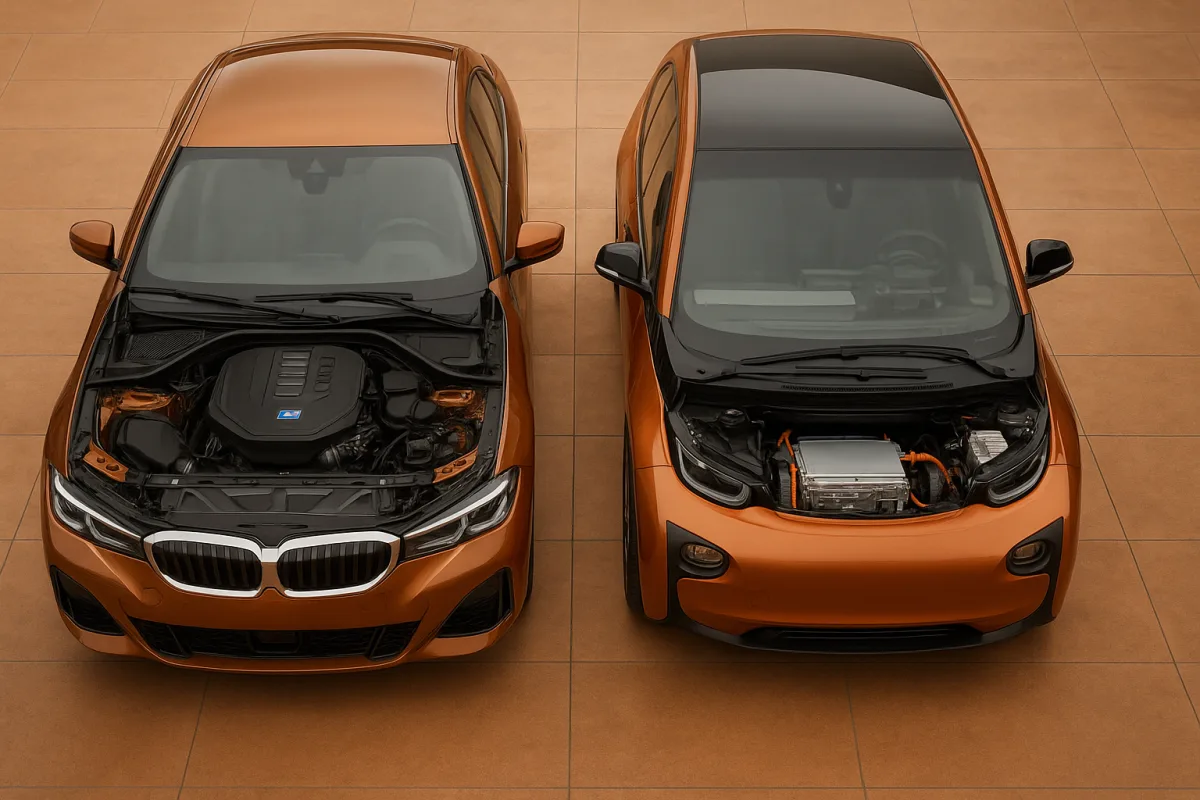
2027 BMW M350 xDrive vs BMW i3 50 xDrive: Which New 3 Series Makes Sense?
The decision: M350 xDrive or i3 50 xDrive?
The honest head-to-head is not M350 versus M3. It is the 2027 BMW M350 xDrive against the new BMW i3 50 xDrive, two similarly priced, rapid four-door BMWs aimed at buyers who might previously have bought a well-optioned M340i.
The M350 is the traditional answer. It has BMW’s turbocharged 3.0-litre B58 straight-six, 48-volt mild-hybrid assistance, xDrive all-wheel drive and an eight-speed automatic. The i3 is the clean-sheet electric answer, built on BMW’s Neue Klasse EV architecture rather than the revised CLAR II architecture beneath the petrol G50.[10]
BMW has deliberately made them look closely related, which is sensible. A buyer can choose fuel or electricity without feeling pushed into a separate, conspicuously electric-looking model. Doug DeMuro’s Car Pod team noted that the two cars are visually similar, while finding the i3 slightly more athletic in profile.
That similarity conceals an important ownership difference. The M350 is effectively the last evolution of the familiar 3 Series formula. The i3 is BMW’s bet that the compact executive sedan can survive as an EV, even while buyers continue migrating toward SUVs and lower-cost electric alternatives.
I have not driven either car, and neither has accumulated the sort of 60,000-mile evidence that makes an ownership recommendation genuinely firm. This is therefore a decision based on disclosed specification, projected pricing and the concerns raised in early reporting, not a substitute for a proper long-term test.
Price: closer than the badges suggest
Projected US pricing puts the 2027 M350 xDrive at $65,900 including the $1,350 destination charge. The i3 50 xDrive is projected at $61,500 including destination, while the 330 begins at $49,900.[5]
That makes the electric car the cheaper purchase on paper, but only just. A $4,400 gap is easily erased by options, finance rates, insurance, local electricity prices or the need to install a proper home charger.
The listed figure is not the final ownership bill. It excludes tax, registration, insurance, finance interest, accessories and options. For the i3, it also excludes any home-charging installation, which can be inexpensive in a modern garage or unexpectedly costly where electrical capacity is limited.
The M350’s price creates a more awkward question. A nearly $66,000 starting price for an M Performance 3 Series is strong money, and Ideal’s early walkaround makes the fair point that this is roughly the sort of territory occupied by an actual M3 not long ago.
Performance and driving character: six cylinders versus silent torque
The M350 makes 437 hp from its B58 3.0-litre turbocharged straight-six in US specification, with 428 lb-ft of torque, standard xDrive and mild-hybrid assistance. BMW quotes 0-60 mph in 3.9 seconds, though the important detail is likely the effortless overtaking response rather than the headline launch number.[10]
BMW also promises a rear-drive Drift Mode through an over-the-air update during 2027. That is a neat capability, but it is not available at launch, so nobody should buy an early car specifically for it and assume delivery timing will be painless.
Carwow’s first-look video identifies revised chassis bracing, a rear limited-slip differential and wider tyres as meaningful hardware changes beneath the M350’s styling. Those parts matter more than the software trick, because they should define whether 4,169 lb feels tied down on a rough road.
The i3 50 xDrive should be quicker in the ordinary electric-car sense: immediate response, no transmission shifts and strong traction. BMW has discussed a range figure near 470 miles under Europe’s more forgiving test cycle, but US EPA range will be lower and remains the number worth waiting for.
The M350 wins for a driver who wants mechanical texture. A straight-six has induction noise, gear changes and a sense of work that even a very fast EV does not reproduce. It is also likely to remain easier to refuel anywhere, in any weather, on any long trip.
The i3 wins for commuting. It should be quieter, smoother in traffic and faster to respond in the small gaps that define everyday driving. For many owners, particularly those covering short trips from a home charger, that will be more valuable than a drift mode used once.
Cabin and practicality: the i3 has the better packaging
The i3 uses a dedicated EV platform with a longer wheelbase than the petrol 3 Series. Carwow found more rear knee room and a flat rear floor, two real advantages when adults use the back seats or when a third passenger occasionally has to sit in the middle.
There is a caveat. The i3’s underfloor battery raises the floor, leaving less footwell depth and reduced under-thigh support for rear passengers. Carwow’s comparison concluded that the petrol 3 Series could actually be more comfortable behind a low-set front seat, despite its narrower cabin.
The M350 has the more familiar long-bonnet proportions, but its transmission tunnel takes useful rear-seat space. It is the option for someone who normally carries one passenger or children, rather than regularly transporting three adults across the rear bench.
Both cars bring BMW’s new cabin philosophy: a 17.9-inch central display, Panoramic Vision projected along the windscreen base, and a reduced number of physical controls. Ideal’s early assessment correctly identifies the ownership risk here, not merely the styling controversy.
Touch-sensitive wheel controls and screen-based climate functions can be acceptable after a week, or they can remain irritating for years. BMW has removed the iDrive rotary controller, something owners of older G20 cars may miss every time they adjust navigation, media or ventilation on the move.
BMW deserves credit for a useful countermeasure to modern driver-assistance irritation. Carwow demonstrated routines that can automatically switch off selected warning sounds, lane-departure alerts and stop-start behaviour when the driver enters the car. That is exactly the kind of software convenience owners notice daily.
Running costs and the 60,000-mile unknown
Neither model has a credible long-term maintenance record. Any claim that the 2027 G50 will be reliable, or that the i3 will be cheap to repair after warranty, is prediction dressed up as ownership knowledge.
Previous-generation 3 Series ownership gives a broad warning rather than a firm forecast. Post-warranty annual maintenance estimates range from roughly $1,200 to $2,500, while individual scheduled services can vary from around $140 to $1,100 depending on mileage and the work required.[8][9]
The M350 brings more potential consumables. It has a turbocharged six-cylinder engine, cooling system, eight-speed automatic, differential hardware, all-wheel-drive components, brakes and tyres likely sized for its performance. That does not mean it will fail, but it gives an owner more expensive systems to maintain.
Its B58 engine has a better reputation than several older BMW turbo engines, but this installation combines mild-hybrid hardware, new electronics and a substantially redesigned vehicle. The sensible buyer leases initially, or keeps a healthy repair reserve after the factory warranty ends.
The i3 removes oil services, spark plugs, exhaust components and conventional gearbox servicing. It does not remove expensive tyres, suspension wear, air-conditioning faults, high-voltage charging problems or the possibility of costly battery-related repairs after warranty.
Depreciation is another concern. iSeeCars estimates that a typical 3 Series loses about 46.5 percent of its value over five years, slightly worse than the luxury compact average.[6] That is historical data, not a forecast for either 2027 car.
The i3 could hold up well if BMW delivers competitive real-world range and dependable charging. It could also depreciate quickly if electric-car price reductions continue, battery technology moves on rapidly, or buyers decide that a used EV without much remaining battery warranty is too large a gamble.
The market problem: the M3 Touring is a warning, not a verdict
BMW is still willing to build enthusiast cars, but the M3 Touring illustrates the limits. BMWBlog reports that only 932 G81 M3 CS Touring units were produced globally, with none allocated to North America. Germany took 282, the UK 72 and Australia 55.[3]
Those numbers are partly a production and allocation story, not simply proof that enthusiasts rejected fast wagons. Still, they show the difficulty of selling expensive niche derivatives when buyers increasingly choose SUVs, electric cars or a regular sedan with enough performance.
Pricing matters as well. In Malaysia, the M3 Touring Competition xDrive launched at RM898,800, a RM60,000 premium over the equivalent M3 sedan. Paultan also reports the Touring lacks the carbon-fibre roof because low-volume assembly costs could not be justified.[4]
That is relevant to the M350. BMW can keep a six-cylinder sports sedan alive because it shares much with the mainstream 3 Series. It cannot assume every enthusiast will pay M-car money for a specialist body style or extra hardware.
The i3 is a larger strategic bet. InsideEVs reports BMW will follow it with a smaller Neue Klasse-based electric hatchback, likely called i1, in Europe during 2028. That car is expected to offer a lower-weight, lower-cost route into BMW EV ownership.[5]
A cheaper i1 may not directly replace a 3 Series for every buyer, but it will put pressure on it. The 3 Series must now justify itself against SUVs, Tesla-style EVs, BMW’s own i3 and eventually a more accessible electric BMW hatchback.
Comparison table
| Criteria | 2027 BMW M350 xDrive | BMW i3 50 xDrive |
|---|---|---|
| Projected US starting price | $65,900 including $1,350 destination charge.[5] Options, taxes, finance and insurance extra. | $61,500 including $1,350 destination charge.[5] Home charger, taxes, finance and insurance extra. |
| Powertrain | 3.0-litre turbocharged B58 inline-six, 48V mild hybrid, eight-speed automatic, xDrive.[10] | Dedicated Neue Klasse EV architecture, dual-motor xDrive configuration. Final US range and full technical details still need confirmation. |
| Everyday performance | Strong, characterful and rapid, with 437 hp and quoted 3.9-second 0-60 mph performance.[10] | Likely the quicker-feeling town car because EV torque is immediate, but final US figures should be treated cautiously. |
| Long-distance use | Better if charging access is inconsistent, with quick fuel stops and familiar refuelling infrastructure. | Best with dependable home charging. Public-charge route planning remains part of ownership. |
| Rear-seat space | Lower floor gives better foot space, but the transmission tunnel compromises middle-seat use. | Longer wheelbase and flat floor improve knee room and centre-seat access, but raised battery floor can reduce thigh support. |
| Cabin controls | Same screen-heavy interface, no iDrive controller and limited physical controls. | Same screen-heavy interface, so it does not avoid the new-control-layout issue. |
| Routine servicing | More regular mechanical servicing and more complex powertrain hardware to maintain. | Fewer routine mechanical service items, but battery and high-voltage repair costs remain an unknown. |
| Driving appeal | The better choice for buyers who value a straight-six soundtrack, shifts and traditional BMW character. | The better choice for quiet commuting, instant response and relaxed urban driving. |
| Main weakness | Fuel, tyres, brakes and post-warranty complexity may make it costly to keep. | Charging dependence and uncertain EV resale values may make long-term budgeting harder. |
Who each option suits
The M350 xDrive suits the buyer who still wants a petrol 3 Series for its engine rather than merely tolerating one. It is for someone with long motorway trips, inconsistent charging access and enough disposable income to accept premium fuel, tyres and eventual mechanical repair risk.
It falls down for the rational commuter. Its projected price is close to the i3’s, it is heavy, and its promised rear-drive mode is initially just a future software update. Buying it solely for the badge or a launch-control number would miss the point.
The i3 50 xDrive suits the owner with home charging, frequent urban or suburban use, occasional rear passengers and an appetite for early adoption. It offers the more convincing family packaging and should have the lower routine service burden, even if it is not necessarily cheaper to insure.
It falls down for apartment dwellers without dependable charging, regular remote-distance drivers, and people who want an engine as part of the experience. The i3 is probably the smarter answer for most buyers, but the M350 remains the more emotionally complete BMW.
Frequently Asked Questions
What are the main differences between the 2027 BMW M350 xDrive and i3 50 xDrive?
The M350 xDrive uses a turbocharged 3.0-litre straight-six petrol engine with mild-hybrid assistance and an eight-speed automatic, while the i3 50 xDrive is a fully electric vehicle built on BMW’s Neue Klasse EV platform. The M350 represents the traditional combustion-engine 3 Series, and the i3 is BMW’s electric successor with a longer wheelbase and a different chassis architecture. Visually, they are similar, but the i3 has a more spacious rear cabin due to its EV design.
How do the running costs of the 2027 BMW M350 compare to the i3?
The M350 has higher fuel and tyre costs due to its petrol engine and performance focus, whereas the i3 offers lower day-to-day energy costs if you have reliable home charging. The i3’s ownership costs may also include the expense of installing a home charger, which can vary widely. Overall, running costs and charging access are more significant factors than the initial price difference of about $4,400.
Which 2027 BMW 3 Series model is better for daily commuting?
The i3 50 xDrive is generally better suited for daily commuting because it is quieter, smoother in traffic, and offers immediate throttle response typical of electric vehicles. Its more spacious rear cabin and lower energy costs make it practical for everyday use, especially for short trips from a home charger. The M350, while powerful and engaging, is better suited for drivers who value mechanical character and longer trips.
What performance advantages does the 2027 BMW M350 have over the i3?
The M350 produces 437 hp and 428 lb-ft of torque with a turbocharged straight-six engine, delivering a traditional driving experience with induction noise and gear changes. It offers a 0-60 mph time of 3.9 seconds and features hardware like revised chassis bracing and a rear limited-slip differential for enhanced handling. The M350 also plans to add a rear-drive Drift Mode via an over-the-air update, appealing to enthusiasts seeking mechanical engagement.
How does the cabin space differ between the 2027 BMW M350 and i3?
The i3 has a longer wheelbase and a flat rear floor, providing more rear knee room and better accommodation for three passengers in the back. However, its underfloor battery raises the floor height, reducing footwell depth and under-thigh support for rear passengers. The M350 has a narrower cabin with a transmission tunnel that limits rear-seat space but may offer more comfort behind low-set front seats.
How we researched this
This article was assembled from 3 video sources across 3 channels, 1 published article, 12 cited references.
Nothing here is based on hands-on testing. Where a figure or finding appears, it belongs to the source cited beside it, and the writing says so rather than implying otherwise. Every source is listed below so you can check it.
Sources
New BMW 3 Series! Mercedes GT Prototype Fire! Tesla Roadster Delayed AGAIN! THIS CAR POD! EP131 — Doug DeMuro
A Cheap BMW Neue Klasse EV Is Coming In 2028 — InsideEVs
2027 BMW 3-Series vs. 2026 BMW 3-Series Spec Comparison | AutoWireDaily
2027 BMW 3 Series Price, Specs, Release Date: From $49,900 — OctaneDaily
BMW 3-Series Reliability by Year — Best & Worst Years | Auto Reliability Index
BMW 3 Series: Generations, Reliability and Ownership Costs | MotorLogic
BMW 3 Series maintenance schedule, costs & known repairs - Carlyle
2027 BMW 3 Series Sedan: Here’s What’s Changed and What’s Staying the Same | Cars.com
New 2027 BMW 3 Series: price, specs & release date | Motorpoint
Watch BMW 3 Series 2027 Model and Market Challenges on Youtube
Also from the sources
Related Articles
2027 BMW 3 Series Review: Launch, Features & Performance
Explore the 2027 BMW 3 Series review covering launch details, design, M350 xDrive performance, and interior updates.
Electric and Hybrid SUV Comparison
Compare electric and hybrid SUVs with a detailed look at Tesla Model Y and Toyota RAV4 PHEV performance, ownership, maintenance, and driving experience.

Supercar Drag Race Comparison and Ownership Insights
Compare top supercars in drag races with insights on performance, quarter mile times, and ownership costs for informed buying decisions.

Mercedes-AMG CLE 646 Ownership
Explore Mercedes-AMG CLE 646 ownership, including performance, maintenance, costs, and the driving experience of this exclusive V8 coupe.