
Mercedes-AMG GT SUV vs Porsche Mission S
Compare the Mercedes-AMG GT SUV and Porsche Mission S for luxury, performance, and ownership insights on these 2026 electric and petrol supercars.
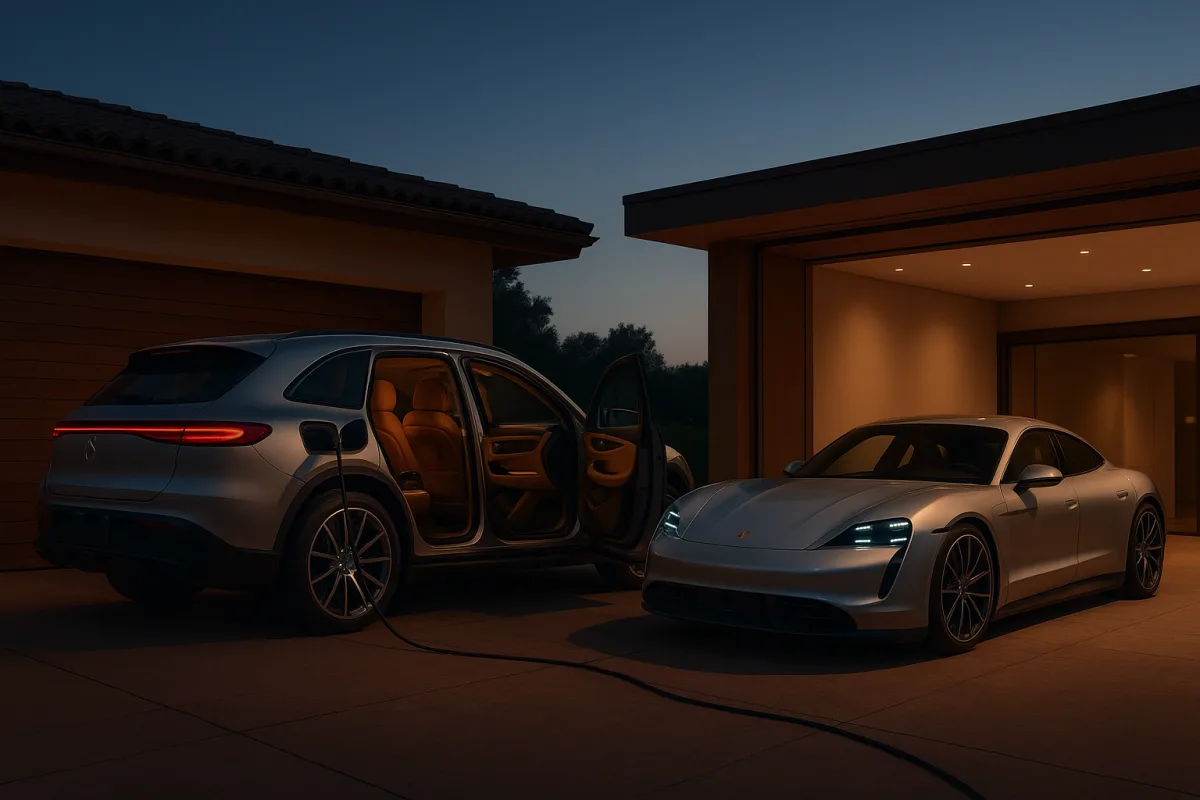
This is not really a straight fight
The premise sounds simple: two new luxury performance electric SUVs with four-figure horsepower. The reality is messier. Mercedes-AMG’s GT SUV is an electric SUV, but Porsche’s Mission S is a low-slung petrol-powered supercar concept, not the electric flagship some early speculation suggested. [8][9]
That matters because these cars answer completely different problems. The Mercedes-AMG is intended to carry people, luggage and a great deal of battery mass very quickly. The Porsche is a proposed halo car, designed around a mid-mounted combustion engine and the driving theatre that goes with it.
So the decision is not about which has the better 0-62 mph claim. It is whether you want an available, highly technical electric SUV, or whether you are prepared to wait for a still-unpriced Porsche supercar whose final production specification has not been published.
My choice, for somebody buying a car rather than collecting launch announcements, is the Mercedes-AMG GT SUV. It has compromises, especially mass, charging dependence and likely ruinous depreciation exposure, but it is at least a defined product with a declared powertrain range.
The Mission S may eventually be the more special machine. At present, though, it is a design study and engineering direction, not a vehicle with a service schedule, a warranty booklet, tyre prices or a delivery date.
Porsche Mission S: the case for waiting
Porsche revealed the Mission S Vision model on 15 October 2026 as a mid-engined supercar study. Porsche says the underlying architecture can accommodate combustion, hybrid and plug-in hybrid installations, but has not confirmed the production drivetrain, power output or transmission. [6][9]
That immediately puts a limit on every 1,000 hp claim attached to it. Carwow and Vehicle Virgins both speculated about a hybrid flagship with more than 1,000 hp, potentially combining a turbocharged flat engine with front electric assistance, but those are educated guesses rather than Porsche specifications.
The Porsche Newsroom material is more restrained. It presents a driver-focused interior, a central rev counter, physical climate controls and a phone mounting solution rather than a large infotainment display. These are interesting design choices, but they do not tell us what the production car will weigh or cost to maintain. [9]
The absence of a fixed central screen could age better than the current crop of giant touchscreens. It could also leave the owner relying on a phone integration system that becomes obsolete, awkward or unsupported long before a six-figure Porsche is mechanically worn out.
The practical downside is obvious. A Mission S would be a weekend car, a continental touring car at best, and probably a car needing careful use around speed humps, poor road surfaces and expensive carbonfibre bodywork. It is not an alternative to an SUV for a family.
Price is also unknown. Porsche has not announced a base price, although outside reporting has suggested a figure above £200,000, roughly $250,000. Treat that as speculation, not a budget figure, because special-order options and limited-production allocation practices could move the final transaction far beyond it. [8]
Nor is there a launch date. Porsche has confirmed the direction of travel, not a production timetable. Anyone putting down money today would be buying the prospect of a future car, with all the usual risks around delays, altered regulations and a final specification that differs from the vision model. [9]
For the driver who wants the last word in engine response, sound and compact supercar proportions, waiting may be entirely rational. But the sensible ownership answer is to wait until Porsche releases battery size, fuel economy, service intervals, tyre sizes, brake specification and warranty coverage.
Mercedes-AMG GT SUV: the case for buying the known quantity
The Mercedes-AMG GT SUV is an altogether more concrete proposal. It is a dedicated electric performance SUV on the AMG.EA architecture, offered as GT 53, GT 55 and GT 63 models with 106 kWh and 128 kWh battery options. [2][7]
The current flagship is the GT 63, quoted at up to 1,169 hp and 2.4 seconds from 0-62 mph. The GT 55 is quoted at up to 1,153 hp and 2.6 seconds, while the GT 53 makes up to 544 hp and reaches 62 mph in 3.8 seconds. [7]
Those numbers will make for absurd overtaking performance, but they should not be confused with an independent road test. There is no published comparison between these versions, no verified motorway range and no information yet on how repeatedly the GT 63 can deliver maximum power in heat.
Mercedes-AMG claims up to 432 miles of range, presumably in the most favourable configuration and WLTP conditions. The sensible expectation is that a fast motorway trip, cold weather, large wheels and regular use of four-figure power will all cut that figure substantially. [7]
The GT SUV’s strongest engineering argument is charging capacity. The 106 kWh pack supports up to 600 kW DC charging, while the 128 kWh pack can accept up to 710 kW. Mercedes-AMG quotes extremely rapid replenishment, assuming the charger, battery temperature and charging curve cooperate. [2]
That last condition is doing a lot of work. TechRadar reports that EVgo’s planned 750 kW American chargers are not due until 2027, and a 400 kW unit stretches the estimated 10-80% time from 12 to about 16 minutes for the larger battery. [3]
In other words, the AMG should be excellent for home charging and potentially brilliant on a carefully planned high-power route. It will not routinely produce its headline charging stop at every motorway services location, particularly in markets without mature ultra-rapid infrastructure.
The other ownership concern is mass. CarScoops reports a GT 55 weight of up to 2,715kg, which gives some idea of what the tyres, brakes, suspension bushes and body control system will be asked to manage. This is not a car likely to be cheap after its warranty expires.
Mercedes-AMG counters that with rear-wheel steering, active roll and pitch control, torque vectoring and carbon-ceramic brakes on the GT 63. Those systems may make it astonishingly capable, but they also create a long list of expensive components that do not become less complex at 60,000 miles.
The GT 53 was reported by CarScoops at €113,500 in Europe, while GT 55 and GT 63 pricing had not been confirmed. That entry price excludes insurance, charging installation, options, finance costs and local taxes, all of which matter more here than the base figure.
US buyers should not assume a federal EV tax credit will soften the purchase. The US Inflation Reduction Act excludes vehicles above $80,000 from the consumer credit, precisely where an AMG GT SUV will sit, while tax treatment and incentives differ sharply by market. [1]
Ownership reality, not brochure reality
Neither manufacturer has given us the information that determines whether ownership is pleasant after the first warranty period. There are no documented service intervals for the production Mission S, and no published long-term repair history for the AMG’s new motors, battery packs or active chassis.
The best available Mercedes ownership context is imperfect. Edmunds estimates a five-year cost to own of $238,501 for a 2026 Mercedes-AMG GT 63 Coupe, but that is a different combustion-powered model, not the electric SUV, and should not be used as a prediction. [4]
Still, the figure is a useful warning about the segment. Depreciation, insurance, tyres, optional equipment and dealer labour can overwhelm the energy-cost advantage of an EV, particularly when the buyer chooses huge wheels, carbon ceramics and rare paintwork.
Porsche ownership is equally hard to forecast because the Mission S does not yet exist as a saleable production car. A naturally aspirated or turbocharged petrol halo car could have lower battery replacement anxiety, but will bring fuel, emissions, heat-management and hybrid-system costs of its own.
The AMG is likely to be cheaper to energise per mile when charged at home. It is unlikely to be cheap in an absolute sense, particularly if a driver uses its acceleration often enough to consume tyres rapidly and spends regularly at expensive public rapid chargers.
Head-to-head comparison
| Criterion | Porsche Mission S | Mercedes-AMG GT SUV |
|---|---|---|
| What it is | Petrol-powered mid-engined supercar vision, not an EV or SUV. [8][9] | All-electric performance luxury SUV. [2][7] |
| Availability | No confirmed production date. [9] | Announced production model range, with sales timing varying by market. [2] |
| Price | No official price. Reports suggesting £200,000-plus remain unconfirmed. [8] | GT 53 reported from €113,500 in Europe. GT 55 and GT 63 prices remain unconfirmed. |
| Powertrain | Combustion, hybrid or plug-in hybrid layouts are possible, but final specification is undisclosed. [6] | GT 53, GT 55 and GT 63 electric models, with up to three motors. [7] |
| Maximum claimed output | Not announced. | Up to 1,169 hp in GT 63 form. [7] |
| Claimed acceleration | Not announced. | GT 63: 0-62 mph in 2.4 seconds. [7] |
| Long-distance use | Fuel stops should be simple, but luggage space, ride and production-car range are unknown. | Claimed range up to 432 miles, but charging performance depends heavily on infrastructure. [3][7] |
| Practicality | Two-seat supercar proposition. | SUV packaging, more suitable for passengers and daily use. |
| Maintenance outlook | Unknown, because the production car and engine are unconfirmed. | Unknown model-specific costs, with added risk from active chassis, high-voltage systems and very high vehicle mass. |
| Main weakness | It cannot be bought or properly evaluated yet. | Charging claims exceed the capability of much current public infrastructure. [3] |
Who each option suits
The Porsche Mission S suits the collector or committed petrol-car enthusiast who values a low-slung mid-engined Porsche more than practicality, and who is happy to wait for confirmed specification. It is the choice for emotional appeal, not for an immediate ownership decision.
It falls down for anyone who specifically wants an electric vehicle, needs rear-seat space, wants predictable pricing or expects to compare running costs before ordering. Until Porsche publishes final powertrain and maintenance details, sensible buyers should regard it as a future possibility.
The Mercedes-AMG GT SUV suits the high-mileage luxury-SUV buyer who can charge at home, carries passengers, wants enormous straight-line performance and accepts that a nearly three-tonne EV is a complicated proposition. Of the two, it is the actual electric performance purchase.
It falls down for drivers without dependable home or destination charging, owners who dislike synthetic powertrain effects, and those seeking light-footed sports-car responses. The GT 53 is the more rational version, while the GT 63 is for buyers who want the headline numbers and accept the likely cost.
Frequently Asked Questions
What are the main differences between the Mercedes-AMG GT SUV and Porsche Mission S?
The Mercedes-AMG GT SUV is an all-electric luxury SUV designed for practicality, carrying passengers and luggage with high performance and usable rear seats. In contrast, the Porsche Mission S is a petrol-powered mid-engined supercar concept, not an SUV or electric vehicle. The Mission S focuses on driving experience and design rather than practicality or electric powertrain.
Is the Porsche Mission S an electric SUV?
No, the Porsche Mission S is not an electric SUV. It is a petrol-powered mid-engined supercar concept with no confirmed electric or hybrid drivetrain for production. Porsche has not announced a production version or drivetrain details as of October 2026.
What performance specs does the Mercedes-AMG GT SUV offer?
The Mercedes-AMG GT SUV comes in several variants: the GT 53 with up to 544 hp and 0-62 mph in 3.8 seconds; the GT 55 with up to 1,153 hp and 0-62 mph in 2.6 seconds; and the GT 63 with up to 1,169 hp and 0-62 mph in 2.4 seconds. It has a top speed of 186 mph and a maximum range of up to 432 miles.
What are the charging capabilities of the Mercedes-AMG GT SUV?
The Mercedes-AMG GT SUV supports fast charging with two battery options: a 106 kWh battery supporting up to 600 kW charging and a 128 kWh battery supporting up to 710 kW charging. However, 710 kW chargers are rare in the real world as of 2026. On more common 400 kW chargers, charging the 128 kWh battery from 10% to 80% takes about 16 minutes, while the 106 kWh battery takes about 14 minutes.
How we researched this
This article was assembled from 2 video sources across 2 channels, 2 published articles, 10 cited references.
Nothing here is based on hands-on testing. Where a figure or finding appears, it belongs to the source cited beside it, and the writing says so rather than implying otherwise. Every source is listed below so you can check it.
Sources
New Porsche Mission S is a 1,000hp+ Ferrari KILLER! — carwow
Porsche Mission S Exclusive First Look! — Vehicle Virgins
Fiat 'Koala': Company is "ready" to reveal Panda-inspired 2CV twin — Autocar
Mercedes-AMG's GT SUV Is More Than Just A 1,153 HP Beast — CarScoops
Mercedes-AMG GT SUV Debuts With 1,169 HP and 710 kW Charging
EVgo says its ultra-fast EV charging stations will launch in the US in 2027
With the Mission S Vision, Porsche sets a course towards a refined era of supercar design
Mercedes-AMG GT SUV Revealed: Up To 1,153 HP And Three Electric Motors
Mission S revealed: This new Porsche supercar isn't electric
Porsche Mission S: the essence of the sports car reinterpreted - Porsche Newsroom USA
Watch Luxury and Performance Electric SUVs: Porsche Mission S and Mercedes-AMG GT SUV on Youtube
Also from the sources
Related Articles
Electric and Hybrid SUV Comparison
Compare electric and hybrid SUVs with a detailed look at Tesla Model Y and Toyota RAV4 PHEV performance, ownership, maintenance, and driving experience.
2027 BMW 3 Series M350 vs i3
Compare the 2027 BMW 3 Series M350 and i3 models on performance, ownership costs, and market challenges to find which suits your needs best.
Supercar Drag Race Comparison and Ownership Insights
Compare top supercars in drag races with insights on performance, quarter mile times, and ownership costs for informed buying decisions.
Electric Vehicle Market and Warranty Trends in 2026
Explore 2026 trends in the electric vehicle market, charging infrastructure, and warranty coverage to make informed EV ownership decisions.