
Subaru EV Platform Independence
Learn how Subaru is developing its own EV platform, gaining independence from Toyota with new tech and a 2029 prototype.
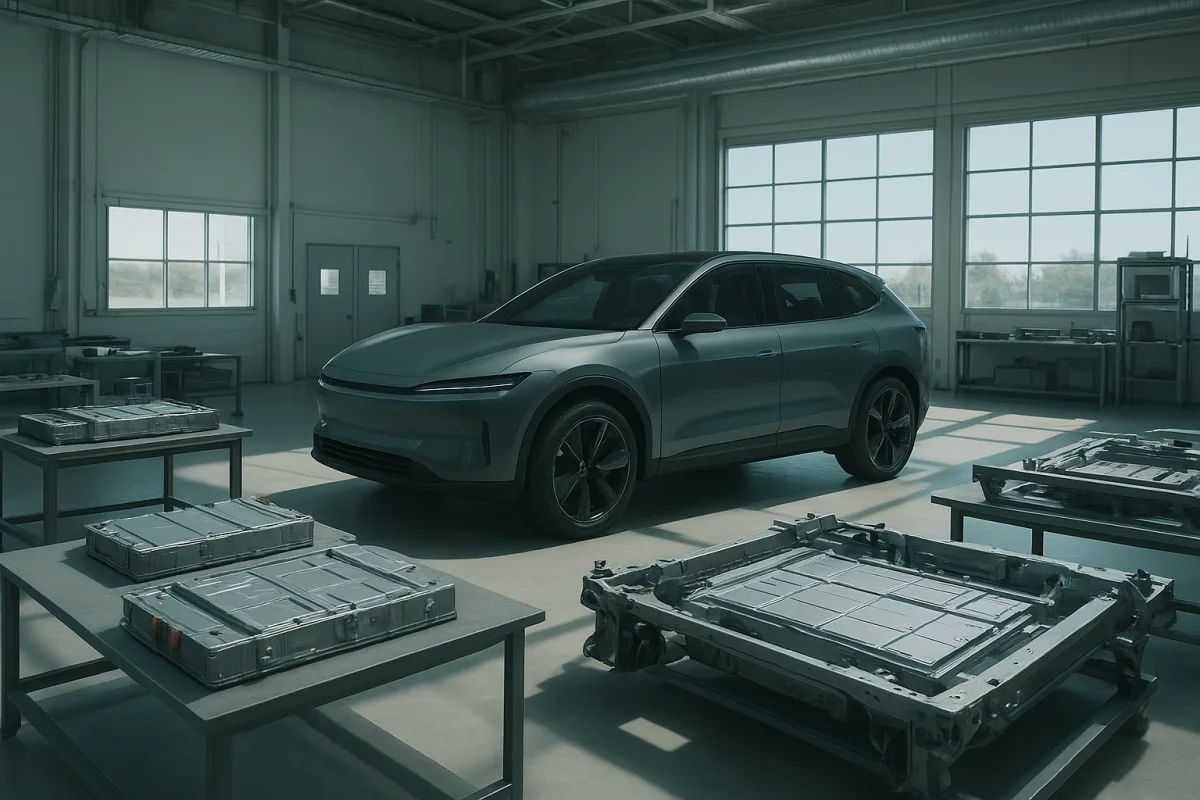
Subaru is moving toward its own EV foundation
The shift is plain enough: Subaru wants to control the important bits of its next electric vehicles rather than simply adapting Toyota-developed hardware. That does not mean Toyota disappears from the picture, but Subaru is trying to own the platform decisions that shape how its cars drive, crash and age.
Car and Driver, Road & Track and InsideEVs each reported the same core development: Subaru has shown journalists a dedicated EV architecture, a new battery approach, new drive units and an integrated control system intended for production technology from around 2029. [1][3]
That convergence matters because the story is not based on a design sketch or a vague executive promise. Subaru has a running prototype, tested at its proving ground north of Tokyo, with hardware sufficiently developed to discuss motor outputs, battery-cell count, crash structure and electronic architecture. [1][3]
Still, it is early. The vehicle itself is not a production preview in the usual sense. Subaru fitted the development hardware beneath a previous-generation Outback body that needed stretched wheel openings because the new platform’s wheelbase is longer. [1][3]
So, do not read “Outback-shaped mule” as confirmation of an electric Outback replacement. The prototype is a test tool, and Subaru has not identified the first production car that will use this architecture. InsideEVs is right to separate that fact from the tempting speculation. [3]
Why independence matters to Subaru
Subaru’s recent EV range has expanded quickly, but it has expanded largely through Toyota. The 2023 Subaru Solterra is closely related to the Toyota bZ4X, while the newer Subaru Trailseeker, Subaru Uncharted and forthcoming three-row Subaru Getaway all continue the shared-development approach. [1][3]
That arrangement made sense for a relatively small manufacturer. Subaru sold about 924,000 vehicles globally in 2025, compared with Toyota’s more than 11 million, so attempting a ground-up EV family alone would have been expensive and slow. [3]
The downside is obvious to anybody who has shopped these cars alongside their Toyota relatives. A different grille, trim package and calibration can make a vehicle feel more Subaru-like, but it cannot fully overcome the packaging, battery and software decisions made upstream.
Subaru executives have framed the in-house push around preserving their own safety and driving character. That sounds like normal corporate language, but the hardware being described makes the claim more concrete than a fresh badge and revised suspension tune. [1][3]
The new platform is said to be about 220 pounds lighter than Subaru’s current EV architecture. The front end has been redesigned to manage crash loads around the passenger compartment and battery, including supports that route forces over the front wheels. [1][3]
Subaru also says the front motor can rotate in a frontal impact to help absorb energy. That is a notable detail because it shows the motor, structure and battery are being designed as one system, rather than a Subaru body department adapting a pre-existing electric toolkit. [1][3]
There is also a practical reason to bring electronics under closer control. Subaru’s proposed integrated electronic control unit is meant to manage driver assistance, powertrain, chassis functions and infotainment, while enabling over-the-air updates for independently developed Subaru vehicles. [3]
For an owner, that can become either a real improvement or a new source of frustration. One central system can make updates and diagnostics more coherent, but it also concentrates complexity. The useful question is not whether the car can update itself, but whether Subaru supports it properly after warranty.
It is independence, not isolation
“Going solo” makes for an easy headline, but it overstates what Subaru is actually doing. The prototype’s e-axles were developed with Aisin, a Toyota Group supplier, while Panasonic Energy is the battery partner. Those relationships began in 2024. [1][3]
That is not a weakness. Almost no manufacturer, including much larger ones, makes every major EV component internally. The meaningful distinction is that Subaru says it is integrating the system and developing the underlying vehicle architecture around its own priorities. [3]
The front motor is rated at 201 horsepower and the rear at 308 horsepower, for about 510 horsepower combined in the prototype. Subaru claims the drive units are smaller, lighter and 30 percent more efficient than an unspecified industry average. [1][3]
That last phrase needs treating carefully. “Thirty percent more efficient than industry average” is not the same as a verified 30 percent range gain over a Solterra, a Tesla Model Y or anything else a buyer can cross-shop. Subaru has not disclosed the comparison method. [3]
Likewise, the battery reportedly uses 4,000 cylindrical cells and is claimed to be 25 percent lighter than Subaru’s previous battery, with energy density targeted at 20 percent above an unspecified industry average. No pack capacity, usable capacity, charging curve or EPA range has been released. [1][3]
Those omissions are more important than the headline performance. A 510-hp all-wheel-drive EV that reaches 62 mph in under four seconds is technically credible, but that tells an owner almost nothing about winter range, DC charging consistency, battery degradation or replacement cost. [1][3]
The current cars remain the relevant buying decision
A shopper needing an electric Subaru now has to assess the existing Toyota-linked range on its merits. The 2027 Subaru Solterra, Subaru Uncharted and Subaru Trailseeker are listed from $34,995 to $41,470, depending on model and specification. [2]
Those are base-vehicle figures, not a complete ownership budget. Destination charges, registration, home-charging equipment, installation work, insurance, finance costs and local taxes can all change the real number substantially. No pricing at all has been released for the later in-house-platform EVs.
The Subaru Solterra has a 72.8-kWh usable battery and EPA range of up to 227 miles in all-wheel-drive form. That is usable for many commuting patterns, but it is not generous by the standards of newer long-range electric crossovers. [4]
The Subaru Uncharted targets roughly 250 miles, while the Subaru Trailseeker is estimated at 274 EPA miles. Edmunds recorded 262 miles in its real-world Trailseeker range test, which is reasonably close to that estimate but also illustrates why published range should be treated as a benchmark, not a promise. [3]
For context, the Hyundai Ioniq 5 Long Range AWD is listed at 303 miles, the Tesla Model Y Long Range at 330 miles, the Rivian R1S Quad AWD at 374 miles and the Lucid Gravity Grand Touring at 386 miles. [4]
Those vehicles do not all suit the same owner or price bracket, so this is not a direct buying recommendation. The Hyundai Ioniq 5 is the closer mainstream crossover reference, while the Tesla, Rivian and Lucid figures show how far Subaru’s present range lags the longest-range alternatives. [4]
The Subaru Trailseeker suits the buyer who wants a more spacious, outdoors-oriented electric Subaru and can live with its range envelope. The Subaru Solterra suits a less demanding compact crossover role. The Subaru Uncharted is aimed at buyers wanting a smaller EV format, though final ownership evidence remains limited. [2][3]
The future three-row Subaru Getaway should suit families needing additional seating, but it remains a forthcoming Toyota-related model rather than evidence of Subaru’s independent EV platform. Subaru’s own platform should not be expected before around 2029, and even that is technology timing, not a confirmed vehicle launch. [1][3]
Why Subaru is doing this now
Subaru cannot afford to stand still while Chinese manufacturers, Tesla and established global rivals shorten EV development cycles. InsideEVs reports that Subaru says it developed the prototype technologies in roughly half the usual time, a claim that suggests speed is now part of the engineering brief. [3]
There is also proof that Subaru has a market to defend. The company sold 4,566 EVs in the third quarter of 2026, up 31.5 percent year on year, with the Trailseeker accounting for 3,174 units in its second quarter on sale. [5]
Production matters too. The Trailseeker, sold in Europe as the e-Outback, entered series production at Subaru’s Gunma Yajima plant, with European availability beginning in early 2026. That gives Subaru a genuine EV manufacturing foothold, even if the underlying product strategy remains shared. [6]
The financial backdrop is less comfortable. Subaru reported a ¥226.9 billion, approximately $1.42 billion, tariff-related impact in May 2026, alongside ¥57.8 billion, approximately $362 million, in EV-related write-downs and impairments. [9]
Those are not small numbers for a company Subaru’s size. Separate reporting says the in-house EV rollout was delayed from 2025 to 2027, which is a useful reminder that an engineering presentation and a trouble-free production launch are separated by years of cost control and supplier work. [10]
There is a regulatory dimension as well. The United States has updated electric-powertrain crash requirements through FMVSS No. 305a, while Europe’s 2026 rules increase expectations around secure vehicle access and repair information for software-controlled systems.
For an owner, these developments are more relevant than a promised acceleration time. Battery containment after a collision, independent diagnostic access, secure software updates and availability of repair data will determine whether an EV remains practical once it is outside its easy early-warranty period.
What to watch if you are planning ahead
If you are planning an EV purchase for 2027 or 2028, do not delay it on the assumption that a radically better Subaru is just around the corner. Subaru has only said that some of the new technology could reach customers from 2029. [1][3]
Instead, assess the current Subaru EVs as current products. Ask for actual cold-weather range, charging performance on your regular routes, insurance quotes, tyre costs and dealer procedures for collision repair. A battery warranty is reassuring, but it is not a substitute for parts availability.
If you are planning a longer-term Subaru ownership project, the information worth tracking is less glamorous. Look for the first confirmed production vehicle, usable battery capacity, DC charging speed, cell serviceability, warranty terms, battery-health reporting and whether independent workshops can access diagnostic information.
There is no evidence yet on resale values for vehicles built on Subaru’s independent EV platform. There is also no disclosed pricing, no production battery capacity and no verified range figure, so predictions about cheap ownership or strong retained value would be guesswork.
The prototype’s chassis does offer one encouraging clue. A brief early drive reported by InsideEVs, based on footage from LOVECARS!TV!, described quick turn-in and secure all-wheel-drive cornering, with double-wishbone front suspension and a five-link rear setup. [3]
That should be treated as an early impression from two restricted laps, not a finished road test. But it does suggest Subaru is trying to preserve something beyond the brochure’s usual electric-SUV checklist: a distinct chassis character, not merely another shared platform with different headlights.
Frequently Asked Questions
What is Subaru's new EV platform and how is it different from Toyota's?
Subaru's new EV platform is a dedicated electric vehicle architecture developed largely in-house, featuring a new battery approach, drive units, and integrated control system. Unlike the current Toyota-shared platforms used in models like the Solterra, this platform allows Subaru to control key aspects such as driving dynamics, crash behavior, and vehicle aging. However, Subaru has not severed ties with Toyota and still collaborates with them and other partners.
How is Subaru becoming independent from Toyota in EV development?
Subaru is shifting from relying on Toyota-developed hardware to building more of its EV technology internally. This includes creating its own platform, battery system, and electronic architecture, aiming to preserve Subaru’s unique safety and driving characteristics. While Subaru remains partnered with Toyota, this new approach gives Subaru greater control over the design and engineering of its EVs.
What are the features of Subaru's in-house EV prototype?
The prototype uses an extended-wheelbase version of the new platform housed under an older Outback body, serving as a development mule rather than a production preview. It features a 510-horsepower electric motor setup and includes new battery cell counts, crash structures, and integrated electronics. This prototype demonstrates Subaru’s engineering direction but does not confirm any specific future production model.
When will Subaru's new EV platform be available?
Subaru expects production technology based on its new EV platform to be ready around 2029. However, no production models, battery sizes, ranges, charging speeds, or pricing details have been disclosed yet. The platform’s launch was delayed from an earlier target of 2025 to around 2027-2029 due to financial and supply chain challenges.
How does Subaru's EV platform affect vehicle safety and performance?
Subaru emphasizes that controlling its own platform allows it to maintain its distinct safety standards and driving feel. The new platform includes updated crash structures and integrated electronic control systems designed to meet evolving safety regulations. This approach aims to ensure that Subaru EVs perform and protect occupants in ways consistent with the brand’s traditional values.
How we researched this
This article was assembled from 3 published articles, 10 cited references.
Nothing here is based on hands-on testing. Where a figure or finding appears, it belongs to the source cited beside it, and the writing says so rather than implying otherwise. Every source is listed below so you can check it.
Sources
Subaru Reveals First Details of New EV Platform Coming in 2029 — Car and Driver
Subaru Is Developing Its Own EVs, and It Starts With a 510-HP AWD Station Wagon Prototype — Road & Track
Subaru Wants Its Own EVs. A 510-HP Mule Shows What’s Coming — InsideEVs
Subaru Reveals First Details of New EV Platform Coming in 2029
New Subaru EV Guide: Solterra Range, Pricing & Ownership Costs | AutoEdgeView
2026 Subaru Trailseeker Falls Short in Our Real-World Range Test
Subaru EV Sales Improve As Trailseeker Deliveries Ramp Up In Q3 2026
Subaru begins series production of Trailseeker EV/e-Outback - electrive.com
Subaru's own EV prototype arrives as its boxer leaves Europe
I drove the Subaru Trailseeker for a week - and it's the all-electric Outback I've been waiting for
Related Articles

2026 Honda CRV Trail Sport Hybrid Review: Quiet Ride & Continental Tires
TheStraightPipes review the 2026 Honda CRV Trail Sport Hybrid, praising its quiet ride and Continental tires. They critique the lackluster Trail Sport features and high price, suggesting opting for a non-hybrid CRV instead.

2025 Chevy Tahoe Z71 Review: Comfort, Power, and Off-Road Capabilities
TheStraightPipes review the 2025 Chevy Tahoe Z71, highlighting its comfort, powerful engine, child seat compatibility, and off-road capabilities.

2025 Lexus IS-500 Review: Power, Design, and Performance Highlights
TheStraightPipes review the 2025 Lexus IS-500, praising its 472 horsepower V8 engine, sleek design, comfortable interior, and impressive performance features.

2025 Kia K4 GT Line Review: Pros, Cons, and Alternatives
The 2025 Kia K4 GT Line is reviewed by TheStraightPipes, critiquing its unappealing exterior, poor interior climate control layout, but praising its smooth driving experience and tech features. Consider alternatives like the Jetta GLI or Civic SI for a more engaging drive.