
BMW Electric Vehicle Battery Innovations and Challenges
Explore BMW electric vehicle battery innovations, including cell-to-pack design, Woodruff plant, iX5 range, and Alpina prototype challenges.
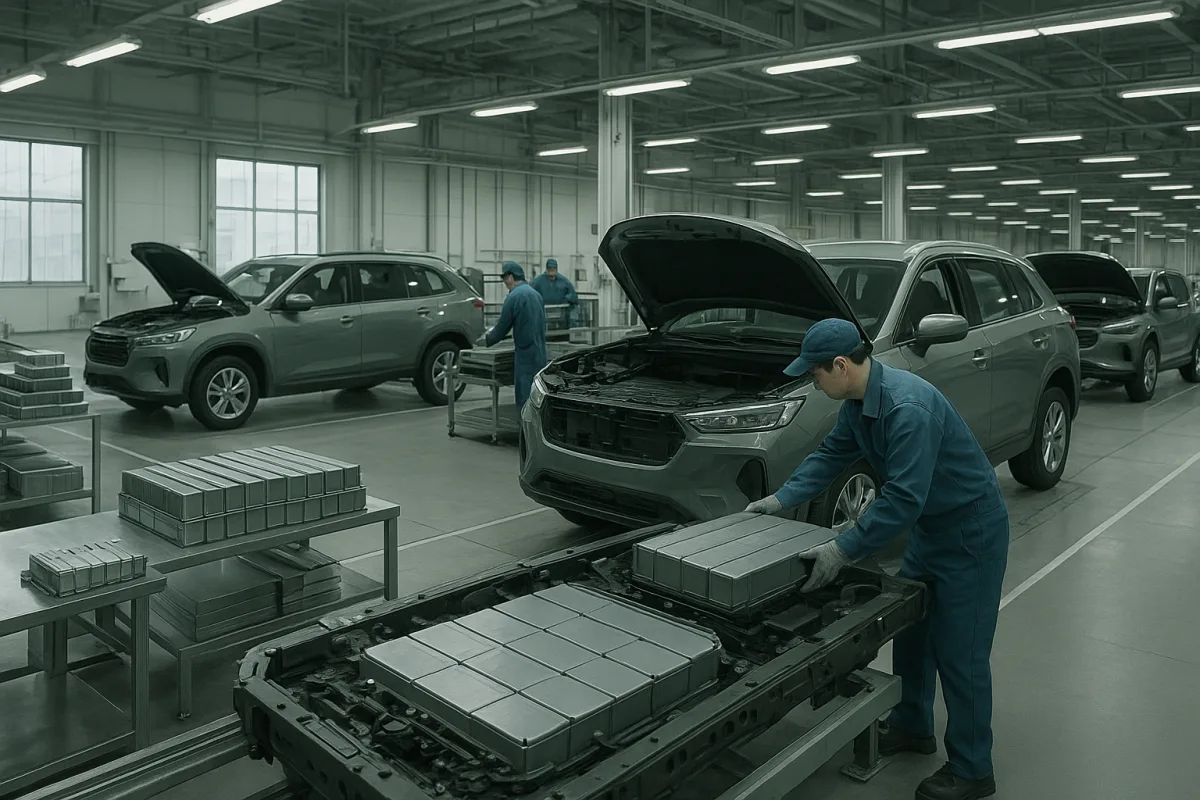
The Woodruff battery plant opened on November 13
BMW opened Plant Woodruff in South Carolina on November 13, 2026, beginning U.S. production of Gen6 high-voltage battery packs for electric vehicles built at nearby Spartanburg. The first vehicle in line is the iX5 electric SUV. [12]
The site sits about 15 miles from BMW’s Spartanburg vehicle plant, shortening the distance between battery-pack assembly and final vehicle assembly. BMW says the combined Woodruff and Spartanburg operation is designed around annual capacity for 450,000 vehicles. [4]
This is a battery-pack plant, not a cell factory. BMW receives completed cylindrical cells from suppliers, measures their electrical condition, groups them with cooling hardware, and assembles the finished high-voltage pack for installation in the vehicle. [12]
More than 300 people work at Woodruff alongside roughly 250 robots, according to EV Infrastructure News. Production staff also use virtual-reality training before working on the assembly line, an attempt to reduce mistakes in a product where one faulty connection can sideline a whole vehicle. [4]
BMW says its normal Woodruff operations do not use fossil fuels, while hydrogen-powered industrial trucks handle material movement. That says something about factory operations, not the entire battery’s carbon footprint, which still depends on cell production and the upstream material supply chain. [12]
Cell-to-pack is the innovation to understand
A conventional EV battery contains cells, modules, and then a large outer pack. Modules are smaller boxed groups of cells, with their own housings, wiring, mounting hardware, and structural separation before they are installed in the pack.
BMW’s Gen6 approach removes the module layer. The cylindrical cells go directly into the pack enclosure, supported and protected with hardened foam, then integrated with cooling components and high-voltage connections. InsideEVs describes this as BMW’s cell-to-pack construction.
Removing modules gives BMW extra room for active material within the same external battery size. More cells can fit into the available space, which raises total stored energy and can raise range without making the vehicle body proportionally larger.
It can also cut material and assembly cost. Fewer module housings, fasteners, electrical links, and structural pieces mean fewer parts to buy, validate, install, and inspect. BMW has said eliminating modules and struts reduces cost in its battery architecture.
The catch is that the pack becomes a more integrated object. If a defect occurs inside an individual cell group, repair options may be more constrained than in a modular battery, where a technician could theoretically isolate a smaller assembly.
BMW has not published a consumer repair-price schedule for Woodruff-built battery packs. There is also no published evidence that a South Carolina-assembled BMW pack will have different depreciation, maintenance costs, reliability, or warranty expense from an equivalent European-built pack. [9]
For an owner, cell-to-pack’s promise is indirect. You may get more range from a given vehicle footprint and potentially a lighter, simpler battery structure, but the financial benefit depends on battery longevity, warranty support, insurance treatment, and eventual repair procedures.
BMW’s newer 46120-format cylindrical cells are reported to reach up to 310 Wh/kg at the cell level. That figure cannot be directly compared with a competitor’s pack-level density, because the completed pack includes cooling, casing, cabling, crash protection, and structural hardware. [8]
That distinction keeps marketing numbers honest. A high cell-level energy-density figure is encouraging, but your road-trip range comes from the full vehicle: battery size, aerodynamics, tire choice, cabin heating or cooling, speed, terrain, and how much reserve BMW keeps inaccessible.
The iX5 proves what a large battery can do
The new iX5’s 144-kWh usable battery is a clear example of BMW’s strategy. Its EPA range is 435 miles, and an Out of Spec Testing highway run cited by InsideEVs reached 410.8 miles at a constant 70 mph.
The result placed it ahead of a Lucid Gravity Grand Touring at 367.7 miles, a Rivian R1S Dual Max at 349 miles, and a Porsche Cayenne Turbo Electric at 309 miles. The iX5 did not lead because it was the most efficient.
The Lucid covered more distance per kilowatt-hour, while the Porsche also used less energy per mile than the BMW in that comparison. BMW won because 144 usable kWh is an enormous energy reserve for an electric SUV.
There was an odd detail at the end of the iX5 test. It initially shut down after delivering almost exactly its stated 144-kWh usable capacity, having displayed 0 percent charge for around 10 miles, then restarted and released about another 4 kWh.
Test host Kyle Conner theorized that BMW may reserve energy after the stated usable capacity, but BMW had not confirmed that explanation. Do not plan trips around a restart unlocking extra range, because the published usable figure is the number you can rely on.
A larger pack also brings costs beyond the window sticker. It requires more cells, more cooling capacity, more structural protection, and more raw materials, while adding mass that the motors must carry every mile.
BMW EVs can still cost less to operate than gas equivalents if you charge at home. Kiplinger estimates roughly $699 annually for home charging compared with $1,569 for gas, with EV maintenance costs 30 to 40 percent lower, though electricity pricing and driving distance can change both figures. [11]
Depreciation remains the hard part. BMWBlog reports that the i7 retains about 26.4 percent of its value after five years, compared with 38.2 percent for a gas-powered 7 Series, so a used EV’s purchase price can fall faster than its operating costs. [10]
Alpina returns under BMW ownership
At Italy’s Nardò test facility, BMW sent a camouflaged Alpina luxury-sedan prototype past 300 km/h, or 186 mph. Ideal’s footage shows the familiar multi-spoke wheel theme, but that run is a development result, not a published production-car top-speed claim.
BMW took over Alpina trademark rights on January 1, 2026, following an agreement announced in 2022. The old BMW-Alpina vehicle cooperation ran through the end of 2025, making this the first Alpina developed as a BMW Group brand.
That ownership change explains why the car deserves scrutiny beyond its speed. Old Alpinas were engineered interpretations of BMWs, usually prioritizing effortless torque, compliant long-distance ride quality, understated appearance, and high top speed over the sharper, louder character associated with M cars.
The 2020 Alpina B7 shows the target clearly. BMW quoted its 4.4-liter twin-turbo V8 at 600 horsepower and 590 lb-ft, with a claimed 205-mph top speed, while 0-60 Specs lists the B7 sedan at roughly 3.2 seconds to 60 mph. [3]
BMW has confirmed a V8 for the new prototype, along with specific transmission calibration intended to provide immediate, smooth power delivery. Ideal also reports that BMW developed the prototype’s wheels with tires containing an added foam layer to reduce noise.
Those details fit the Alpina brief, but they do not guarantee the finished car will ride well. The test worth waiting for is how its suspension handles expansion joints, broken pavement, and long highway miles, while remaining composed at serious speed.
BMW has not announced a production name, power figure, price, final top speed, or U.S. availability for the prototype. Calling it the next B7 is understandable given its apparent 7 Series basis, but BMW has not confirmed that name.
Do not confuse the absent Alpina sedan price with the confirmed 2026 Alpina XB7 price. The XB7 is the three-row SUV, not a sedan, and Edmunds lists its starting price at $156,000 before options, taxes, registration, insurance, and dealer charges. [2]
For context, Automobile Catalog lists the European-market 2026 Alpina B3 GT Limousine Allrad at about 3.3 seconds to 60 mph. [1] That is a smaller all-wheel-drive sedan and says nothing definite about the forthcoming V8 flagship.
We would hold out for the finished car if what you want is a long-distance luxury sedan with real character. A green Alpina with its traditional wheels could be deeply appealing, but only if BMW preserves the old formula of quiet speed without an unnecessarily punishing chassis.
Recalls are part of the ownership calculation
BMW’s electrification push has not removed the need for basic recall discipline. The biggest issue for an owner is not whether a recall sounds dramatic, but whether the specific car has had the campaign completed and documented by a BMW dealer.
A driveshaft-connection recall, NHTSA campaign 26V525000, affects nearly 28,000 vehicles, including certain 2020-2026 8 Series models, 2021-2023 5 Series variants, and 2024-2026 750e xDrive models. The defect can cause power loss or a rollaway risk. [5]
BMW also issued a January 2026 starter-related fire-risk recall affecting multiple 2021-2024 BMW models and Toyota Supra variants. The remedy is free replacement of the starter, so confirm the repair before parking an affected used car in an attached garage. [6]
The broader February 2026 starter-relay fire-risk action covered about 575,000 vehicles, with owners advised to park outside pending repair. The reported remedy is free, but an owner still loses time arranging transport, inspection, and the dealer visit. [13]
Electric BMW shoppers should pay particular attention to campaign 26V422000, issued June 30, 2026, for an integrated brake-system malfunction. It affects certain 2023-2025 i7, 7 Series, i5, 5 Series, X7, XM, X1, X6, X5, Mini, and Rolls-Royce Spectre vehicles. [6]
The concern is reduced brake assist and loss of stability-control functions. BMW’s inspection and replacement remedy is free, but the consequence of skipping it is not, especially in a heavy EV where braking confidence and stability systems carry substantial loads. [6]
Before purchase, ask for the VIN, run it through BMW’s recall lookup and the NHTSA database, then request dealer paperwork showing every campaign was completed. For a future iX5, also ask exactly what BMW’s battery warranty covers and how pack diagnosis will work after warranty expiration.
Frequently Asked Questions
What is BMW's cell-to-pack battery technology?
BMW’s cell-to-pack technology removes the traditional module layer inside the battery pack. Instead of grouping cells into modules, cylindrical cells are placed directly into the pack enclosure with integrated cooling and structural support. This design allows more cells to fit in the same space, increasing total energy storage and potentially reducing material and assembly costs.
How does BMW's Woodruff plant affect EV production?
The Woodruff plant in South Carolina assembles high-voltage battery packs for BMW electric vehicles, including the iX5. It receives completed cells from suppliers and integrates them into packs near the Spartanburg vehicle assembly plant, enabling efficient production for up to 450,000 vehicles annually. The plant uses advanced robotics and virtual-reality training for workers and operates without fossil fuels on site.
What range does the BMW iX5 electric SUV offer?
The BMW iX5 electric SUV has a 144-kWh usable battery and an EPA-rated range of 435 miles. Independent testing showed it could travel over 410 miles at a steady 70 mph. Its long range is primarily due to the large battery capacity rather than superior energy efficiency.
What are the challenges of BMW's electric vehicle batteries?
Because BMW’s cell-to-pack design integrates cells directly into the pack without modules, repairing defects inside the battery may be more difficult than with modular batteries. Repair options could be limited if a cell group fails, and BMW has not published repair cost details for these packs. Battery longevity, warranty, and maintenance costs remain important factors for owners.
What is known about the new BMW Alpina electric prototype?
The BMW Alpina electric prototype has been tested at speeds exceeding 186 mph, but BMW has not yet released its production name, final power output, top speed, or pricing. Independent road tests will be needed to assess its ride quality and power delivery before it can be compared to previous Alpina models.
How we researched this
This article was assembled from 5 video sources, 3 published articles, 13 cited references.
Nothing here is based on hands-on testing. Where a figure or finding appears, it belongs to the source cited beside it, and the writing says so rather than implying otherwise. Every source is listed below so you can check it.
Sources
BMW Just Brought Alpina Back (And It’s Already Doing 200 MPH), Ideal
BMW Just Brought Alpina Back (And It’s Already Doing 200 MPH), Ideal
BMW Just Brought Alpina Back (And It’s Already Doing 200 MPH), Ideal
BMW Just Brought Alpina Back (And It’s Already Doing 200 MPH), Ideal
BMW Just Brought Alpina Back (And It’s Already Doing 200 MPH), Ideal
BMW Just Started Making EV Batteries In America. The New iX5 Will Be First In Line, InsideEVs
BMW Unearths M7 Prototype It Secretly Built Decades Ago, Motor1
BMW’s iX5 Beat The Lucid Gravity On Highway Range. Not On Efficiency, InsideEVs
BMW begins high-voltage EV battery production in South Carolina
BMW Recalls Nearly 28,000 Vehicles Over Driveshaft Issue - Kelley Blue Book
AESC launches mass production of new 46120 cylindrical cells for the BMW iX5 - electrive.com
BMW Battery Car Longevity: Chemistry, Degradation & Costs | AutoEdgeView
Used EV Prices Are Falling - Here's How They Compare to Gas Cars Now
BMW Opens High-Voltage Battery Plant in Woodruff, Start of Production
BMW llama a revisión a miles de vehículos por un posible riesgo de incendio
Watch BMW's Electric Vehicle Innovations and Challenges on Youtube
Related Articles
Electric Vehicle Range Tests and New EV Developments
Explore electric vehicle range tests, efficiency, and new EV developments to understand real-world performance and ownership factors.
GM AI and EV Technology Advancements Explained
Explore GM's AI and EV technology advancements, including faster vehicle development and new battery innovations for future electric cars.
Subaru EV Platform Independence
Learn how Subaru is developing its own EV platform, gaining independence from Toyota with new tech and a 2029 prototype.
EV Incentives and Market Challenges in 2026
Explore 2026 EV incentives, market challenges, and new models including California rebates, UK leasing, and used EV ownership risks.