
Rare Unique Car Builds: Custom Restorations and One-Offs
Explore rare unique car builds, custom restorations, and one-off exotic conversions with insights on ownership and insurance challenges.
The quick list
Best overall: S Klub LA McLaren CLK 750S, for the owner who wants a recognizable one-off that can still be driven, parked, and serviced as a modern McLaren.
Best for show impact: Rob Dahm’s 12-rotor Miata engine stand, for the builder who values engineering theater above ordinary road-car packaging or proven long-term durability.
Best for old-school driving: Spyker C8 Preliator, for the collector who wants a manual, twin-turbo V8 exotic with production-car fit and finish rather than a conversion project.
Three ways to make a car nobody else has
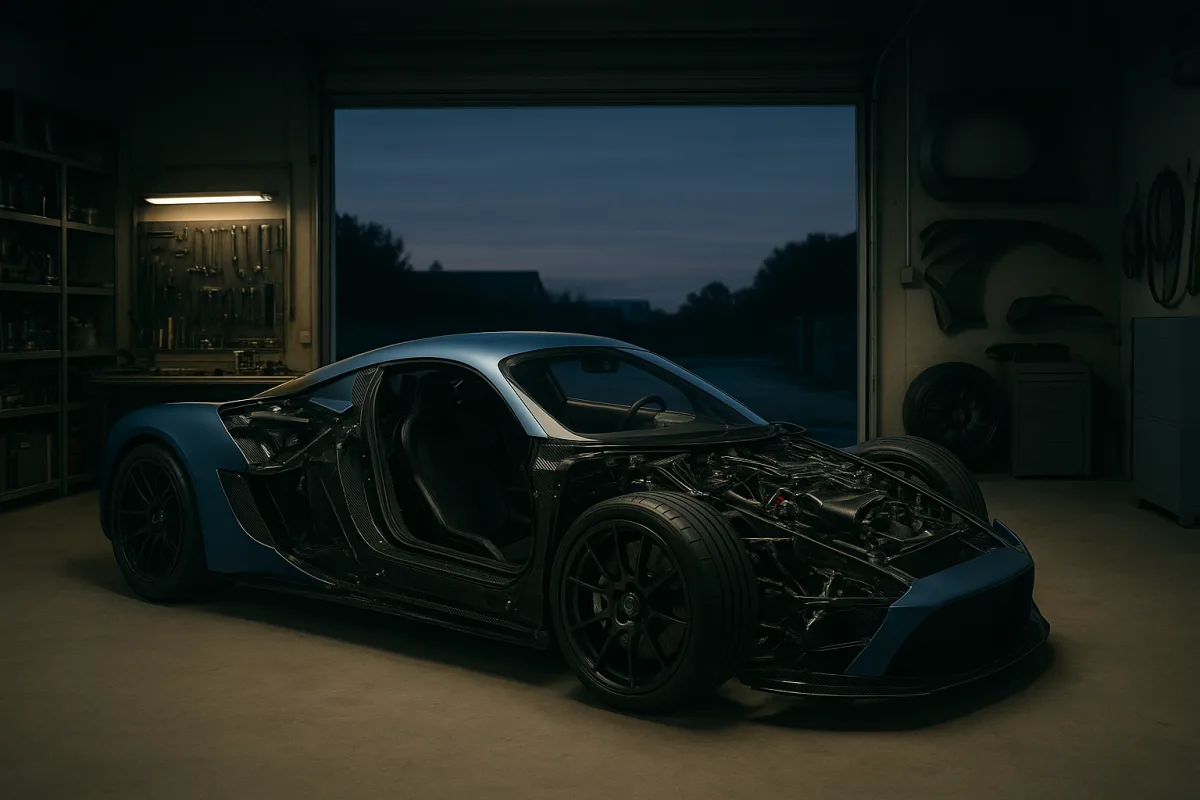
The blue McLaren 750S’s original carbon body panels came off, and a red CLK GTR-shaped shell went on. That is the clearest dividing line among these machines: one keeps a factory supercar underneath, one uses a small roadster as a rolling exhibit, and one is a limited-production exotic built around its own identity.
The S Klub LA McLaren is the one we would pick, assuming the conversion’s insurance, registration, and paperwork are all in order. It has the least compromised layout, the most usable modern hardware, and an underlying car that its builders had already driven extensively before putting it on the lift.
Rob Dahm’s Miata is the opposite approach. The car carries a huge 12-rotor engine over its nose, yet the actual propulsion comes from a 654 cc single-rotor engine with a Garrett GBC22 turbocharger, rated at 155 horsepower and 136 lb-ft on a dyno by Motor1.
The Spyker C8 Preliator sits between them. It is rare enough to be effectively unique on the road, but it still has a twin-turbo V8, a manual transmission, doors, glass, lighting, and a cabin designed as a finished car rather than a display platform.
| Option | Base vehicle or platform | Layout | Output | Size and packaging trade-off | Known price position | Main ownership concern |
|---|---|---|---|---|---|---|
| Rob Dahm 12-rotor Miata | Mazda Miata with one-rotor powertrain | Front-engine roadster, giant 12-rotor display above front end | 155 hp, 136 lb-ft from 654 cc one-rotor engine | 1,300-pound display engine versus 1,950-pound car weight | Build cost undisclosed | Experimental, no real-world multi-rotor durability record |
| S Klub LA McLaren CLK 750S | McLaren 750S | Mid-engine supercar with 3D-printed CLK GTR-style front and rear bodywork | McLaren output not published here | Factory McLaren doors and rear roof area retained for access and function | Builder cites about $400,000; conversion cost undisclosed | Specialty insurance, body repair, custom-panel replacement |
| Spyker C8 Preliator | Factory limited-production Spyker | Twin-turbo V8, manual transmission | 800-plus hp claimed by TheStradman | Low-volume exotic, but designed as a complete production car | Price undisclosed, 25 planned | Parts access, low-volume support, unknown long-term costs |
The Miata: brilliant engineering theater, limited road-car logic
Rob Dahm brought the Miata into the 2026 SEMA Show with an engine assembly so large that it changes what the little roadster is. The car and its engine together were said to weigh 1,950 pounds, while the 12-rotor assembly alone weighs 1,300 pounds.
That leaves very little room for ordinary Miata virtues such as balance, visibility, cooling airflow, luggage space, or easy service access. It is deliberately absurd, and it succeeds because it looks like the sort of impossible sketch a rotary fan would draw in a school notebook.
The important correction is that the 12-rotor does not propel the car. Motor1 reports that it functions as a display piece, while the single-rotor engine beneath it drives the Miata and makes the verified 155 hp and 136 lb-ft figures.
A theoretical 4,500-hp figure has been attached to the 12-rotor, but that is not a road-performance number for this Miata. You would not buy or build around it expecting a 4,500-hp car, because it has no verified contribution to the car’s movement.
The single-rotor arrangement has an appealing point beyond the joke: the engine is half the displacement of Mazda’s familiar 13B. At 654 cc, it makes the Miata a working vehicle, while the huge upper engine gives it the visual payoff of two projects in one.
Serviceability is where we would stop and ask hard questions. There is no documented daily-driving reliability history for a 12-rotor engine of this type, and no usable maintenance schedule, parts catalog, or record of routine repair costs has been published.
You also need to price insurance before building anything similar. TrueMotion Auto says modified cars can bring 20 to 90 percent higher premiums, while standard policies may exclude aftermarket parts unless they are specifically declared and insured. [3]
This is the build for someone with fabrication access, a trailer, space to work, and an acceptance that the car is an ongoing engineering program. It is not the build for someone who wants a fun Miata after work on Friday.
The CLK 750S: the one-off that preserves the useful McLaren bits
S Klub LA’s McLaren CLK 750S began with a scanned Mercedes-Benz CLK GTR body. The builder found that the McLaren 750S had the same wheelbase as the original CLK GTR, then used 3D-printed body sections to blend both designs. [2]
The donor-car choice is better than it first sounds. The 750S is a rear-engine supercar with the wheelbase needed for the GTR proportions, and its factory doors were retained because they are easier to enter and exit through than a recreated CLK GTR solution.
That decision makes the car less pure as a replica but better as something you might actually live with. The McLaren doors, roof section, front camera, parking sensors, and front-lift equipment remain functional, and the builder reports no current fault codes.
The bodywork is not a simple wrap or bolt-on nose. The front clip and rear section are 3D printed, while factory McLaren panels were removed, and some front metal had to be cut for clearance. The rear body section is a large single piece, echoing the original CLK GTR’s construction.
Small details show why this was expensive work. S Klub LA sourced three of the final four new CLK taillights still held by Mercedes in Germany, then found, refinished, and color-matched the fourth used light.
The McLaren’s 765-style four-tip exhaust was adapted to fit, the brake calipers were repainted red, and the car received Rosso Corsa paint over bodywork that was originally planned in white or black. The completed cabin was retrimmed in red and white.
Larry Chen’s feature puts the work at 48 days, which is remarkable, but fast work does not make replacement panels or future repair simpler. A damaged printed fender or rear clamshell could demand scanning, printing, finishing, paint matching, and a shop that understands the integration.
The $400,000 figure quoted by the builders describes their view of the McLaren 750S’s performance value, not a published out-the-door cost for the finished CLK 750S. Wallpaper lists the 750S at roughly £250,000 to £270,000 before custom bodywork, taxes, insurance, registration, and conversion labor. [1]
No conversion price has been published, so treat any finished-value guess with caution. An original CLK GTR is a different financial universe, which is why this car works best as a tribute built to enjoy, not a substitute bought for investment logic.
For registration, a heavily modified car may need to be classified as custom or reconstructed depending on the state, with inspection requirements that vary widely. Dirt Legal notes that extensive chassis and body changes can trigger a different registration path. [7]
The Spyker: the collector’s answer, if you want a finished car
The Spyker C8 Preliator is not a restoration or a home-built special, but it belongs here because it delivers the rare-car experience without asking you to become its development engineer. TheStradman showed the Quail Green car with rose-gold details after its August debut at The Quail.
Spyker plans to build 25 examples. This one carries an 800-plus-hp twin-turbo V8 and a manual transmission, combining current supercar output with exposed shift linkage, aircraft-inspired switches, extensive glass, and a cabin built around mechanical theater.
Its trade-off is not packaging, as with the Miata, or custom-body integration, as with the McLaren. It is support. A low-volume Dutch exotic may have an easier time looking complete on day one, but parts supply, specialist knowledge, and future repair times are unknown.
Price has not been announced in the material, so do not assume it costs less than a custom McLaren simply because it starts as a factory vehicle. The purchase price would also leave out transport, sales tax, insurance, routine service, and the risk of low-volume parts delays.
We would favor the Spyker only if you want the manual gearbox and aviation-style cabin enough to accept that dealer coverage and parts depth will never resemble Porsche, Ferrari, or McLaren ownership. It is a finished statement, but not necessarily an easy one.
What the crashed Ferrari restoration tells you
TheStradman’s Ferrari 812 Superfast restoration is nearly complete, but it is also the reminder to inspect the work behind the paint. At Fix Auto Provo, the doors and front fenders were installed, while the clear coat had been sanded in preparation for a center stripe.
That is normal restoration sequencing, but it shows why a dramatic reveal cannot tell you whether panel gaps, paint thickness, corrosion protection, wiring repairs, cooling-system repairs, or calibration work were done correctly. Those are the details that decide whether a rebuilt exotic survives 60,000 miles.
A 3D-printed repair part was also used on a SEMA build after a carbon-fiber piece detached, then wrapped and installed before the show. That is impressive turnaround capability, but it is not the same as a validated factory replacement part with known aging behavior.
Who each option suits
Rob Dahm’s 12-rotor Miata suits the fabricator and show-car owner. You want people to stop walking, you enjoy solving problems nobody else has encountered, and you accept that its 12-rotor display engine has no daily-use maintenance history.
The S Klub LA McLaren CLK 750S suits the driver who wants a usable one-off. You get a genuine 750S underneath, retained factory convenience features, and CLK GTR visual drama, but you need agreed-value insurance and a body shop capable of repairing custom work.
The Spyker C8 Preliator suits the collector who wants rarity without inventing the car. Its manual gearbox, 800-plus-hp V8, and finished interior make it the least compromised driving proposition, assuming you can accept unknown purchase price and limited support infrastructure.
The restored Ferrari 812 Superfast suits the buyer who values documentation over spectacle. A repaired exotic can be worth owning, but only after you see repair invoices, alignment and calibration records, paintwork details, and proof that the final finish is not hiding rushed structural work.
Frequently Asked Questions
What are some examples of rare unique car builds?
Examples include Rob Dahm’s Miata with a massive 12-rotor engine display atop a single-rotor powertrain, the S Klub LA McLaren CLK 750S which combines a McLaren 750S chassis with 3D-printed CLK GTR-style bodywork, and the Spyker C8 Preliator, a limited-production exotic with a manual transmission and twin-turbo V8. Each represents a different approach to uniqueness, from showpiece engineering to practical supercar usability.
How do custom car builds affect insurance and ownership?
Modified-car insurance can cost 20 to 90 percent more than standard coverage, and insurers may exclude aftermarket or undocumented parts from claims. Specialty insurance providers offer agreed-value policies for such vehicles, but owners must disclose all modifications to avoid coverage issues. Registration and compliance can also be more complex, especially for extensively altered or reconstructed vehicles.
What makes a car build unique or rare?
Uniqueness can come from using uncommon donor vehicles, extensive body modifications like 3D-printed panels, or unusual engineering choices such as a 12-rotor engine display. Limited production numbers, like the 25 planned Spyker C8 Preliators, and retaining factory components while adding custom elements also contribute to rarity and distinctiveness.
What are the challenges of owning a one-off or custom exotic car?
Challenges include higher insurance premiums, difficulty sourcing parts, and uncertain long-term maintenance costs. Experimental builds may lack documented reliability or service schedules, and extensive modifications can complicate registration and legal compliance. Owners often need space, fabrication skills, and acceptance of ongoing maintenance demands.
How do builders create unique supercar conversions?
Builders may start with a compatible donor car chassis and use technologies like 3D printing to produce custom body panels that replicate or reinterpret iconic designs. For example, the McLaren CLK 750S retains factory doors and systems while adding 3D-printed front and rear sections to mimic the CLK GTR shape, balancing aesthetics with usability.
How we researched this
This article was assembled from 3 video sources across 3 channels, 7 cited references.
Nothing here is based on hands-on testing. Where a figure or finding appears, it belongs to the source cited beside it, and the writing says so rather than implying otherwise. Every source is listed below so you can check it.
Sources
My Crashed Ferrari is 98% Done. The Ultimate Transformation., TheStradman
We SNUCK the 12 Rotor into SEMA with the 1 Rotor Miata as an Drivable Engine Stand, Rob Dahm
3D Printed CLK GTR Body On A $400k McLaren 750s, Larry Chen
The McLaren 750S is a truly purist expression of the modern supercar template
S Klub LA Builds McLaren 750S Into CLK GTR Tribute | Wisevoter
Modified Car Insurance: How Modifications Affect Your Rates & Coverage | Penny Pincher
Modified Car Insurance: Coverage & Costs (2026) | Compare.com
Hypermodding Cars: To What Extent Can You Modify and Register?
Watch Rare and Unique Car Builds and Restorations on Youtube
Also from the sources
Related Articles
Rare Exotic Car Ownership Builds: Stories, Costs & Choices
Explore rare exotic car ownership builds, restoration costs, and stories to help decide what to drive, preserve, or modify.

Yiannimize: A Journey Through Automotive Passion and Customization
Yiannimize's car ownership journey, from a Ford Fiesta to custom BMWs and luxury vehicles, showcases his passion for automotive excellence and unique customization style. His evolution in the industry, featuring Range Rovers, smart cars, and collaborations with top brands, highlights his influence as a trendsetter in the automotive world.

Inside the Hartley Estate: Luxury Car Collection Unveiled
Explore the exclusive Hartley estate car collection with Tom Hartley's son, Carl, featuring iconic cars like the SF90, Senna, and Pagani wire. Discover the history behind these luxury vehicles and the legacy of the renowned Hartley brand.

Yiannimize: Tax Controversy, Media Misinformation & Loyalty to Carwow
Yiannimize addresses tax evasion and racial attacks, clarifying his UK tax history and potential move to Dubai or Cyprus. He confronts media misinformation, reaffirms loyalty to Carwow, and emphasizes the importance of fact-checking in the digital age.