
Acura Integra Type S Heritage Edition
Explore the Acura Integra Type S Heritage Edition's unique design, performance specs, and ownership costs in this detailed review.
The $2,300 question
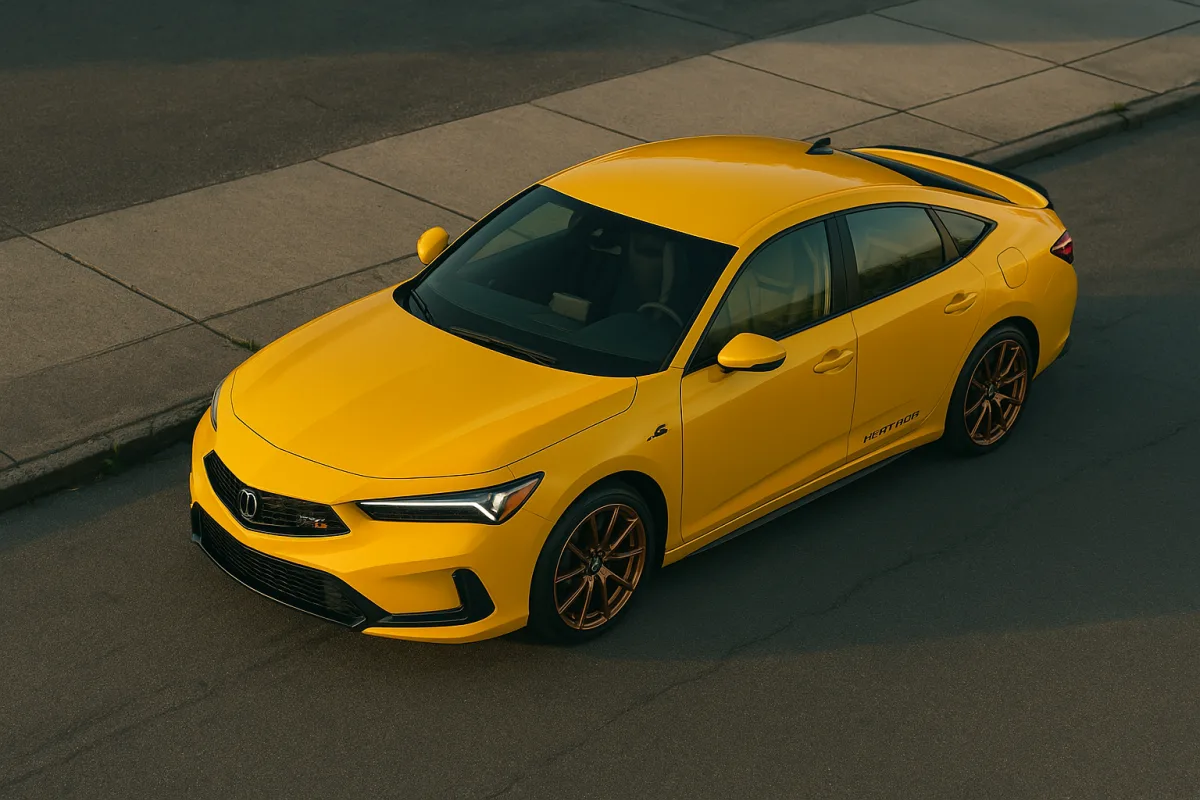
Blazing Phoenix Yellow is the whole point of the 2027 Acura Integra Type S Heritage Edition. It is the color you will notice across a parking lot, and it explains why Acura can ask $58,295 for a car whose regular Type S sibling starts at $55,995. [1]
That $58,295 includes Acura’s $1,395 destination charge and a $455 premium-paint charge. [1] The remaining $1,845, measured against the standard Type S’s published starting price, covers the Heritage Edition’s exclusive visual and cabin pieces.
Acura is building 700 Heritage Editions for the U.S. market. [9] Limited production gives the car a clear story, but the number alone does not make it mechanically different from the standard 2027 Type S.
The important number, then, is not 700. It is $2,300, because that is what you pay for Acura’s idea of Type R heritage, and it defines exactly what this anniversary edition is.
What Acura has put in the package
The Heritage Edition receives Blazing Phoenix Yellow paint, copper-finish 19-inch wheels, black Type S badging, and a titanium shift knob. [3] Its cabin is limited to the black upholstery treatment with yellow detailing also offered on other 2027 Type S models. [9]
Those details are carefully chosen. Yellow paint recalls the late DC2 Integra Type R, while the titanium knob borrows a tactile Type R cue that matters every time you select a gear.
The copper wheels are the least literal part of the tribute. Acura has not presented them as a historical DC2 feature, so view them as a current design decision, intended to make the yellow bodywork look special.
A titanium knob will feel different from a leather-wrapped or aluminum piece because titanium is a dense metal with a distinct cool surface temperature. It does not change shift linkage precision, gear ratios, or clutch action.
That is the Heritage Edition in miniature. Acura has concentrated the anniversary treatment in the things you see and touch, while leaving the engine, differential, suspension specification, and braking hardware where they were.
The car underneath remains a Type S
Every 2027 Integra Type S uses a turbocharged 2.0-liter four-cylinder rated at 320 horsepower and 310 lb-ft of torque. [3] Power reaches the front tires through a six-speed manual transmission and a limited-slip differential. [3]
There is no automatic option. There is also no Heritage Edition power increase, shorter final-drive ratio, revised damper calibration, larger brake package, or special tire listed by Acura. [3]
The Type S is closely related to the Honda Civic Type R in its basic mechanical layout, though Acura gives its version its own damper tuning and exhaust character. CarScoops reports that the Civic carries five fewer horsepower, while both use front-wheel drive, manuals, and limited-slip differentials.
Car and Driver quotes a 5.1-second 0-60 mph time for the Integra Type S. [9] Acura’s published performance material and MotorTrend instead place the Heritage Edition at about 5.5 seconds, a gap that reflects differing test conditions and methods. [3] [4]
For your money, neither number changes the central reality. The yellow Heritage Edition will accelerate, brake, turn, and consume tires like a regular Type S, because it is mechanically a regular Type S.
Why the Type R connection is real, but limited
The DC2 Integra Type R sold in America from 1997 through 2001, carrying a naturally aspirated 1.8-liter four-cylinder, 195 horsepower, 130 lb-ft of torque, five-speed manual transmission, and front-wheel drive. [1]
The modern car has 125 more horsepower and 180 more lb-ft of torque, plus two additional doors and substantially different expectations for safety, comfort, and equipment. Its approximate 5.5-second 0-60 mph estimate compares with about 6.8 seconds for the DC2. [1] [4]
The original Type R’s appeal came from its focused lightness, high-revving engine, close-ratio manual gearbox, and stripped-back performance character. The new Type S honors that spirit most credibly through its manual transmission, front-drive layout, limited-slip differential, and driver-centered controls.
It does not replicate the original shape or mission. The current Integra is a five-door liftback, and the DC2 Type R was a compact two-door coupe, which is why yellow paint and a shift knob carry much of the visual heritage work.
Phoenix Yellow itself arrived late in the DC2’s American run, for 2000. CarScoops correctly points out the awkward detail: Acura’s 30-year anniversary language reaches back to the Type R’s broader history, not to a color available three decades ago.
Blazing Phoenix Yellow is also not an exact revival. Acura calls it a more vibrant, modern interpretation of Phoenix Yellow, and Car and Driver notes that it makes this the first yellow Integra since the 2001 Type R. [9]
The 2027 updates you get without the Heritage price
The standard 2027 Type S also receives gloss-black 19-inch wheels, gloss-black mirror caps, and yellow Brembo brake calipers. [9] Those changes make the Heritage Edition less isolated than its price premium might initially suggest.
Inside, Acura adds dark gray trim around the doors, handles, shift boot, dashboard, and instrument-panel area, including a new diamond pattern. The climate-control knobs become gloss black, while the upholstery choices receive new contrasting accents. [9]
Ebony upholstery gains yellow stitching on the steering wheel, door panels, and shift boot. [9] That means the Heritage Edition’s black-and-yellow interior atmosphere is shared, even if its titanium knob remains exclusive.
Driver-seat memory, memory brake hold, and reverse-linked mirror tilt are also standard 2027 additions. [9] They will matter more at 60,000 miles than a copper wheel finish, particularly if the car is shared or spends time in tight parking garages.
None of those additions alters the car’s basic ownership proposition. The Type S remains a manual, front-drive sport compact with 19-inch tires and a powerful turbo engine, so consumables and fuel will cost more than they would in a regular Integra.
The ownership math behind the anniversary treatment
There is no five-year ownership estimate specifically for the 2027 Heritage Edition. The closest published guide is the 2026 Integra Type S, and Edmunds estimates its five-year cost to own at $74,600. [2]
That total includes $22,716 in depreciation, $6,548 in taxes and fees, $12,087 in financing, $18,516 in fuel, $8,135 in insurance, $5,393 in maintenance, and $1,205 in repairs. [2]
Kelley Blue Book reaches a slightly higher five-year estimate of $76,002 for the 2026 Type S. Its calculation assigns $30,334 to depreciation and $45,668 to out-of-pocket costs. [1]
Those figures are estimates, not a Heritage Edition forecast. The yellow paint, limited production, and special wheels could help resale, but no established depreciation record exists for this specific edition or for the Type S as a distinct long-term market segment.
Regular Integras provide only a loose comparison. iSeeCars estimates 41.6 percent depreciation over five years, while CarEdge projects 43 percent and CARFAX forecasts 46 percent for the non-Type S model. [5] [6] [7]
A 700-car special edition can command a premium later, or it can become expensive only when something unique needs replacing. Copper-finish wheels and exclusive paint are especially worth protecting from curb damage, collision repair variation, and careless touch-up work.
What we would buy
The regular 2027 Integra Type S is the value choice because it supplies the 320-hp turbo engine, manual gearbox, limited-slip differential, Brembo brakes, 2027 convenience upgrades, and same fundamental road manners for $2,300 less. [3] [9]
We would spend the extra $2,300 on the Heritage Edition only if Blazing Phoenix Yellow is the color you have wanted since the DC2 Type R era. A limited-production badge is too uncertain a reason to spend it.
That is not a criticism of the tribute. Acura has made the package honest: it does not pretend a paint-and-trim edition is a new Type R, and it has not used the anniversary to inflate performance claims.
The Heritage Edition is a modern Type S wearing its history on the outside and at your right hand. If those details make you glance back after parking it, they may be worth the money, but buy them for that feeling.
Frequently Asked Questions
What makes the Acura Integra Type S Heritage Edition unique?
The Heritage Edition is distinguished primarily by its exclusive Blazing Phoenix Yellow paint, copper-finish 19-inch wheels, black Type S badging, and a titanium shift knob. These visual and tactile elements pay tribute to the original Integra Type R and set it apart from the standard model without altering mechanical components.
How does the Heritage Edition differ from the standard Integra Type S?
The Heritage Edition adds unique exterior and interior design features but shares the same engine, suspension, brakes, and drivetrain as the standard Integra Type S. There are no power increases, chassis upgrades, or special tires included with the Heritage Edition.
What are the performance specs of the Acura Integra Type S Heritage Edition?
The Heritage Edition uses a turbocharged 2.0-liter four-cylinder engine producing 320 horsepower and 310 lb-ft of torque. It comes with a six-speed manual transmission, limited-slip differential, front-wheel drive, and accelerates from 0-60 mph in about 5.5 seconds according to Acura’s published figures.
What is the cost to own the Acura Integra Type S Heritage Edition?
Ownership costs for the Heritage Edition are expected to be similar to the 2026 Integra Type S, with Edmunds estimating about $74,600 over five years before considering any potential resale value advantage. This estimate includes depreciation, taxes, fuel, insurance, maintenance, and repairs.
Does the Heritage Edition offer mechanical upgrades over the standard model?
No, the Heritage Edition does not include any mechanical upgrades. It retains the same engine, brakes, suspension, and drivetrain hardware as the regular Integra Type S, focusing its enhancements solely on appearance and interior details.
How we researched this
This article was assembled from 3 published articles, 9 cited references.
Nothing here is based on hands-on testing. Where a figure or finding appears, it belongs to the source cited beside it, and the writing says so rather than implying otherwise. Every source is listed below so you can check it.
Sources
Rimac Is Reportedly Ending Nevera Production After Selling Just 71 Cars, Car and Driver
Blazing Phoenix Yellow Adorns 2027 Acura Integra Type S Heritage Edition, CarScoops
2027 Acura Integra Type S Turns Back the Clock with New Retro Theme, Car and Driver
Acura Debuts 2027 Integra Type S Heritage Edition - Kelley Blue Book
2027 Acura Integra Type S Updated; New Heritage Edition Pays Tribute to Iconic Integra Type R
2027 Acura Integra Type S Heritage Edition First Look: An Homage to a Legend
2026 Acura Integra Prices in the US, Median $38,744 | VinAssessment
Related Articles
Classic Car Ownership and Restoration
Explore classic car ownership and restoration with insights on the 1966 Pontiac GTO, Acura Integra 40, and Jaguar D-Type restorations.
2027 Mid-Size Family SUV Comparison
Compare 2027 mid-size family SUVs like the Kia Telluride and Volkswagen Atlas on performance, space, fuel economy, and features to find your best fit.
2027 Electric and Hybrid SUVs: Trends, Costs, and Ownership
Explore 2027 electric and hybrid SUV trends, ownership costs, and maintenance insights to help you choose the right SUV for your needs.
2027 BMW X5 Review: Performance, Ownership & Impressions
In-depth 2027 BMW X5 review covering performance, ownership costs, maintenance, and driving impressions of the new X5 and iX5 models.