
Rare Exotic Car Ownership Builds: Stories, Costs & Choices
Explore rare exotic car ownership builds, restoration costs, and stories to help decide what to drive, preserve, or modify.
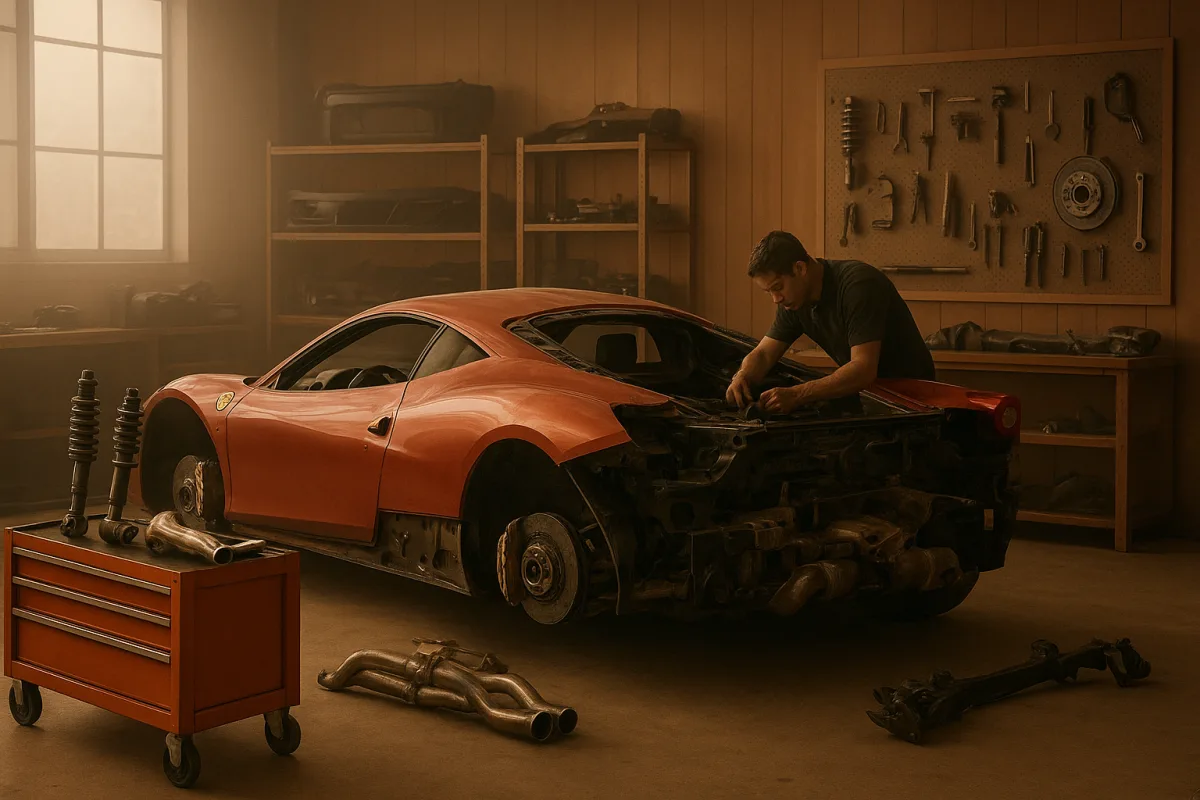
Rare and Exotic Car Ownership Stories and Builds: What Is Worth Building, Preserving or Simply Driving?
The quick list
- Best overall driver’s exotic: Ferrari 458 Italia, for the owner who wants a naturally aspirated Ferrari to use regularly and modify carefully.
- Best value V12: Ferrari 599 GTB Fiorano, for a buyer who accepts age-related cosmetic and import risks in return for an Enzo-related V12.
- Best usable performance car: 2018 Mercedes-AMG GT R, for someone wanting modern pace, luggage space and winter usability rather than future-classic purity.
- Best preservation-led restoration: Porsche 964, for the owner prepared to spend properly on documented, sympathetic OEM-plus work.
- Best no-cutting show build: Lamborghini Temerario widebody, for a new-car owner who wants visual impact without permanently altering original bodywork.
- Best wrap-led hypercar build: Lamborghini Revuelto, for an owner who wants a reversible visual transformation but can manage hybrid-car battery care.
- Best for a radical custom identity: carbon Aventador SVR build, for the enthusiast who values an established heavily modified build over originality.
The real decision in exotic ownership is rarely whether one car is faster than another. It is whether you want to preserve an asset, improve a driver, finish a restoration, or create a show car that will never again be valued like a standard example.
That distinction matters more than the badge. DailyDrivenExotics’ Ferrari projects revolve around cars that can still be driven hard, while Adam LZ’s Porsche 964 work is preservation-minded. TheStradman’s Lamborghini projects are deliberately more theatrical, built around SEMA deadlines, custom bodywork and wraps.
I have not driven or owned any of these cars. The comparisons here rest on the ownership details shared by their builders and on current market and restoration research, rather than launch-event impressions or manufacturer claims.
Comparison table
| Option | Price mentioned or current market evidence | Layout and practical character | Build approach | Main trade-off |
|---|---|---|---|---|
| Ferrari 599 GTB Fiorano | US recent sales roughly $125,000 to $250,000, median about $226,000 [[1]](https://driveshifty.com/cars/ferrari/599/sold?utm_source=openai "Ferrari 599 Sold Prices & Auction Results | Shifty") | Front-mid V12 grand tourer, two seats, large coupe footprint | Buy carefully, preserve condition, consider modest reversible upgrades |
| Ferrari 458 Italia | A rejected rough example was offered at $250,000, with its buyer estimating around $50,000 of issues | Mid-engine V8 coupe, more compact and approachable than the 599 | OEM-plus suspension, front lift, spacers and exhaust | Clean examples command a premium and modifications can hurt collector appeal |
| 2018 Mercedes-AMG GT R | C$163,000 paid by DailyDrivenExotics | Front-mid twin-turbo V8 coupe, hatchback cargo area | Lowering and power modifications planned | Track image, firm ride and depreciation rather than rarity |
| Porsche 964 | Full driver-quality interior restoration parts $1,800 to $5,000, installation $5,000 to $12,000 [5] | Rear-engine 911, compact exterior, classic cabin | Interior refresh retaining period-correct feel | Hidden mechanical and rust issues can outweigh upholstery costs |
| Lamborghini Temerario widebody | Price not stated by TheStradman | Mid-engine hybrid supercar | Full-replacement carbon widebody, no cutting | New-car parts, wrapping logistics and a very narrow resale audience |
| Lamborghini Revuelto | Price not stated by TheStradman | V12 hybrid flagship, 4,800 lb quoted by its owner | Satin chrome coloured PPF and soft kit | Battery-management sensitivity and complex hybrid systems |
| Carbon Aventador SVR build | Price not stated by TheStradman | Older V12 Lamborghini platform, heavily modified | Established carbon-focused SEMA display build | Originality has already been traded for visual drama |
The Ferrari choice: V12 theatre or V8 usability?
The Ferrari 599 GTB Fiorano is the strongest value proposition if the aim is an old-school naturally aspirated V12 rather than a museum piece. DailyDrivenExotics frames it as the accessible route to the Enzo-related 6.0-litre V12 experience, with a quoted 600 horsepower for the 2009 car examined.
That does not mean every 599 is a bargain. The channel’s inspection of a 2009 example found non-original parking-sensor finishing, a missing rubber trim strip, damage to a plexiglass lamp cover and leather wear behind the driver’s seat. Those are not necessarily deal-breakers, but they are reminders that cheap-looking defects on a Ferrari can become difficult parts searches.
The market also needs separating from the hype. A regular 599 is not a 599 GTO, and neither is a 599 SA Aperta. The ordinary model’s US median sale price is around $226,000, whereas recent sales range from roughly $125,000 to $250,000.
[1] A 2011 599 SA Aperta selling for $4.95 million is an extreme rarity-led outlier, not evidence that every 599 is heading there. [1]
For a Canadian buyer, the 599 can be easier to import than it is for an American buyer. Canada permits importation once a vehicle is more than 15 years old, calculated from its manufacture month and year. The United States generally requires 25 years for the federal safety exemption. That difference can materially affect supply, provenance and valuation.
DailyDrivenExotics also makes a worthwhile point about North American-market cars. A European or Japanese-market car imported into Canada may be legal, but it is not automatically valued like a Canadian or US-delivery equivalent. Documentation, VIN history, service records and specification matter when you later sell.
The Ferrari 458 Italia is the better answer if you want to drive rather than speculate. DailyDrivenExotics bought a clean black car with tan interior after rejecting another 458 at a $250,000 asking price. The channel says the rejected car could have needed about $50,000 spent on faults, which is exactly why the cheapest advertised car can be the most expensive ownership proposition.
The planned 458 build is sensibly restrained: custom suspension, a front-lift system, spacers on the original wheels and a custom exhaust. That is a more defensible route than cutting bodywork or fitting irreversible parts. Keep the factory parts, photograph every installation and avoid modifications that prevent normal servicing.
The 458’s appeal is not that it beats a new hybrid Ferrari on a spec sheet. It is the mid-mounted naturally aspirated V8, the dual-clutch gearbox and a relatively compact shape that remains usable. It is also easier to make personal without turning it into a permanent project car.
The AMG GT R: the rational fast car, relatively speaking
DailyDrivenExotics bought a 2018 Mercedes-AMG GT R for C$163,000 and calls it a value alternative to more expensive Porsche GT cars. At that figure, it is the least romantic car in this group, but arguably the one most likely to be used frequently.
It has the practical advantages exotic owners normally pretend do not matter. The GT R has a hatchback rear opening, usable cargo space, a front-engine layout and a proper dual-clutch transmission. The channel also fitted winter tyres immediately, which is more revealing than any drag-race footage.
Its Nürburgring reputation needs context. The GT R set a 7:10.9 lap in December 2016, then a rear-wheel-drive production-car record. [6] That remains serious pace, but newer machinery has moved on substantially: the AMG GT Black Series ran 6:48.047, while the Porsche 911 GT2 RS MR recorded 6:43.300. [6]
That does not make the GT R slow. It means buyers should not pay a premium because they think they are acquiring the current benchmark. The attraction is instead a comparatively modern, rear-wheel-drive twin-turbo V8 car with rear-wheel steering, adjustable traction control and a factory titanium exhaust.
The first ownership warning arrived immediately in the DailyDrivenExotics example, with a “reduce oil level” warning following purchase and an out-of-province inspection required before registration. A 20,000 km car can still need administrative work, tyre changes and fault investigation before it becomes a carefree daily driver.
Canadian financing adds another layer. Specialty lenders commonly require 10 to 30 percent down, usually favour buyers with credit scores above 700, and may require agreed-value collector insurance. [2] Lenders also care about income stability and debt-to-income ratios, generally preferring the latter below roughly 40 to 45 percent. [3][4]
The Porsche 964: build the cabin, inspect the car
Adam LZ’s Porsche 964 is the opposite of a SEMA-style transformation. The work centres on a mint-condition Japanese-market car whose original interior was good enough to preserve, while selected worn panels, seats and trim were upgraded to create a period-plausible OEM-plus cabin.
The key restraint is that the interior was not stripped indiscriminately. The existing dashboard lower section, headliner and pillars were retained because they remained in good condition. New upholstery and Rennline-style door panels changed the atmosphere without pretending the car was a factory RS model.
That is the right philosophy for a usable 964. A full driver-quality interior restoration typically runs $1,800 to $5,000 in parts and $5,000 to $12,000 in installation, while show-quality work starts around $15,000. [5] Correct-leather retrims can also cost £4,500 to £9,500. [5]
Do not spend all the budget on visible trim. The 964’s M64 engine is well supported, but common ownership concerns include oil leaks, distributor-belt failure risk, chain-tensioner and idler wear, dual-mass flywheel expense, cracked heads on higher-mileage cars and degraded suspension bushes. [5]
Blocked sunroof drains matter too, because even galvanised 964 shells can rust when water remains trapped. A sympathetic interior restoration makes the most sense after a proper pre-purchase inspection, not before it. Restoration timelines can reach 10 to 16 months for driver-grade work and 20 to 36 months for show-standard projects. [5]
The Lamborghini builds: replacement panels versus irreversible cuts
TheStradman’s Lamborghini Temerario project is the most sensible of the three SEMA-focused builds on ownership grounds. The ZACkO Performance widebody is described as a full-replacement carbon-fibre kit, meaning the original body panels are removed rather than cut.
That does not make it cheap or low-risk. It means the car can theoretically return to stock if the original panels are retained, undamaged and properly stored. For a brand-new supercar, that is far more sensible than the irreversible cutting required for older widebody conversions.
The Lamborghini Revuelto build takes the less mechanical route. It uses a ZACkO Performance soft kit and a satin chrome coloured paint-protection film, rather than conventional vinyl. TheStradman says the film protects the original Viola Pasifae paint while delivering the desired silver finish.
The Revuelto also illustrates the ownership oddities of modern hybrid exotics. Leaving doors, windows and luggage compartments open while wrapping the car drained the 12-volt battery. The builder needed a jump pack after the factory trickle charger could not provide enough immediate charge.
That is not a reason to avoid the Revuelto. It is a reason to understand that the 4,800 lb V12 hybrid is not simply an Aventador with extra power. It has multiple electrical systems, battery-management requirements and more ways for a cosmetic project to become an operational problem.
The carbon Aventador SVR build is the most uncompromising option. TheStradman describes the Aventador as effectively complete while the newer cars are still being wrapped and assembled. It suits someone who wants a finished, highly individual display car and accepts that originality is no longer the point.
Who each option suits
The Ferrari 599 GTB Fiorano suits the patient V12 buyer who can inspect paintwork, interior trim, service records and import history as seriously as mechanical condition. It is for driving and maintaining, not assuming every example will become a seven-figure collectible.
The Ferrari 458 Italia suits the enthusiast seeking the most balanced ownership proposition here. It offers a naturally aspirated Ferrari experience with enough modernity to use, provided the starting car is clean and modifications remain reversible.
The 2018 Mercedes-AMG GT R suits the owner who wants to put mileage on an exotic. It is not the latest lap-record car, but it combines serious performance with hatchback practicality, winter-tyre compatibility and a lower entry price than many collectible Ferraris.
The Porsche 964 suits the detail-oriented restorer. Buy one with documented mechanical history, investigate drains and rust before re-trimming anything, and preserve good original pieces. The best 964 build is rarely the loudest one.
The Lamborghini Temerario widebody suits a new-car owner who wants SEMA presence without sacrificing the possibility of returning to stock. Store the removed factory panels, and treat fitting, wrapping and transport as specialist work rather than casual modifications.
The Lamborghini Revuelto suits an owner comfortable with modern hybrid complexity and careful battery management. Its coloured PPF transformation is comparatively reversible, but even a wrap can immobilise the car if its support battery is neglected.
The carbon Aventador SVR build suits the buyer who wants a statement car already committed to a custom direction. It is the least suitable choice for a purity-focused collector, but potentially the most appropriate for someone who values a distinctive build over factory specification.
Frequently Asked Questions
What are the best rare exotic cars to build or preserve?
The Ferrari 599 GTB Fiorano is recommended for buyers seeking a V12 experience and is best preserved with modest reversible upgrades. The Porsche 964 is ideal for preservation-led restoration with sympathetic OEM-plus interior work. Lamborghini show cars like the Temerario and Revuelto suits owners comfortable with rapid deadlines and specialist modifications rather than preservation.
How much does it cost to restore a Porsche 964 interior?
Restoring a Porsche 964 interior to driver-quality standards typically costs between $6,800 and $17,000, including parts and installation. A proper show-standard interior restoration starts around $15,000 before considering broader mechanical work.
What are the trade-offs in modifying a Ferrari 458 Italia?
Modifying a Ferrari 458 Italia with OEM-plus suspension, front lift, spacers, and exhaust can improve usability, but clean, unmodified examples command a premium. Modifications risk reducing the car’s collector appeal, so reversible and careful changes are advised.
Which rare exotic cars are best for driving versus collecting?
The Ferrari 458 Italia is best suited for owners who want a naturally aspirated Ferrari to drive regularly and modify carefully. The Porsche 964 is better for owners focused on preservation and restoration. The Ferrari 599 GTB Fiorano offers a V12 experience but is more suited to preservation than daily driving.
What are the challenges of owning and building Lamborghini show cars?
Lamborghini show cars like the Temerario widebody and Revuelto involve challenges such as managing rapid build deadlines, specialist wrapping, expensive replacement panels, and complex hybrid battery care. These builds are not ideal for buyers seeking protected collector assets due to their theatrical and heavily modified nature.
How we researched this
This article was assembled from 5 video sources across 3 channels, 6 cited references.
Nothing here is based on hands-on testing. Where a figure or finding appears, it belongs to the source cited beside it, and the writing says so rather than implying otherwise. Every source is listed below so you can check it.
Sources
Damon Bought ANOTHER Ferrari!!!? — DailyDrivenExotics
I BOUGHT A NEW FERRARI! — DailyDrivenExotics
My Dream Supercar Arrived…BROKEN :( — DailyDrivenExotics
My Mint Porsche 964 Gets a Complete Interior Transformation — Adam LZ
My SEMA Build Full Reveal that No One has Seen. — TheStradman
How to Finance an Exotic Car: Lenders, Rates & Strategies for 2026 | Automonitor
What lenders actually look at when you apply for a car loan, DealerLends | DealerLends
Watch Rare and Exotic Car Ownership Stories and Builds on Youtube
Also from the sources
Related Articles
Rare Exotic Car Ownership: Stories, Costs, and Restorations
Explore rare exotic car ownership stories, restoration costs, and maintenance insights for models like Ferrari, Porsche, and Toyota Supra.
Classic Car Restoration Stories
Explore classic car restoration stories focusing on usability, maintenance, and ownership challenges for vintage vehicles.
Exotic Car Restoration Stories and Ownership Insights
Explore exotic car restoration stories, ownership challenges, and costs for high-performance rebuild projects like Ferrari and Lamborghini.

Exotic Car Ownership Experience: Challenges and Insights
Explore the exotic car ownership experience, including maintenance, modifications, insurance, and financing for high-performance vehicles.