
GM AI and EV Technology Advancements Explained
Explore GM's AI and EV technology advancements, including faster vehicle development and new battery innovations for future electric cars.
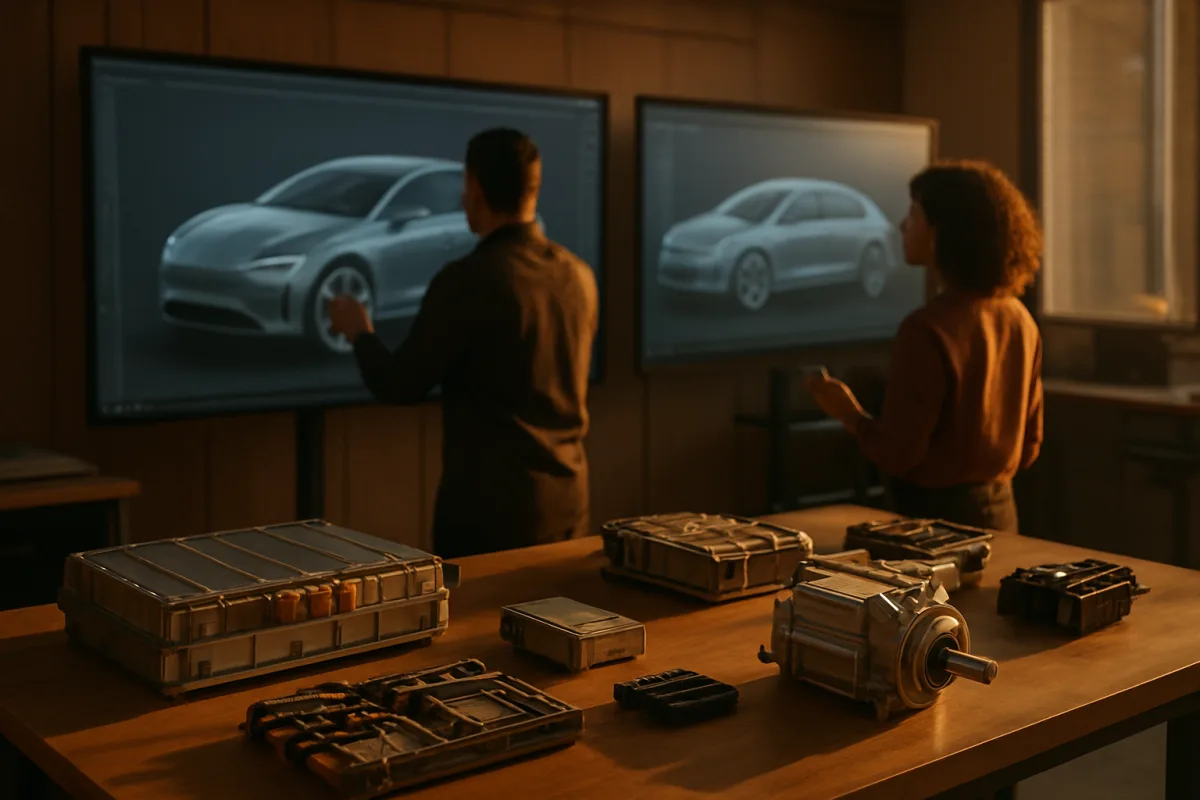
GM’s AI Future Is Really About One Thing: Making Prediction Cheap
The important number is two years
The headline from General Motors’ technology presentation is easy to repeat: a new vehicle could go from concept to production in about two years, rather than the traditional four- to five-year cycle. [1] The useful question is what GM has actually shortened.
It has not found a way to skip validation, durability work, crash requirements, supplier tooling, or factory launch problems. Cars still need to survive potholes, hot weather, cold starts, towing, corrosion, and the general abuse of owners who do not read manuals.
What GM is trying to remove is waiting. In a conventional development programme, styling proposes a shape, engineers test it, manufacturing finds a production problem, then the work loops backward. Each department hands a near-finished answer to the next.
That serial arrangement made sense when computing power was scarce and prototypes were comparatively cheap. It is expensive now, especially with EVs, where the battery pack, thermal system, electrical architecture, software, motors, and crash structure are tied tightly together.
GM’s new model is concurrent engineering. Designers, aerodynamicists, structural engineers, battery specialists, calibration teams, suppliers, and manufacturing engineers work against shared virtual models rather than waiting for an approved physical mule to arrive.
Artificial intelligence matters here because it makes a prediction much faster. It is not magic, and it is not a replacement for the engineer who must decide whether the prediction is plausible. It is a way to rank options before expensive testing begins.
From a 60-hour simulation to a 60-second answer
Road & Track reported that GM’s traditional computational-fluid-dynamics analysis can take more than 60 hours to run. GM’s internally developed machine-learning tool, called “themed aero,” is said to deliver a closely comparable answer in roughly 60 seconds.
That is the heart of the two-year target. A conventional CFD calculation divides the air around a vehicle into an enormous number of small zones, then calculates pressure, velocity, turbulence, and heat flow repeatedly until it reaches a solution.
It is accurate enough to guide real engineering, but slow. If a designer changes the rear roofline, mirror shape, wheel opening, grille shutter strategy, or underbody panel, the team may effectively get one serious aerodynamic answer per day.
A machine-learning model works differently. GM trains it on the outcomes from old CFD runs, wind-tunnel data, vehicle geometry, and presumably its own accumulated engineering data. It learns the relationship between a proposed shape and likely aerodynamic result.
The output is an estimate, not a new law of physics. Its value is that a team can try hundreds or thousands of shape variations quickly, discard the weak ones, then spend full CFD and wind-tunnel time on the finalists.
That distinction matters. Anyone who has owned a vehicle through several software campaigns knows that a promising computer model is not the same as a finished product. Road noise, crosswind stability, cooling performance, range, and component durability still meet reality eventually.
GM executive Jason Fischer used the Chevrolet Corvette ZR1 as an example of the tighter loop. After a 231-mph test result, the virtual prediction suggested 233 mph was possible. GM reportedly revised the calibration and reached that target the following day.
That is a compelling demonstration of rapid iteration, but it is not evidence that all development risk disappears. A powertrain calibration is comparatively easy to revise. A battery pack enclosure, front crash rail, or suspension pickup point is not.
Why batteries are the most useful test case
The strongest example is GM’s lithium manganese-rich, or LMR, battery programme. According to reporting on GM’s technology plans, the company virtually assessed more than 300,000 battery designs before building a physical prototype. [1]
GM says that process reduced the route from first concept to formal programme approval to one month, while laboratory work fell to 256 hours from a conventional requirement exceeding 60,000 lab hours. That is an enormous claim, and it needs careful interpretation.
It does not mean a production battery can be invented, validated, industrialised, and guaranteed for eight years in a month. It means the company narrowed down candidate chemistry and cell designs faster, without physically producing every potential formulation.
For an EV owner, the reason this matters is not merely that the vehicle might arrive sooner. Battery choices determine purchase price, usable range, charge curve, winter behaviour, towing range, degradation, collision repair complexity, and eventually residual value.
GM says its fourth-generation EVs will use LMR cells that are lower-cost and 20 percent more compact, while maintaining long-range capability. Car and Driver reported GM’s broader claims that Gen 4 vehicles will be 15 percent lighter, 25 percent more aerodynamic, and use 40 percent fewer parts.
Those are programme-level targets, not specifications for a particular Chevrolet, GMC, Buick, or Cadillac. Until GM publishes battery capacity, warranty terms, charge curves, repair procedures, and replacement-pack pricing, owners should not confuse a promising architecture with proven ownership economics.
GM’s present EV range at least shows why cost pressure matters. AutoEdgeView lists the 2026 Chevrolet Equinox EV 2LT AWD at about $33,600 with a claimed 319-mile EPA range, while the Cadillac Lyriq Luxury AWD is listed at $58,590 with 314 miles. [4]
The Equinox EV suits buyers seeking a lower-priced family crossover, while the Lyriq suits buyers who want a more premium cabin and badge without materially greater claimed range. Both show that battery cost, rather than motor performance, remains the fundamental commercial issue.
AutoEdgeView estimates five-year maintenance at $1,800 for an Equinox EV, versus $3,600 for an equivalent gasoline vehicle. [4] That is plausible because an EV loses oil changes, spark plugs, exhaust work, and conventional transmission servicing, but it is still an estimate.
The missing part of most EV ownership calculations is out-of-warranty electronic and battery-related repair. Fewer mechanical service items do not make a vehicle immune to costly faults. A failed telematics module or unavailable software service can be very inconvenient even when the traction battery is healthy.
OnStar AI uses the same principle, but faces a different test
GM’s OnStar AI assistant is also built around prediction, although it has a far less forgiving job than an aerodynamic model. The planned assistant must infer what an owner means, identify the relevant vehicle system, then act without causing annoyance or distraction.
Motor1 reports that the assistant will debut in the 2027 Cadillac Lyriq, initially through an over-the-air update. GM says it will answer vehicle questions in ordinary language, operate functions such as climate control and lights, and assist with EV charging planning.
The useful ownership example is not asking the system to play music. It is saying, “It’s getting warm in here,” and expecting the car to adjust climate settings appropriately, without opening the wrong menu or requiring a precise command.
That sounds trivial until one considers the chain underneath it. The system must recognise speech over tyre noise, know which occupant is speaking if that matters, interpret intent, check the current climate settings, and send a correct command to the car’s body-control systems.
It must also know when not to act. “Open the charge port” is harmless enough in a driveway, but natural-language control creates edge cases that conventional buttons avoid. The owner needs a clear confirmation, a way to override it, and the confidence that it will not improvise.
The Drive reported that GM plans to consolidate Chevrolet, GMC, Buick, Cadillac, and OnStar apps into one OnStar app during 2027. It is also meant to connect vehicle data with calendars, navigation, road conditions, weather, and family devices, if the owner permits it.
That last phrase is doing substantial work. GM and OnStar agreed to a five-year Federal Trade Commission order in January 2026 that restricts sharing precise location and driving-behaviour data with consumer-reporting agencies, and requires affirmative express consent for collection or sharing.
California’s separate 2026 settlement cost GM $12.75 million in civil penalties over allegations that it collected and sold personal and driving data without proper consent between 2016 and 2024. The point is not to assume the new assistant breaks rules. There is no evidence it does.
The point is that this assistant can be useful only if it has access to information. A system that knows charging status, route, calendar appointments, camera footage, location, and voice requests can be genuinely helpful. It can also accumulate a lot of sensitive data.
The ownership risk is connectivity, not artificial intelligence
GM says its OnStar Connected Cameras feature will preserve footage surrounding an incident, including when a theft alarm triggers. InsideEVs reports that clips can include about 30 seconds before and after an event, with encrypted storage in the new OnStar app.
That could be useful after a parking-lot impact or disputed collision. It does not replace a conventional dashcam for every buyer, however, because the trigger logic, cloud connection, retention policy, available camera angles, and subscription details will determine whether footage actually exists when needed.
There is also a more basic concern. GM investigated telematics problems in 2026 affecting navigation, Google Built-In services, Wi-Fi, app controls, and OnStar functions on various vehicles, including the Cadillac Lyriq and Chevrolet Blazer EV.
Nobody has yet owned the new OnStar AI assistant long enough to establish a reliability pattern. That is important to say plainly. There are no credible 60,000-mile reports, no meaningful failure-rate data, and no established out-of-warranty repair costs for it.
GM does have a considerable data foundation for the next step, particularly autonomous driving. The company says its self-driving software runs more than three billion simulated miles daily, compared with roughly one million real-world miles per month. [2]
Simulation is exactly how GM can expose an autonomous system to unusual conflicts faster than road testing alone allows. But the limiting factor is not the number of simulated miles. It is whether the simulated scenarios faithfully represent wet roads, poor markings, bad drivers, sensor faults, and unpredictable humans.
For buyers, the sensible approach is less dramatic than the presentation. Treat AI functions as optional convenience until they prove dependable, keep basic controls usable without cloud access, review every privacy permission, and do not pay extra for promised capability without clear subscription and support terms.
GM’s achievement is making the early, expensive decisions of car development dramatically faster. If that produces simpler EVs, more mature software, and better battery durability, owners benefit. If it merely moves unfinished decisions from the engineering office to an over-the-air update, they will notice that too.
Frequently Asked Questions
How is GM using AI to speed up vehicle development?
GM uses AI-assisted simulation and concurrent engineering to reduce the vehicle development cycle from four to five years down to about two years. AI enables much faster predictions, allowing engineers to test many more design options virtually before committing to physical prototypes or tooling, thereby removing waiting times between departments.
What are the benefits of GM's AI-assisted EV battery design?
GM’s AI-driven lithium manganese-rich battery program virtually assessed over 300,000 battery designs, reducing the concept-to-approval timeline to about one month and cutting lab testing hours from over 60,000 to 256. This approach helps narrow down promising battery chemistries faster without physically producing every formulation, potentially lowering costs and improving compactness while maintaining range.
When will GM's OnStar AI assistant be available?
The new OnStar AI assistant is scheduled to debut in the 2027 Cadillac Lyriq. As of now, no owner reliability data exists since it has not yet been deployed in consumer vehicles.
How does GM's AI technology impact EV ownership and maintenance?
While AI accelerates development and may improve vehicle features, it does not automatically guarantee lower repair costs or simpler maintenance. Owners should consider privacy permissions, connectivity reliability, and subscription terms carefully, as GM’s future software features depend heavily on these factors in addition to traditional concerns like range and charging speed.
What makes GM's lithium manganese-rich batteries different?
GM’s lithium manganese-rich batteries are designed to be 20 percent more compact and lower cost while maintaining long-range capability. These batteries are part of a broader strategy to create lighter vehicles with fewer parts and better aerodynamics, though detailed ownership costs and repair implications remain to be seen.
How we researched this
This article was assembled from 8 published articles, 5 cited references.
Nothing here is based on hands-on testing. Where a figure or finding appears, it belongs to the source cited beside it, and the writing says so rather than implying otherwise. Every source is listed below so you can check it.
Sources
Here’s How General Motors Plans to Speed Up Vehicle Development Cycles Using AI — Road & Track
Save 20% on Bolt-On Running Boards for GM Trucks and Jeep Wranglers — The Drive
GM Tech Day: Autonomous Driving, More Helpful OnStar, Faster Product Development — Car and Driver
GM Is Turning OnStar Into An AI Assistant For Your Car — Motor1
GM Is Adding Its Own Version Of Tesla's Sentry Mode To Cars — InsideEVs
GM Is Rebooting OnStar as Your Personal AI Assistant—and Killing Off Its Brand Apps — The Drive
2027 Lexus RX Hybrid — Car and Driver
Rivian Was The Second Best-Selling EV Brand In Q3 2026, But Still Far Behind Tesla — InsideEVs
From 'hands-free' to 'eyes-off': how General Motors is simulating its way to autonomous driving
Imagine Every AI Agent on Earth Buying the Same Cheap Paper Towels
GM EV Vehicles in 2026: Range, Pricing, and Ownership Costs Explained | AutoEdgeView
Used EV Prices Are Falling - Here's How They Compare to Gas Cars Now
Related Articles
Subaru EV Platform Independence
Learn how Subaru is developing its own EV platform, gaining independence from Toyota with new tech and a 2029 prototype.
Electric Vehicle Market and Warranty Trends in 2026
Explore 2026 trends in the electric vehicle market, charging infrastructure, and warranty coverage to make informed EV ownership decisions.
Electric Vehicle Range Tests and New EV Developments
Explore electric vehicle range tests, efficiency, and new EV developments to understand real-world performance and ownership factors.
Electric Vehicle Pricing and Ownership Costs Explained
Explore electric vehicle pricing, ownership costs, tax credit impacts, and key maintenance tips to make informed EV buying decisions.