
Electric Vehicle Pricing and Ownership Costs Explained
Explore electric vehicle pricing, ownership costs, tax credit impacts, and key maintenance tips to make informed EV buying decisions.
Electric-car prices are falling, but the transaction price is not the ownership cost
The number everybody quotes, and what it actually means
The useful number in today’s EV market is not range, horsepower or even list price. It is the average transaction price, the amount a buyer actually pays before their own finance interest, insurance and charging costs enter the picture.
Kelley Blue Book data reported by InsideEVs put the average U.S. new-EV transaction price at $54,813 in August, against $50,089 for the average new vehicle overall. That is a 9.4 percent gap, down from 16 percent a year earlier. [2]
At first glance, that looks like near-parity. It is progress, certainly, but it is not the same as saying the typical electric car costs only nine percent more than an equivalent petrol vehicle parked beside it.
An average transaction price blends expensive electric pickups and luxury SUVs with cheaper models, fleet registrations, lease support and dealer cash. It tells us where money changed hands across the market, not what a particular family will pay.
That distinction matters because EVs are now being sold with more discounting than combustion cars. InsideEVs reported EV incentives equivalent to 12 percent of the average transaction price, compared with 6.5 percent across the wider new-car market. [2]
A buyer sees the sticker price, then a dealer discount, then perhaps a manufacturer incentive, then a finance rate. The industry records a transaction price somewhere in that stack. Those are related figures, but they are not interchangeable.
It is the same mistake people made with diesel PCP deals a decade ago. A low monthly payment looked like affordability, until the balloon payment, excess-mileage bill, tyre wear and weak trade-in value arrived at the end.
Why EV prices can fall after a tax credit disappears
The U.S. federal new-EV tax credit, worth up to $7,500, ended on September 30, 2025. The $4,000 used-EV credit ended at the same time. [2] It was reasonable to expect showroom prices to jump.
Instead, the research brief notes that Cars.com found average new-EV prices fell by more than 12 percent after the credit ended. [2] That sounds backwards only if tax credits are mistaken for the whole market.
The credit had pulled demand forward. Buyers who could qualify had a reason to buy before the deadline, and manufacturers had a reason to build cars that met the credit’s rules. Once the deadline passed, the urgency vanished.
Dealers were then left with inventory, manufacturers still had factories to keep moving, and EV competition had increased. A discount is often cheaper for a manufacturer than an idle plant, especially when battery supply contracts still have to be honoured.
That is why transaction price is more revealing than MSRP. The refreshed Chevrolet Bolt starts at $28,995 including destination, the Toyota bZ starts at $36,575, and the entry Hyundai Ioniq 5 is listed at $36,900. [2]
Those are starting prices, not a universal promise of an out-the-door bill. Sales tax, registration, destination charges where excluded, dealer fees, finance interest, insurance and optional equipment can change the final number substantially.
State support also remains uneven. Colorado, for example, offers up to $3,500 in EV credit during 2026, but that support is due to reduce to $750 in 2027, while an annual $60.05 EV registration fee also applies.
The buyer’s job is therefore not to ask whether EVs are at price parity. It is to compare a specific car, in a specific state, with a specific finance quote and a realistic estimate of resale value.
The used market is doing much of the work
The sharpest EV price reductions are often not on a new-car forecourt. They appear once a one- or two-year-old leased EV returns, especially where the original lease was heavily subsidised.
Car and Driver gives a particularly clear example: a new 2026 Honda Prologue Touring with front-wheel drive lists at $45,795, while lightly used 2024 and 2025 Touring examples with under 10,000 miles can be found below $30,000.
That gap is not free money. It is the first owner, often a leasing company, absorbing a severe early depreciation hit. The research brief estimates roughly 56 percent depreciation over two years for a 2024 Honda Prologue.
For a used buyer, that can be excellent news. A 2024 Prologue’s estimated resale value is around $22,600, with trade-in value nearer $18,850, while a Touring version is estimated around $25,400 retail and $21,500 trade-in.
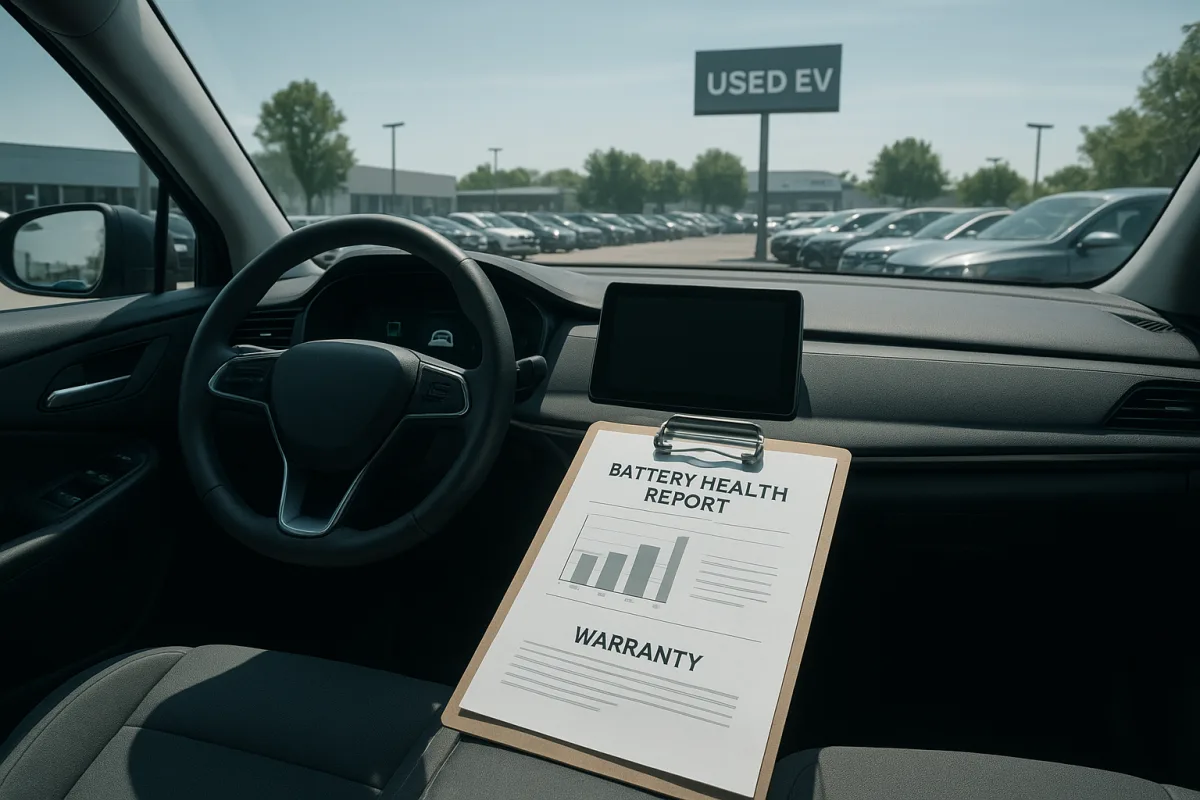
But the cheap used EV needs a different inspection routine from a cheap used petrol car. There is no oil condition to inspect and no timing belt service to budget for, but battery condition and charge behaviour are central.
Car and Driver recommends asking for a battery-health report. Auction wholesaler Manheim, for example, provides battery degradation assessments for some EVs, and a dealer that bought through such a channel may already have the report.
The federal battery warranty baseline is eight years or 100,000 miles. That is useful protection, but it is not a substitute for knowing whether the battery has lost meaningful capacity before you buy the car.
A battery-health report also needs interpretation. A small reduction from new capacity is normal. The important question is whether the remaining range suits the owner’s real journeys, particularly in winter and after several more years of use.
Battery coolant: the unglamorous technology behind the warranty
The battery pack is not simply a large box of cells. In most modern EVs, it is a temperature-managed system containing cells, cooling plates or channels, pumps, valves, sensors, electronics and coolant.
Lithium-ion cells work best in a controlled temperature range. Too cold, and charging is slow or restricted. Too hot, and performance, charging speed, cell life and safety margins can all suffer.
The cooling system moves heat away from the pack during hard driving and rapid charging. Depending on the car, it may also share components with the cabin air-conditioning system or use a separate refrigerant circuit and heat exchanger.
That is why battery coolant is not comparable with engine oil. It is not being deliberately contaminated by combustion deposits, fuel dilution and soot. In a sealed system, it can remain serviceable for many years.
The interval varies by manufacturer. Tesla Model 3 and Model Y vehicles generally have no fixed coolant replacement interval, while the Chevrolet Bolt EV is commonly listed around 150,000 miles and Hyundai and Kia EVs around 80,000 miles.
Mercedes-Benz EVs are commonly listed around 124,000 miles. The point is not to memorise those numbers, but to stop believing there is an industry-wide “EV service schedule.” There is not.
Coolant itself may cost only $25 to $60 per gallon, but the service bill cannot be predicted from fluid price alone. Labour, access, bleeding procedures, diagnostic checks and model-specific equipment matter more than the bottle.
At 60,000 miles, most EV owners are far more likely to be buying tyres, wiper blades, cabin filters and brake-fluid work than battery coolant. Regenerative braking reduces pad wear, but heavy EV weight can be hard on tyres.
Insurance is the less-discussed running-cost issue. The research brief finds EV premiums can run from 10 percent to nearly 49 percent higher than comparable combustion vehicles, partly because collision repairs can be expensive and specialist-led.
Cheap EVs show why list price is not enough
The carwow range test of small European EVs is useful because it exposes the gap between the city-car sales pitch and the occasional long trip everybody eventually makes.
The Microlino tested by carwow cost £23,000 and had a claimed 140-mile range. It is a quadricycle rather than a conventional passenger car, with different safety requirements, modest performance and no air conditioning in the tested version.
That makes it suitable for short urban trips where its compact footprint and distinctive front-opening door matter more than motorway ability. It is difficult to justify as a cheap all-round car once its price approaches conventional EV territory.
The Honda Super N in the same carwow test was quoted at £19,000, with a claimed 128-mile range. It suits an owner who needs a genuinely small car but still wants airbags, ABS, stability control and usable cabin flexibility.
The pre-facelift Dacia Spring in carwow’s test was quoted at £17,000 in higher-range form, although used examples were said to be around £10,000. It suits price-led local use, but the test noted sparse equipment and limited rear-seat room.
Carwow also included the BYD Dolphin Surf, Citroën e-C3, Fiat Grande Panda, Hyundai Inster and Leapmotor T03. The supplied test material does not state prices for those individual cars, so it would be dishonest to invent a comparison figure.
The same caution applies to range. The independent research brief puts typical summer real-world range around 100 to 120 miles for a Microlino and 120 to 130 miles for a Dacia Spring, but stresses that no authoritative controlled 2026 test exists.
A Fiat 500 Electric is estimated at roughly 150 to 160 real-world summer miles, and a Renault Twingo Electric around 130 to 140 miles, again from user reports and reviews rather than a single standardised test.
That is the ownership lesson beneath the market statistics. A cheap EV becomes expensive when it cannot cover a regular journey without inconvenient charging, or when its low purchase price is offset by costly insurance and finance.
Where the extra EV volume may come from
Private retail demand is not the only thing keeping EV factories busy. Hyundai told InsideEVs it plans to make tens of thousands of Ioniq 5 robotaxis for Waymo at its Georgia plant.
Waymo’s fleet currently totals around 4,000 vehicles across 14 U.S. cities, according to InsideEVs. Hyundai is expected to deliver the first Ioniq 5 robotaxis intended for service, rather than testing alone, in the fourth quarter.
This matters because fleet demand can support production volume even when private buyers are cautious. Rivian has agreed to supply up to 50,000 R2 crossovers to Uber, while Lucid has deals involving autonomous vehicles for Uber, Nuro and Bolt.
A robotaxi operator buys very differently from a household. It cares about uptime, repairability, sensor integration, charging logistics, software support and depreciation over huge mileages, not whether the rear seat feels plush on a Sunday drive.
That could help spread fixed battery and factory costs across more vehicles. It does not automatically make a private EV cheaper, but it may make manufacturers less dependent on chasing retail buyers with ever-larger cash incentives.
For the ordinary buyer, though, the sensible question remains simple: what will this particular EV cost after three years and 30,000 miles? The answer lies in the transaction price, interest rate, insurance quote, charging routine and resale value, not the brochure.
Frequently Asked Questions
What factors affect the true cost of owning an electric vehicle?
The true cost of owning an EV includes more than the transaction price; buyers must consider finance interest, insurance, charging costs, and depreciation. Insurance premiums for EVs tend to be 10% to nearly 49% higher than for comparable gasoline cars due to expensive repairs. Maintenance costs are generally lower, but potential battery replacement and long-interval battery coolant maintenance add to ownership expenses. State incentives, registration fees, and resale value also influence the overall cost.
How do electric vehicle transaction prices differ from sticker prices?
Transaction prices reflect the actual amount paid after dealer discounts, manufacturer incentives, trade-ins, and tax changes, while sticker prices are the manufacturer's suggested retail price (MSRP). EVs often have more discounting than combustion cars, with incentives averaging about 12% of the transaction price. Buyers may see a lower transaction price than the sticker price, but additional costs like sales tax, registration, dealer fees, and optional equipment can increase the final amount.
Why did EV prices fall after the federal tax credit ended?
After the federal $7,500 new-EV tax credit ended on September 30, 2025, average new EV prices fell by more than 12%. This happened because the credit had pulled demand forward, creating urgency to buy before the deadline. Once the credit expired, dealers were left with inventory and manufacturers needed to keep factories running, leading to substantial discounts to move vehicles. Increased competition and the cost of idle plants also encouraged price reductions.
What should buyers check when purchasing a used electric vehicle?
Buyers should check the battery health, remaining warranty, charging access, and insurance costs before buying a used EV. Lightly used EVs can be significantly cheaper than new ones, especially off-lease vehicles, but early depreciation and potential battery issues affect value. Understanding these factors helps avoid surprises beyond the lower sticker price.
How often do electric vehicles need battery coolant maintenance?
Battery coolant maintenance intervals vary widely by model, ranging from about 80,000 miles (Hyundai/Kia EVs) to 150,000 miles (Chevrolet Bolt EV). Some EVs, like Tesla Model 3/Y, have sealed systems with no fixed coolant replacement interval, performing service as needed. Toyota/Lexus hybrids change coolant first at 100,000–120,000 miles, then every 50,000 miles. Costs and intervals depend entirely on the manufacturer and model.
How we researched this
This article was assembled from 1 video source, 8 published articles, 5 cited references.
Nothing here is based on hands-on testing. Where a figure or finding appears, it belongs to the source cited beside it, and the writing says so rather than implying otherwise. Every source is listed below so you can check it.
Sources
What to Know Before Buying a Discount Low-Mile Used EV — Car and Driver
Never Stop Driving #200: Commerce, Live — Hagerty
McLaren to retire Artura, GTS and 750S in next two years — Autocar
Hyundai's Answer For The EV Slowdown: Building Thousands Of Robotaxis — InsideEVs
At $8,900, Could You Muster Some Interest In This 1978 Ford Mustang II? — Jalopnik
This Porsche Tuner’s Singer Rival Was 17 Years In The Making — CarScoops
‘The Trend Is Clear’: How EVs Are Closing In On Gas Car Prices — InsideEVs
1987 Buick GNX For Sale With 30 Miles Is As Close As It Gets To Buying One New — Jalopnik
Used EV Prices Are Falling - Here's How They Compare to Gas Cars Now
New EVs Have Gotten Cheaper Since the Federal Electric Vehicle Tax Credit Ended | Cars.com
Trends in electric cars – Global EV Outlook 2026 – Analysis - IEA
Electric Vehicle Tariffs & Demand Impact: 2025-2026 Buyer's Guide | AutoEdgeView
Watch Electric Vehicle Market and Technology Updates on Youtube
Related Articles
Electric and Hybrid SUV Comparison
Compare electric and hybrid SUVs with a detailed look at Tesla Model Y and Toyota RAV4 PHEV performance, ownership, maintenance, and driving experience.
Used Luxury and Sports Cars Reliability and Ownership Guide
Explore reliability, ownership experiences, and costs of used luxury and sports cars under $40K to make informed buying decisions.

Rare Exotic Car Ownership: Stories, Costs, and Restorations
Explore rare exotic car ownership stories, restoration costs, and maintenance insights for models like Ferrari, Porsche, and Toyota Supra.
Bentley Torcal Electric SUV Ownership and Maintenance
Explore Bentley Torcal electric SUV ownership, maintenance, and driving experience insights for the 2028 model.