
Car Maintenance and Repair Insights for Smart Ownership
Get practical car maintenance and repair insights including fuel economy, windshield care, and air-cooled VW belt tips for better ownership.
Start with the ownership calculation, not the window sticker
The first maintenance decision happens before you own the car. It is choosing an engine, body style and powertrain that you can afford to fuel and repair after the finance payment stops feeling new.
Fuel-economy rules matter here, although not in the simplistic way that political announcements suggest. The federal Corporate Average Fuel Economy system regulates manufacturers’ fleet averages, not the real-world mpg printed on one particular vehicle’s window sticker.
Regular Car Reviews explains that the current rollback changes the regulatory environment around CAFE compliance, while also tightening the definition of a light truck. From the 2030 model year, a three-row crossover with a fold-flat floor should no longer qualify automatically for easier truck treatment.
That distinction matters because many family crossovers have spent years being regulated as light trucks despite doing the work of passenger cars. Under the revised approach, a vehicle needs to meet work-capability or stricter off-road criteria to receive that classification.
The 2026 federal position remains legally unsettled. A California-led coalition of 26 states is challenging the rollback, and specific revised CAFE targets for 2026 have not been publicly pinned down, so do not buy a car on the assumption that today’s policy will remain unchanged.
The clearer long-term figure is the administration’s stated 2031 target: a fleetwide average of 34.9 mpg, down from the earlier 50.4-mpg target. The Department of Transportation projects average vehicle prices could fall by about $1,300 by 2031. [1]
That is a projection, not money already returned to buyers. The Washington Post reports that analysts doubt the whole saving will reach consumers, particularly when tariffs, rising material costs and fuel prices can move in the opposite direction. [1]
For an owner, the practical response is dull but useful. Compare the actual EPA figures of the cars you are considering, then calculate annual fuel spend using your own mileage, local fuel price and likely ownership period.
Do not assume looser rules make a thirsty vehicle cheap to run, and do not assume tighter rules guarantee that a hybrid will be expensive or troublesome. Hybrids, EVs and gasoline models each have different purchase costs, repair patterns and resale risks.
The policy change may encourage manufacturers to give gasoline-powered models more attention and reduce the urgency around EV programmes. That could affect choice and pricing, but it is still an evolving production decision rather than a settled outcome. [1]
When the air-cooled VW belt starts squealing
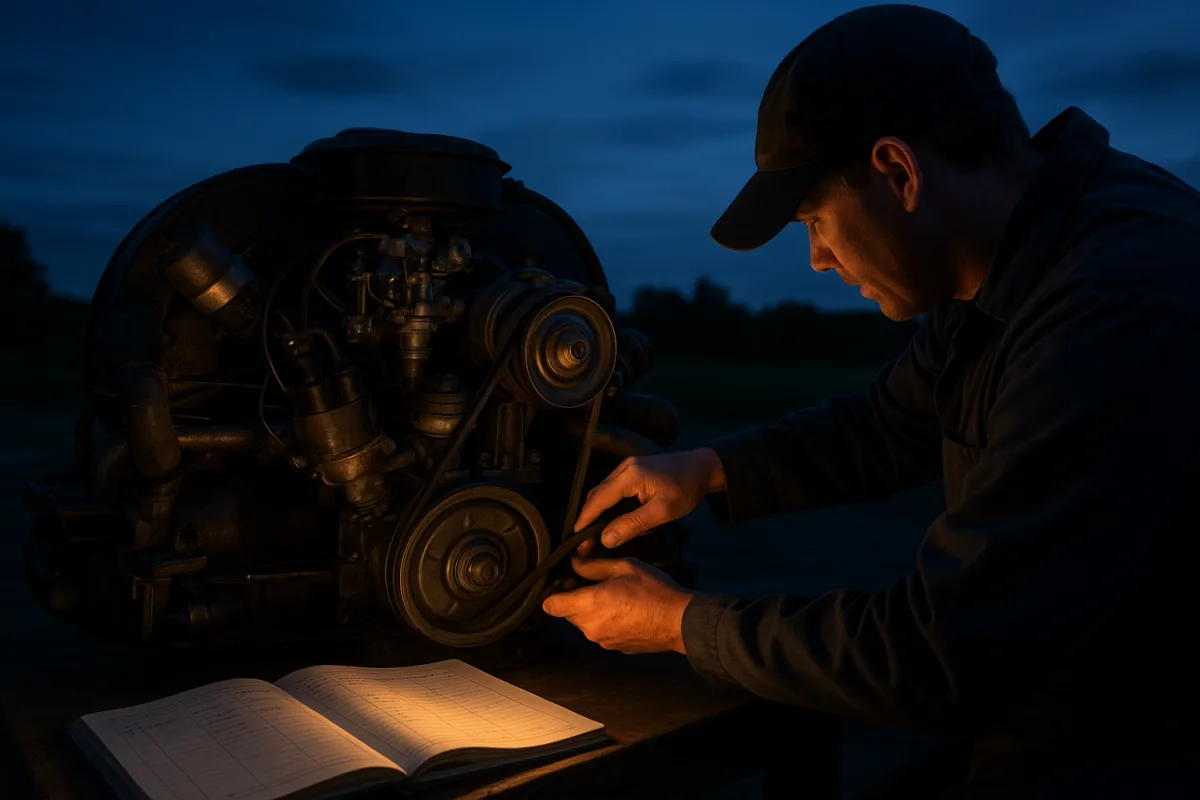
The fan belt on an air-cooled Volkswagen is not just an accessory-drive belt in the modern sense. On the familiar air-cooled flat-four found in Beetles, Type 3s and related models, it drives the cooling fan through the generator or alternator pulley.
That makes a thrown or slipping belt more urgent than one on a car whose belt only drives air conditioning. Stop and investigate before continuing. An overheating air-cooled engine can become an expensive engine very quickly.
Jalopnik recently described the notorious “five-second” replacement method: with the engine idling, a large flat screwdriver is used to walk the old belt off and feed a new one onto the spinning pulleys. It looks clever right up to the point it does not work.
Do not do it. The screwdriver can be thrown toward your hands, face or engine bay, can jam in a pulley, and can damage bearings or pulley surfaces. The new belt itself can also be cut or shredded during the attempted shortcut.
The engine-off method remains simple enough that there is no worthwhile reward for the risk. Carry the correct belt, basic hand tools and a flashlight in an older VW, then do the job on level ground with the ignition off.
Once fitted, set belt tension rather than simply admiring that it stayed on. Jalopnik’s guidance is roughly an inch of play and no more than 90 degrees of belt twist. A loose belt can jump off, while excessive tension loads generator or alternator bearings.
If you are unsure how the shims and pulley arrangement affect belt tension on your particular Volkswagen, pause there. The air-cooled VW setup is basic, but “basic” is not the same as consequence-free when that belt also runs the cooling system.
Record the belt replacement in your maintenance log, including brand, part number and mileage. That sounds fussy until a belt begins slipping early and you need to distinguish poor adjustment from an incorrect part or an underlying pulley problem.
When a stone chip appears in the windscreen
A windscreen chip is one of those jobs where waiting changes the answer. A small mark can often be repaired, but vibration, temperature swings and water entering the damage can turn a manageable chip into a replacement-screen problem.
Start by looking at size and location. Jalopnik advises replacement rather than repair if damage is longer than six inches, reaches the edge of the windscreen, crosses multiple laminated layers, or interferes with the driver’s sightline.
Current repair guidance is broadly consistent with that threshold. Professional repairs for chips and cracks under six inches typically cost $60 to $150, while a conventional windscreen replacement commonly runs $200 to $600. [2][3]
The bill changes substantially on newer cars with cameras and sensors behind the glass. Replacement on an ADAS-equipped vehicle can run from $600 to more than $1,500 once sensor recalibration is included. [2][3]
That is why an apparently minor chip deserves attention before it spreads. A $60 repair is not merely cheaper than a full replacement, it may also avoid recalibration work and the risk of getting a poorly installed replacement screen.
DIY resin kits typically cost $10 to $20, but use them only for tiny, uncomplicated damage. Current guidance limits their sensible use to cracks up to around 1.25 inches, away from the edge and outside the driver’s direct view. [2][3]
Ignore social-media fixes involving super glue. Jalopnik notes that proper kits use resin because ordinary adhesive does not provide a durable windscreen repair. A cloudy, badly filled chip also remains a distraction even if the glass does not immediately crack further.
Before paying cash, call your insurer and ask specifically about glass coverage. Comprehensive cover often waives the deductible for a repairable chip, while collision cover generally involves its deductible and liability-only policies normally provide no glass cover. [2][3]
State rules can alter the answer. Some states require zero-deductible windscreen replacement under qualifying policies, so confirm your policy and location rather than relying on a friend’s claim experience from another state. [3]
Avoid an automatic car wash until the glass has been assessed. Jalopnik points out that pressure jets and rapid hot-cold water changes can worsen an existing crack, exactly the kind of false economy that turns a repair into replacement.
When receipts begin disappearing into the glovebox
A usable service record is not a stack of receipts. It is a timeline that lets you answer what was done, when it was done, at what mileage, with which parts, and whether the work is still under warranty.
For every job, retain or create a record containing the date, VIN, odometer reading, work performed, parts and fluids used, labour cost, parts cost and total paid. Jalopnik highlights a Kia warranty dispute where records existed but lacked VIN and mileage details.
That detail is not bureaucracy for its own sake. If a warranty claim turns contentious, the difference between “oil changed regularly” and a dated, mileage-stamped invoice can be the difference between an argument and evidence.
Keep diagnostic paperwork too, even when it led nowhere or you had the repair done elsewhere. A later technician can work faster if they can see previous fault codes, tests performed, recommended repairs and parts already replaced.
Save zero-dollar paperwork with the paid invoices. Recall work, warranty repairs, goodwill repairs and complimentary servicing all form part of the car’s history, and they may explain why a component was replaced earlier than the normal schedule suggests.
Also keep estimates for work you declined. This is not about advertising skipped maintenance to a future buyer. It is about making the next decision with a clear reminder that the advisory on brakes, tyres or suspension was not imaginary.
Jalopnik recommends keeping invoices and maintenance records together, then maintaining a simple running log in chronological order. Compare that log with the manufacturer’s maintenance schedule, not with a generic internet interval for a vaguely similar engine.
For a home-serviced car, make your own invoice immediately after the job. Include oil viscosity and quantity, filter brand and part number, spark-plug specification, belt part number, coolant type, torque-critical work and the odometer reading.
Paper remains useful because workshops still issue physical invoices, but scan every important document. Use a clearly named folder structure, such as year, mileage and job description, then keep a copy in cloud storage and another independent backup.
Do not make an automaker’s companion app your only archive. Consumer Affairs reports that infotainment and connectivity account for about 25 percent of new-vehicle problems, while J.D. Power data cited there records 56.7 infotainment issues per 100 vehicles. [5]
Companion-app problems include outages, slow responses and login failures after updates. Another 2026 review notes response times of 10 to more than 30 seconds, and interrupted Android apps can lose saved state information. [6]
There is also a privacy reason to keep your own plain files. Consumer Reports found that nearly all automakers share vehicle and personal data with third parties, including major technology companies, while about one-quarter of vehicle apps send personally identifiable information to advertising and analytics firms. [7]
The sensible setup is therefore a paper folder for originals, a spreadsheet or notebook for the chronological log, and independently stored scans for backup. It is less glamorous than an app, but it still works when the app changes, fails or disappears.
Frequently Asked Questions
How does fuel economy regulation affect car maintenance costs?
Fuel economy regulations influence the types of vehicles manufacturers produce, which can affect maintenance patterns. The recent federal rollback lowers the fleetwide mpg target, potentially encouraging more gasoline-powered models that may have different repair needs than hybrids or EVs. However, the actual impact on maintenance costs depends on the vehicle chosen and is not directly tied to the regulation itself.
What is the safest way to replace a fan belt on an air-cooled Volkswagen?
The safest method is to replace the fan belt with the engine turned off, on level ground, using the correct belt and basic hand tools. The common shortcut of changing the belt while the engine is running is risky and can cause injury, damage to the belt, pulleys, or bearings. Proper belt tension should be set after installation, with about an inch of play and no more than 90 degrees of twist.
When should a windshield chip be repaired versus replaced?
Small windshield chips should be repaired promptly to prevent spreading, especially if they are far from the edges and under six inches in length. Replacement is recommended if there is edge damage, cracks in the driver’s line of sight, or cracks approaching six inches. DIY repair kits are only suitable for very small chips.
Why is keeping a detailed car service log important?
A detailed service log helps track maintenance history, including dates, mileage, parts, labor, costs, and warranty details. Storing scanned records independently is advisable because manufacturer apps and digital systems can be unreliable, with frequent connectivity and data loss issues. This ensures you have a complete archive regardless of app failures.
How we researched this
This article was assembled from 1 video source, 3 published articles, 7 cited references.
Nothing here is based on hands-on testing. Where a figure or finding appears, it belongs to the source cited beside it, and the writing says so rather than implying otherwise. Every source is listed below so you can check it.
Sources
Oh Cool, They’re Gutting Fuel Economy Standards (The Roman Report) — Regular Car Reviews
The 5-Second Belt Change On Air-Cooled 4-Cylinder VWs Is Both Impressive And Terrifying — Jalopnik
DIY Vs Professional Windshield Crack Repair: What To Know About Your Options — Jalopnik
How To Keep Service Records The Right Way (And 4 Things You're Probably Forgetting) — Jalopnik
Trump says new fuel economy rules will cut car prices. Analysts are doubtful. - The Washington Post
Windshield Crack Repair: What Can Be Fixed vs. What Needs Replacement | ShieldFinder
Watch Car Maintenance and Repair Insights on Youtube
Related Articles
Rising Car Repair Costs: Why Ownership Is Becoming Pricier
Explore why rising car repair costs are increasing ownership expenses and how technology and labor affect your maintenance budget.
2027 Mid-Size Family SUV Comparison
Compare 2027 mid-size family SUVs like the Kia Telluride and Volkswagen Atlas on performance, space, fuel economy, and features to find your best fit.
Automotive Legal and Regulatory Issues Affecting Ownership
Explore key automotive legal and regulatory issues, recalls, lawsuits, and maintenance rules impacting vehicle ownership and buyer decisions.
Electric Vehicle Pricing and Ownership Costs Explained
Explore electric vehicle pricing, ownership costs, tax credit impacts, and key maintenance tips to make informed EV buying decisions.