
Hybrid Large SUVs: GM’s Plans and What Buyers Should Know
Explore GM’s hybrid large SUVs plans, costs, and ownership insights for 2027. Learn what buyers need to know before choosing a hybrid large SUV.
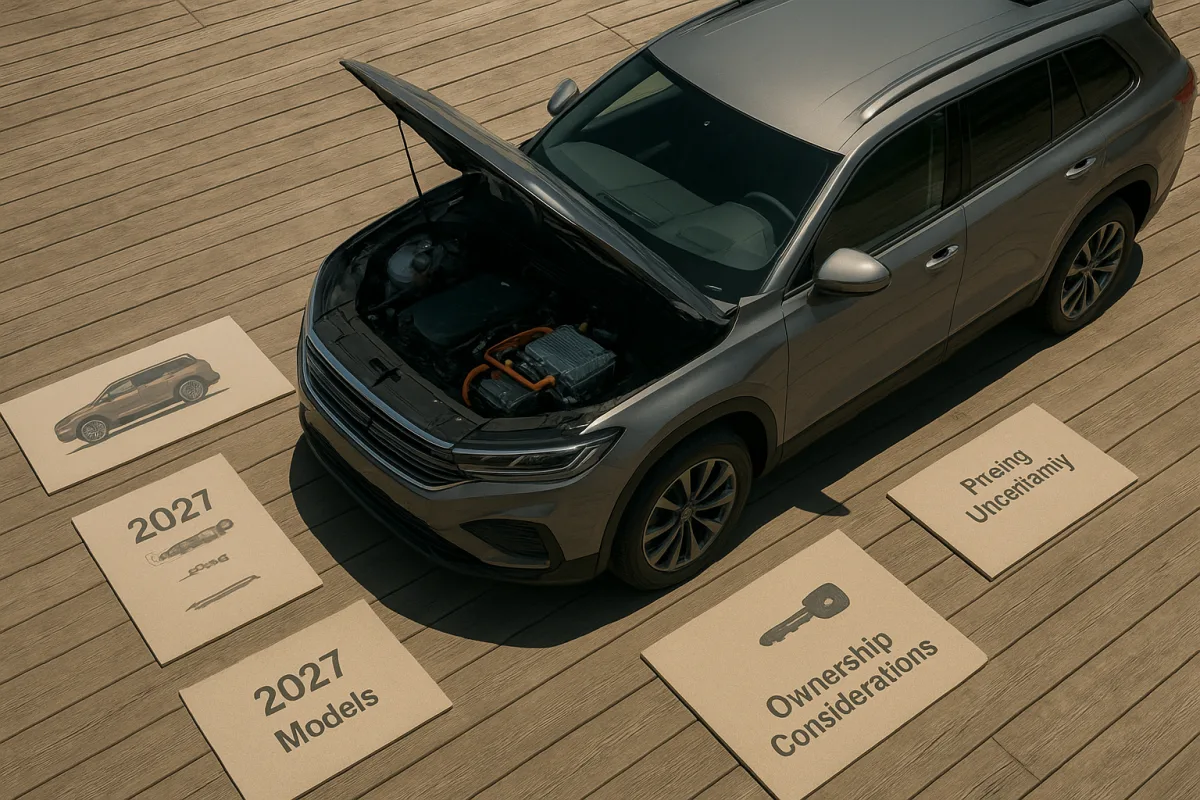
Hybrid Large SUVs Are Coming, but the Details Still Matter More Than the Announcement
GM is moving toward hybrids, but has not yet put a finished product on the lot
General Motors is preparing to put hybrid powertrains into its big mainstream crossovers. That is a meaningful shift for a company whose current hybrid offering is effectively limited to the Chevrolet Corvette E-Ray, a low-volume performance car rather than a family tow vehicle.
Car and Driver reports that GM is retooling its Lansing Delta Township plant for future hybrid production, with the Chevrolet Traverse, Buick Enclave and GMC Acadia identified by Reuters sources as likely recipients. Reuters has separately characterised the move as GM responding to a US hybrid market it largely sat out. [4]
Motor1 and InsideEVs have also reported that the Traverse, Enclave and Acadia are due for electrification, while GM’s plant investment is public. The important distinction is that the reporting points to an industrial plan, not a published model-year specification sheet.
That may sound pedantic, but it is the difference between a useful purchase plan and an expensive assumption. Carmakers routinely announce investment, capacity or technology direction well before the exact engine, battery, transmission, trim structure and launch timing are settled.
As of October 2026, there are no official hybrid powertrain outputs, battery capacities, EPA economy figures, towing ratings or pricing for a 2027 Chevrolet Traverse, Buick Enclave or GMC Acadia. Published 2027 specifications still concern petrol versions, so do not assume a hybrid is available merely because it appears in news coverage.
GM’s reported Lansing spending is substantial. Car and Driver puts the investment at $1.25 billion for the plant, within more than $2 billion planned in the Lansing area, while Motor1’s shorter report puts $750 million toward electrifying the three SUVs. Those figures are not necessarily directly comparable, because they may describe different portions of a wider programme.
The common point is stronger than the precise dollar total: GM is allocating real factory money to a family of high-volume three-row crossovers. Lansing produced more than 291,000 vehicles in its strongest year, according to Car and Driver, so this is not an experimental halo-car exercise.
Why this is happening now
The practical case for a hybrid large SUV is easier to make in 2026 than it was during the industry’s EV-first phase. A three-row crossover is often bought for school runs, road trips, towing, winter use and infrequent long-distance travel, all jobs where public charging availability still affects buying decisions.
A conventional hybrid reduces fuel use without requiring the owner to charge. That matters to households that cannot charge at home, tow regularly, or simply do not want every family journey to begin with a charging calculation.
GM also needs a bridge product. Reuters reported that its heavy EV investment left it exposed as hybrids gained US market share, while competitors such as Toyota, Honda, Hyundai and Ford had more established petrol-electric options. [4]
The policy picture has changed as well. The federal credit for new clean vehicles, including plug-in hybrids, expired for purchases after September 30, 2025. A buyer considering a hybrid Traverse-class vehicle in 2026 or 2027 should not build a payment calculation around federal money that no longer exists. [4]
Some state programmes remain, but they generally focus on battery-electric and fuel-cell vehicles rather than ordinary hybrids. Colorado, for example, has offered a credit for qualifying EVs and fuel-cell vehicles, not a broad incentive for petrol-electric hybrids, so eligibility needs checking against the exact vehicle and registration state.
High fuel prices make the sales argument more obvious, but manufacturers also like hybrids because they can work with familiar vehicle architectures. A battery-electric three-row SUV requires a large battery, a different charging proposition and usually a more difficult price conversation.
That does not automatically make a hybrid cheaper to own. It means the technology can meet buyers where they are, especially buyers who want one vehicle to cover commuting, family transport, towing and holiday mileage without changing habits.
Ford belongs in the electrification trend, not yet in this hybrid claim
Ford is part of the wider shift toward electrified utility vehicles, but the evidence supplied here does not show Ford launching a hybrid large SUV or truck alongside GM’s programme. That is worth stating plainly because “electrification” gets used too loosely.
CarScoops reports that Ford’s forthcoming 2028 Ford Fathom will be a fully electric compact pickup with a claimed starting price of $29,945. It is reported to use two large aluminium unicastings replacing 146 conventional structural components, an approach aimed at lowering manufacturing cost.
The Ford Fathom suits a buyer who wants an affordable, five-seat electric pickup and has a workable charging routine. It does not suit the same buyer as a three-row Traverse, Enclave or Acadia, and it does not offer evidence about Ford hybrid service costs or large-SUV hybrid availability.
CarScoops also reports a target 0-60 mph time of about 4.5 seconds, bidirectional charging and passenger room greater than a Toyota RAV4. Those are interesting claims, but battery capacity, range, charging speed and real-world payload effects were still unknown in that report.
The manufacturing lesson is more useful than the acceleration claim. Ford is trying to remove cost from the structure of an EV, while GM is reportedly adding hybrid capability to existing big crossover production. Both are electrification strategies, but they solve different commercial problems.
For a buyer, the distinction is simple. A hybrid is primarily a fuel-use and convenience decision. A battery-electric truck is an energy-source, charging-access and route-planning decision, even if its performance is much stronger than the old petrol truck norm.
What the announced GM vehicles cost today
The 2027 Chevrolet Traverse currently spans from an LT FWD at $42,795 to a High Country AWD at $60,095 in published petrol pricing. It suits the buyer who needs three rows and substantial family space but wants to stay below premium-brand pricing.
The 2027 GMC Acadia petrol range starts with the Elevation FWD at $45,895 and reaches $65,400 for the Denali Ultimate AWD. It suits the same basic practical brief as the Traverse, but with a more premium trim mix and a higher ceiling.
The 2027 Buick Enclave begins at $48,595 for the Preferred FWD and rises to $67,295 for the Avenir AWD. Cars.com lists the Enclave as a three-row crossover, and it suits buyers prioritising a more comfort-oriented cabin over the GMC’s tougher presentation. [1]
None of those prices is hybrid pricing. GM has not announced a hybrid trim walk, a hybrid option cost or even confirmation that each named crossover will be sold as a 2027 hybrid, so any predicted premium would be guesswork.
Nor are these out-the-door costs. Manufacturer pricing excludes sales tax, registration, dealer fees, finance charges, insurance and often accessories. In the real household budget, the monthly payment, tyre replacement and fuel spend usually matter more than a headline starting MSRP.
The Chevrolet Corvette E-Ray remains GM’s only current hybrid, according to Car and Driver, but it is not a useful cost template for a family SUV. Its performance-led hybrid system, price position and buyer use case are fundamentally different from a Traverse-class vehicle.
The 60,000-mile questions GM still needs to answer
For ownership planning, horsepower can wait. The useful questions are whether the hybrid battery receives its own warranty, what the cooling-system service schedule is, whether the e-motor and inverter are separately covered, and how much the replacement parts catalogue costs after warranty.
Regenerative braking should reduce friction-brake wear, particularly on urban family use. That is a real ownership advantage, but it does not eliminate brake servicing, because heavy SUVs still use pads and discs, and corrosion can become a problem when friction brakes are used less often.
Available broad cost data suggests hybrids are not automatically cheaper in every maintenance category. AAA-based estimates cited by Your Auto Options put five-year maintenance and repair costs at $9,510 for hybrids versus $9,145 for comparable petrol vehicles, a $365 difference. [2]
That is a modest gap, not a reason to avoid hybrids outright. It reflects the trade-off: fewer brake consumables and often less engine load, set against additional high-voltage hardware, power electronics, cooling circuits and more complicated diagnostic work.
Model-specific outcomes can differ sharply. Edmunds estimates five-year maintenance and repairs for the 2026 Toyota Highlander Hybrid at $6,874, illustrating why a mature hybrid system with long production experience cannot simply be compared with a future GM design on category averages alone. [3]
Insurance is another line item that needs quoting, not assuming. Industry commentary points to potentially higher premiums for hybrids because higher purchase prices, battery-related repair work and specialised parts can raise claims costs, but insurer, postcode and driver profile still matter more than broad averages. [5]
There is no GM-specific insurance or finance data for the planned large-SUV hybrids because the products are not yet on sale. Anyone telling you exactly what a hybrid Acadia payment or premium will be is filling a gap with confidence rather than evidence.
How to plan a purchase or project around the shift
If your present SUV is still reliable, the sensible move is to watch for GM’s official launch material rather than rushing into a petrol replacement because a hybrid is rumoured. Wait for EPA fuel economy, towing figures, battery warranty and the actual price difference.
If you need a vehicle now, compare the petrol Traverse, Enclave and Acadia on the things that will still matter at 60,000 miles: dealer access, service reputation, tyre size, insurance quotes, fuel requirement, towing need and second-row usability.
For a project vehicle or tow rig, do not assume a hybrid will automatically improve every use case. The key missing number is towing performance under sustained load, including how the system manages battery state of charge and cooling on long grades.
The strategic shift is real because GM is preparing a major factory for hybrids and several outlets report the same crossover family as the target. Ford’s reported Fathom shows a parallel push toward lower-cost electric utility vehicles, but it is not proof of a Ford hybrid large-SUV launch.
That leaves buyers in an unusually familiar position: the manufacturer’s direction is clearer than the product. Until GM publishes the mechanical details, the honest answer is that hybrid large SUVs are coming into the mainstream, but the ownership case has not yet been written.
Frequently Asked Questions
When will GM release hybrid large SUVs?
GM is preparing hybrid powertrains for the Chevrolet Traverse, Buick Enclave, and GMC Acadia, but as of October 2026, no official specifications, pricing, or launch dates have been announced. Hybrid versions are not confirmed as available for the 2027 model year, so buyers should not expect hybrids on lots imminently.
What are the benefits of hybrid powertrains in large SUVs?
Hybrid large SUVs can reduce fuel consumption and brake wear compared to conventional petrol models. They offer improved efficiency without requiring charging infrastructure, which suits buyers who tow regularly or cannot easily charge at home.
How do hybrid large SUVs compare to petrol versions in cost and maintenance?
Hybrids typically have a higher purchase price and may incur slightly higher insurance and long-term repair costs due to more complex systems. While hybrids benefit from regenerative braking that reduces brake wear, maintenance and repair expenses over five years tend to be modestly higher than petrol equivalents.
Are there federal tax credits available for hybrid large SUVs in 2026?
No, federal tax credits for hybrid vehicles expired after September 30, 2025. Most remaining state incentives favor battery-electric or hydrogen vehicles rather than conventional hybrids, so buyers should not rely on federal or broad state credits for hybrid large SUVs.
What should buyers consider before purchasing a hybrid large SUV?
Buyers should wait for official GM announcements on hybrid specifications, pricing, fuel economy, and warranty details before planning a purchase. Given the lack of confirmed hybrid models for 2027 and the absence of federal incentives, it may be more practical to buy an existing petrol SUV now and reassess hybrids once more information is available.
How we researched this
This article was assembled from 4 published articles, 5 cited references.
Nothing here is based on hands-on testing. Where a figure or finding appears, it belongs to the source cited beside it, and the writing says so rather than implying otherwise. Every source is listed below so you can check it.
Sources
Chevy Traverse Will Reportedly Get GM’s New Hybrid Powertrain — Car and Driver
GM Is Finally Bringing Hybrid Power To Three Of Its Largest SUVs — Motor1
GM Didn't Want Hybrids. Now It's Putting Them In Its Biggest SUVs: Report — InsideEVs
Ford's Radical Fathom Electric Uses A Tesla Trick To Turn 146 Parts Into 2 — CarScoops
GM’s EV-first bet leaves it on sidelines of US hybrid boom By Reuters
Why Hybrid Vehicle Owners Pay More in Insurance | My Auto Resource
Related Articles
New Hybrid Off-Road SUVs: 2026-2027 Models and Features
Explore new hybrid off-road SUVs for 2026-2027, including fuel economy, AWD features, and suitability for family and light off-road use.
Electric and Hybrid SUV Comparison
Compare electric and hybrid SUVs with a detailed look at Tesla Model Y and Toyota RAV4 PHEV performance, ownership, maintenance, and driving experience.
2027 Mid-Size Family SUV Comparison
Compare 2027 mid-size family SUVs like the Kia Telluride and Volkswagen Atlas on performance, space, fuel economy, and features to find your best fit.
2027 BMW X5 Review: Performance, Ownership & Impressions
In-depth 2027 BMW X5 review covering performance, ownership costs, maintenance, and driving impressions of the new X5 and iX5 models.