
New Hybrid Off-Road SUVs: 2026-2027 Models and Features
Explore new hybrid off-road SUVs for 2026-2027, including fuel economy, AWD features, and suitability for family and light off-road use.
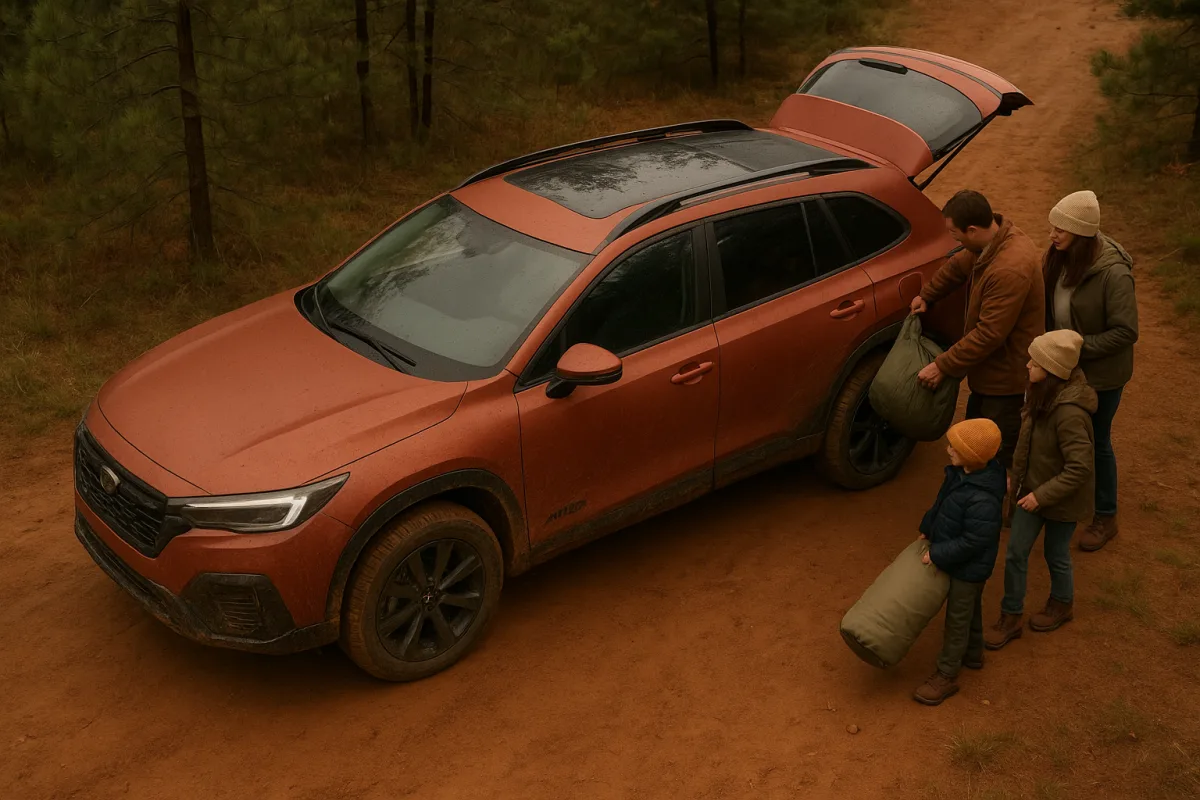
The shift is plain: hybrids are becoming the mainstream adventure SUV powertrain
SUV makers are moving toward a familiar formula: hybrid power for everyday running costs, standard or available all-wheel drive for bad weather, and tougher styling to sell the idea of weekend escape. The important point is that several manufacturers are moving this way at once.
Hyundai is applying the formula at two ends of its range. The 2026 Palisade Hybrid puts electrified power into a three-row family SUV, while the 2027 Tucson XRT wraps a compact crossover in skid-plate styling, black cladding, all-wheel drive, and dirt-friendly cabin trim.
Volkswagen’s Tiguan R represents a different branch of the same trend. It is not a hybrid in the information supplied here, but it combines the SUV body style with a performance engine, 4MOTION all-wheel drive, a centre limited-slip differential, and descent control.
That overlap matters because manufacturers are no longer treating economy, performance, family space, and mild off-pavement ability as separate niches. Buyers increasingly expect one car to cover school runs, motorway work, wet winter roads, towing or carrying outdoor equipment, and the occasional rough access track.
There is evidence beyond the badges. Hyundai has improved the fifth-generation Tucson’s aerodynamic drag coefficient from 0.33 to 0.30 while making the body larger and boxier, according to Motor1. That is not glamorous, but it shows where the engineering focus sits: preserving fuel efficiency while delivering the SUV shape buyers want.
Why it is happening now
Fuel economy has become harder to ignore in large SUVs, particularly when a vehicle is bought as the household’s only car. A full-size, three-row SUV has the weight and frontal area to make a petrol-only powertrain expensive in ordinary commuting, even before towing or winter fuel use enters the picture.
The Palisade Hybrid is the clearest response. Hyundai’s official EPA figures vary sharply by drivetrain and trim: front-wheel-drive Blue SEL and Blue SEL Premium versions are rated at 34 mpg combined, while AWD Limited and Calligraphy models are rated at 29 mpg combined. [1]
That five-mpg gap is worth noticing before ordering the fashionable specification. The lower-consumption figure belongs to particular front-drive Blue models, not every Palisade Hybrid. An AWD buyer should budget around the 29-mpg number, and perhaps a little below it in real motorway use.
Webb Hyundai cites a 75-mph test returning 28 mpg for an AWD Palisade Hybrid, two mpg below its EPA combined rating. [1] Motormouth’s reported 28-to-29-mpg combined averages point in the same direction: the official result is plausible, but it is not a guarantee.
The other pressure is buyer taste. People want the higher seating position, square load area, and visual security of an SUV, but many do not actually need a transfer case, locking differentials, aggressive all-terrain tyres, or the poor road manners that can accompany them.
Manufacturers have therefore found a less expensive middle ground. Add all-wheel drive, traction modes, a little underbody protection, darker trim, and perhaps a hill-descent system. It looks purposeful in a showroom and can genuinely help on gravel, snow, a muddy campsite entrance, or an unploughed driveway.
Regulation has also changed the calculation, though not in the simplistic way some dealership advertising suggests. The federal US Clean Vehicle Credit ended on September 30, 2025, so a buyer should not assume a federal tax saving on a hybrid SUV. [6]
State and local programmes remain patchy. Some programmes in Illinois and New Jersey can reach $4,000, while Massachusetts programmes can reach $5,000, but eligibility can be income-based and vehicle-price limited. [6] Check the programme before signing, rather than treating an advertised maximum as money already in hand.
2026 Hyundai Palisade Hybrid: the sensible long-distance family tool
The 2026 Hyundai Palisade Hybrid is the most convincing example here for an owner who needs space first and adventure styling second. It suits families covering regular motorway miles, carrying several passengers, and wanting less fuel anxiety than a conventional large petrol SUV creates.
Car and Driver lists the Palisade Hybrid from $43,315, depending on trim and drivetrain. [2] That is vehicle MSRP, not an on-the-road total. Sales tax, registration, dealer fees, finance charges, insurance, accessories, and any towing or roof-rack equipment sit outside it.
The important ownership calculation is not simply whether 34 mpg sounds good. It is whether the trim you want delivers it. The FWD Blue trims are rated 33 mpg city, 35 mpg highway, and 34 mpg combined, while AWD Limited and Calligraphy versions are rated 29 city, 30 highway, and 29 combined. [1]
That makes the Palisade Hybrid a potentially useful project vehicle for the owner building a road-trip or light-overlanding family setup. It has more reason to exist than a cosmetic special edition because fuel savings can repay some of the hybrid premium over sustained mileage.
Still, do not mistake it for a proper trail vehicle. The supplied evidence does not establish serious off-road geometry, tyre sidewall, recovery points, or underbody protection. A Palisade Hybrid makes sense for maintained forest roads and poor weather, not for routes where clearance and wheel travel decide whether you get home.
Long-term hybrid ownership also requires a battery plan, even if the risk is years away. General 2026 market estimates put hybrid-battery module repair around $1,200 to $2,500, with full-pack replacement commonly quoted at $3,000 to $8,000. [4]
Those figures are not Palisade-specific predictions, and they should not be presented as such. They are useful as a reminder that the fuel saving should be banked, not spent immediately on oversized wheels, heavy accessories, or modifications that make warranty discussions more complicated.
2026 Volkswagen Tiguan R: hardware is not the same as trail ability
The 2026 Volkswagen Tiguan R suits a different buyer: somebody who values quick road pace, all-weather traction, and a more focused driving experience, but still needs the upright seating position and practical body shape of a compact SUV.
No confirmed US MSRP for the 2026 Tiguan R was supplied in the available research, so there is no responsible price to quote here. That alone is a reason not to build a purchasing plan around it until Volkswagen confirms market availability, specification, and pricing.
Its off-road credentials are also easy to over-read. The Tiguan R has 7.0 inches of ground clearance, an 18.0-degree approach angle, and a 25.2-degree departure angle. Those are usable figures for rutted car parks and shallow tracks, but modest for serious off-road work.
The 4MOTION system’s centre limited-slip differential and descent control are worthwhile. They should help it maintain composure on loose or slippery surfaces, particularly on a steep downhill. But electronic traction management cannot lift the floorpan, shorten the overhangs, or protect low-profile tyres from sharp rocks.
For an ownership project, the Tiguan R is best treated as a road car that can tolerate access roads. Good winter tyres, sensible wheel protection, and a compact recovery kit make more sense than a suspension lift and aggressive all-terrain rubber that compromise ride, braking, noise, and fuel consumption.
Its comparison with larger performance SUVs can be misleading. A BMW X5 M or Audi RS Q8 is hardly an expedition platform either, but their larger proportions and off-road-oriented options can create a false impression that the Tiguan R belongs in that class. It does not.
2027 Hyundai Tucson XRT: the styling-led version of the trend
Motor1’s reporting on the 2027 Hyundai Tucson XRT is refreshingly clear about what Hyundai has built. It is a tougher-looking Tucson, not a hardcore rock crawler. That distinction makes it easier to judge honestly.
The XRT gets a split rectangular grille, revised bumpers, skid-plate styling, black wheel-arch trim, XRT-marked wheels, protective floor mats, darker interior trim, and standard HTRAC all-wheel drive, according to Motor1. It is a useful package for owners who genuinely bring mud, sand, dogs, boots, and camping gear into the cabin.
The 2027 model is larger than before, with a 60-mm longer body, 40-mm greater width, and a wheelbase stretched by 30 mm, Motor1 reports. Rear headroom rises by 29 mm, while rear-door opening increases from 73 to 83 degrees.
Those details are more meaningful than the black plastic. Easier rear access and added interior room improve daily ownership, especially with child seats, older passengers, or bulky gear. The improved aerodynamics and extra sound insulation should also make it a calmer long-distance crossover rather than merely a more theatrical one.
Pricing remains unconfirmed for the 2027 Tucson XRT. The current 2026 Tucson XRT starts at $33,725 in front-wheel-drive form and $35,225 with AWD. [5] Those prices exclude tax, registration, dealer charges, insurance, accessories, and the inevitable cost of adding tyres, racks, or towing equipment.
The existing 2026 XRT uses a 2.5-litre, 187-hp petrol engine, 18-inch dark alloy wheels, exclusive cladding, and available HTRAC AWD with Terrain Mode. [5] It suits buyers wanting a conventional compact crossover with a more durable-looking appearance, rather than someone seeking hybrid economy.
That is where the evidence gets thin. Hyundai has announced hybrid powertrain details for the wider new Tucson range, according to Motor1, but no final 2027 XRT pricing, trim breakdown, or model-specific maintenance data is available. Do not assume the XRT will automatically be the hybrid version.
Previous Tucson Hybrid models provide some context, not a forecast. Tom’s Guide recorded 38.5 mpg average in its comparison driving, and referenced a Tucson Hybrid Limited at roughly $43,000. [3] Actual results will vary by route, weather, speed, tyre choice, and how often the hybrid system can recover energy.
What this means for your own SUV plan
Start by separating the job from the image. If the vehicle will mostly do long family journeys, the Palisade Hybrid’s fuel consumption case is stronger than its off-road case. If it will spend most of its time on twisty roads and in winter weather, the Tiguan R’s road hardware is more relevant.
If you want a compact SUV for dogs, bikes, unmade campsite roads, and ordinary commuting, the Tucson XRT may fit. But wait for final pricing and powertrain confirmation if a hybrid is essential, because the current evidence does not prove that the XRT badge brings hybrid power.
For modifications, protect reliability before chasing the catalogue look. Tyres, a full-size spare where possible, basic underbody inspection, floor protection, and a realistic load plan make more difference than decorative skid plates. Actual off-road use also accelerates wear on tyres, suspension components, brakes, and underbody panels.
Finally, calculate costs around your likely specification, not the brochure’s best-case number. The Palisade Hybrid proves why: 34 mpg is real for selected FWD Blue trims, but an AWD Limited or Calligraphy buyer is officially buying a 29-mpg vehicle. [1]
Frequently Asked Questions
What are the new hybrid off-road SUVs coming in 2026 and 2027?
The 2026 Hyundai Palisade Hybrid and the 2027 Hyundai Tucson XRT represent the new wave of hybrid SUVs with rugged styling and all-wheel drive options. The Palisade Hybrid is a three-row family SUV, while the Tucson XRT is a compact crossover with off-road-inspired design elements. The 2026 Volkswagen Tiguan R is also noted but is not a hybrid.
How fuel efficient are new hybrid SUVs with off-road features?
Fuel efficiency varies by model and drivetrain. The 2026 Hyundai Palisade Hybrid’s front-wheel-drive Blue trims are rated at 34 mpg combined, while all-wheel-drive Limited and Calligraphy trims are rated at 29 mpg combined. Real-world tests for the AWD Palisade Hybrid show slightly lower figures around 28–29 mpg combined.
Which hybrid SUVs offer all-wheel drive for light off-road use?
The 2026 Hyundai Palisade Hybrid offers all-wheel drive on Limited and Calligraphy trims, and the 2027 Hyundai Tucson XRT is expected to offer AWD with Terrain Mode. These AWD systems provide traction benefits for bad weather and light off-road conditions but are not designed for serious off-road use.
Is the 2026 Hyundai Palisade Hybrid suitable for off-road adventures?
The Palisade Hybrid is primarily designed as a spacious family SUV with hybrid efficiency and all-wheel drive for adverse weather and mild off-road conditions like gravel or muddy driveways. It does not have the low-range gearing or aggressive off-road features typical of dedicated off-road vehicles.
What off-road capabilities do hybrid SUVs like the Volkswagen Tiguan R have?
The 2026 Volkswagen Tiguan R features 4MOTION all-wheel drive with a center limited-slip differential and descent control, but its off-road capability is limited. It has 7.0 inches of ground clearance and an 18.0-degree approach angle, which restricts its use to light off-road or winter-road conditions rather than serious off-road terrain.
How we researched this
This article was assembled from 1 published article, 6 cited references.
Nothing here is based on hands-on testing. Where a figure or finding appears, it belongs to the source cited beside it, and the writing says so rather than implying otherwise. Every source is listed below so you can check it.
Sources
2027 Hyundai Tucson XRT Breaks Cover Trying To Look Tough — Motor1
2026 Palisade Hybrid Real-World MPG: What Owners Actually Get | Webb Hyundai Highland
I drove the Hyundai Tucson Hybrid and Kia Sportage Hybrid for a week - here's the SUV I recommend
Hybrid Battery Repair Cost: Repair or Replace in 2026? - Tucson Hybrids & EV Repair in Tucson, AZ
What Hybrid Vehicle Incentives Are Still Available? - LegalClarity
Related Articles
Off-Road and AWD Family Vehicles Comparison
Compare off-road and AWD family vehicles like the Toyota Sienna Woodland and Honda Passport TrailSport for performance, ownership, and driving needs.
2027 Off-Road and 4x4 Vehicles Comparison: Defender vs Ram
Compare 2027 off-road and 4x4 vehicles including the Land Rover Defender and Ram Power Wagon diesel for towing, performance, and ownership.
Ferrari 296 GT Modificata vs McLaren P34
Compare Ferrari 296 GT Modificata and McLaren P34 track cars, specs, performance, and ownership insights for enthusiasts and prospective buyers.
Electric and Hybrid SUV Comparison
Compare electric and hybrid SUVs with a detailed look at Tesla Model Y and Toyota RAV4 PHEV performance, ownership, maintenance, and driving experience.