
Automotive CEO Leadership Changes
Explore key automotive CEO leadership changes, focusing on Volvo's new CEO Klaus Zellmer and what this means for the car industry.
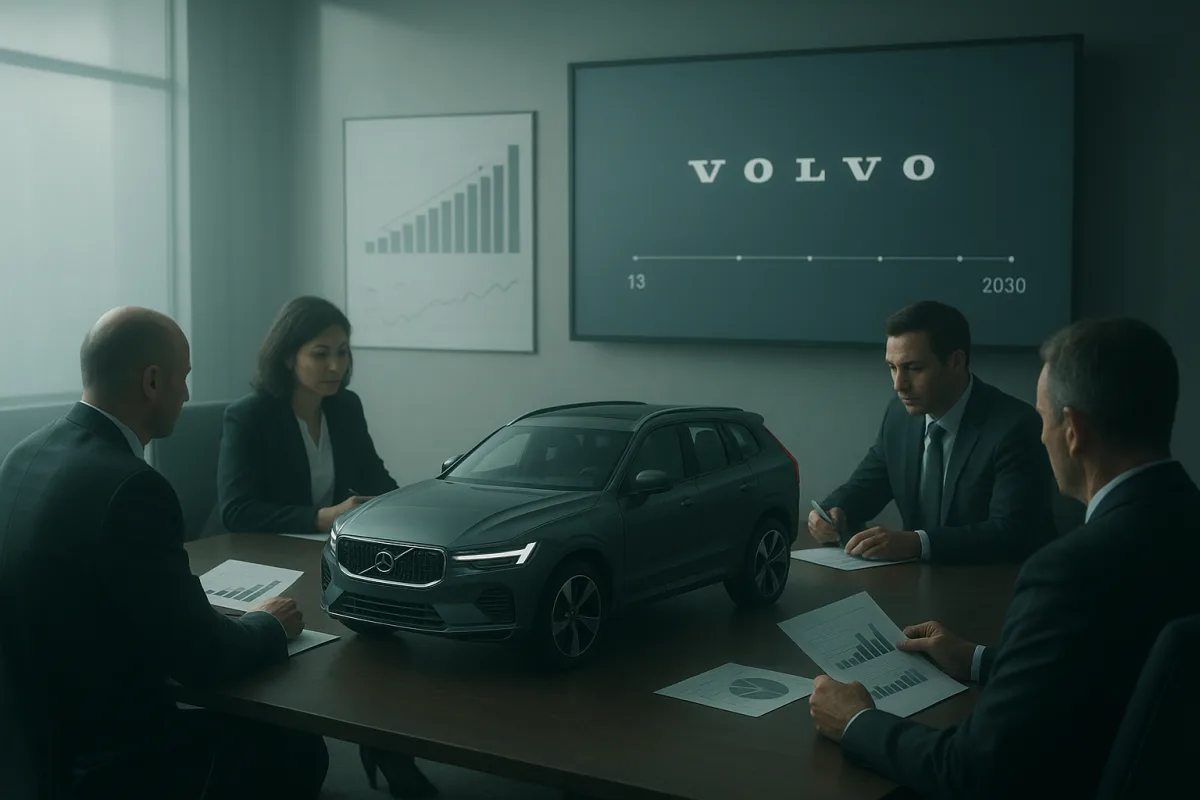
Volvo is changing bosses because the old plan needs an operator
The straightforward shift is that Volvo Cars is moving from a caretaker-style leadership arrangement to a designated long-term chief executive. Klaus Zellmer, currently leading Škoda, is due to replace Håkan Samuelsson by October 2027. [5]
That timetable matters. Samuelsson’s 2025 return was never presented as an indefinite restoration of the previous regime, but as a two-year assignment while Volvo found a successor. The company has now chosen one before that deadline.
CarScoops and InsideEVs independently reported the same broad picture: Volvo has recruited a leader with Volkswagen Group volume-brand experience, premium-brand exposure through Porsche, and a record running a business through electrification and cost pressure.
That agreement between publications is useful confirmation of the appointment, but it should not be inflated into a sweeping automotive-industry management revolution. The evidence supplied here is strong for Volvo, but thin for claims about leadership turnover at every major manufacturer.
What is visible is a narrower pattern. When product plans become more expensive, regional and software-dependent, boards appear less interested in a charismatic launch-event spokesperson than in an executive who has managed factories, model mix, margins and dealer networks.
That may sound bloodless, but it is closer to what affects an owner. A chief executive does not repair a failed infotainment module or make a brake service cheaper, yet their decisions determine whether those jobs remain reasonable five or eight years later.
The appointment is about margins as much as cars
Volvo’s headline ambition is big: 13 new models by 2030 and a plan to double market share. Reuters reported that the product programme is intended to cover both Western markets and China, rather than relying on one global range. [5]
The financial backdrop is less accommodating. Volvo Cars recorded a 3.5% operating margin for full-year 2025, down from 6.8% in 2024, and its Q2 2026 operating margin fell further to 1.1%. [2]
That is the number worth keeping in mind when reading optimistic product announcements. A company can have a full order book, good-looking concepts and a desirable badge, while still struggling to turn the work into enough profit.
A low margin does not automatically mean a carmaker is in immediate trouble. It does mean there is less slack for warranty campaigns, generous incentives, slow-moving inventory and repeated software fixes than when margins are comfortably healthy.
InsideEVs highlighted Škoda’s reported 8.5% operating margin in the first half of 2026 under Zellmer. That comparison explains the appeal, although it is not sensible to assume a Škoda result can simply be copied into Volvo. [3]
Volvo sells premium cars with a different manufacturing footprint, different pricing expectations and a different history of technical complexity. A chief executive can improve discipline, but cannot instantly erase engineering costs already committed to production.
There is also a tempting claim that Swedish production is inherently more expensive than Czech production. The available evidence does not support treating that as a settled fact. Sweden’s producer-price index was higher in March 2026, but Czech labour-cost inflation was higher. [3]
Without a full breakdown of materials, energy, capital, supplier terms, logistics and overheads, declaring one country categorically cheaper is speculation. That distinction matters because simplistic factory-cost stories tend to become excuses for every future product decision.
Regional cars are replacing one-size-fits-all assumptions
The practical core of Volvo’s strategy is regionalisation. The company plans seven models for Western markets and six for China, with China-developed vehicles co-developed with Geely and using more shared components. [3]
For Europe and the United States, Volvo’s new products are expected to use SPA2 and SPA3 architectures, plus the HuginCore computing platform. The Western line-up is intended to mix battery-electric cars with third-generation hybrids. [3]
That hybrid detail is more meaningful than another promise about eventual full electrification. Plenty of owners can work with an EV, but plenty cannot, especially those without reliable home charging, those towing regularly, or those covering long winter motorway miles.
Volvo’s stated direction is still a full EV line-up in Europe and the United States by 2030, while hybrids remain part of the route because customer demand and regulatory conditions do not move at the same speed everywhere. [3]
For somebody planning a project car, commuter replacement or long-term family vehicle, this suggests a less glamorous but sensible question: buy the drivetrain that works where you live now, not the one that best fits a corporate presentation in 2030.
The new boss may have room to refine the balance between battery-electric and hybrid models, but the architecture decisions are already well advanced. CEO changes usually alter timing, spending priorities and market emphasis more than they reinvent a platform overnight.
The same applies to body styles. Reports suggest Volvo’s future range may again include sedans and wagons alongside SUVs, but detailed model specifications remain high-level. [3] Until there is a production announcement, that is a possibility, not a buying plan.
What Zellmer’s background could change
Zellmer’s résumé is unusually relevant to Volvo’s immediate problem. His Škoda role involved a high-volume European brand, while his earlier position leading Porsche Cars North America exposed him to a premium business and the American retail market.
The easy interpretation is that Volvo wants Škoda-style cost control with Porsche-style pricing power. Real life will be messier. Those brands have different dealer structures, brand histories, customer expectations and tolerance for paying extra for options.
Still, the combination is logical. Volvo needs to protect its safety-led premium positioning while increasing commonality with Geely, improving purchasing leverage and avoiding a range of technically impressive vehicles that are costly to build and difficult to sell profitably.
The target is to raise group platform and component commonality from roughly 10% to 30% by 2030. [3] For an owner, commonality can be good when it produces readily available parts and well-understood systems.
It can also spread a fault further and faster when a shared electronic architecture has a weakness. That is not a prediction about any particular Volvo platform, merely the normal trade-off with shared modules, software and supplier parts.
I have not lived with every current Volvo powertrain, and a CEO appointment cannot tell us which future drivetrain will be the keeper. The useful evidence will arrive later in technical service bulletins, recall data, independent reliability reporting and workshop parts availability.
Do not confuse incentives with affordability
Volvo’s short-term sales tools show why leadership decisions cannot be separated from pricing. In the United States, Volvo has advertised a $3,000 purchase allowance on the 2026 XC90 B6 AWD Plus. [1]
The same American offers include $1,000 allowances on the 2026 XC60 B5 AWD Core and V60 B5 AWD Cross Country Plus, along with 0.99% APR financing for up to 60 months on selected models. [1]
Those figures are useful if a buyer is shopping now, but they are not universal pricing. They apply to the U.S. market, selected cars and specific finance terms, and should not be translated into equivalent discounts in Europe or China.
Publicly verified incentive and finance detail for Europe and China is much thinner. Anyone ordering there should check the local Volvo site and dealer paperwork, rather than assuming an American allowance signals a global policy.
A $3,000 allowance can reduce the purchase price, but it does not answer the ownership question. Insurance, tyres, charging arrangements, depreciation, servicing, finance interest after promotional periods and repair costs remain separate calculations.
That is especially important with premium SUVs. The monthly figure can look manageable while the eventual ownership cost is shaped by options, wheel size, lease mileage limits and whether the car is returned before expensive age-related work begins.
What owners should watch from 2027 onward
The first test of Zellmer’s Volvo will not be a keynote speech. It will be whether the company can launch 13 models without leaving owners with fragmented software versions, long parts waits or service departments unable to keep up.
Service-network capacity is a known concern around rapid model expansion, but Volvo has not published detailed plans or quantified the risk. The same is true of potential pressure on resale values as more models and drivetrains arrive. [3]
That uncertainty should make a cautious buyer more methodical, not alarmed. Before committing to a newly launched Volvo, ask the supplying dealer about diagnostic capability, battery repair policy, courtesy-car provision and the availability of trained technicians.
For a plug-in hybrid, ask what the service schedule looks like after the warranty ends, not merely how far it can travel electrically in ideal conditions. A hybrid carries both an internal-combustion system and high-voltage hardware, which changes the ownership equation.
For an EV, ask whether battery repairs are handled locally, whether modules can be replaced individually, and what software updates require a workshop visit. Those answers are more valuable at 60,000 miles than a claimed charging time.
Volvo’s leadership change therefore matters, but mostly as an indicator of priorities. The company is under margin pressure, leaning harder on Geely scale and trying to serve markets with different regulations and buyer habits. [2] [3]
That calls for a manager who can make difficult choices about complexity and spending. It does not yet provide evidence that future Volvos will be cheaper to maintain, more reliable, or better value than today’s cars.
For buyers, the sensible position is to watch the first production results, not the biography. If the new strategy brings simpler specifications, stable software, supported hybrids and properly staffed dealers, owners will feel it. If not, the press release will not matter.
Frequently Asked Questions
Who is the new CEO of Volvo Cars and when will they start?
Klaus Zellmer, currently the chief executive of Škoda, has been appointed as the new long-term CEO of Volvo Cars. He is expected to take over from Håkan Samuelsson no later than October 1, 2027.
What are the reasons behind Volvo's CEO leadership change?
Volvo is transitioning from a caretaker leadership under Samuelsson to a designated long-term CEO to operate its ambitious product and market plans. Samuelsson’s return was always intended as a two-year interim role while the company searched for a successor with experience in volume brands, premium markets, electrification, and cost management.
How do CEO changes affect automotive company strategies?
CEO changes often reflect a shift in focus from charismatic leadership to operational discipline, especially as product plans grow more complex and costly. Boards increasingly favor executives skilled in managing factories, model mix, margins, and dealer networks, which directly impact long-term product quality, service costs, and residual values.
What challenges will Klaus Zellmer face as Volvo's CEO?
Zellmer will need to manage a 13-model program split between Western and Chinese markets while aiming to double Volvo’s market share by 2030. He inherits a company facing significant margin pressures, with operating margins falling sharply in recent quarters, requiring careful cost control and execution across production, software, and dealer support.
Are other car manufacturers also changing their CEOs recently?
The article notes that Volvo’s leadership change is not part of a broad industry-wide wave of CEO replacements. Instead, it represents a specific reset at Volvo, with no strong evidence that every major carmaker is undergoing similar leadership turnover at this time.
How we researched this
This article was assembled from 2 published articles, 5 cited references.
Nothing here is based on hands-on testing. Where a figure or finding appears, it belongs to the source cited beside it, and the writing says so rather than implying otherwise. Every source is listed below so you can check it.
Sources
Volvo Hires Ex-Skoda CEO To Lead Massive 13-Model Strategy — CarScoops
Volvo’s CEO Is Out. Again. — InsideEVs
Volvo Cars Posts Grim Q2 2026 Operating Results | AutoInformed
Volvo Cars EBIT Margin Push Rests on Geely Synergies and a 13-Model Bet
Volvo Cars plans 13 new models by 2030 in bid to double market share By Reuters
Related Articles

Automotive Legal and Regulatory Issues Affecting Ownership
Explore key automotive legal and regulatory issues, recalls, lawsuits, and maintenance rules impacting vehicle ownership and buyer decisions.

Automaker Challenges and Market Shifts Explained
Explore key automaker challenges and market shifts, including fixed costs, factory capacity, and dealer network impacts on profitability.
2028 Volvo XC40 Refresh and EV Strategy Explained
Explore the 2028 Volvo XC40 refresh, mild hybrid updates, and Volvo's US EV strategy including EX40 discontinuation and new tech features.

Volkswagen Group Restructuring
Explore Volkswagen Group restructuring impact on ownership, model cuts, maintenance, and driving experience in this detailed analysis.