
2028 Volvo XC40 Refresh and EV Strategy Explained
Explore the 2028 Volvo XC40 refresh, mild hybrid updates, and Volvo's US EV strategy including EX40 discontinuation and new tech features.
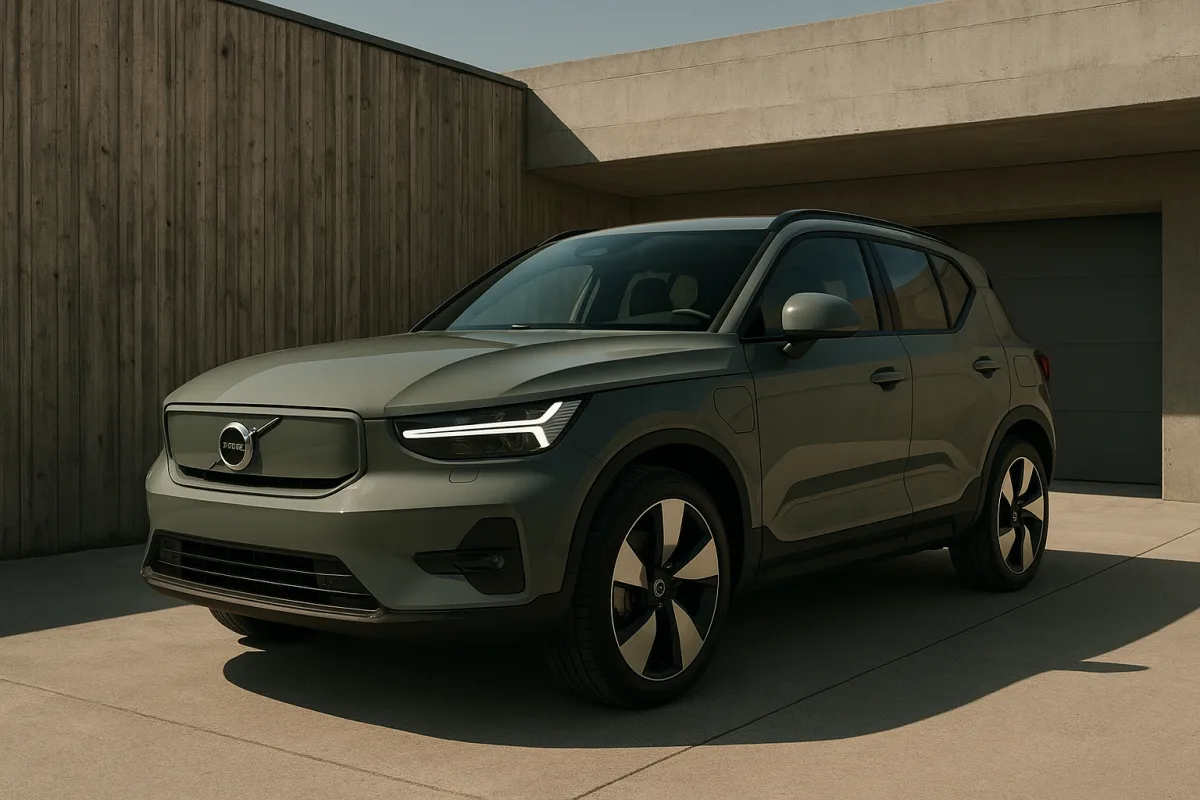
Volvo has changed the plan, even if the XC40 does not look radically different
The plain shift is this: Volvo is refreshing its small gasoline-assisted SUV for 2028 while removing its similarly sized EX40 electric SUV from the U.S. range. That is a product-planning reversal from the brand’s earlier, more absolute EV timetable. [7]
The 2028 XC40 is not a stopgap with a new grille. Car and Driver reports new sheetmetal ahead of the A-pillars, revised lighting, a larger screen and expanded driver-assistance hardware, all while Volvo retains the 247-hp B5 mild-hybrid powertrain. [2]
At the same time, Kelley Blue Book reports that the EX40 will not return for the 2028 model year in America. Volvo’s replacement entry point for an electric SUV is the larger EX60 P6, priced from $59,795. [7]
That is a meaningful change for buyers, not just an internal model-code shuffle. The old EX40 began at $56,545, so Volvo is asking buyers to spend another $3,250 before taxes, registration, insurance, financing costs and optional equipment. [7]
Volvo is not the only manufacturer discovering that a published EV ambition and an actual retail order book can diverge. Reuters also reported Volvo’s decision to end U.S. sales of the smaller EX30, another sign that the American product mix is being adjusted rather than simply electrified. [8]
The evidence points to a U.S. market realignment, not an EV retreat
It would be too easy to call this Volvo abandoning EVs. The company is still selling electric SUVs, and the EX60 is intended to offer more space and range than the outgoing EX40, which is a better fit for many American households. [7]
But it is also wrong to present this as business as usual. Removing both the EX30 and EX40 from the U.S. lineup leaves Volvo without a small battery-electric crossover here, while the mild-hybrid XC40 remains its lower-cost compact SUV option. [7][8]
The price gap matters more than the marketing language around range or software. Research in the supplied briefing puts the average EV transaction price roughly $6,200 above the average vehicle price, even as high 2026 fuel prices have renewed interest in electric motoring.
That is the awkward middle ground Volvo is now navigating. There are drivers who want an EV, but there are fewer who will stretch their budget for a compact premium EV when a larger electric SUV is only modestly more expensive.
For someone shopping with their own money, that means the refreshed XC40 should be seen as Volvo’s affordable on-ramp. It is not an EV substitute in operating character, but it may be the more practical choice for buyers without reliable home charging.
The refreshed XC40 is a familiar mechanical proposition
The 2028 U.S.-spec XC40 will drop the front-wheel-drive B4 version and use the B5 mild-hybrid drivetrain across the range. Car and Driver describes it as a 247-hp turbocharged four-cylinder with standard all-wheel drive. [2]
Volvo’s current U.S. specifications list the B5 as a 2.0-liter turbocharged four-cylinder mild hybrid paired with an eight-speed automatic and all-wheel drive. That is useful continuity for an owner wary of being first in line for unfamiliar hardware. [3]
Do not mistake “mild hybrid” for a plug-in hybrid. There is no meaningful electric-only commuting range to unlock, no charge cable to plan around and no claim that this XC40 will deliver EV-style running costs.
The mild-hybrid system should instead be read as an efficiency and drivability aid around a conventional petrol drivetrain. It can smooth stop-start operation and fill small gaps in response, but it does not remove the usual maintenance needs of a turbocharged luxury crossover.
There is a small specification discrepancy worth watching. Road & Track cited 196 lb-ft for the B5, while Jalopnik reported 258 lb-ft, so final U.S. certification figures should be checked once Volvo publishes its 2028 specification sheet. [2]
That may sound fussy, but it is exactly the sort of detail that becomes important after the first owner has moved on. Torque, towing ratings, wheel size and fuel-economy certification can all vary by market and model year.
Better tech can be useful, but it adds another ownership layer
The most visible cabin change is the 11.2-inch portrait touchscreen, replacing the old 9.0-inch unit. Volvo is also adding Google-based software, Gemini voice-assistant functions, an upgraded wireless charger and over-the-air update capability. [2]
The old XC40’s modestly old-fashioned controls were part of its appeal. Road & Track notes that physical window and mirror switches, a volume knob and a start-stop button remain, which is better news than another clean-sheet dashboard designed around menus. [2]
That is not nostalgia. At 60,000 miles, a physical volume knob still works without a login, a software update or a voice command interpreted correctly. The refreshed car’s basic cabin ergonomics may therefore age better than Volvo’s more aggressively screen-led interiors.
The trade-off is that the 2028 XC40 carries more cameras, radar units, ultrasonic sensors and software-dependent assistance functions. Those improvements may help prevent a low-speed scrape or door-opening incident, but they also create more potential diagnostic work after warranty coverage ends. [2]
No reliable source in the supplied material identifies recurring 2028 XC40 failures, because production has not started. Anyone claiming to know the refresh’s weak points today is predicting, not reporting.
The sensible approach is to distinguish known architecture from unknown execution. The B5 drivetrain has continuity, but the revised screen, sensors, lighting hardware and software integration are new enough that their long-term reliability cannot yet be judged.
Matrix headlights are real progress, but not a reason to rush an order
The 2028 XC40 will use matrix LED headlights in the United States, designed to shape the beam around other road users and reduce glare. Car and Driver says the system debuts on this XC40 for the U.S. market. [2]
Adaptive Driving Beam technology was federally approved in 2022 under Federal Motor Vehicle Safety Standard 108, opening the door for these systems after years of American-market delay. Axios reported that approval as a major change in U.S. lighting rules. [1]
Approval is not the same as effortless implementation. The independent research brief notes that manufacturers still face calibration, hardware and compliance complexity, while The Atlantic has documented the broader American problem of poorly aimed or excessively bright headlights. [4]
For a night-driving owner, effective matrix lights could be one of the refresh’s genuinely worthwhile upgrades. But wait for independent road testing, because the specification alone does not show how smoothly the system recognizes traffic, reacts to crests or handles dirty sensors.
Pricing is unknown, and that should govern the buying timetable
Volvo has not released a 2028 XC40 starting MSRP. Car and Driver says the company expects pricing to remain close to the outgoing lineup, but that is not a price promise and should not be treated as one. [2]
For context, Volvo lists the 2026 XC40 at $41,295 for the B4 front-wheel-drive model and $43,995 for the B5 all-wheel-drive version. Those figures are useful baselines, not confirmed 2028 prices. [3]
The missing B4 matters. If the least expensive front-drive version does not return, the effective entry price may rise even if Volvo holds the B5 close to its present sticker, simply because the cheaper alternative has disappeared.
As always, MSRP is only the first line of the ownership budget. It does not cover sales tax, title and registration, insurance, loan interest, dealer accessories, fuel, tyres, servicing or repairs after the factory warranty expires.
A September 2026 dealer advertisement showed 1.99 percent APR for up to 72 months on certain 2026 XC40s through Volvo Car Financial Services, subject to well-qualified credit. That was time-limited and is not evidence of future 2028 finance terms. [9]
For a buyer planning ahead, the best move is not to base a 2028 purchase on today’s promotional APR. Compare the eventual loan rate, insurance quote and trade-in value, because those can outweigh a small difference in headline MSRP.
Depreciation favours caution, especially for EV shoppers
There is no resale data for the 2028 mild-hybrid XC40, and anyone producing a precise future-value forecast is filling a gap with assumptions. We do, however, have useful history for earlier XC40s. [5]
iSeeCars estimates that the conventional XC40 loses about 44.7 percent of its value over five years, leaving an estimated resale value of $22,082. That is relatively respectable for a luxury subcompact SUV, but it is still substantial depreciation. [5]
The same source estimates approximately 57.6 percent depreciation after seven years and 75.1 percent after 10 years. Those are reminders that a premium-badge compact crossover is not normally a low-cost long-term asset. [5]
Electric XC40 Recharge models have depreciated faster in available historical data. Recharged estimates three- to four-year losses of 46 to 64 percent, with five-year retained value around 36.2 percent, or roughly $22,945. [6]
That gap helps explain why a buyer should not assume the discontinued EX40 is automatically the bargain choice. A used EV can be excellent value, but rapid technology development, changing incentives and a growing used-EV supply make residual values less predictable. [6]
What this means for a long-term Volvo plan
If the plan is to buy new and keep the car through 60,000 miles, the 2028 XC40’s appeal is straightforward. It combines a familiar turbocharged petrol architecture, all-wheel drive, manageable exterior dimensions and controls that have not been sacrificed entirely to a screen.
The servicing picture is less clear than it should be this early. Volvo has not released a 2028 maintenance schedule in the supplied sources, so do not assume intervals, consumables or warranty terms simply carry over unchanged from prior B5 models.
Before signing, ask the dealer for the published maintenance plan, the warranty exclusions, tyre prices for the exact 18-, 19- or 20-inch wheel package, and the cost of replacing a windshield or headlamp assembly. Those costs are more revealing than a launch-day acceleration figure.
If the project is an EV purchase, the EX40 discontinuation means acting sooner rather than later if that specific size suits your parking space and charging setup. But compare it against the EX60 carefully, because Volvo itself is positioning the newer model as the more spacious, longer-range alternative. [7]
If the project is a practical premium crossover with no home charging dependency, waiting for final XC40 pricing and independent testing is the rational move. The refresh looks meaningful, but the market evidence says Volvo is selling flexibility now, not forcing every buyer into an electric future.
Frequently Asked Questions
What are the key updates in the 2028 Volvo XC40 refresh?
The 2028 XC40 features new sheetmetal ahead of the A-pillars, revised lighting including matrix LED headlights, a larger infotainment screen with Google Gemini AI, and expanded driver-assistance hardware. Mechanically, it retains the 247-hp B5 mild-hybrid turbocharged four-cylinder with an eight-speed automatic and all-wheel drive. This refresh is a subtle update rather than a new generation.
Why is Volvo discontinuing the EX40 electric SUV in the US?
Volvo is discontinuing the EX40 in the US to realign its product mix, focusing on larger electric SUVs like the EX60 P6, which offers more space and range and is priced higher at $59,795. The EX40, which started at $56,545, sold modestly and the shift reflects Volvo’s response to US market preferences and the economics of EV pricing.
How does the 2028 XC40 mild hybrid compare to the EX40 EV?
The 2028 XC40 mild hybrid uses a 247-hp turbocharged four-cylinder with mild-hybrid assistance and all-wheel drive, while the EX40 was a fully electric SUV. The mild hybrid is not a plug-in and does not offer electric-only driving. The XC40 is positioned as a more affordable and practical choice for buyers without reliable home charging, whereas the EX40 was a higher-cost electric option with faster depreciation.
What new technology features does the 2028 Volvo XC40 have?
The 2028 XC40 adds a larger infotainment screen featuring Google Gemini AI, revised lighting with matrix LED headlights, and expanded driver-assistance systems. These updates enhance usability and safety but keep the underlying mechanical and control systems familiar to existing XC40 owners.
Is the 2028 Volvo XC40 a good choice for buyers without home charging?
Yes, the 2028 XC40 mild hybrid is a practical option for buyers without reliable home charging because it uses a conventional turbocharged gasoline engine with mild hybrid support, avoiding the need for plug-in charging infrastructure. It offers continuity in mechanical layout and conventional controls, which may suit owners planning to keep the vehicle for many miles.
How we researched this
This article was assembled from 7 published articles, 9 cited references.
Nothing here is based on hands-on testing. Where a figure or finding appears, it belongs to the source cited beside it, and the writing says so rather than implying otherwise. Every source is listed below so you can check it.
Sources
2028 Volvo XC40’s Newest Nip and Tuck Is an Exercise in Subtlety — Car and Driver
The Volvo XC40 Gains a Fresh Look As EV Sales Climb Slower Than Expected — Road & Track
The pro racer who turned his A-Class into a 220bhp GTI chaser — Autocar
2028 Volvo XC40 Refresh Is Slightly More Chiseled, Charming, And Smarter Inside — Jalopnik
View Exterior Photos of the 2028 Volvo XC40 — Car and Driver
View Interior Photos of the 2028 Volvo XC40 — Car and Driver
2028 Volvo XC40’s Newest Nip and Tuck Is an Exercise in Subtlety
Volvo XC40 Recharge Depreciation Rate & Resale Value | Recharged
Volvo EX40 Discontinued, Refreshed XC40 Skips 2027 Model Year - Kelley Blue Book
Related Articles
2027 Lexus NX Hybrid Refresh
Explore the 2027 Lexus NX hybrid refresh, including new battery, e-axle, and ownership details for hybrid and plug-in models.
2027 SUVs and Trucks Updates
Explore key updates on 2027 SUVs and trucks including Ford Ranger, BMW X5, Kia Sorento PHEV, and Volvo EX60 EV. Get insights on features and ownership.

Acura 2028 Off-Road and Large SUVs: What to Expect
Explore Acura's 2028 off-road and large SUVs, including hybrid tech, release timelines, and how they fit into Acura's future lineup.
2027 Hyundai Tucson Redesign and Hybrid Powertrain Details
Explore the 2027 Hyundai Tucson redesign, hybrid powertrain, fuel economy, towing, and new features in this detailed overview.