
Ford Fathom EV Home Power Generator: Features and Costs
Learn how the Ford Fathom EV works as a home power generator, its built-in inverter, setup costs, and backup power capabilities.
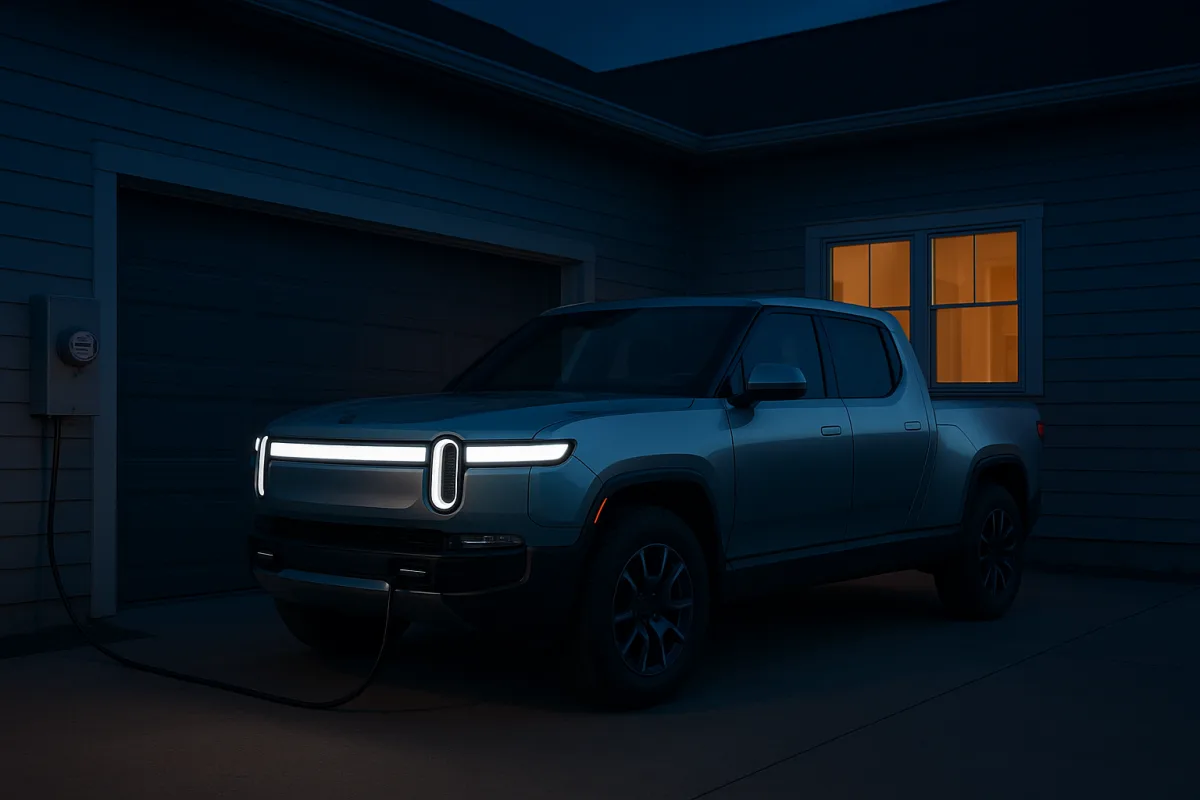
The important bit is not the battery, it is the inverter
Ford’s Fathom is being presented as a sub-$30,000 electric truck that can also run a house. That sounds familiar after the F-150 Lightning, Tesla Cybertruck and several General Motors EVs, but Ford’s claimed cost reduction comes from one specific engineering decision.
The Fathom has its bidirectional inverter integrated into the vehicle’s electrical box, or E-box. Ford says the truck can provide more than 10 kW of AC power for a home without adding the large external inverter normally required for vehicle-to-home operation. [9][10]
That distinction matters because an EV battery stores direct current. A house runs on alternating current. The truck cannot simply send battery energy down a cable into the consumer unit, any more than a 12-volt battery can directly operate a mains-powered refrigerator.
An inverter converts DC electricity from the traction battery into AC electricity compatible with household circuits. Bidirectional hardware also allows energy to flow the other way, from the grid into the vehicle while charging, and from the vehicle back toward the house when required.
Most people meet an inverter in a solar installation. Solar panels produce DC, and the solar inverter produces the AC used by lights, appliances and mains sockets. In a vehicle-to-home arrangement, the EV battery effectively becomes another very large DC energy store.
Ford has moved that conversion hardware into the Fathom itself. The company says its acquisition of Auto Motive Power in 2023 helped it redesign the bidirectional hardware and software around fewer multifunctional parts, rather than adapting an existing vehicle charging architecture. [9]
That does not eliminate the need for hardware on the wall. It eliminates one particularly costly and duplicative component. The home still needs a safe way to connect the truck, control its charging and, during a blackout, separate the house from the live utility network.
Why a home cannot just be plugged into an EV
The safety device that matters most is the transfer function in the backup panel. During a power cut, it disconnects the home from the grid before the truck begins supplying electricity to selected circuits or the wider household.
Without that isolation, the truck could backfeed power into utility lines. That is dangerous for line workers and potentially destructive to the vehicle, house wiring and connected equipment when the grid supply returns. This is why a domestic extension lead is not a home-backup system.
Ford says the Fathom’s system is designed to meet UL 1741 requirements and IEEE 1547 interconnection standards, which govern how distributed energy equipment interacts with the electrical grid. It uses SAE J3068 communications technology to coordinate the vehicle and charger. [9]
In plainer language, the truck, charging equipment and panel need to agree about when the truck may charge, when it may export power and when it must disconnect. The electrical work is less glamorous than a 10 kW claim, but it determines whether the system is usable.
Ford’s Home Power Station is the charger and energy-management link. It can charge the Fathom when electricity is cheaper, then draw from the truck when the rate rises, assuming the owner has time-of-use electricity pricing and Ford’s necessary active subscription. [3][9]
The Home Backup Power package includes the backup panel needed for outage operation. Buy the charging station alone and the Fathom can potentially participate in Ford’s Home Power Management strategy, but it is not a properly installed automatic backup-power installation. [3][4]
That is the useful dividing line for prospective owners. Load shifting is about reducing bills by charging cheap and using stored power during expensive periods. Backup is about keeping the freezer, internet, lighting or whole home alive when the grid is down.
The cost claim needs careful reading
Ford’s Fathom starts at $28,350, not merely “around $30,000.” [1][5] Ford’s quoted price for the Home Backup Power package is about $2,100, while the Home Power Station is expected to cost about $650. [3][4]
Those numbers suggest $31,100 before installation. Independent reporting puts the practical headline figure at approximately $31,400 for truck and required backup hardware, so there is already a small difference between simple component arithmetic and the reported system total. [3][4]
Neither number is an installed price. It excludes the electrician’s labour, permit fees, any trenching or cable run, changes to the consumer unit, and potentially utility approval. It also excludes Ford’s subscription cost, which has not been firmly announced. [3][9]
This is where launch material can make ownership arithmetic look tidier than it will be. A straightforward installation in a newer house with a suitable panel is not the same job as fitting backup equipment to an older property with limited service capacity.
Ford says the Home Power Station will cost roughly half as much as its first-generation bidirectional charger, while the backup panel will be at least 60 percent cheaper than the earlier equivalent. [3][9] Those are relative savings, not a promise that installation becomes cheap.
For context, the discontinued 2025 Ford F-150 Lightning could power a house, but its Home Integration System was reported at roughly $4,000 to $5,310 before installation, depending on the source and configuration. The Fathom’s lower-cost hardware is the real change. [3][4]
General Motors offers bidirectional capability on the 2027 Chevrolet Bolt, which starts at $28,995, but reports place its necessary conversion kit at around $7,000. [3] The Bolt suits buyers who want a lower-priced hatchback EV, rather than a truck, but home-power hardware changes the comparison.
Tesla’s Cybertruck can also be configured for home backup through Tesla’s ecosystem. It suits buyers wanting a larger, more expensive pickup and an integrated Tesla energy setup, but its properly equipped starting point is reported to be at least $8,000 above the Fathom’s opening price. [3]
The Ford F-150 Lightning suits someone needing a full-size pickup and substantial battery capacity, with the larger pack rated at 131 kWh. [4] Its bidirectional system was compelling, but the Fathom is aimed at making the connection hardware less financially punishing.
None of these comparisons proves the Fathom will work better. It only shows why its packaging is significant. Ford is removing the external inverter cost from the equation, not removing the costs of making a home electrically safe and legally connected.
What 10 kW means in an actual house
Ten kilowatts is a rate of power, not an amount of stored energy. It tells you how much electrical load the Fathom can supply at one moment. It does not tell you how many hours the truck can support that load.
A kettle, microwave, electric hob, tumble dryer, heat pump and air-conditioning compressor can each make meaningful demands. A home drawing 10 kW continuously would consume 10 kWh every hour, which is why sensible backup systems manage loads rather than treating every appliance as essential.
Ford has not supplied a final Fathom battery capacity in the material provided here, so any claim about how many days it will power a house would be guesswork. Backup duration depends on battery size, usable state of charge and household consumption.
It also depends on what the backup panel feeds. A panel that supports lighting, refrigeration, internet equipment and a gas-furnace blower has a very different job from one expected to run electric resistance heating, central air conditioning and an induction range.
That is why vehicle-to-home advertising often produces misleading mental pictures. The useful question is not, “Can it power a home?” It is, “Which loads, for how long, from what starting charge, while leaving how much range for the next drive?”
A 10 kW inverter should be ample for many carefully managed domestic loads. But it will not alter the basic physics of a large all-electric house on a cold evening. High-demand heating and cooking are where battery energy disappears quickly.
Ownership questions Ford cannot answer yet
The Fathom is forthcoming, so there are no owner reports, no 60,000-mile maintenance histories and no credible long-term failure pattern for its E-box inverter. I have not driven or owned one, and neither has any ordinary retail buyer.
That means there is no established service interval for the bidirectional equipment, no published repair-cost record and no data showing how regular home use affects the traction battery. Ford’s lower hardware price is credible as a design proposition, not yet as a lifetime-cost claim.
Battery degradation is particularly worth separating from panic. Occasional emergency backup may have little practical effect compared with normal driving and charging. Daily cycling for time-of-use arbitrage is a different use case, because it adds energy throughput and thermal cycles.
Modern battery-management systems can limit discharge depth, temperature and charging rates, but Ford has not published Fathom-specific evidence showing the long-term result. An owner planning to use Home Power Management every day should treat battery wear as an unresolved running-cost question.
There is also an opportunity cost. If the truck is powering the house overnight, it may not be charged enough for an unexpected journey. Conversely, keeping a large reserve for outages means accepting that part of the battery is unavailable for normal driving.
Insurance is another unglamorous loose end. General homeowner policies commonly exclude the EV itself when it is used as backup power, although some insurers offer endorsements for charging equipment. Available guidance suggests premiums may rise slightly, but no standard EV-backup policy exists. [8]
Installation is the remaining expensive variable
The 2026 National Electrical Code requires qualified installers for permanent home EV charging equipment under Section 625.4. [6] That is not bureaucracy for its own sake when the installation may involve high-voltage charging, automated transfer equipment and grid interconnection.
A homeowner should expect an electrician to assess service capacity, panel condition, grounding, cable route, charger location and the circuits intended for backup. The answer may be a modest critical-load panel, or it may expose a costly need to upgrade old electrical infrastructure.
Permitting is not nationally uniform. Colorado has joined Michigan, Maryland and California in clarifying treatment of EV home-backup systems, but rules still vary by state, utility and local authority. [7] A buyer should check this before treating Ford’s hardware price as the project budget.
Ford’s achievement, if production pricing holds, is making the truck do the inverter’s job. That is a meaningful reduction in duplicate hardware. It does not make a 2028 Fathom a substitute for an electrician, a permit, sensible load planning or an honest calculation of outage needs.
Frequently Asked Questions
How does the Ford Fathom EV work as a home power generator?
The Ford Fathom EV includes a built-in 10 kW bidirectional inverter inside the vehicle’s electrical box, which converts DC battery power into AC electricity usable by a home. This integrated inverter allows the truck to supply power directly to the house without needing an expensive external inverter. However, the home must have a backup panel that isolates it from the grid during outages to safely receive power from the truck.
What is the cost to set up the Ford Fathom EV for home backup power?
The total estimated cost is about $31,400, which includes the $28,350 base price of the Fathom truck, the Home Backup Power package (around $2,100), and the Home Power Station charger (approximately $650). This estimate does not cover electrical installation, permits, subscription fees, or any utility-required work.
Does the Ford Fathom EV include a built-in inverter for home power?
Yes, the Fathom EV has a built-in 10 kW bidirectional inverter integrated into its electrical box. This design eliminates the need for a separate external inverter typically required for vehicle-to-home power setups.
What electrical work is needed to use the Ford Fathom EV as a home backup?
A qualified electrician must install a backup panel that safely isolates the home from the utility grid during outages. This transfer switch prevents dangerous backfeeding into utility lines and coordinates with the truck and charger to manage power flow. Compliance with NEC 2026 and local permitting is required for a permanent installation.
How reliable is the Ford Fathom EV for powering a home during outages?
The Fathom EV is not yet on sale, and there is no real-world data on its battery wear, inverter reliability, outage runtime, or service costs after extended use as a home battery. Therefore, its long-term reliability for home backup power remains unknown.
How we researched this
This article was assembled from 5 published articles, 10 cited references.
Nothing here is based on hands-on testing. Where a figure or finding appears, it belongs to the source cited beside it, and the writing says so rather than implying otherwise. Every source is listed below so you can check it.
Sources
Ford’s $30K Fathom EV Can Double as a Home Power Generator — Car and Driver
I Started Collecting Fast & Furious Cars, and Now I Can’t Stop — Hagerty
The Ford Fathom's Home Backup System Will Be Way Cheaper Than The F-150 Lightning's — InsideEVs
Ford's Sub-$30,000 Fathom EV Will Power Your Home Without Requiring An Expensive Inverter Install — Jalopnik
Herbert “The Maestro” Von Karajan Adored Engine Music — Hagerty
Ford's next-gen electric pickup will start at $28K and be called Fathom
Ford Fathom will be the cheapest American EV capable of powering a house | TechCrunch
Ford’s $28,000 electric truck can power your house. Here’s roughly what that will cost | Fortune
Ford Fathom home backup power: prices, how it works | Peepals
How Home Batteries Affect Homeowner's Insurance: 2026 Guide | Elevate Home
Ford simplifies using your EV as a home battery with the $30K Fathom - Ars Technica
Related Articles
Slate Truck Towing and Hitch Details Explained
Learn about the Slate Truck's towing setup, hitch installation, wiring, and how it compares to Ford pickups for trailer use.
Apartment EV Charging Installation
Learn about apartment EV charging installation costs, permits, mounting options, and managed charging solutions for multi-unit buildings.

Fuel Economy Regulation Rollback and Its Impact
Explore how the 2026 fuel economy regulation rollback affects automakers, vehicle design, and regulatory compliance.
GM 8.3-Liter Duramax Diesel Engine for 2027 Heavy-Duty
Explore GM's 8.3-liter Duramax diesel engine specs, torque, and impact on 2027 Silverado HD and Sierra HD heavy-duty trucks.