
Apartment EV Charging Installation
Learn about apartment EV charging installation costs, permits, mounting options, and managed charging solutions for multi-unit buildings.
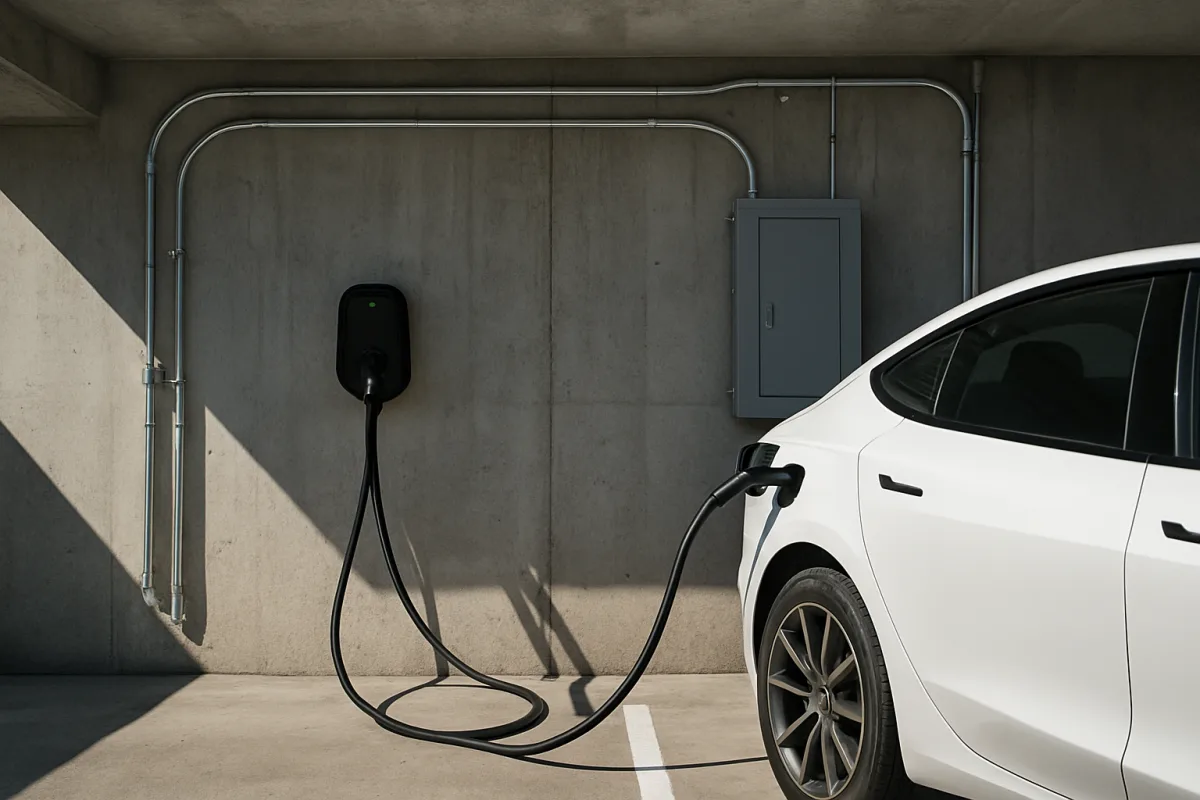
The shared-resource problem behind apartment charging
The useful way to think about apartment EV charging is not as buying a charger. It is as joining a shared electrical system without making everyone else pay for your car. That sounds bureaucratic, but it determines whether charging is convenient or a permanent public-charger routine.
A house owner can fit a 7 kW Level 2 unit to their own supply, then charge overnight at their domestic electricity rate. An apartment resident may have a deeded bay, an allocated but shared bay, a garage space controlled by a management company, or nothing but street parking.
Those are very different cases. A charger fitted beside a privately owned garage bay is still attached to common electrical infrastructure. The route for the cable, the capacity of the building’s switchgear, fire-safety requirements and electricity metering can all involve the landlord, HOA or condo association.
That is why the much-repeated charger price means little on its own. The hardware may be the smaller part of the job. The expensive surprises tend to be an electrician finding no spare capacity, a cable route requiring fire-rated containment, or a panel already close to its limit.
General US Level 2 installation estimates are $800 to $2,500 including charger hardware, electrical labour, permits and possible modest electrical work. A substantial panel upgrade can add $1,500 to $3,000. [5] Those are broad numbers, not a quote for any particular garage.
The honest answer for the new Voltpost Air Ceiling Mount and Air Surface Mount units is that no public, Voltpost-specific installed-cost data was available as of August 2026. Anyone presenting a fixed installed price for an apartment garage is guessing until the site has been surveyed.
Why mounting location matters more than it sounds
Voltpost, the company known for converting existing lampposts and utility poles into chargers, has expanded its Air range with a ceiling-mounted Level 2 charger for garages and a surface-mounted unit for walls or pedestals. InsideEVs reports that both use retractable cables.
The ceiling unit makes sense in a tight garage because nothing has to sit beside the parking bay. The cable drops from overhead when needed and retracts afterwards. That reduces the chance of a loose cable becoming a trip hazard or being driven over.
The surface-mount version is aimed at walls, existing structures and pedestal installations where there is no suitable pole. In practical terms, it is an option for the end wall of a parking row, a building facade or a car park island.
The central Voltpost pitch is avoiding excavation. The company says retrofitting existing infrastructure can cut installation costs by as much as 70 percent, because installers may avoid digging trenches through pavement and reinstating concrete or asphalt afterwards, according to InsideEVs.
That figure needs handling carefully. It describes a potential reduction against an installation that would otherwise require extensive trenching. It does not mean every apartment resident gets a charger installed for 70 percent less, or that a building with inadequate electrical capacity becomes inexpensive.
A ceiling mount can save physical space and perhaps simplify cable routing. It cannot create spare electrical capacity. Similarly, fitting a charger to a lamppost may avoid groundworks, but it still needs an approved electrical connection, billing arrangement, network service and maintenance plan.
This is the part often missed in glossy charging announcements. A charger is not useful merely because it can deliver power. Somebody has to decide whose meter is charged, what happens if it fails, who can authorize repairs and how the installation will serve the next resident.
The load-management number that matters
For a multi-unit building, the important number is not the maximum output of one charger. It is the maximum demand of all chargers at the same time, added to the building’s existing evening demand from homes, lifts, lighting, air conditioning and common services.
A basic installation treats every charger as if it might run flat out simultaneously. That can force a large and expensive electrical upgrade. Managed charging instead sets a ceiling for the whole group, then divides available power among connected cars.
Imagine a garage with several Level 2 charging points. If the building can spare only a defined amount of power overnight, software can reduce charging rates when demand is high and increase them after residents have cooked dinner and general demand falls.
That is not magic and it does not make electricity free. It is simply load allocation. For most overnight charging, a car does not need its maximum possible charging speed for every minute it is plugged in, so slower charging can still deliver a useful refill by morning.
The trade-off is ownership and trust. Residents need to know that a managed system will not leave them short before a long trip, and the building needs rules against one car occupying a shared point for days. A booking system may matter as much as the electrical hardware.
For residents with a dedicated bay, the preferable arrangement is usually a charger tied to their own meter or a clearly itemised sub-meter. For communal chargers, transparent per-kWh billing and a defined idle fee are more important than impressive peak-kW claims.
Permission is part of the installation
The regulatory picture is local rather than national. About 75 percent of surveyed US cities require electrical permits for Level 2 charger installations, with cited permit fees ranging from $100 to $349. [5] That is before considering building-specific approval and inspections.
California’s Assembly Bill 1236 requires an expedited process for qualifying EV-charger permits, including a completeness check within five business days and approval or denial within 20 business days. [5] It helps, but it does not waive electrical safety requirements or solve a building-capacity shortage.
Street-side and curbside charging adds another layer. Portland, Oregon requires a Right-of-Way License and a Master Lease Agreement for public-right-of-way charger proposals. [1] A lamppost may look like an obvious place for a plug, but it sits in public infrastructure.
Right-to-charge laws are more immediately relevant to residents with designated spaces. The Alternative Fuels Data Center identifies protections in states including California, Washington, New York, Maine and Massachusetts, preventing associations from imposing unreasonable EV-charger restrictions. [2]
“Cannot ban it” is not the same as “must fund it.” Washington’s law, for example, allows associations to require licensed installation, insurance and reasonable conditions, while placing installation, maintenance, repair and liability costs on the owner requesting the charger. [10]
That is a sensible distinction. An association can reasonably care about electrical safety, appearance, access and liability. What it should not do is use endless paperwork, arbitrary locations or punitive conditions to turn a legal right into an unusable one.
Before buying hardware, an apartment resident should establish four things in writing: whether the space is exclusively assigned, where power will come from, how electricity will be billed, and who owns the equipment when the property is sold or rented out.
Autonomous driving has the same ownership question
The latest autonomous-driving debate has a similar underlying issue: who is actually responsible when the system is operating? A driver-assistance car can automate parts of driving, but the human remains responsible. A driverless robotaxi takes responsibility for the driving task itself.
Waymo, the autonomous ride-hailing operator, argues that this distinction matters more than headline claims about artificial intelligence. InsideEVs reported its position that a supervised Level 2 system does not automatically mature into full autonomy simply by accumulating more miles with a human ready to intervene.
Its technical case centres on redundancy. Waymo’s latest system uses 13 cameras, four lidar sensors, six radar units and microphones, according to InsideEVs. Cameras read signs, signals and lane context, lidar measures three-dimensional geometry, and radar helps track objects and relative speed.
The case for combining sensors is straightforward. Lidar can create detailed depth information, while radar can function better than cameras in poor visibility. [6][7] If one sensor produces uncertain data, another may provide a check rather than letting the vehicle act on one flawed interpretation.
But sensor fusion has costs. Radar generally has poorer resolution than cameras or lidar, lidar performance can degrade in fog and heavy rain, and combining multiple streams adds computational complexity. [6][7][8] More sensors are not automatically a simpler or more trustworthy system.
There are also security and transparency questions. Complex sensor stacks make it harder for the public to understand why a car made a particular decision, while concerns have been raised about potential vulnerabilities in some lidar supply chains. [8] A redundant system still needs auditable safeguards.
Some researchers and commentators argue that better computer vision and driving models may matter more than adding lidar and radar. [9] That remains a technical argument rather than a settled fact, but it explains why camera-only systems and multimodal systems continue to coexist.
Reading Waymo’s safety claims without swallowing the marketing whole
Waymo says its autonomous fleet has covered more than 217 million fully autonomous miles and recorded 16 times fewer serious-injury crashes than human drivers, according to CarScoops. It also says pedestrian injury crashes were 14 times lower.
Those figures are promising, but company data should not be treated as the final word. Waymo’s later internal analysis of more than 220 million autonomous miles claimed 94 percent fewer serious or fatal injury crashes, alongside 82 percent reductions in airbag-deployment and injury crashes. [3]
An independent IIHS analysis is useful because it reaches a more restrained, still positive result. Looking at about 50 million Waymo miles across San Francisco, Phoenix, Los Angeles and Austin from 2021 to 2024, it found 68 percent fewer police-reportable crashes per mile than human drivers. [3]
The city variation matters. The reduction was 76 percent in Phoenix but 35 percent in San Francisco. [3] That is exactly why an overall average should not be mistaken for a universal safety guarantee, especially when different cities bring different weather, road design, traffic density and driving culture.
Waymo’s planned Munich operation illustrates the point. CarScoops reports that its vehicles will initially be manually driven while the company maps local roads and works through regulatory approval, with commercial operations targeted for the end of the following year.
That is not a weakness. It is an admission that autonomous driving is not an app update that can be dropped unchanged onto every road. There is no comparable independent crash dataset for Waymo in Munich, so American safety results cannot honestly be transplanted there yet.
For apartment charging and autonomous driving alike, the interesting innovation is not the component itself. It is the system around it: electrical capacity, rules, metering and maintenance for the charger, then sensors, maps, operational boundaries and accountability for the robotaxi.
Frequently Asked Questions
How much does it cost to install an EV charger in an apartment?
General Level 2 EV charger installation costs range from $800 to $2,500, which includes hardware, electrician labor, permits, and modest electrical work. If the building’s electrical panel needs upgrading, this can add another $1,500 to $3,000. These are broad estimates and actual costs depend on site conditions and electrical capacity.
What are the challenges of EV charging in multi-unit buildings?
Challenges include coordinating approval from landlords, HOAs, or condo associations, dealing with shared electrical infrastructure, and managing limited electrical capacity. Installation may require fire-safety compliant cable routing and metering arrangements. Additionally, the building’s total electrical demand must be managed to avoid costly panel upgrades.
How do right-to-charge laws affect apartment EV charging?
Right-to-charge laws prevent HOAs or condo boards from banning EV charger installations in designated parking spaces. However, these laws generally do not make associations responsible for installation, maintenance, insurance, or electricity costs. Residents must still follow reasonable association rules and bear all related expenses.
What are the benefits of ceiling-mounted EV chargers in garages?
Ceiling-mounted chargers save physical space by hanging overhead, reducing trip hazards and cable damage risks. They can simplify cable routing in tight garages and avoid placing bulky equipment beside parking bays. However, they do not reduce electrical capacity requirements or eliminate the need for proper metering and maintenance.
How does managed charging work for shared EV chargers?
Managed charging sets a power ceiling for all chargers combined and allocates available electricity among connected vehicles. It reduces the need for costly electrical upgrades by preventing all chargers from running at full power simultaneously. This approach requires trust, clear usage rules, and often a booking system to ensure fair access and adequate charge before trips.
How we researched this
This article was assembled from 6 published articles, 10 cited references.
Nothing here is based on hands-on testing. Where a figure or finding appears, it belongs to the source cited beside it, and the writing says so rather than implying otherwise. Every source is listed below so you can check it.
Sources
Voltpost Is Making A Charger For People Without A Driveway — InsideEVs
Lotus Is Now One Company—What That Means For Emira And EVs — Motor1
How The Volvo EX60 EV Can 'See' Deer Around Corners Through A New Update — InsideEVs
Will The New Montero Come To America? Mitsubishi Still Isn’t Sure — Motor1
Cameras 'Aren't Enough': Waymo Takes A Swipe At Tesla’s Self-Driving Strategy — InsideEVs
Information for Companies Seeking to Install EV Chargers in the Public Right-of-Way | Portland.gov
Exclusive: Waymo says there's no AI shortcut to self-driving
Understanding Lidar Sensors: Key Technology for Autonomous Vehicles
(PDF) Sensor Strategy in Autonomous Vehicles: Camera vs LiDAR vs Radar Systems
Multimodal Sensor Fusion in Autonomous Vehicles: Technologies, Architectures, and Open Challenges
Related Articles
BMW Electric Vehicle Sales Milestone and Neue Klasse iX3
Explore BMW's electric vehicle sales milestone and the Neue Klasse iX3's range, ownership, and impact on Europe's EV market.
Electric Vehicle Range Tests and New EV Developments
Explore electric vehicle range tests, efficiency, and new EV developments to understand real-world performance and ownership factors.
New Electric and Hybrid SUVs: Reviews and Comparisons
Explore reviews and comparisons of new electric and hybrid SUVs, covering performance, ownership costs, range, and driving experience.
Bentley Torcal Electric SUV: Specs, Charging & Ownership
Explore the Bentley Torcal electric SUV's specs, 800V charging, performance, price, and ownership insights for Bentley's first EV SUV.