
Aston Martin Valhalla Spider Performance
Explore Aston Martin Valhalla Spider performance, roof-off top speed, and active aero tech that keeps this hypercar stable at 217 mph.
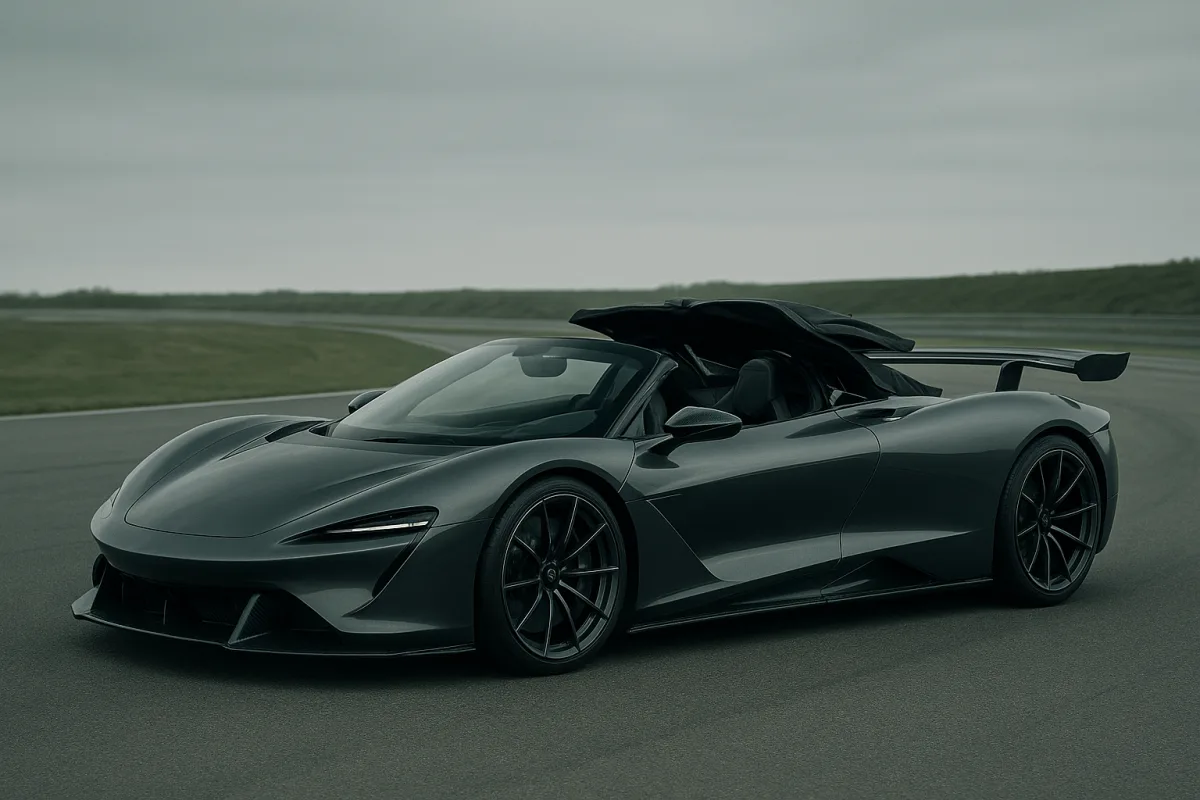
The number that matters is not 217 mph
Aston Martin’s headline for the Valhalla Spider is easy to repeat: 217 mph, roof on or roof off. It is also the figure most likely to obscure what makes the car technically interesting.
The important detail is that there are effectively three configurations. Roof removed, the Spider can reach its electronically limited 217 mph maximum. Fit the carbon-fibre hardtop and it can do the same. Fit the standard fabric roof and its limit falls to 124 mph. [1][6]
That is not a minor calibration difference. It is a 93 mph gap, and it explains why the phrase “same top speed with the roof off” needs care. The Valhalla Spider does preserve the coupe’s maximum speed while open, but not with every roof arrangement.
For the likely owner, 124 mph is already far beyond sensible road use. Still, on a car positioned at around £1.3 million, the distinction matters. A fabric roof is a weather cover, not a high-speed aerodynamic surface. [8]
The carbon panel is not merely an expensive option for a more finished-looking car. It completes the airflow shape Aston Martin needs to certify the full-speed setting. The roof-off setting is separately engineered, rather than simply accepting the aerodynamic penalty of an open cockpit.
Why an open cockpit changes everything
At ordinary speeds, removing a roof mostly changes comfort. It increases wind noise, makes conversation harder and turns a drizzle into a reason to stop. At 200 mph, it changes the pressure field around the whole vehicle.
Air approaching the windscreen normally flows over a coupe’s roof and down its rear deck in a predictable stream. That flow contributes to the pressure acting on the rear bodywork, rear wing and engine intake. Remove the roof and the air spills into the cockpit.
The cockpit becomes a low-pressure, turbulent cavity. Air curls behind the windscreen, circulates around the occupants and exits toward the rear deck. That turbulence can increase drag, create buffeting and, more seriously, alter the aerodynamic load acting on each axle.
Aerodynamic balance is the key term here. It is not simply how much total downforce a car makes. It is where that downforce acts. Too much front load relative to rear load can make a car nervous. Too much rear load can leave the front reluctant to turn.
Aston Martin says the Valhalla Spider’s systems target a 40/60 front-to-rear aerodynamic balance when running roofless. [6][7] That number is the useful one to understand, because it explains the elaborate active devices more clearly than a peak-power claim ever could.
At 217 mph, a small change in wing angle or airflow separation can have a large effect. Aerodynamic forces rise approximately with the square of speed. Double the speed and the force is roughly quadrupled, assuming the shape and airflow remain comparable.
That is why a convertible hypercar cannot rely on a fixed setup developed for the coupe. The car must recognise its roof state and actively alter its response. The Valhalla Spider has roof detection, so the relevant speed and stability calibrations follow the hardware actually fitted. [1]
The system that keeps the Spider settled
The core structure remains the Valhalla’s carbon-fibre tub, which is a major reason Aston Martin can create a removable-roof derivative without the huge weight gain traditionally associated with convertibles. The Spider is quoted at 1,680kg dry, only 25kg heavier than the coupe. [8]
That modest weight increase is important, but it is not the whole answer. Stiffness keeps suspension geometry and steering responses consistent. It does not stop disturbed air from changing the front-to-rear load distribution at very high speed.
Aston Martin therefore combines several separate systems. There is an active front wing, a dual-element rear T-wing, adjustable ride and chassis controls, active front-axle torque vectoring, and an electronically controlled rear limited-slip differential. [6][7]
The rear T-wing can rise by 255mm in Race mode. [6][7] Raising it puts the aero surface into cleaner air and changes its effective angle and leverage over the rear axle. That gives the car more ability to generate or trim rear downforce as conditions require.
At the front, the active wing adjusts its angle to maintain the intended balance. If the rear aero system adds load without a corresponding front adjustment, the car may become more stable in a straight line but less eager to turn. The systems must work as a pair.
Then there is DRS, or drag reduction, which Aston Martin says can activate above 150 mph. [6][7] In simple terms, DRS reduces wing drag when maximum downforce is not required, allowing the car to keep accelerating rather than pushing an unnecessarily large aerodynamic wall through the air.
This is the balancing act. A wing angle that improves high-speed grip usually costs top speed because it creates drag. A flatter wing helps maximum speed but can make the car less secure under braking, in a fast curve or over a crest.
The Valhalla’s software is tasked with deciding when each compromise is appropriate. It monitors the roof state and other vehicle conditions, then coordinates aero surfaces, stability control, powertrain response, braking and torque delivery. That is the real reason roof-off 217 mph is plausible. [6][7]
The plug-in hybrid powertrain helps here as well. Two electric motors drive the front axle and a third electric motor is integrated with the eight-speed dual-clutch transmission, while the twin-turbo 4.0-litre flat-plane-crank V8 drives the rear through the gearbox. Combined output is 1,064hp and 811lb ft. [6][7]
There is no mechanical propshaft linking the front and rear axles. That means front-axle torque can be adjusted rapidly and independently. If the car needs a little more rotation into a corner, or stability as it exits one, the control system has another lever to use. [7]
It is tempting to call that “electronic four-wheel drive” and leave it there. In reality, it is part of the aerodynamic strategy. The bodywork controls the air loads, while the motors and differential help the tyres cope with the resulting balance.
The hardware changes that look minor
The obvious visual addition is the removable roof, fabric as standard in some markets and carbon fibre for buyers seeking full maximum speed. In the US, Aston Martin specifies the carbon-fibre roof rather than the fabric panel. [6]
Less obvious is the revised rear intake. Aston Martin has raised the scoop by 35mm to ensure the engine continues receiving clean air despite the altered flow from an open cockpit. [8] That small dimensional change is a useful example of how interconnected the design is.
The Spider also uses a removable wind deflector, which clips behind the occupants and folds for storage in 15-litre sill cubbies. Its job is not to make 217 mph comfortable in any ordinary sense. It controls cockpit airflow and reduces the worst buffeting. [8]
That deflector has a second role. By directing air over the cabin and toward the rear of the car, it makes the airflow entering the raised intake more predictable. A roadster’s windbreak is usually discussed as a comfort feature. Here it is part of engine breathing and aero management.
The dihedral doors remain, but their design changes because there is no fixed roof structure from which to hinge them. The Spider uses frameless doors with revised geometry intended to improve access when the roof is fitted. [8]
Aston Martin fits a carbon-fibre Touring Seat as standard in the Spider, while the more aggressively shaped coupe seat remains a no-cost option. [6] This is one of the few specifications that acknowledges the likely reality of ownership: the car may travel between events rather than merely pose outside them.
Price, rivals and the awkward ownership question
Autocar reports a price of about £1.3 million, roughly 40 percent above the £850,000 coupe. [8] That figure is before options, taxes, registration and the bespoke work that tends to accompany an Aston Martin at this level.
The supplied comparison data puts the Ferrari 296 Testarossa Spider at £450,000, described as three times its coupe’s price. It suits the buyer seeking a lower-entry Ferrari Spider, although the available comparison material does not provide like-for-like technical or production data.
The McLaren Sabre Spider is listed at £2 million, against £1.6 million for its coupe, a 25 percent premium. It suits the buyer prioritising a still more expensive limited-production McLaren route, rather than the Valhalla’s particular hybrid, F1-linked Aston Martin proposition.
The Porsche 911 Turbo S Cabriolet is listed at £150,000, against £125,000 for the coupe. It suits the buyer wanting an open Porsche that remains comparatively attainable and usable, although it is not a direct hypercar rival in price, layout or exclusivity.
The Ferrari SF90 Spider and McLaren 765LT Spider are also relevant roofless performance cars because both use active aerodynamics, but the supplied research provides no comparable pricing or engineering figures for either. It would be false precision to assign them numbers not supported here.
Car and Driver also identifies the Chevrolet Corvette ZR1-X as a performance-value alternative, citing a $3,735,000 Valhalla starting comparison elsewhere in its market listings, but that is not a direct UK price comparison and does not establish a Spider equivalent. The Valhalla’s actual appeal is rarity and engineering theatre, not value.
The running-cost question remains largely unanswered because customer cars have not accumulated the years or mileages needed for meaningful ownership data. There are no established 60,000-mile failure patterns, independent service schedules or Spider-specific insurance records yet.
One published Valhalla estimate suggests about 16 mpg US and an annual fuel spend of roughly $3,067 at 12,000 miles, using its stated fuel-price assumptions. [2] That is a planning exercise, not a figure from real owners of the Spider.
Maintenance estimates of $1,500 to $6,000 annually are similarly broad, with tyres suggested at $1,200 to $2,500 per set. [3][4] Neither number captures the risk of carbon-fibre damage, bespoke component delays, track use or an out-of-warranty hybrid-system fault.
Insurance is even less certain. A Vantage-based estimate is not a sensible proxy for a limited-run £1.3 million hybrid hypercar, regardless of any superficially similar Aston Martin badge. [5] For a buyer, the realistic first call is a specialist broker, not an online comparison site.
The Valhalla Spider’s significance, then, is not that it is a coupe with a panel removed. Its 217 mph roof-off claim rests on treating roof position as an active vehicle-dynamics input, then changing aero, cooling, stability control and torque delivery around it.
Frequently Asked Questions
What is the top speed of the Aston Martin Valhalla Spider with the roof off?
The Valhalla Spider can reach its electronically limited top speed of 217 mph with the roof removed or with the optional carbon-fiber hardtop fitted. However, if the standard fabric roof is used, the top speed is significantly reduced to 124 mph.
How does the roof configuration affect the Valhalla Spider's performance?
The roof configuration greatly influences the car’s aerodynamics and top speed. The fabric roof acts mainly as a weather cover and restricts the top speed to 124 mph due to its impact on airflow and stability. In contrast, the carbon-fiber hardtop completes the aerodynamic shape, allowing the car to maintain the full 217 mph top speed either with the hardtop installed or with the roof fully removed.
What active aerodynamic features does the Valhalla Spider use?
The Valhalla Spider employs several active aerodynamic systems including a dual-element rear T-wing that rises 255 mm in Race mode, an active front wing that adjusts its angle for aerodynamic balance, and a Drag Reduction System (DRS) that activates above 150 mph to reduce drag. These features work together to manage downforce and maintain stability at high speeds.
How does the Valhalla Spider maintain stability at high speeds without a roof?
Without a roof, the Spider relies less on extra chassis bracing and more on active aerodynamic controls, airflow management, and software that continuously adjusts front-to-rear aerodynamic balance as cockpit airflow changes. The car targets a 40/60 front-to-rear aerodynamic balance to ensure stable handling despite the turbulent airflow created by the open cockpit.
What is the weight difference between the Valhalla Spider and the coupe?
The Valhalla Spider weighs approximately 1,680 kg dry, which is only about 25 kg heavier than the coupe. This modest weight increase is achieved by retaining the Valhalla’s carbon-fiber tub structure, helping to minimize the typical weight gain associated with convertibles.
How we researched this
This article was assembled from 8 published articles, 8 cited references.
Nothing here is based on hands-on testing. Where a figure or finding appears, it belongs to the source cited beside it, and the writing says so rather than implying otherwise. Every source is listed below so you can check it.
Sources
New Aston Martin Valhalla Spider: £1.3m roadster tops 217mph — Autocar
The Aston Martin Valhalla Spider Carves the Roof Off the Hypercar Without Cutting Its Top Speed — Road & Track
2028 Aston Martin Valhalla — Car and Driver
1,064-HP Aston Martin Valhalla Spider Is Actually Faster With Its Roof Off — The Drive
Aston Martin's Valhalla Spider Loses Its Top, Keeps Its 1,064 HP — CarScoops
Aston Martin's New Valhalla Spider Can Hit 217 MPH With The Roof Down — Motor1
Aston Martin Valhalla Spider Wants You To Go Topless At 217 MPH — Jalopnik
Range Rover Sport Electric driven: it really could be the best 4x4 by far — Autocar
Aston Martin Valhalla Spider does 217 mph with the roof off - DriveLife
Aston Martin Valhalla 2026 running costs — United States | KnowCarCost
The Real Running Costs of a Modern Supercar, Explained | Cool Supercars
2026 Aston Martin Vantage cost to own a year: $12,467 | GizmoDriver
2028 Aston Martin Valhalla Spider First Look: Top Off, 217-MPH Top Speed, No Problem
New Aston Martin Valhalla Spider: £1.3m roadster tops 217mph | Autocar
Related Articles

Aston Martin DBX GT Suspension Updates for 2027 Performance
Discover the 2027 Aston Martin DBX GT suspension updates that enhance luxury and performance in this high-powered SUV.
2027 Porsche Cayenne Electric Charging and Performance EVs
Explore the 2027 Porsche Cayenne Electric's 400 kW charging, performance specs, and what it means for real-world EV ownership and driving.
Mercedes-AMG GT SUV vs Porsche Mission S
Compare the Mercedes-AMG GT SUV and Porsche Mission S for luxury, performance, and ownership insights on these 2026 electric and petrol supercars.
2028 Dodge Charger Hellcat Return: What We Know So Far
Explore the 2028 Dodge Charger Hellcat return, rumored specs, ownership costs, and what to expect from this upcoming muscle car.