
2028 Dodge Charger Hellcat Return: What We Know So Far
Explore the 2028 Dodge Charger Hellcat return, rumored specs, ownership costs, and what to expect from this upcoming muscle car.
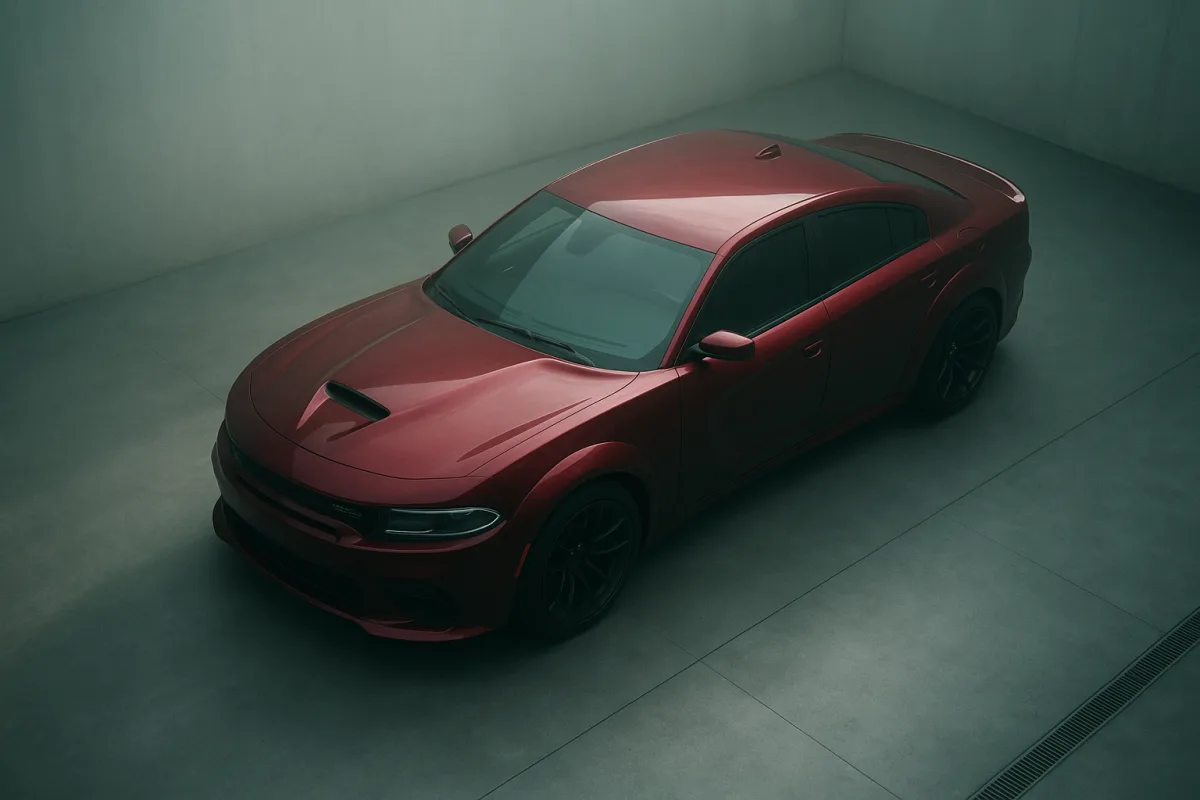
The shift is real, but the car is not official yet
Dodge appears to be reversing part of its move away from the Hemi V8. The reported plan is for a supercharged 6.2-litre Charger Hellcat to enter production late in 2027 as a 2028 model, alongside Hurricane-six and electric Daytona Chargers.
That is a meaningful change in direction. Dodge ended Charger and Challenger Hemi production after 2023, then introduced its replacement Charger first as an EV and later with twin-turbocharged 3.0-litre Hurricane inline-six engines.
The important distinction is between credible reporting and manufacturer confirmation. Car and Driver says internal documents obtained by MoparInsiders list a supercharged V8 Charger for 2028, but also says Dodge had not replied to its request for confirmation. [2]
Motor1, Road & Track and Jalopnik have all reported broadly the same late-2027 production timing and a target of approximately 12,000 Hellcats annually. Their reporting traces back to supplier information, Automotive News reporting and apparent internal planning documents, rather than a Dodge press release.
That makes this stronger than a forum rendering or a dealer rumour. It is still not the same thing as an order guide, EPA certification, pricing announcement or a production car parked under lights at Roadkill Nights.
Why this is happening now
The simple answer is that the first stage of Dodge’s Charger replacement strategy did not recreate the old car’s appeal. The Daytona EV offered very serious performance on paper, but muscle-car buyers are not purchasing only a number.
A Hellcat Charger is not merely a 700-plus-horsepower sedan. It is a particular combination of noise, mechanical theatre, rear-wheel-drive behaviour, aftermarket familiarity and the slightly unreasonable sense that a family car should be able to haze its tyres.
The Hurricane-powered Charger fills some of the performance gap and may be a better all-weather daily driver. But six cylinders and all-wheel drive do not land with the same buyers who spent years identifying Dodge with the Hemi.
Motor1 reports that Dodge had sold 8,029 combustion Chargers through September, a substantial percentage increase over the prior year but still far below the final old-generation volumes. The last full run recorded 75,920 Charger sedans and 44,960 Challenger coupes. That is the scale Dodge is trying to recapture.
A reported 12,000-unit Hellcat plan is more restrained than those old total Charger and Challenger numbers. It looks less like a wholesale return to the past than a calculated halo-car programme aimed at people Dodge knows it lost.
The wider brand picture matters too. Road & Track reports Dodge may be close to returning to NASCAR’s Cup Series, potentially beginning with Kaulig Racing. That remains unfinalised, but a NASCAR return and a V8 Charger revival would make obvious marketing sense together.
Neither development proves the other. A Cup car does not need a showroom Hellcat engine, and a Hellcat does not require a NASCAR programme. Still, both point toward Dodge leaning back into an American V8 identity while other Stellantis brands carry more of the electrification burden.
What the reported specification actually says
The most consistent reports say the new Charger Hellcat would use the supercharged 6.2-litre Hemi V8, a ZF 8HP95 eight-speed automatic transmission and rear-wheel drive. Car and Driver says both the two-door and four-door Charger bodies are expected to receive it. [2]
Rear-wheel drive is not a small detail. The current Hurricane Charger is sold with all-wheel drive, so a rear-drive Hellcat would be more than an engine swap in a catalogue. It implies Dodge is developing a distinct drivetrain configuration for the new platform.
The 8HP95 is also worth noticing if you are planning a project. It is a transmission engineered for big torque, but no source says Dodge will sell the 2028-specific calibration, controllers, harnesses or fitment parts to the aftermarket.
Do not read “Hellcat returns” as “new parts bin for every old Charger build.” The new car may share an engine family name, but electronic architecture, cooling packages, accessory drives, emissions hardware and immobiliser systems can make modern powertrain swaps costly quickly.
Horsepower is the largest blank. Car and Driver floated two possibilities: the familiar 717-hp configuration or a version closer to the 777-hp supercharged 6.2 used in the future Ram 1500 SRT TRX. Neither figure is confirmed for the Charger. [2]
Historical Hellcat outputs show why guessing is unhelpful. The standard Hellcat made 707 hp and 650 lb-ft, while the Hellcat Redeye was rated at 797 hp and 707 lb-ft, and the Jailbreak at 807 hp and 707 lb-ft. [1]
Those numbers are useful benchmarks, not 2028 specifications. Dodge has not published power, torque, boost pressure, cooling changes, kerb weight, top speed, braking hardware, tyre sizes or quarter-mile claims for the supposed new model.
The ownership questions remain unanswered
The old Hellcat’s official fuel economy should not be recycled into a story about the new one. A 2018 Charger SRT Hellcat was rated at 16 mpg city, 22 mpg highway and 19 mpg combined, but those figures do not predict the economy of a heavier, newer and differently certified 2028 car. [4]
There is no EPA fuel-economy label, emissions certificate or official compliance statement for the reported 2028 Hellcat. Anyone promising a combined mpg number, range between fill-ups or road-tax figure today is filling gaps with assumptions.
Pricing is equally open. MotorTrend lists the current 2026 Charger range from a $51,990 SXT rear-drive model to just under $91,000 for an 807-hp SRT Jailbreak. [3] That is a broad ladder, not evidence of a 2028 Hellcat sticker.
For context, the 2018 Charger SRT Hellcat began at $66,295. [4] A new Hellcat positioned above the current Jailbreak is plausible, especially with a new platform and modern safety equipment, but plausible is not a number you can finance.
Insurance could be one of the less glamorous reasons to wait. Estimates for a current 2026 Dodge Charger average roughly $2,400 to $3,400 per year, while the Charger Daytona EV is reported at approximately $2,500 to $5,000 because of repair cost and technical complexity. [5] [6]
Those figures are not quotes and should not be presented as a 2028 Hellcat forecast. A 700-plus-horsepower rear-drive car can produce very different premiums depending on driver age, postcode, mileage, security, claims history and insurer appetite.
The market does not justify easy optimism
A V8 revival does not automatically make every old Hellcat a collector car. The independent market data in the research is mixed, but it points away from the notion that every supercharged Dodge is appreciating because it is no longer sold new.
CarSearch.Pro reported Charger Hellcat Redeye values falling 2.0 percent in the fourth quarter of 2026, to a median of $32,988. [8] That is only one dataset, but it is a useful corrective to the usual “last of the V8s” sales pitch.
CarScout listings for 2026 Charger SRT Hellcats range from $34,995 to $139,500 at around 25,000 miles. [9] That enormous spread tells you more about condition, mileage, provenance, modifications and seller expectations than it does about a single dependable market value.
New Chargers have also not been immune to depreciation. One tracking source estimated a 9.0 percent, or $2,151, loss by August 2026. [10] The data is limited, but it undercuts the claim that a Dodge badge alone protects an owner from normal market behaviour.
For a buyer planning a project, that can be good news. Softening values may create better opportunities to buy an unmodified, documented car. The trap is assuming a cheap Hellcat is cheap to own after tyres, brakes, fuel, insurance and deferred maintenance arrive.
What this means for a Charger project
If your project is an older 2006-2023 Charger or Challenger, the sensible plan is unchanged: prioritise a straight shell, complete service history, unmodified wiring and a drivetrain that has not spent its life on borrowed tyres and questionable tuning.
I have not driven the reported 2028 model, because no production example has been shown or confirmed. I would not advise delaying a sound current project for it, particularly when its price, service requirements and parts compatibility remain unknown.
The practical upside of the rumour is indirect. A new V8 flagship could preserve attention around Hemi specialists, performance shops and the broader Mopar aftermarket. It may also make Dodge more willing to support the V8 story with parts and events.
The practical downside is that manufacturers increasingly lock performance cars behind software, networked modules and security systems. Even if the 2028 Charger uses the familiar 6.2-litre displacement, that does not mean its powertrain will be simple to transplant or tune.
Buy the current car you can inspect and maintain. The reported 2028 Charger Hellcat is evidence that the V8 muscle-car market still has influence, not yet a reliable foundation for a build budget or a five-year ownership plan.
Frequently Asked Questions
When will the 2028 Dodge Charger Hellcat be released?
The 2028 Dodge Charger Hellcat is reported to enter production in late 2027 as a 2028 model year vehicle. However, Dodge has not officially confirmed this timing, so it remains unconfirmed but credible based on supplier and internal document reports.
What engine and drivetrain will the 2028 Dodge Charger Hellcat have?
Reports indicate the 2028 Charger Hellcat will use a supercharged 6.2-litre Hemi V8 engine paired with a ZF 8HP95 eight-speed automatic transmission and rear-wheel drive. This represents a shift from the current Hurricane-powered Charger, which uses all-wheel drive.
How does the 2028 Dodge Charger Hellcat compare to previous models?
The 2028 model is expected to return to a rear-wheel-drive layout and use a new platform, differing from the current Hurricane inline-six AWD Charger. While it shares the supercharged 6.2L V8 family name with past Hellcats, the new car’s electronic architecture and drivetrain components are new, so it is not a direct continuation of older Hellcat hardware.
What are the expected ownership costs for the 2028 Dodge Charger Hellcat?
Specific ownership costs for the 2028 Hellcat are not available. Current Charger insurance estimates range from $2,400 to $3,400 annually, but these are only starting points and may not reflect the 2028 model. Buyers should budget for insurance, fuel, tires, and financing rather than focusing solely on horsepower or performance.
Will the 2028 Dodge Charger Hellcat use the same parts as older models?
No, the 2028 Charger Hellcat uses a new platform and drivetrain configuration, including a new transmission and electronic systems. This means parts and calibrations from older Hellcat models are unlikely to be compatible or interchangeable with the new model.
How we researched this
This article was assembled from 5 published articles, 10 cited references.
Nothing here is based on hands-on testing. Where a figure or finding appears, it belongs to the source cited beside it, and the writing says so rather than implying otherwise. Every source is listed below so you can check it.
Sources
2028 Dodge Charger to Gain Supercharged V-8, Documents Show — Car and Driver
Dodge’s Return to NASCAR Could Be Imminent, New Report Claims — Road & Track
A New Dodge Charger SRT Hellcat Could Return By End Of 2027 — Motor1
Dodge Wants To Bring Back The V8 Hellcat — Jalopnik
Dodge Charger SRT Hellcat Reportedly Tipped to Return for 2028 Model Year — Road & Track
Used Hellcat Buyer's Guide: What 717 Horsepower Really Costs | TrueCostMotors
2026 Dodge Charger Depreciation - Lost 9.0% | CarResaleValue
Related Articles
Bentley Torcal Electric SUV Ownership and Maintenance
Explore Bentley Torcal electric SUV ownership, maintenance, and driving experience insights for the 2028 model.
High-Performance Car Builds
Explore high-performance car builds, comparing drift setups, exotic mods, costs, and ownership challenges in this detailed guide.
2027 BMW 3 Series M350 vs i3
Compare the 2027 BMW 3 Series M350 and i3 models on performance, ownership costs, and market challenges to find which suits your needs best.
Exotic Car Restoration Stories and Ownership Insights
Explore exotic car restoration stories, ownership challenges, and costs for high-performance rebuild projects like Ferrari and Lamborghini.