
Electric and Hybrid Vehicle Market Trends and Innovations
Explore electric and hybrid vehicle market trends, innovations, and practical ownership insights including small EVs, charging, and financing.
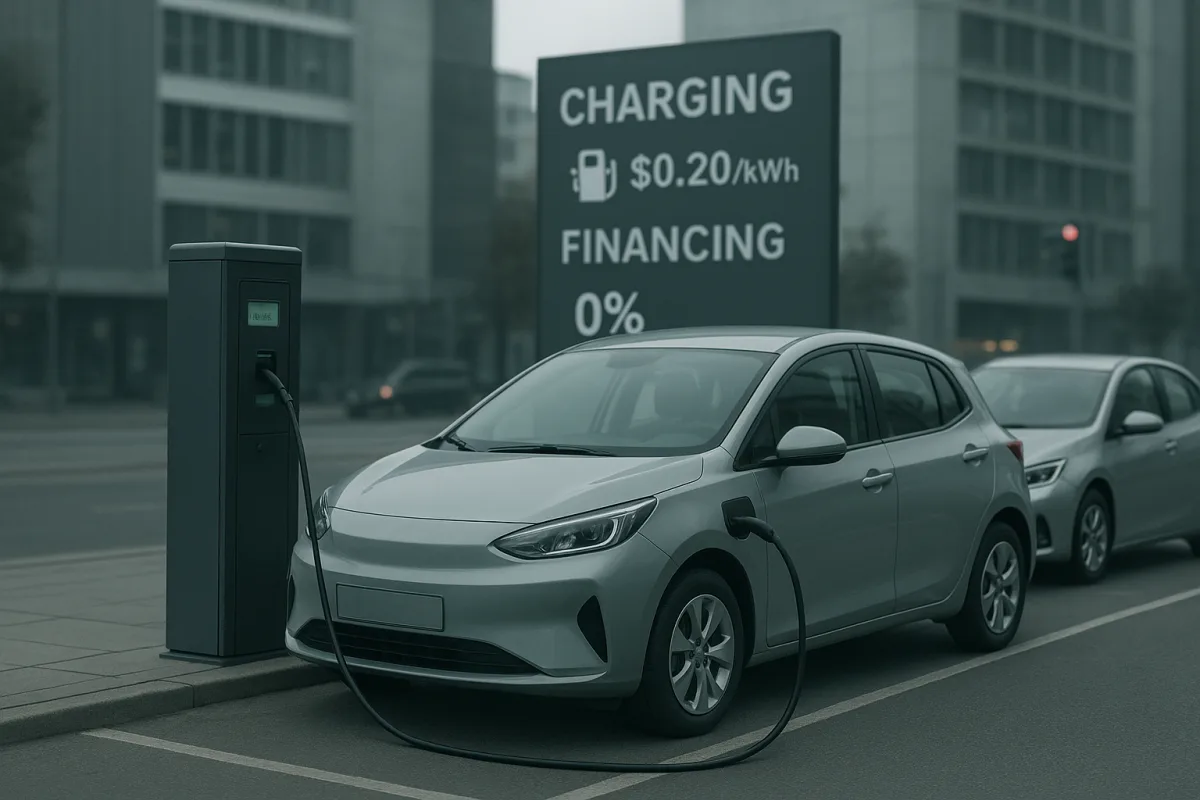
The shift is toward practical electrification, not an all-electric takeover
The plain version is this: the EV market is becoming more selective. Carmakers are still investing in batteries, charging and software, but the strongest signs of life are affordable small cars, hybrids, and charging sites that fit into normal travel habits.
That is a different market from the recent period when every manufacturer seemed to be announcing a huge electric SUV with a four-figure monthly payment. Buyers are asking more ordinary questions now: where will it charge, what happens after warranty, and can the payment survive an interest-rate rise?
Several independent developments point in the same direction. Smart has revived the two-seat city-car idea, Citroën is preparing a low-cost 2 CV-inspired EV, Mini is offering electric versions alongside petrol models, and Jeep is openly considering electrified compact off-roaders.
Meanwhile, the charging network is still expanding, although less quickly than it did a year earlier. InsideEVs, citing charging-data company Paren, reports that the U.S. passed 80,000 public fast-charging ports after adding 4,106 ports in the third quarter.
This is not the same as saying the infrastructure problem is solved. The pattern matters more than the total. Most new capacity is going into large metro areas and busy corridors, while rural deployment remains thin. That distinction will matter far more to an owner than a national charger count.
Small EVs are back on the agenda in Europe
The clearest product signal comes from the new Smart #2. Car and Driver and Jalopnik both describe a production return to the old Smart Fortwo formula: a very short two-seat electric city car, rear-drive, with a split tailgate and a focus on fitting into crowded European streets.
The Smart #2 is 108 inches long, uses a 35.8-kWh LFP battery and has an 80-horsepower rear-mounted motor. Smart quotes about 180 miles on the WLTP cycle, plus a 10% to 80% DC charging time of 20 minutes.
That range needs translating before it becomes a buying decision. WLTP results are generally friendlier than U.S. EPA figures, particularly for a small EV used at sustained motorway speeds, in winter, or with cabin heat working hard. There are no independent range tests yet.
Smart’s European starting price is €19,990, according to the research briefing. That price covers the car, not insurance, home-charger installation, electricity, finance interest, registration costs, or the inevitable option creep that tends to find its way onto small premium-branded cars. [5]
The Smart #2 suits a city household with off-street charging, a commuter doing short predictable journeys, or someone replacing a second petrol car rather than a family’s only vehicle. Its LFP battery chemistry and vehicle-to-load function are sensible ownership details, not showroom gimmicks.
It does not currently suit an American buyer, because there is no confirmed U.S. sale date, specification or price. That is worth stating plainly, since the old Fortwo had a U.S. presence and the demand for compact urban EVs is often discussed as though availability were the same thing.
Depreciation is another unanswered question. There is no Smart #2 used-market data because the car is too new, and its resale value will depend on battery condition, parts support, software support and whether urban buyers continue to want cars this small.
The closest cautionary reference is the previous Smart Fortwo Electric Drive. Kelley Blue Book listed a 2016 example at roughly $10,800 retail resale value and around $6,500 trade-in value in mid-2026, though condition, mileage and local demand can move those figures substantially. [6]
Across the broader market, one depreciation calculator estimates average EV depreciation at 57.2% over five years. That is a broad industry figure, not a Smart #2 forecast, but it explains why buying on monthly payment alone can be an expensive way into an EV. [7]
Affordable European EVs are becoming more deliberate
The Smart is not alone. At the Paris Motor Show, The Drive reported that Citroën’s 2 CV Concept points toward a production-oriented small EV expected within two years, with a target starting price of roughly €15,000.
The Citroën 2 CV successor is aimed at buyers who need inexpensive everyday transport rather than long-distance luxury. As with the Smart, that advertised entry price would not include insurance, finance, charging equipment, registration, or country-specific taxes. It is also still a concept-led programme, not a car ready for a used-car search.
Peugeot’s E-T16 Concept makes the opposite point. The tri-motor electric hatchback and its Hypersquare steering controller show what steer-by-wire could enable, including variable steering ratios and a small square control rather than a conventional wheel.
But the Peugeot E-T16 is a concept, and concept-car performance claims are not ownership evidence. The Drive correctly notes the unanswered question with steer-by-wire: without a mechanical connection to the wheels, steering feel is generated by software. That needs years of production use, not a show-stand demonstration.
For a buyer planning a project, these cars matter because they show where European engineering effort is going. Low-cost EVs are being designed around battery packaging, urban access and simpler use cases, while more advanced hardware is arriving first as expensive or experimental technology.
Hybrids are filling the gap EVs have not closed
Hybrids are benefiting from the uneven charging picture. Experian data reported through Dealership Tech Report found that hybrids accounted for 16.8% of new-vehicle financing, at a time when the average new loan had reached $43,610 and the average payment was $765. [9]
That is not a romantic reason to buy a hybrid, but it is a real one. A hybrid lets an owner reduce fuel consumption without first solving apartment charging, rural travel, a landlord’s electrical supply, or a workplace’s willingness to install a charger.
Jeep’s European leadership has suggested a possible Willys-inspired compact model combining a small footprint, off-road capability and electrification. CarScoops stresses that this is still an idea rather than a confirmed production vehicle, with no price or launch date.
The proposed Willys-style Jeep would suit buyers who want compact dimensions and genuine rough-road ability, but it is too early to budget around it. Jeep’s present roadmap includes the electric Recon and future Renegade replacement, while the Willys proposal may not arrive before 2030.
Mini’s 2027 Countryman Untamed Edition is a more immediate example of manufacturers broadening choices rather than betting everything on one drivetrain. It will be offered in North America on the petrol Countryman S All4 and electric Countryman SE, though Europe receives only the electric version.
Car and Driver lists the petrol 2027 Mini Countryman S All4 Untamed Edition at $45,250 before tax, registration, insurance, finance charges or accessories. It suits a buyer who wants a small crossover for gravel roads, snow and occasional towing, not serious rock crawling.
The Countryman’s modest 0.6-inch lift, all-terrain tyres and 8.8 inches of ground clearance may be useful on rutted access roads and campsite tracks. The same report found that the traction-control software could become intrusive on loose surfaces, which is the sort of limitation a spec sheet will not tell you.
Charging is improving, but the useful detail is location
The U.S. added 664 fast-charging stations in the third quarter, according to Paren data reported by InsideEVs. Deployment was down year over year, yet the network still passed 80,000 public fast-charging ports, and charging sessions hit 17.6 million in July.
New equipment is also becoming more capable. InsideEVs reports that 73% of new fast-charge ports installed in that quarter could supply at least 250 kW, up from 60% a year earlier, while 400-kW hardware has become a common choice for new sites.
That does not mean every EV will charge at 250 kW, never mind 400 kW. Battery temperature, charge level, route planning and each car’s voltage architecture still determine the result. A vehicle advertised with a 350-kW peak may only hold that rate briefly.
The useful shift is that more chargers are appearing where drivers already stop: petrol stations, travel centres, retail sites and fleet hubs. Uber’s planned $100 million charging investment in hubs around San Francisco, Los Angeles and Dallas is another sign that private operators see charging as transport infrastructure, not a side business. [2]
Federal standards matter here too. The National Electric Vehicle Infrastructure programme requires federally funded U.S. charging projects to meet rules on reliability, payment, data sharing, accessibility and 97% uptime. Those requirements are more valuable than another optimistic press release about plug counts. [1]
There is a catch. The federal EV charger tax credit expires on June 30, 2026, which removes some certainty for home and business installations after that date. Anyone planning a charger project should check eligibility and installation timing rather than assuming support will remain in place. [4]
Europe is taking a more regulatory route. The EU’s Alternative Fuels Infrastructure Regulation sets national infrastructure targets, while the revised Energy Performance of Buildings Directive pushes charging provision in homes and workplaces as Europe works toward supporting 40 million EVs by 2030. [10]
From April 2026, updated EU measuring rules require visible measurement data and replaceable charging cables in relevant equipment. New and renovated public chargers also face ISO 15118 compliance requirements, which should improve interoperability but can add cost and complexity for operators. [11]
Software claims are getting a necessary reality check
The other major trend is less about batteries than language. Tesla has renamed Full Self-Driving as Tesla Assisted Driving on European sales sites after German regulators argued that the original name overstated what the system can do.
Motor1 notes that the European system remains SAE Level 2 driver assistance. It can steer, accelerate, brake and change lanes in supported conditions, but the driver must watch the road and take over immediately when required.
That is not merely legal wording. Tesla’s U.S. driving technology remains under NHTSA scrutiny following concerns including red-light violations and crashes, according to Associated Press reporting. The investigation does not prove every system is unsafe, but it does make hands-off assumptions irresponsible. [3]
The European version has reportedly undergone extensive Dutch testing, but approval is not the same thing as a safety guarantee. Reports of phantom braking and awkward edge cases are still anecdotal, and there is no comprehensive independent comparison of U.S. and European system performance.
For an owner, the sensible approach is to value driver assistance as fatigue reduction on a long motorway run, not as a substitute for attention. It may make a car easier to live with, but it should not be priced into your purchase as autonomous driving.
What this means when planning your own car project
If the project is buying a new daily driver, start with parking and charging rather than acceleration figures. A small EV such as the Smart #2 makes sense only if its size, range and charging routine match the life you actually lead.
If charging at home is uncertain, a conventional hybrid or plug-in hybrid may be less elegant on paper but easier to own. It avoids dependence on public charging while still reducing fuel use in stop-start driving, where many petrol engines are at their least efficient.
If the project is a used EV, budget for a battery-health report before arranging finance. Lenders can demand higher down payments on used EVs, particularly for three-to-six-year-old cars, and buyers with credit scores below 600 may face APRs above 20%.
That makes condition more important than badges or touchscreen features. Check battery warranty transfer rules, DC charging history where available, tyre wear, suspension condition, software support, accident repairs and whether the charging port works consistently on both AC and DC.
Finally, do not confuse an expanding market with a settled one. The evidence supports real progress in cheaper EVs, faster charging and hybrid demand. It does not yet support treating public charging, resale values, advanced driver assistance or long-term finance costs as solved problems.
Frequently Asked Questions
What are the current market trends for electric and hybrid vehicles?
The EV market is currently split between inexpensive city EVs and hybrids, which are gaining attention, and more expensive battery electric cars that rely heavily on usable charging infrastructure and realistic financing terms. Buyers are focusing on practical questions such as charging availability, warranty coverage, and affordability rather than just vehicle features or high monthly payments.
How are affordable electric vehicles evolving in Europe?
Affordable European EVs are becoming more deliberate and focused on practical urban use. New models like the Smart #2 and Citroën’s 2 CV successor target city households and commuters with short predictable journeys, featuring modest prices around €15,000 to €20,000 and smaller battery capacities suited for everyday transport rather than long-distance travel.
What impact does charging infrastructure have on EV adoption?
Charging infrastructure remains a key factor in EV adoption, with most new fast-charging capacity concentrated in large metro areas and busy corridors, while rural deployment remains sparse. This uneven distribution means EV owners must plan trips around reliable charging locations rather than relying on headline charging speeds or national charger counts.
Why are hybrids still popular despite growing EV options?
Hybrids remain a lower-risk choice for drivers without dependable home charging, appealing to those concerned about charging availability and cost. They accounted for 16.8% of new-vehicle financing as of mid-2026, partly because average new-car payments have risen, making hybrids a more affordable and practical option for many buyers.
What should buyers know about electric vehicle depreciation?
Electric vehicles generally depreciate faster than conventional cars, with an average depreciation rate of about 57.2% over five years. For ultracompact EVs like the Smart #2, there is no direct resale data yet, but previous models such as the 2016 Smart Fortwo Electric Drive show significant value drops, influenced by battery condition, parts and software support, and ongoing urban demand.
How we researched this
This article was assembled from 8 published articles, 11 cited references.
Nothing here is based on hands-on testing. Where a figure or finding appears, it belongs to the source cited beside it, and the writing says so rather than implying otherwise. Every source is listed below so you can check it.
Sources
Smart #2 Is an Ultracompact City Car with Mercedes-Benz Style — Car and Driver
This Guy Got More Power From a Harbor Freight Engine Using Old-School Hot-Rod Techniques — The Drive
America Now Has More Than 80,000 Public Fast Charging Ports — InsideEVs
Tesla Rebrands Full Self-Driving In Europe After Regulators Called Name Misleading — Motor1
Jeep Could Go Back To Basics With A Modern Willys — CarScoops
Fortwo-Succeeding Smart #2 Keeps The Bench Seat And Splitgate Alive — Jalopnik
The 2027 Mini Countryman Untamed Edition Can Climb Like a Goat, But Its Software Stumbles — Car and Driver
This Square ‘Steering Wheel’ Could Only Work With Steer-by-Wire — The Drive
Uber to spend $100 million on charging for electric robotaxis
Tesla granted more time in US investigation into its self-driving tech
Smart looks set to scale down again with its forthcoming ultra-compact electric city car
2016 smart fortwo electric Depreciation Value | Kelley Blue Book
Full Self-Driving is 'misleading' says Germany's Ministry of Transport
Related Articles
Electric Vehicle Range Tests and New EV Developments
Explore electric vehicle range tests, efficiency, and new EV developments to understand real-world performance and ownership factors.
Luxury Exotic Car Market Trends and Ownership Insights 2026
Explore 2026 luxury exotic car market trends, auction prices, and ownership costs to make informed buying decisions.
BMW Electric Vehicle Sales Milestone and Neue Klasse iX3
Explore BMW's electric vehicle sales milestone and the Neue Klasse iX3's range, ownership, and impact on Europe's EV market.

2026 Honda CRV Trail Sport Hybrid Review: Quiet Ride & Continental Tires
TheStraightPipes review the 2026 Honda CRV Trail Sport Hybrid, praising its quiet ride and Continental tires. They critique the lackluster Trail Sport features and high price, suggesting opting for a non-hybrid CRV instead.