
Luxury Exotic Car Market Trends and Ownership Insights 2026
Explore 2026 luxury exotic car market trends, auction prices, and ownership costs to make informed buying decisions.
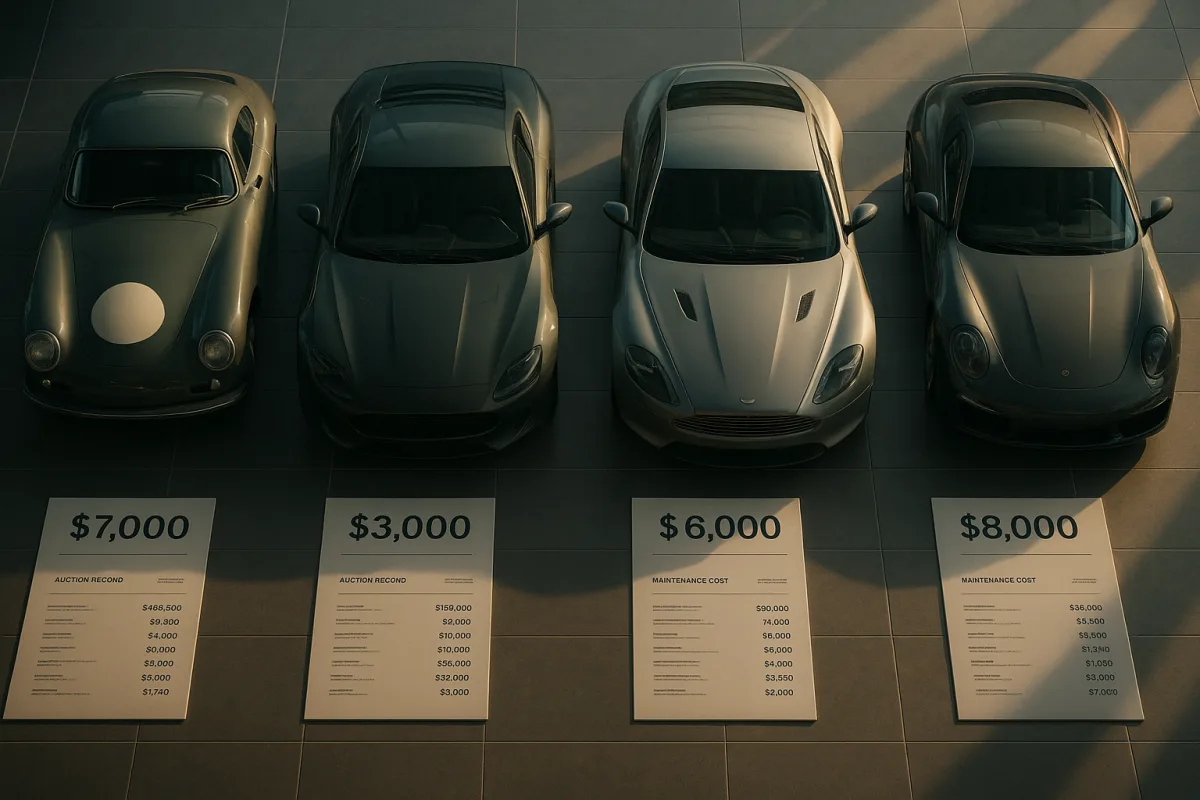
The market has split, not simply risen or fallen
The luxury and exotic market has separated into two very different businesses. Exceptional collector cars with rarity, history and impeccable presentation are achieving extraordinary auction numbers, while mainstream high-end models face softer demand, heavier depreciation and more cautious finance.
That distinction matters because auction headlines can create the impression that every Ferrari, McLaren or Aston Martin is appreciating. They are not. The evidence points instead to a very narrow top end pulling away from the cars most people actually consider owning.
At Monterey Car Week in 2026, the 1964 Shelby Cobra Daytona Coupe sold for $42.905 million through Gooding & Christie’s, becoming the highest-priced American car sold at auction. [1] RM Sotheby’s also recorded a $40 million sale for a 2026 Ferrari Luce Tailor Made. [2]
The same event produced a $34.655 million result for a 1996 McLaren F1 GTR at RM Sotheby’s, a record for a British-built car at auction. [2] Octane Magazine’s reporting put the combined Monterey auction total at $718 million, underlining that this was not one isolated bidding contest. [3]
Then there were the secondary records: a 1963 Chevrolet Corvette Grand Sport at $18.705 million, a 2023 Ferrari Daytona SP3 at $17.825 million, and a 1996 Ferrari F50 at $14.575 million. [2][3] These are genuine signals of intense demand, but only for an unusually small slice of the market.
Mr JWW’s Monterey auction footage captures the emotional part of this market well: packed rooms, rapid telephone bidding and values apparently moving in real time. But the video’s apparent top-ten figures should not be used as definitive sale data, since the independently compiled 2026 results show a different ranking and higher headline sales.
Rarity now carries more weight than the badge
The auction market is rewarding cars that can be explained in a sentence: first of something, one of very few, a competition car, a known ownership chain, or a specification nobody can replicate. That is a stronger proposition than merely being expensive when new.
A McLaren F1 GTR is not being bought as a substitute for a new McLaren Artura. Nor is a Shelby Daytona Coupe competing with a new Corvette. These are historically specific objects, with motorsport relevance and a finite supply that cannot be expanded.
That distinction is why the $11.555 million 1985 Ferrari 288 GTO and the two Ferrari Enzos, at $12.1 million and $10.675 million, should be read carefully. [2][3] They validate the very top end of Ferrari collecting, rather than every V12 Ferrari or every limited-run supercar.
The same applies to the Aston Martin DB4 GT Zagato mentioned in Mr JWW’s auction coverage. A rare British 1960s coachbuilt car attracting eight-figure interest says little about the likely resale value of a modern Aston Martin bought for regular road use.
For somebody planning a purchase, this is the point where the brochure and the real world separate. Limited production is helpful, but it is not enough. A limited car still needs a following, an established specialist network, a coherent history and buyers who can afford to keep it pristine.
The middle of the luxury market is under pressure
The Drive reports that Bentley, Porsche and Aston Martin are all dealing with a weaker luxury market, while Ferrari and Bugatti remain comparatively insulated by lower volumes and intentionally restricted supply. [2] That is the central tension in the current market.
Porsche’s problem is particularly instructive because it is not a tiny maker with only one product line. The Drive described its previous year as its worst since 2009, with China down 26 percent, while Bentley sales fell 4.8 percent overall. [2]
Aston Martin’s figures are more severe. The company’s 2025 revenue fell 21 percent to £1.26 billion, while operating losses rose 161 percent to £259.2 million. [11] This is not merely a question of buyers losing interest in V12 engines or leather-lined cabins.
It is a combination of expensive money, economic uncertainty, tariff exposure, increasing competition and customers asking whether the replacement model is sufficiently better than the car already in their garage. In the expensive middle, a facelift, new wheel design or revised screen is not always enough.
The Drive’s dealer reporting is useful here because it describes the buyer’s logic rather than only a manufacturer’s quarterly results. A customer paying several thousand dollars per month is still a customer, and is likely to notice when the new car is only incrementally different. [2]
Electrification has complicated the decision further. The market has not rejected electrified performance outright, but the pace has slowed, and hybrids have become a safer bridge for manufacturers than a full commitment to battery-only luxury cars.
Aston Martin has responded accordingly. Chief executive Adrian Hallmark announced a production cap of 6,500 to 7,000 cars annually, down from a previous 10,000-car ambition, aiming to protect exclusivity and profitability. [9] The company has also delayed its full EV plans into the 2030s. [11]
That strategy may make sense for Aston Martin, but it does not automatically improve the value of every used DB11 or Vantage. Reduced future production can support the brand’s long-term positioning, yet a buyer of a used car still faces the immediate questions of depreciation, finance and maintenance.
Depreciation remains the ownership opportunity
The useful news for an owner rather than an investor is that depreciation has made certain exotics much more attainable. The dangerous news is that the original owner’s depreciation saving can become the second or third owner’s repair bill.
A 2018 McLaren 720S, for example, has fallen from around $350,000 when new to roughly $160,000 in the finance research briefing. That changes the loan-to-value calculation dramatically, particularly when a lender sees an older exotic with substantial mileage and a complicated service record.
The research briefing puts typical 570S depreciation at roughly 30 to 35 percent, from a $198,500 original price to about $120,000 to $140,000. A 720S is estimated to have lost around 25 to 30 percent, leaving many cars around $180,000 to $220,000.
These are broad market indications, not guaranteed prices for any particular chassis. Colour, options, accident history, warranty status and dealer support matter. A well-kept car with annual servicing at a recognised specialist may be materially more valuable than a superficially similar cheap one.
The McLaren 765LT is the counterexample worth noting. The briefing estimates it retains about 38 percent of original MSRP after five years, with current values around $529,000 against a $382,000 MSRP. That is exactly the collector-market split in miniature: scarcity and demand can overpower ordinary depreciation.
Aston Martin presents another version of the same story. The research briefing estimates that a DB11 can lose 15 percent in its first year and about 35 percent over three years, falling from €293,500 to €190,775, while the more exclusive DBS retains an estimated 83 percent after five years.
Bentley’s Bentayga remains a reminder that luxury SUVs are not immune. The briefing estimates 30 to 40 percent depreciation over five to six years, from around $230,000 to roughly $155,000 to $185,000. It suits the buyer who wants comfort and daily usability, not someone expecting a collector return.
Finance is part of the car, not a separate decision
At today’s prices, finance terms can alter the cost of ownership more than a modest difference in purchase price. Several exotic-finance guides place well-qualified borrowers, generally those with credit scores above 740, in a 5.5 to 8.5 percent APR range. [4][5][6]
Typical down payments are 15 to 20 percent, though lenders assess the individual car and borrower rather than using a simple fixed formula. [5][7] Terms can run to 180 months for some high-value cars, which lowers the monthly payment but increases interest exposure and negative-equity risk. [4][5]
The sensible rule from the finance research is that exotic-car payments should be no more than 10 to 15 percent of gross monthly income. [6][7] That is not a glamorous figure, but it leaves room for insurance, tyres, storage, servicing and the repair that arrives at precisely the wrong time.
Older cars can be harder to fund than newer ones. Lenders may impose age and mileage limits, especially beyond 20 years old or roughly 75,000 miles, because maintenance risk and resale certainty decline. [5][6] Complete records can improve both approval odds and the terms offered. [7]
This is where auction values can be actively misleading. A $10 million Ferrari is generally purchased by someone who can absorb a major change in value. A $140,000 McLaren financed aggressively by an ordinary enthusiast is a very different risk, despite the cheaper entry price.
The repair reserve determines whether the project works
I have not owned or driven every car in this market, so the maintenance figures below are not presented as personal workshop experience. They are best treated as planning numbers, then checked against a marque specialist before money changes hands.
For Aston Martin ownership, the available estimates suggest $1,500 to $2,500 annually for routine maintenance, rising to roughly $2,500 to $4,000 once tyres and brakes are included. [12][13] Electrical faults, manual-clutch replacement and suspension wear after around 40,000 miles are recurring concerns in the briefing.
Aston Martins also tend to dislike inactivity. A car parked as an ornament can develop battery, electrical and seal-related problems that do not show up during a short viewing. A regular but sympathetic use pattern, battery conditioning and documented preventative work are more valuable than a tiny odometer reading alone.
Bentley ownership needs an even larger routine allowance. Available estimates place annual maintenance above $2,000, before major wear items or faults. [14] There is no equally detailed 2026 evidence in the research briefing identifying model-specific Bentley failures, so it would be irresponsible to invent a definitive list.
For McLaren, the research briefing estimates $2,000 to $3,000 annually for basic servicing, while extended service contracts can add $4,000 to $6,000 per year. That means a warranty is not a free comfort blanket, it is a known operating cost that needs comparing with repair exposure.
Model choice matters sharply. The MP4-12C has documented hydraulic-suspension failures between roughly 40,000 and 80,000 miles, with suggested repair costs of $10,000 to $15,000. A 650S can suffer door-actuator issues costing around $3,000 to $5,000, while 570S HVAC repairs are estimated at $4,000 to $8,000.
A 720S’s reported door-alignment issues are comparatively modest, at roughly $500 to $1,500 in the briefing, but that does not make the car cheap to own. It means the buyer should distinguish a known, contained fault from a more serious hydraulic or drivetrain risk.
The practical project is therefore not “buy a depreciated exotic.” It is “buy a documented car with enough cash left after purchase to correct its known weaknesses.” A pre-purchase inspection by someone who knows the exact model is worth more than a generic inspection and a persuasive advert.
Jalopnik’s owner anecdote about a $5,000 Saab 9-3 Cabriolet is not a luxury-car market study, but it contains the right ownership lesson. The owner bought the turbocharged convertible despite warnings, then faced an electrical fault serious enough to make the car uneconomic to save.
That story scales up uncomfortably well. On an exotic, the consequences are not usually a $5,000 car being scrapped, but a repair reserve disappearing, a finance balance exceeding the car’s value, or a buyer discovering that the cheap example was cheap for a reason.
Frequently Asked Questions
What are the current trends in the luxury exotic car market?
The market has split into two distinct segments: exceptional collector cars with rarity, history, and impeccable condition are achieving record auction prices, while mainstream high-end models face softer demand and heavier depreciation. Brands like Ferrari and Bugatti remain relatively insulated due to low volume and restricted supply, whereas Bentley, Porsche, and Aston Martin are experiencing weaker sales and price pressure.
How do auction prices affect exotic car values in 2026?
Record auction prices at events like the 2026 Monterey Car Week highlight strong demand for rare, historically significant cars but do not indicate that all exotic cars are appreciating. These headline sales reflect a narrow top tier of the market rather than the broader used exotic car segment, where many models continue to depreciate.
What should buyers consider about ownership costs of exotic cars?
Buyers need to budget beyond the purchase price for financing, servicing, tyres, warranties, and unexpected repairs. Even relatively cheaper models from brands like McLaren, Aston Martin, or Bentley can become costly to maintain over time. A complete service history is crucial to avoid expensive deferred maintenance and to secure favorable financing.
Why are some exotic cars appreciating while others depreciate?
Cars that appreciate typically have exceptional provenance, rarity, motorsport relevance, or a known ownership chain that makes them unique and collectible. In contrast, limited production alone is not enough—cars must also have a strong following, specialist support, and a documented history. Ordinary models, even from prestigious marques, often face depreciation due to softer demand and higher running costs.
How does rarity influence luxury exotic car prices?
Rarity significantly boosts prices when combined with clear historical significance, competition pedigree, or unique specifications that cannot be replicated. Auction buyers pay premiums for cars that can be described simply as “first of their kind” or “one of very few.” This explains why some rare models command extraordinary sums while more common limited editions do not.
How we researched this
This article was assembled from 1 video source, 8 published articles, 14 cited references.
Nothing here is based on hands-on testing. Where a figure or finding appears, it belongs to the source cited beside it, and the writing says so rather than implying otherwise. Every source is listed below so you can check it.
Sources
INVESTIGATING THE WORLDS MOST EXPENSIVE CAR AUCTION — Mr JWW
Luxury Car Sales Are Cratering. Some Porsche Dealers Are Making It Worse — The Drive
Toyota, Lexus, Honda Lead Latest List of Car Brands Expected to Go 250,000 Miles or More, Study Finds — Road & Track
Hyundai's New Pleos Connect Infotainment System Is High-Tech Without Completely Losing The Plot — Jalopnik
This Electric Camper SUV Has Heated Floors, A Loft, And Built-In Storage. See The SkyNomad N90 Max Studio. — InsideEVs
This 2003 Ford Super Duty Got a 2023 10-Speed. Now It Drives Like a New Truck — The Drive
Mercedes-Benz Customer Acquitted on Charge of Kidnapping Dealer Employee During Test Drive — Road & Track
What Car Have You Owned That Taught You The Most About Yourself? — Jalopnik
2027 Honda Civic Type R HRC Sounds Like Way More Than an Aero Package: TDS — The Drive
2026 RM Sotheby's Monterey Sale (Auction Results) - Classic Car Auctions
The biggest surprises of the $718million 2026 Monterey Car Week auctions - Octane Magazine
Supercar Finance Rates 2026 UK | Ferrari, Lamborghini, Porsche | Doulton
How to Finance an Exotic or Sports Car (2026): Rates & Terms | Digital AutoFi
How to Finance an Exotic Car: Lenders, Rates & Strategies for 2026 | Automonitor
Exotic Car Financing Explained: Rates, Terms, and What Lenders Look For - Exotics Hunter
Exotic Car Financing: How It Works and Where to Find Loans | LendingTree
Aston Martin Cuts A Fifth Of Its Workforce, CEO Says Trump Was A Big Part Of The Problem | Carscoops
Aston's financial woes continue, no EV till 2030s - PistonHeads UK
Aston Martin Maintenance Cost: Real Annual Service Prices and Ownership Insights - AxleAddict
Watch Luxury and Exotic Car Market Trends and Ownership Stories on Youtube
Related Articles
Rare and Classic Car Market Highlights and Trends 2026
Explore key trends, values, and stories in the rare and classic car market, including auction results and ownership insights for 2026.
Used and Classic Car Market Highlights: Key Models and Costs
Explore used and classic car market highlights, including top models, ownership costs, and buying tips for enthusiasts and collectors.
Rare Exotic Car Ownership Stories and Auction Insights
Explore rare exotic car ownership stories, auction values, and key risks for collectors and enthusiasts considering these unique vehicles.
EV Incentives and Market Challenges in 2026
Explore 2026 EV incentives, market challenges, and new models including California rebates, UK leasing, and used EV ownership risks.