
2027 Porsche Cayenne Electric Charging and Performance EVs
Explore the 2027 Porsche Cayenne Electric's 400 kW charging, performance specs, and what it means for real-world EV ownership and driving.
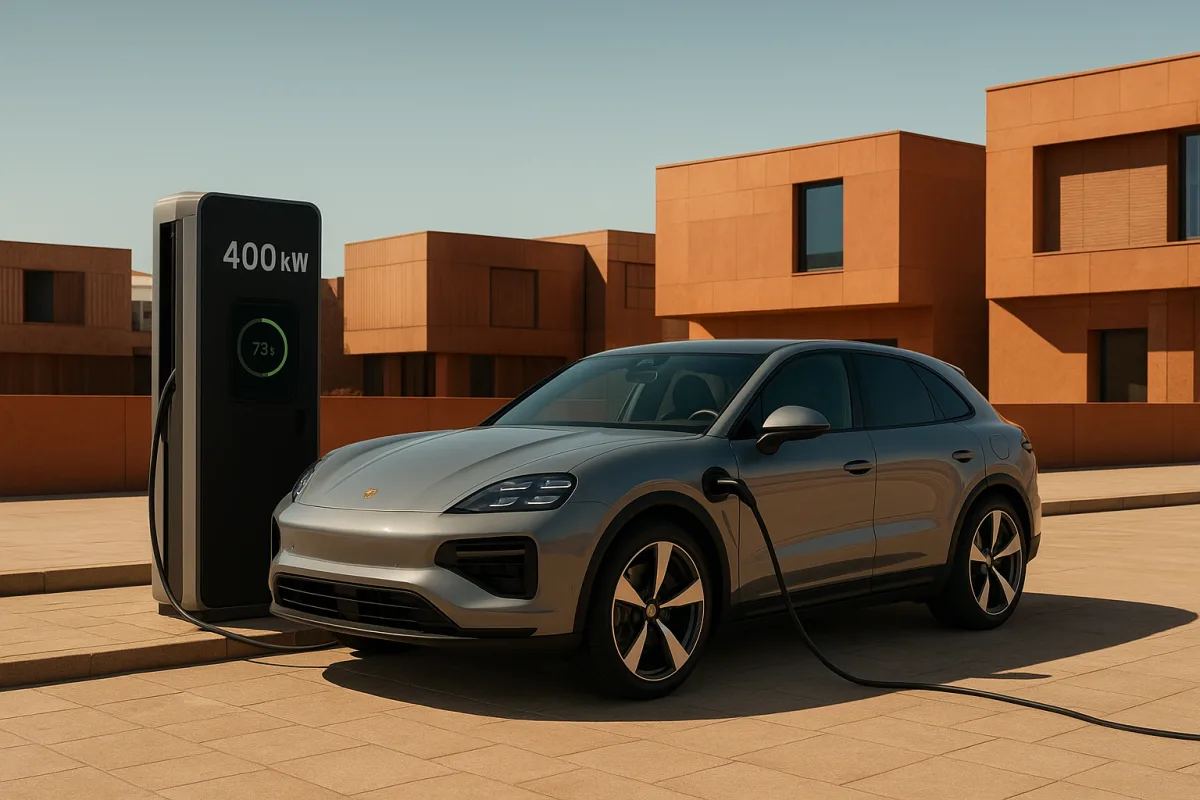
The important Cayenne Electric number is 400 kW
Porsche wants the headline to be 1,139 hp. That is understandable, because the 2027 Cayenne Turbo Electric is claimed to be the most powerful production Porsche yet, with up to 850 kW available in Launch Control. [1][8]
But an owner who intends to use one beyond the first few weeks will care at least as much about the other large number: 400 kW DC charging capability. Porsche says the Cayenne Electric uses an 800-volt electrical architecture and can charge from 10 to 80 percent in roughly 16 minutes under suitable conditions. [1][2]
That is the figure to unpack, because it determines whether an electric Cayenne works as a fast family long-distance vehicle or becomes a very rapid SUV whose journeys revolve around charging stops. The distinction is not academic at this price.
The headline performance is still remarkable. Porsche quotes 0-60 mph in 2.4 seconds and a 162 mph top speed for the Turbo Electric. [1] Independent figures quoted in early reporting vary, including one Car and Driver test result for a differently described 2026 model, so prospective buyers should wait for final US-market specifications rather than treating every early number as interchangeable. [7]
A carwow drag-race video portrayed a Cayenne Turbo EV as a 2.6-tonne, 1,156-hp SUV capable of a 10.0-second quarter mile. That makes good entertainment, but it also illustrates why launch-control numbers should be separated from the repeatable performance available on an ordinary road trip.
Charging, unlike a standing-start run, is an ownership event. It happens when the family needs lunch, when the route has only one working high-power charger, and when the battery is cold after an overnight stop.
What 400 kW actually means
Kilowatts measure power, or the rate at which energy enters the battery. Kilowatt-hours measure stored energy, which is the useful equivalent of asking how much fuel is in the tank.
The Cayenne Turbo Electric is reported to use a 113 kWh battery. [2] If it could accept its maximum 400 kW continuously, simple arithmetic suggests adding 70 kWh would take just over 10 minutes.
That is not how a lithium-ion battery charges. Porsche’s 16-to-18-minute 10-to-80-percent claim is more realistic because it allows for a charging curve, not an unwavering 400 kW plateau. [1][2]
At a low state of charge, with the pack at its preferred temperature, the vehicle can accept very high power. As battery charge rises, the system progressively reduces power to protect cells, manage heat, and preserve durability.
Think of it as filling a tyre with an air compressor. Early on, air flows in easily. As pressure inside the tyre rises, the system needs more control and the final increment takes disproportionately longer.
The difference is especially important beyond 80 percent. The last 20 percent is not merely another fifth of the battery. It usually arrives at a much lower rate, which is why experienced EV drivers often make shorter fast-charging stops rather than waiting for 100 percent.
For the Cayenne, 10 to 80 percent represents around 79 kWh of its stated 113 kWh pack. An average rate near 260 to 300 kW would deliver that energy in roughly 16 to 18 minutes, even though the peak claim is 400 kW.
That is the honest reading of Porsche’s claim. It is not that an owner will see 400 kW for an entire charging session. It is that the electrical hardware may sustain an unusually high average over the useful part of a road-trip stop.
Why 800 volts helps, but does not solve everything
Power is voltage multiplied by current. Raising system voltage allows Porsche to move the same amount of energy with less current, reducing electrical losses and heat in cables, motors, inverters, and battery connections.
The Cayenne Electric’s 800-volt architecture comes from Porsche’s evolved Premium Platform Electric approach. [10] It is the enabling technology behind the 400 kW claim, rather than a marketing feature separate from real-world charging.
A 400 kW session at 400 volts would need roughly 1,000 amps. At 800 volts, the required current is around half that. Lower current makes extreme charging rates more manageable, though certainly not effortless.
It also explains why the charger matters. Many public DC stations are rated at 150 kW or 250 kW, and some older equipment operates around 400 volts. The Cayenne cannot draw 400 kW from hardware that cannot supply it.
The best-case result requires a genuine high-power charger, sufficient grid capacity, a charger not splitting output with another vehicle, compatible voltage, and a battery that has been preconditioned before arrival. Miss one of those conditions and the stop gets longer.
Battery preconditioning means the car uses energy before reaching the charger to warm or cool the pack to its optimum charging temperature. A cold battery arriving after a winter motorway run can accept far less power than a properly prepared one.
This is why the navigation system is part of the charging system. If the Cayenne’s route planner knows the charging stop in advance, it can prepare the battery. Turning up unannounced at a charger after a short local trip may produce a very different result.
Owners of older high-performance EVs will recognise the pattern. The charging peak is memorable, while the average rate and the consistency of the route are what make the car easy or irritating to live with.
Range remains the unresolved part of the calculation
Charging speed only helps if the vehicle covers enough distance between stops. Here, the public information is not settled. As of September 2026, Porsche has not released an official EPA range figure for the 2027 Cayenne Turbo Electric. [1][10]
Early reports are all over the map. TechRadar cited a preliminary 398-mile estimate for Cayenne Electric variants, while The Week referred to a 387-mile real-world figure. Neither should be treated as final EPA range. [3][8]
Those figures also need context. A large, heavy electric SUV driven at US motorway speeds, on winter tyres, in low temperatures, or while towing will not deliver the same result as a favourable certification cycle or carefully managed mixed driving.
For now, the useful planning assumption is not a promised range number but the charging window. If the Cayenne can repeatedly add roughly 70 percent in under 20 minutes, it may make long journeys reasonably practical even if real range falls well below optimistic estimates.
That is the more mature way to assess this car. A claimed 400-mile range sounds impressive, but a reliable 220-mile motorway leg followed by a predictable 18-minute stop can be more valuable than a larger paper number with slow recharging.
The price is not $163,000 in the driveway
Porsche lists the Cayenne Turbo Electric from $163,000 in the US. [1] That is base MSRP, not a complete ownership figure, and the likely transaction price can be much higher once options and dealer inventory are involved.
A Porsche Long Beach listing cited in the research reached $203,740. [9] That spread is plausible for a Porsche, where suspension, brakes, wheels, interior trim, assistance systems, and cosmetic choices can push a well-specified car far above the entry figure.
Neither figure includes sales tax, title and registration charges, insurance, finance interest, or a home charging installation. It may also exclude dealer accessories and any market adjustment, depending on the individual sale agreement.
There is no documented financing or insurance problem unique to the Cayenne Turbo Electric yet. Still, insurers price risk rather than brochure appeal, and a 1,139-hp, six-figure SUV with expensive bodywork, battery hardware, and large tyres is unlikely to be cheap to cover.
The closest rivals show where Porsche has positioned it. The Tesla Model X Plaid costs about $120,000 and has 1,020 hp, suiting buyers who prioritise straight-line pace, Tesla’s charging network, and three-row utility over Porsche branding. [8]
The Rivian R1S is about $85,000 with up to 835 hp, making it the more plausible choice for families needing genuine outdoor and towing usefulness without Cayenne money. [8] The Ford Mustang Mach-E GT costs around $60,000 with 480 hp, suiting buyers who want EV performance at a much lower entry point. [8]
Audi’s e-tron S is listed around $85,000 with 496 hp. It suits the buyer after a premium electric SUV experience without the Cayenne’s extreme performance or price, though it is not a like-for-like answer to Porsche’s latest 800-volt hardware. [8]
What 60,000-mile ownership still cannot tell us
There is no credible 60,000-mile service history for a vehicle that has not reached customers in meaningful numbers. Porsche has not published a detailed, model-specific maintenance-cost breakdown for the 2027 Cayenne Electric, either. [4][6]
That means anyone presenting a precise annual ownership budget is filling in blanks. Indicative Indian estimates cite annual Cayenne Electric maintenance around ₹25,000 to ₹35,000 and energy at approximately ₹3.50 per kilometre, but those are not US-market guarantees and may not transfer to the Turbo Electric. [6]
Electric vehicles eliminate oil changes, spark plugs, exhaust systems, and many transmission-related service items. They do not eliminate tyres, brake fluid, cabin filters, suspension wear, cooling-system maintenance, alignment issues, or expensive collision repairs.
The Turbo Electric’s mass and performance are worth remembering here. Porsche’s quoted power is delivered through four tyres, and rapid acceleration in a nearly three-tonne SUV can turn premium tyre replacement into a regular, expensive line item. [1]
Porsche warranty coverage includes four years or 50,000 miles for the vehicle and eight years or 100,000 miles for the battery, according to current Porsche information. [1] The research found no complimentary maintenance program, so scheduled visits remain the owner’s responsibility.
Where it fits in Porsche’s strategy
The Cayenne Electric is not Porsche abandoning combustion Cayennes. Porsche’s stated plan is a mixed portfolio of internal-combustion, plug-in-hybrid, and fully electric models, with electrified vehicles expected to exceed 80 percent of sales by 2030. [10]
That caution matters because Porsche’s electric strategy is not developing in a vacuum. CarScoops reports that the forthcoming electric 718 Boxster and Cayman are expected to arrive in 2027, yet combustion versions may follow after weaker-than-expected luxury EV demand. [7]
The electric 718 models are expected to use a battery arrangement intended to preserve a low seating position and mid-engined-style balance. [7] They suit sports-car buyers who value compactness and handling character, not the Cayenne buyer needing five seats and family practicality.
The Cayenne Electric therefore has a different task. It must persuade existing Cayenne owners that an EV can tow, travel, carry people, and charge without becoming a second car used only around town.
Its 400 kW claim is the practical answer Porsche is offering. The horsepower gets attention, but the charging curve, charger availability, route planning, and final real-world range will decide whether the 2027 Cayenne Turbo Electric feels like progress after the novelty has worn off.
Frequently Asked Questions
How fast can the 2027 Porsche Cayenne Electric charge?
The 2027 Porsche Cayenne Turbo Electric can charge from 10 to 80 percent in roughly 16 to 18 minutes under suitable conditions using a 400 kW DC fast charger. This rapid charging time depends on factors like battery temperature and starting charge level.
What does 400 kW charging mean for the Porsche Cayenne EV?
A 400 kW charging capability means the Cayenne Electric can accept very high power early in the charging session, allowing it to add about 70 percent of its battery capacity in under 20 minutes. However, charging power tapers off as the battery fills to protect battery health, so the 400 kW peak is not sustained throughout the entire session.
What affects the charging speed of the 2027 Porsche Cayenne Electric?
Charging speed depends on battery temperature, the current state of charge, charger sharing, software management, and route preconditioning. These factors influence how much power the battery can safely accept at any given time, causing actual charging rates to vary from the maximum 400 kW rating.
How does the 800-volt system improve charging in the Porsche Cayenne Electric?
The 800-volt electrical architecture allows Porsche to deliver the same energy with less current, reducing electrical losses and heat generation during charging. This helps improve charging efficiency and supports the high 400 kW charging rate, although it does not guarantee maximum power at all times.
What is the expected range and charging time for the 2027 Porsche Cayenne Turbo Electric?
No official EPA range figures have been released yet for the 2027 Cayenne Turbo Electric. Estimates from various sources suggest a real-world range between approximately 298 and 398 miles. Charging from 10 to 80 percent is expected to take about 16 to 18 minutes using a 400 kW charger under optimal conditions.
How we researched this
This article was assembled from 1 video source, 4 published articles, 10 cited references.
Nothing here is based on hands-on testing. Where a figure or finding appears, it belongs to the source cited beside it, and the writing says so rather than implying otherwise. Every source is listed below so you can check it.
Sources
Tested: The 2026 Porsche Cayenne Turbo Electric Makes Supercar Performance a Side Feature — Car and Driver
Porsche’s Boxster EV Is Almost Showroom-Ready, But Is The Showroom Ready For An Electric 718? — CarScoops
View Exterior Photos of the 2026 Porsche Cayenne Turbo Electric — Car and Driver
View Interior Photos of the 2026 Porsche Cayenne Turbo Electric — Car and Driver
Porsche Cayenne Turbo Electric: 1,139 HP And A 16-Minute Charge | MotorSpec
2027 Porsche Cayenne Electric / Cayenne Coupe Electric Review, Pricing, and Specs
New Porsche Cayenne Turbo Electric for sale at Porsche Long Beach
Watch 2027 Porsche Cayenne Electric and Performance EVs on Youtube
Related Articles

2027 Electric SUVs: Volvo EX60, Porsche Cayenne & EV Tech
Explore 2027 electric SUVs like the Volvo EX60 and Porsche Cayenne, plus key EV tech advances and ownership insights.
Electric SUV Software Updates: Features and Ownership Impact
Explore electric SUV software updates, including RivianOS 2 and Volvo EX60 features, and how they affect performance and ownership.
2027 Range Rover Electric Review: Performance and Ownership
Explore the 2027 Range Rover Electric review covering performance, range, price, off-road ability, and ownership insights.
New Electric and Hybrid SUVs: Reviews and Comparisons
Explore reviews and comparisons of new electric and hybrid SUVs, covering performance, ownership costs, range, and driving experience.