
Slate Truck Towing and Hitch Details Explained
Learn about the Slate Truck's towing setup, hitch installation, wiring, and how it compares to Ford pickups for trailer use.
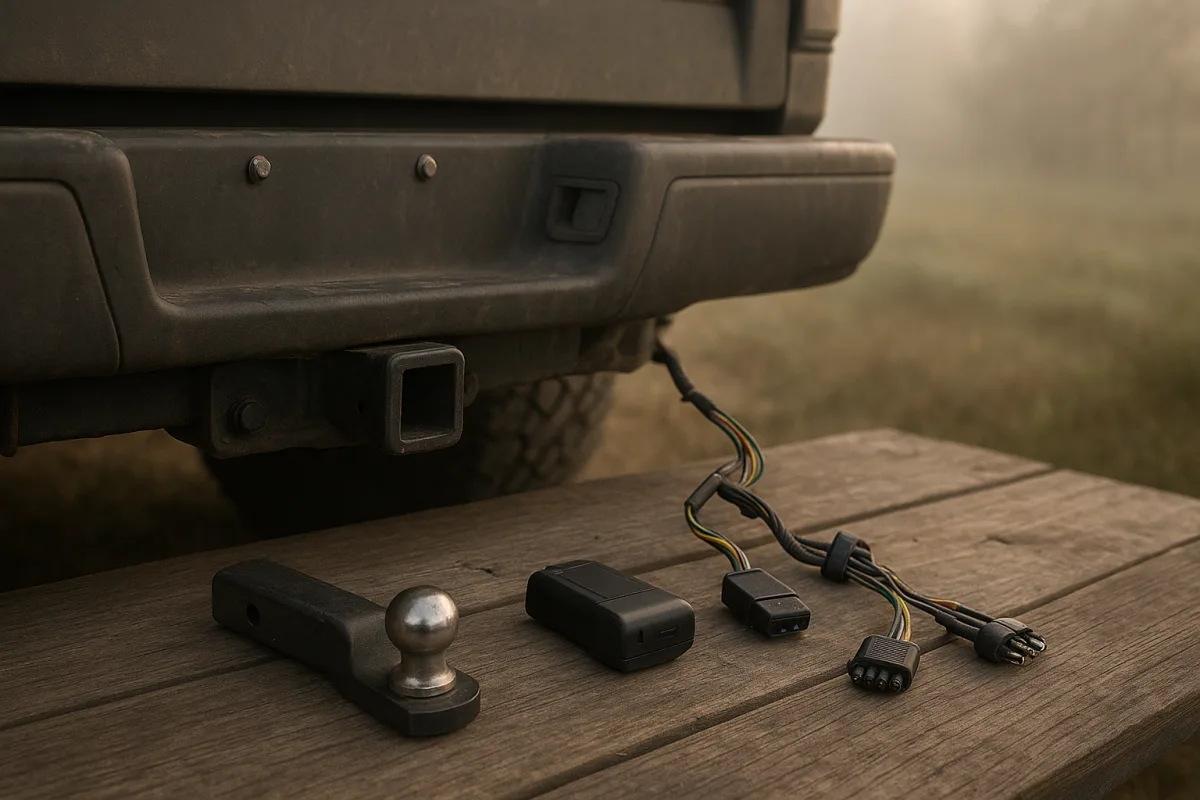
Four bolts are the easy part
The most useful detail in the recent Slate Truck coverage is not the quoted range or the deliberately sparse interior. It is the optional trailer hitch. A vehicle designed around owner-installed accessories has to make ordinary jobs genuinely ordinary.
InsideEVs reports that Slate Auto’s receiver kit costs $99.99, uses a standard two-inch receiver and attaches beneath the truck with four bolts. Slate says fitting it should take between 30 minutes and two hours using basic tools.
That sounds almost comically simple compared with installing a hitch on many modern vehicles. Anyone who has wrestled with a corroded exhaust hanger, removed bumper trim, or tried to fish wiring through a boxed frame will understand the appeal.
But “four bolts” describes only one part of a towing system. It means the receiver can be attached to the truck’s structure. It does not automatically mean the truck is equipped to operate a trailer’s lights, charge a trailer battery or control electric trailer brakes.
That distinction matters more on the Slate than it would on an established pickup. Slate Auto is selling the truck as a modular, owner-configurable electric utility vehicle, not as a conventional pickup with a long options list fitted at the factory.
First, clear up the Ford name
There is no Ford Slate Truck. The Slate Truck is built by Slate Auto, an electric-vehicle startup backed by Jeff Bezos, and it is unrelated to Ford’s F-Series or Maverick range. [13][14]
The supplied Ideal channel video frames the startup’s challenge against a claimed forthcoming Ford affordable pickup called the Fathom. That comparison makes a fair broader point about startup competition, but the Ford model, price and delivery timetable cited there are not confirmed in the supplied independent research.
That is not pedantry. It changes how a buyer should read the story. Slate is not Ford stripping down an F-150, and its hitch arrangement should not be assumed to use Ford parts, Ford wiring layouts or Ford dealer support.
A 2026 Ford F-150 is ordinarily supplied with a rear 7/4-pin trailer connector, according to the Go-Parts Ford wiring guide. Ford also offers additional 7-pin fifth-wheel or gooseneck wiring accessories for F-Series trucks, sometimes requiring drilling and dealer installation. [10]
Ford’s 2017-2027 Super Duty accessory catalogue similarly covers a 7-pin harness for bed-mounted towing applications. [11][12] That is useful context for how conventional trucks handle towing, but it is not evidence of equipment on the Slate.
No price comparison is useful here because the supplied Ford wiring sources do not provide comparable F-150 or Super Duty vehicle prices. Their relevance is the mature support system behind the hardware, not a claim that either Ford is an alternative at Slate money.
A receiver is a mechanical connection
The receiver is the square steel tube at the rear of a truck. The owner slides a removable drawbar, bike rack, cargo carrier or other accessory into it, secures it with a pin, then uses the drawbar’s ball to couple a trailer.
Slate’s two-inch receiver is the common North American size. That gives the owner a large existing market of ball mounts, bicycle racks and utility accessories, though every one of those items is extra.
The four bolts are likely fastening the receiver assembly to mounting points on the Slate’s steel structure. Slate’s body panels are non-structural injection-moulded composite pieces bolted to a steel frame, which should make body repairs and accessory access conceptually simpler. [9]
What matters is not merely that the bolts fit. The hitch has to transfer a trailer’s vertical tongue weight, acceleration loads and braking forces into the vehicle structure without bending the receiver, crushing mounting points or loosening fasteners.
A 2,000-pound towing figure does not mean a buyer can simply attach any 2,000-pound trailer. That number normally refers to the loaded trailer weight, including its own weight, cargo, water, tools and everything left inside it.
The tongue weight, the downward force imposed on the hitch, is equally important. Slate has not supplied a figure in the materials provided here, so owners should not invent one by applying a generic percentage to its tow rating.
For a light utility trailer, a pair of bicycles or a small garden trailer, the receiver may be the whole practical job. For a camper, enclosed trailer or anything fitted with brakes, it is merely the beginning.
The missing electrical half
InsideEVs notes that Slate’s promotional material briefly shows wires hanging beneath the rear of the truck. Slate had previously told a reservation holder that a four-pin trailer cable would arrive as an accessory, but the current receiver listing does not describe it.
That leaves two possibilities. The truck may have wiring pre-installed behind the bodywork, waiting for an add-on socket, or Slate may yet sell a separate harness. Until the company publishes parts information and instructions, neither should be presented as settled fact.
A four-pin flat connector normally operates the essentials: left indicator and brake light, right indicator and brake light, tail and marker lights, plus ground. It is enough for many small trailers, but it does not generally provide electric trailer-brake control.
A seven-pin arrangement adds circuits commonly used for brake controllers, reverse lights and auxiliary power. That matters because towing a heavier trailer safely may be governed by the trailer’s braking requirements in the buyer’s state, not only by Slate’s 2,000-pound headline rating.
The practical risk is simple. An owner may spend $99.99 on the receiver, buy a ball mount and trailer, then discover that lights require another accessory, installation labour or a wait for an unavailable harness.
That is the less glamorous side of a startup ownership experience. With a Ford, GM or Toyota pickup, an independent shop can normally identify the connector, locate wiring diagrams and order established aftermarket hardware. Slate still has to create that ecosystem.
The truck behind the hitch
Slate Auto lists the basic two-seat Blank Slate at $24,950 before destination, tax, title and registration. The mandatory $1,450 destination charge takes the advertised starting point to $26,400 before those local costs. [1][4]
That model suits a buyer who genuinely needs a compact two-seat work vehicle, perhaps for local maintenance work, a campus, groundskeeping, deliveries or a household that already has another passenger vehicle. It is not automatically a cheap substitute for a family pickup.
The truck uses a 181-horsepower rear motor and a 65-kWh lithium-iron-phosphate battery, with a quoted 205-mile range. [1] That range is a no-trailer figure, and electric vehicles routinely consume substantially more energy pulling a boxy or heavy trailer.
Slate quotes a 2,000-pound towing capacity and roughly 1,550 pounds of payload in the supplied Ideal channel material. Both figures are plausible for a compact utility vehicle, but payload must cover passengers, cargo, hitch load and accessories together.
The Squareback SUV Kit is listed at $29,950 and adds a rear seat, airbags and a squared-off bed cap. It suits buyers who need occasional rear passengers and enclosed cargo, but it moves the proposition away from the very basic work-truck idea. [3]
The Fastback SUV Kit is listed at $31,950, adding the same practical changes with a sloping roof design. It suits a buyer who values the SUV conversion’s appearance and enclosed cabin, rather than someone trying to keep purchase cost minimal. [3]
Those figures still need reading carefully. They exclude the same government charges and ownership costs as the base truck, while wraps, audio equipment and interior accessories add more. Slate offers wraps from $499, but not every accessory price has been confirmed. [3]
The Weekly Driver found an accessorised Slate configuration reaching $46,493, while Car and Driver reported a fully optioned Fastback at about $47,746. [2][4] The discrepancy is less important than the lesson: options can almost double the entry price.
Why the hitch matters to Slate’s survival
Slate Auto has raised substantial funding, including a $650 million Series C round led by TWG Global in April 2026, bringing reported total funding to roughly $1.4 billion. [14] That is meaningful money, but vehicle manufacturing consumes it quickly.
The company is converting a former printing plant in Warsaw, Indiana, for production, a project reported at about $400 million and expected to create more than 2,000 jobs. [13] Building the factory is only one part of getting a truck ownership programme working.
A hitch kit needs inventory, packaging, accurate instructions, replacement bolts, torque specifications and customer support. If an owner rounds a bolt head, loses hardware or finds a mounting point damaged, someone needs to have the part and answer the phone.
That is where Ford’s involvement in the wider discussion is relevant, even without treating Ford as Slate’s manufacturer. Ford already has dealers, workshop equipment, collision networks, parts warehouses and technicians familiar with towing systems.
Slate’s direct-sales approach avoids dealer mark-ups and the usual dealership negotiation routine. It also means Slate must decide who handles accessory installation disputes, warranty claims, accident repairs and the awkward cases that appear once thousands of owners begin modifying trucks.
I have not driven or handled a Slate Truck, and nobody can honestly report 60,000-mile maintenance patterns yet. Customer deliveries are expected in the fourth quarter of 2026, so there is no meaningful real-world record for panel durability, battery ageing or accessory reliability. [16]
The composite panels may be cheaper to replace than painted steel and should resist minor dents differently, but the long-term answer is unknown. Older plastic-panel cars such as Saturn S-Series models showed potential for panel-gap changes, fading and brittleness, not proof that Slate will suffer those problems.
For a buyer considering the hitch, the sensible approach is to wait for Slate’s final wiring documentation and towing manual. Confirm the connector type, tongue-weight rating, brake-controller provision, warranty position and available replacement parts before ordering trailer equipment.
The four-bolt receiver is a good piece of product thinking. It makes a modest truck more useful without paying a dealer to perform a basic mechanical job. Whether the truck becomes easy to own depends on everything Slate has not yet had to prove.
Frequently Asked Questions
How does the Slate Truck's trailer hitch installation work?
The Slate Truck’s trailer hitch is an optional receiver kit costing $99.99 that uses a standard two-inch receiver. It attaches to the truck’s steel frame with four bolts, and Slate estimates installation takes between 30 minutes and two hours using basic tools. This simple mechanical connection allows owners to mount accessories like ball mounts or cargo carriers without complex disassembly.
What towing capacity does the Slate Truck have?
The Slate Truck’s receiver hitch is rated for towing up to 2,000 pounds of loaded trailer weight. However, Slate has not provided details on tongue weight or other towing parameters, so owners should be cautious and not assume full capability for all trailer types or weights.
Does the Slate Truck come with factory trailer wiring?
Slate has not supplied clear information about factory-installed trailer wiring or a trailer connector. Unlike established pickups, the Slate’s wiring harness arrangement remains unclear, and buyers should not assume it includes a factory trailer wiring harness.
Is the Slate Truck's receiver hitch compatible with standard accessories?
Yes. The Slate Truck uses a common North American two-inch receiver, allowing owners to use a wide range of standard ball mounts, bike racks, cargo carriers, and other hitch-mounted accessories. However, all such accessories are sold separately.
How does Slate Truck towing compare to Ford pickups?
The Slate Truck is unrelated to Ford pickups and does not share Ford’s wiring, parts, or dealer support. While Ford F-150 and Super Duty trucks come with factory trailer wiring and a mature towing support system, the Slate Truck’s towing setup is more basic and modular, reflecting its startup origins and modular design rather than the fully integrated towing features of Ford pickups.
How we researched this
This article was assembled from 1 video source, 1 published article, 16 cited references.
Nothing here is based on hands-on testing. Where a figure or finding appears, it belongs to the source cited beside it, and the writing says so rather than implying otherwise. Every source is listed below so you can check it.
Sources
Ford Just KILLED the Slate Truck — Ideal
The Slate Truck’s Trailer Hitch Installation Is As Simple As It Gets — InsideEVs
Slate Auto's electric truck starts at $24,950 with 205 miles of range | Electrek
Slate's $24,950 Truck Reaches $46,493 Once You Add the Options - The Weekly Driver
We Take Our First, Brief, Ride in Slate's New $26,400 EV Truck
2027 Slate Truck Review: Expert Insights, Pricing, and Trims
Truck Financing Guide: How to Finance a Semi 2026 | O Trucking
Are There Any Rebates for Electric Cars Anymore? - LegalClarity
I Laughed at Plastic Panels, But The Slate Truck Silenced Me
Super Duty 2017-2027 7-Pin Trailer Wiring Harness | Accessories | Ford.com
Super Duty 2017-2027 7-Pin Trailer Wiring Harness | Accessories | Ford.ca
Slate Auto’s $650M Funding Round to Enable EV Truck Production by End of Year
Slate Auto raises $650M to fund its affordable EV truck plans | TechCrunch
The Slate Truck Is Great, But This One Problem May Stop A Lot Of Folks From Buying It
Watch Ford's Slate Truck and Related Developments on Youtube
Related Articles
2027 New SUV and Pickup Models: Features and Ownership Guide
Explore 2027 new SUV and pickup models with insights on performance, ownership costs, maintenance, and driving experience.
2027 SUVs and Trucks Updates
Explore key updates on 2027 SUVs and trucks including Ford Ranger, BMW X5, Kia Sorento PHEV, and Volvo EX60 EV. Get insights on features and ownership.
2027 Hyundai Tucson Redesign and Hybrid Powertrain Details
Explore the 2027 Hyundai Tucson redesign, hybrid powertrain, fuel economy, towing, and new features in this detailed overview.
GM 8.3-Liter Duramax Diesel Engine for 2027 Heavy-Duty
Explore GM's 8.3-liter Duramax diesel engine specs, torque, and impact on 2027 Silverado HD and Sierra HD heavy-duty trucks.