
GM 8.3-Liter Duramax Diesel Engine for 2027 Heavy-Duty
Explore GM's 8.3-liter Duramax diesel engine specs, torque, and impact on 2027 Silverado HD and Sierra HD heavy-duty trucks.
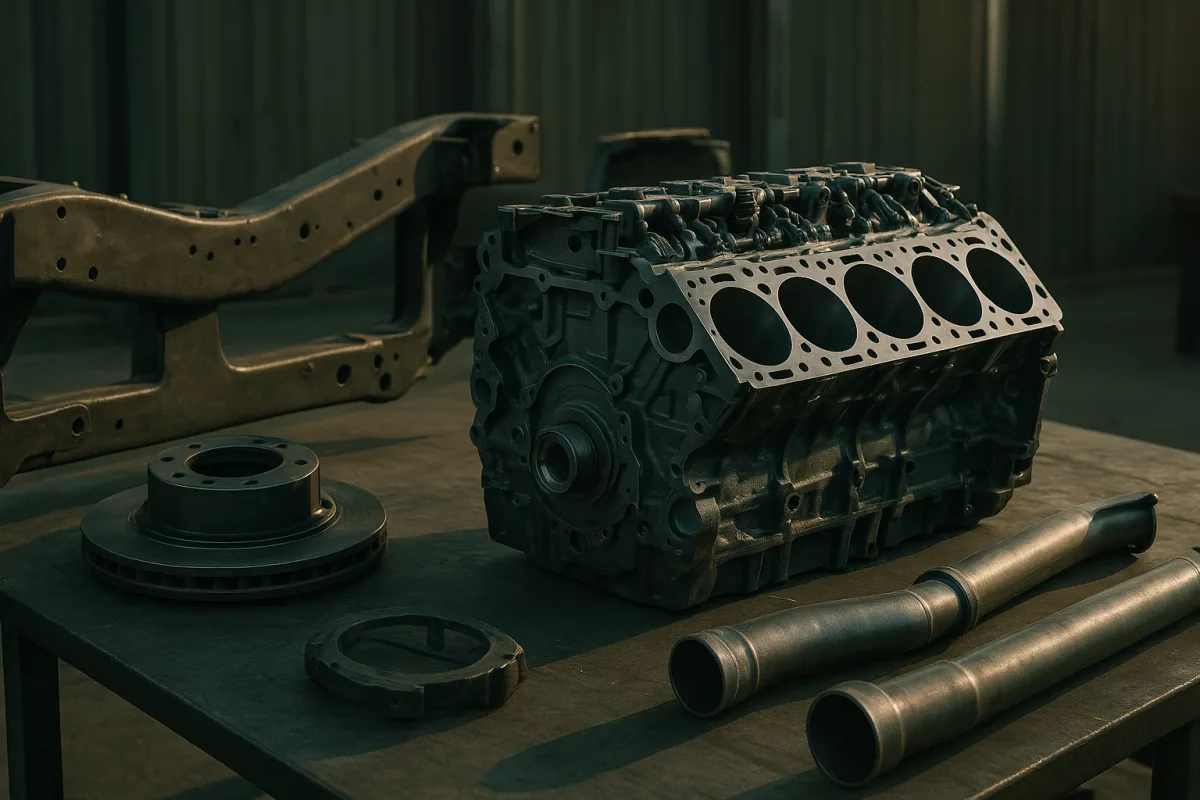
GM’s 8.3-Liter Duramax Is Not Really About Displacement. It Is About the 1,200 lb-ft War
The important number is 1,200 lb-ft, not 8.3 liters
The teaser campaign makes the 8.3-liter figure sound like the whole story. It is certainly significant, because GM’s pickup Duramax diesel has been 6.6 liters since 2000, but displacement alone does not tell an owner what a truck will pull or cost to run.
GM announced the Mongoose on September 21, 2026, for the 2027 Chevrolet Silverado HD and GMC Sierra HD. What is confirmed is limited: an 8.3-liter Duramax turbo-diesel V8, headed for GM’s heavy-duty pickups. [1]
The Drive and Road & Track both correctly read the mongoose-versus-scorpion imagery as a direct shot at Ford. Scorpion is Ford’s internal name for the 6.7-liter Power Stroke diesel V8, and its current headline rating is 500 horsepower and 1,200 lb-ft. [1]
That 1,200 lb-ft number is the line GM needs to cross if it wants the marketing victory implied by the teaser. Industry chatter about more than 600 hp and 1,200 lb-ft of torque is just that, chatter. GM has not published output figures.
Ram is the third comparison point, although it uses a different layout. The 6.7-liter Cummins inline-six in Ram heavy-duty trucks is rated at 430 hp and 1,075 lb-ft, so an engine that simply matches Ford’s diesel would also move GM beyond Ram’s published figures. [1]
None of that establishes that Mongoose will be the better truck for a particular operator. A fifth-wheel owner, a hotshot driver, a farmer hauling equipment locally, and somebody who mostly commutes in an empty 2500 have very different priorities, even when they all like torque.
What torque actually does in a heavy-duty pickup
Torque is twisting force at the crankshaft. In a diesel, combustion pressure pushes down on each piston, the connecting rod transfers that force to the crankshaft, and the crankshaft turns it into rotational effort measured in pound-feet.
More engine displacement gives GM more swept volume. In plain terms, an 8.3-liter V8 has more cylinder volume available to fill with air, add fuel, and convert combustion pressure into crankshaft force than a 6.6-liter V8.
That does not mean torque rises in direct proportion to displacement. Turbocharger boost, injector capacity, combustion pressure limits, piston and rod strength, exhaust temperature, cooling capacity, emissions calibration, and transmission durability all determine the final rating.
A diesel’s useful character comes from where it makes its torque, not just its peak figure. An engine delivering strong torque from low rpm can get a loaded trailer moving without needing high revs, which is why diesels still make sense for sustained heavy work.
But the crankshaft is only the first stage. The transmission multiplies engine torque in its lower gears, then the transfer case or driveshaft and differential alter it again before it reaches the wheels.
A simplified example shows why peak engine torque is not a tow rating. If an engine makes 1,200 lb-ft and a transmission’s first gear is 4:1, that becomes 4,800 lb-ft before the axle ratio multiplies it again.
That immense wheel torque is helpful when pulling away with a trailer on a grade. It is also exactly why manufacturers have to manage torque electronically, because too much force can stress driveshafts, universal joints, axle gears, tires, and the transmission itself.
The truck also has to keep doing that work for hours. Cooling capacity is often more meaningful than a brief peak-torque claim when towing uphill in summer, especially at highway speeds where the engine, transmission, charge-air cooler, and exhaust aftertreatment system are all working hard.
Why 1,200 lb-ft does not automatically equal a bigger tow rating
The present 6.6-liter L5P Duramax is rated at 470 hp and 975 lb-ft. In properly configured current GM heavy-duty trucks, the maximum quoted towing figure is 36,000 pounds. [9]
It would be easy to assume that another 225 lb-ft necessarily creates a 40,000-pound tow rating. It does not work that way. Manufacturers set ratings around the whole truck, rather than allowing the engine’s peak output to dictate the answer.
Gross combined weight rating is particularly important. It is the maximum permitted weight of truck, passengers, fuel, cargo, trailer, and trailer cargo together. A diesel engine can have the muscle to move more weight than the cooling system, brakes, or rear axle are certified to carry.
Payload is even less connected to the engine’s torque number. Payload is mainly a chassis question, determined by truck configuration, suspension, axle ratings, tires, wheels, cab, bed, options, and the weight of the engine itself.
That distinction matters for fifth-wheel buyers. A trailer may be within a truck’s advertised maximum towing capacity while putting too much pin weight in the bed, leaving the owner over the truck’s payload or rear-axle rating.
GM has not released Mongoose towing or payload ratings. Motor1’s suggestion that the engine could replace the 6.6-liter Duramax describes the likely direction, but it is not evidence that any particular 2027 truck will tow more than today’s 36,000-pound maximum. [2]
The sensible reading is that GM is chasing a class-leading headline, likely horsepower, torque, or maximum towing. Until GM provides the exact cab, bed, axle, hitch, and drivetrain configuration behind a rating, there is no useful towing comparison to make.
The 60,000-mile question: fuel is not a footnote
Jalopnik framed the announcement against unusually expensive diesel, and that is a more useful ownership angle than the teaser’s cartoon fight. Heavy-duty trucks are exempt from EPA fuel-economy ratings, so GM does not publish an official combined mpg number for the current Duramax. [5]
Owner-report aggregations put the current 6.6-liter Duramax near 13 mpg combined in ordinary real-world use. That will vary heavily with speed, idle time, tire choice, weather, terrain, load, and whether a trailer is attached. [5]
At 13 mpg and $6.50 per gallon, fuel alone is about 50 cents per mile. Over 15,000 miles, that works out to approximately 1,154 gallons and at least $7,500, before DEF, oil changes, filters, insurance, finance costs, tires, or repairs.
That calculation is more useful than pretending the 8.3-liter truck has an economy figure. It does not. A larger engine may be efficient when lightly loaded if calibration and gearing are right, but it may also consume substantially more fuel under the conditions buyers actually care about.
The current 6.6-liter’s reported 13 mpg should be treated as a proxy, not a prediction. Nobody has driven a production Mongoose long enough to establish empty, loaded, cold-weather, highway, city, or towing fuel-consumption patterns.
There is also no published Mongoose maintenance schedule. Anyone claiming to know its oil-change interval, fuel-filter interval, DEF consumption, transmission service interval, or likely repair bill is filling in blanks GM has not yet addressed.
What current Duramax ownership can, and cannot, tell us
Existing Duramax experience is still relevant because modern diesels are not simply big mechanical engines with a turbocharger. They are fuel systems, exhaust aftertreatment systems, sensors, software, wiring, and cooling systems packaged around a high-compression diesel V8.
The costly failure people worry about most is the high-pressure fuel pump. The research brief identifies CP4.2 fuel-pump failures on existing Duramax applications as potential $8,000 to $12,000 repairs when metal contamination spreads through the fuel system.
That is not a forecast that the Mongoose will suffer the same failure. GM has not disclosed the new engine’s injection-pump design, injector system, turbocharger arrangement, compression ratio, transmission pairing, or emissions hardware, so a direct reliability prediction would be irresponsible.
Diesel particulate filter service is another reality of modern ownership. The research brief puts DPF cleaning or replacement at roughly $500 to $1,500 on existing Duramax trucks, depending on whether the issue is cleaning, a failed component, or a wider exhaust-system problem.
EGR carbon buildup can bring repair bills in the $300 to $800 range, while SCR and related emissions-system faults can run from a few hundred dollars to more than $1,000. Those systems are necessary for legal emissions compliance, not optional accessories. [7]
For a buyer keeping an HD truck beyond warranty, the important question is not whether Mongoose makes a dramatic torque number. It is whether GM has improved access, diagnostics, sensor durability, fuel-system protection, regeneration behavior, and parts pricing.
GM’s 8.3-liter engine may prove to be an excellent answer to Ford’s Power Stroke. For now, though, it is a confirmed displacement and configuration, plus an obvious competitive target, rather than a finished ownership case.
Frequently Asked Questions
What are the key features of GM's 8.3-liter Duramax diesel engine?
GM’s 8.3-liter Duramax, called the Mongoose, is a turbo-diesel V8 confirmed for the 2027 Chevrolet Silverado HD and GMC Sierra HD. While displacement is larger than the current 6.6-liter Duramax, GM has not released official horsepower, torque, towing, payload, or fuel economy figures. The engine is positioned to compete with Ford’s 6.7-liter Power Stroke.
How does the GM 8.3L Duramax compare to Ford's 6.7L Power Stroke?
The 8.3L Duramax is aimed at matching or exceeding the benchmark set by Ford’s 6.7L Power Stroke, which is rated at 500 hp and 1,200 lb-ft of torque. However, GM has not officially confirmed output numbers for the Mongoose engine, so comparisons remain speculative.
Will the 8.3L Duramax increase towing capacity in 2027 Silverado HD?
An increase in torque does not automatically translate to a higher towing rating. Towing capacity depends on the entire truck system, including cooling, transmission, axles, frame, brakes, and certification. GM has not released official towing or payload ratings for the 8.3L Duramax-equipped trucks.
What does 1,200 lb-ft torque mean for heavy-duty truck performance?
Torque is the twisting force at the crankshaft that helps move heavy loads, especially from a standstill or on grades. A torque rating around 1,200 lb-ft, like Ford’s current 6.7L Power Stroke, allows for strong low-rpm pulling power. However, peak torque is only one factor; transmission gearing and vehicle components also affect overall performance and durability.
How does engine displacement affect diesel truck towing and fuel economy?
Larger displacement means more cylinder volume to burn fuel and air, potentially increasing torque and power. But torque output depends on many factors beyond displacement, such as turbocharging and cooling. Fuel economy is influenced by engine size but also by vehicle weight and driving conditions; the current 6.6L Duramax averages about 13 mpg in real-world use.
How we researched this
This article was assembled from 5 published articles, 9 cited references.
Nothing here is based on hands-on testing. Where a figure or finding appears, it belongs to the source cited beside it, and the writing says so rather than implying otherwise. Every source is listed below so you can check it.
Sources
GM Is Actually Putting an 8.3L Duramax Diesel in Its HD Pickups to Devour Ford — The Drive
GM’s New Heavy Duty Pickup Truck Engine Is an 8.3-Liter Behemoth Called ‘Mongoose’ — Road & Track
GM Teases New 8.3-Liter Duramax 'Mongoose' Engine Just As Diesel Crosses $6.50 Per Gallon Nationwide — Jalopnik
GM Teases New 8.3-Liter Duramax Diesel V8 For Its Heavy-Duty Trucks — Motor1
Jalopnik Suspends White House Pool Coverage In Solidarity With Politico, CNN And MS Now — Jalopnik
GM Confirms 8.3L Duramax for 2027 HD Trucks; Stock Rises 2.1% | StockTi
2027 Chevrolet Silverado, GMC Sierra V-8 Specs: 402 HP and 481 HP Confirmed | Cars.com
Silverado 2500 Duramax Diesel: Real-World Fuel Economy | McFarland Chevrolet
Silverado 2500 Duramax Diesel: Real-World Fuel Economy | Barry's Chevrolet, Inc.
What Year Duramax to Avoid: The Complete Buyer's Guide to Known Problem Years (2001–2026)
2.8 Duramax Problems: Common Issues, Solutions, and Prevention Tips
6.6L V-8 L5P Duramax® Turbo-Diesel Engine | GM Powered Solutions
Related Articles
2027 Off-Road and 4x4 Vehicles Comparison: Defender vs Ram
Compare 2027 off-road and 4x4 vehicles including the Land Rover Defender and Ram Power Wagon diesel for towing, performance, and ownership.
Slate Truck Towing and Hitch Details Explained
Learn about the Slate Truck's towing setup, hitch installation, wiring, and how it compares to Ford pickups for trailer use.
2027 Hybrid Pickup Trucks and SUVs
Compare the 2027 Lincoln Corsair hybrid and Volkswagen Amarok plug-in hybrid pickups and SUVs on performance, ownership, and maintenance.

2027 Nissan Rogue Hybrid vs Toyota RAV4 Hybrid
Compare the 2027 Nissan Rogue Hybrid and Toyota RAV4 Hybrid on price, fuel economy, features, and ownership risks to find the right hybrid SUV for you.