
Car Ownership Costs and Residual Value Explained
Learn how car ownership costs relate to residual value and depreciation to make smarter buying and selling decisions.
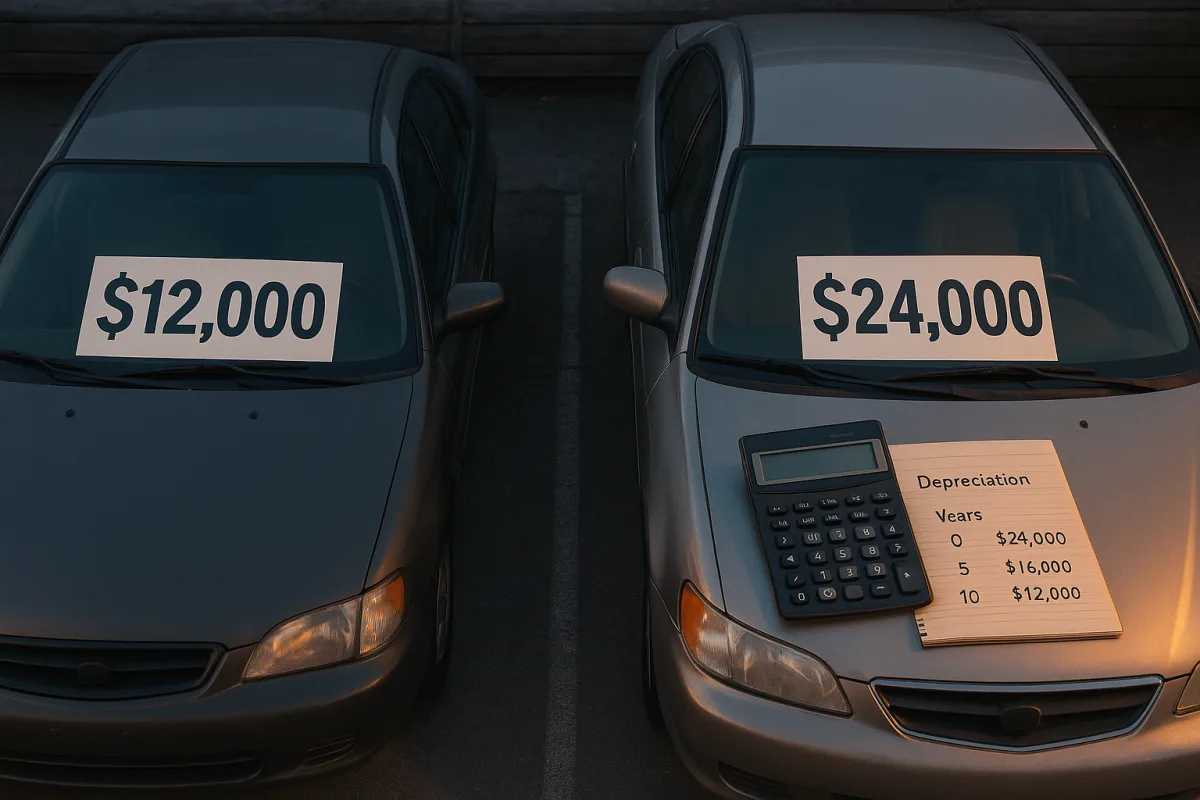
Residual Value Is the Ownership Cost You Pay When You Sell
Start with what the car will be worth when you are done with it
You are choosing between two $30,000 cars. One may lose $12,000 in five years and the other $5,000. Before gas, tires, insurance, repairs, or interest, that is a $7,000 ownership-cost difference.
That number is called residual value, the portion of a vehicle’s original or purchase price that remains when you sell or trade it. Depreciation is the inverse: what disappears between the price you paid and the price someone will actually pay later.
The key word is actually. A dealer’s online listing, a trade-in offer, a private-party valuation, and a completed retail sale can all produce different values for the same car on the same day.
Residual value is not fixed by the badge on the hood. It is the result of supply, demand, model changes, reputation, mileage, condition, trim, title status, local appetite, and the cost of keeping the vehicle running.
A popular used car with a large owner base can hold value because buyers know what it is, parts are available, and dealers can move it quickly. A complicated vehicle can lose value faster if the next owner sees expensive uncertainty.
The price you see is not necessarily the value you can realize
A dealer retail price includes reconditioning, advertising, overhead, profit, and often room for negotiation. That makes it the highest number you are likely to see, not the amount you should assume will arrive in your bank account.
Trade-in value is lower because the dealer must prepare the car, carry it in inventory, and resell it with some warranty exposure. Private-party value often lands between trade and retail, assuming you can advertise, show, negotiate, and wait.
That spread explains why market guides disagree without necessarily being wrong. They use different data, assumptions, timing, geographic coverage, condition categories, and definitions of what a buyer is paying for.
A five-year retention percentage is therefore a useful planning tool, not a guaranteed check. It gives you a way to compare likely financial damage between models before you become attached to a color, wheel package, or monthly payment.
Mileage changes the result fast. A five-year-old vehicle with 68,000 miles is a different proposition from one with 25,000 or 110,000 miles, particularly where tires, brakes, major services, and warranty expiration are involved.
Condition does too. Accident history, branded titles, incomplete records, worn interiors, cheap replacement tires, and overdue maintenance can push your individual car far below an optimistic average, even if the model itself has strong resale.
The Volkswagen Taos shows how depreciation becomes a buying opportunity
Volkswagen introduced the Taos for 2022 as its entry-level two-row SUV. Jalopnik reported that the base 2022 Taos originally stickered at $24,190 including a $1,195 destination charge, then lost a substantial share of that price within four model years.
Current market figures show why you should shop by trim and condition, not by a single headline value. Edmunds places 2022 Taos trade-in values from $12,042 to $22,088, a range wide enough to cover very different versions and histories. [3]
VehiSales reports an average asking price of $18,090 for used 2022 Taos models. [4] CarHunt’s fair-price range is roughly $16,000 to $22,288, depending on trim and mileage, while CarMax valuations run from $12,600 to $16,400. [5][6]
Those figures describe different points in the transaction chain. If you are buying, an $18,000 advertised Taos may be reasonable, but it does not mean you could trade that same vehicle tomorrow for $18,000.
The Taos has a five-year residual value estimate of 53.7% from iSeeCars. [7] CARFAX puts five-year depreciation at 52%, which points to much the same outcome: a buyer who purchased new absorbs a large early loss. [8]
For a used buyer, that loss can be your discount. A lower entry price means less capital tied up in the car, lower sales-tax exposure in many cases, and a smaller amount at risk if you sell after a few years.
But cheap depreciation has a cause. Jalopnik noted that the Taos received a mechanical and cosmetic refresh for 2025, which can make earlier 2022 through 2024 vehicles less desirable beside the newer version.
That is how a refresh changes residual value. It does not need to make the old car bad. It only needs to make used-car shoppers feel that the newer one looks better, drives better, has better equipment, or will age with less embarrassment.
We would consider a 2022 Taos only at a used price that clearly reflects this drop, with service records and a pre-purchase inspection. We would skip paying near-new money for one when the market itself says older examples need a discount.
Toyota’s strong resale protects owners, but it raises the used-car entry fee
Toyota often sits on the opposite side of this equation. Jalopnik’s review of Toyota residual values identified the Tacoma, GR Supra, Tundra, Corolla Hatchback, RAV4, 4Runner, and Corolla sedan as strong five-year value retainers.
The Tacoma is the cleanest example of how demand supports residual value. CarWhere estimates that it retains about 80.5% of its value after five years, or loses roughly 19.5%, better than the 30.2% midsize-pickup average. [14]
That protects the original owner from a large depreciation bill. It also means that a used Tacoma buyer may face a stubbornly high asking price for a truck with substantial mileage, expired factory coverage, and wear already baked in.
Jalopnik found that a 2021 Tacoma SR5 double cab with rear-wheel drive averaged about $29,500 in listings, against an original MSRP of $33,405. Its calculation produced an unusually high 88.3% residual value in current listings.
A high-retention car is not automatically the cheaper ownership choice. If you pay too much for a five-year-old truck, finance it at a used-car rate, and then need tires, brakes, suspension work, or deferred service, the resale advantage narrows.
The same tension appears with Toyota sports cars. Jalopnik reported that a 2021 GR Supra four-cylinder, originally priced at $43,985, hovered around $37,000 used, while 3.0 Premium examples listed around $47,000 against a $55,485 original MSRP.
Low depreciation reflects demand for a specific product: a BMW-built Toyota sports coupe with limited supply and a recognizable enthusiast market. It does not erase the cost of tires, insurance, repairs, financing, or a premium paid for a clean example.
We would rather buy a well-documented high-residual vehicle than chase a suspiciously cheap one. But we would not pay any premium merely because a model has a reputation for holding value, especially when the vehicle itself is overdue for expensive work.
Modifications can erase the market’s normal rules
A stock car has comparables. Dealers, lenders, insurers, buyers, and valuation guides can look at similar vehicles with similar equipment and mileage, then arrive at a range they can defend.
A custom build breaks that system. Throtl’s Lamborghini Murciélago project combines a non-LP640 Murciélago, an LP640 engine, a manual conversion, twin turbochargers, a Haltech Nexus R5 standalone ECU, air suspension, and a Liberty Walk widebody kit.
The channel’s build also required a new engine harness after the factory wiring could not be used. Its team fabricated intercooler plumbing, established top dead center manually, primed the fuel system, and began calibrating ignition and sensor settings through the standalone ECU.
Those details are exciting because they show the car’s individuality. They are also exactly why the finished vehicle cannot be valued like an unmodified Murciélago listed in a guidebook.
A prospective buyer must trust the engine installation, cooling capacity, turbo oil control, wiring quality, ECU calibration, clutch and transmission integration, brakes, bodywork, and documentation. The buyer pool gets smaller as the questions multiply.
Lamborghini discontinued the Murciélago long before 2026, and no published ownership-cost dataset covers a 2026 twin-turbo example. You should not use modern Huracán ownership estimates as if they were a prediction for this particular custom car.
Huracán figures do show the scale of exotic-car costs around the build. Annual routine maintenance is estimated at $3,500 to $8,000, tires at $3,000 to $5,000 per set, and annual insurance at $10,000 to $15,000. [1]
Those are reference points, not a Murciélago budget. A modified twin-turbo car can require bespoke diagnosis and fabrication when something fails, and its insurance cost may depend on whether the insurer accepts the modifications and agreed value.
Financing is another problem. Mainstream lenders often set age and mileage limits, commonly excluding vehicles more than 10 years old or with more than 100,000 to 150,000 miles. [10]
Modified vehicles may require specialty financing, an independent appraisal, photographs, receipts, and proof of build quality. CarJourney reports that mainstream lenders are often reluctant because modified vehicles have uncertain values and resale prospects. [9]
That is why a heavily modified exotic should be bought with a resale plan before the purchase. Keep invoices, build photos, dyno information if available, tuning records, alignment sheets, parts lists, and every service record, because the paperwork is part of the value.
Residual value belongs in your monthly budget
Depreciation becomes real only when you sell, but it is accumulating while you own the car. Divide your expected loss by the months you plan to keep it, then add that figure to the payment, insurance, fuel, maintenance, and repair reserve.
A $30,000 vehicle that will be worth $18,000 after five years costs you $200 per month in depreciation. A $30,000 vehicle that will be worth $24,000 costs $100 per month, before either has turned a wheel.
Do this calculation from your purchase price, not MSRP, when buying used. If you buy after the steep early decline, you can reduce the loss, though a weak model can still keep falling if demand fades or a major refresh arrives.
Also account for loan interest separately. Better credit generally earns lower rates, while subprime borrowers can face rates above 20%, according to SuperMoney’s 2026 lending-tier overview. [11]
We would make residual value one line in every car-buying spreadsheet. It will not choose the car for you, but it will show whether the vehicle you want is affordable to own, or merely affordable to finance.
Frequently Asked Questions
What is residual value in car ownership?
Residual value is the portion of a vehicle’s original or purchase price that remains when you sell or trade it. It reflects the actual amount you can expect to receive after accounting for depreciation, which is the loss in value over time.
How does depreciation affect car ownership costs?
Depreciation is the difference between the price you paid for a car and the price you can sell it for later. It can represent a significant part of ownership costs, sometimes thousands of dollars over a few years, and varies widely between models and conditions.
Why do some cars retain value better than others?
Cars retain value based on factors like supply and demand, brand reputation, model updates, mileage, condition, and local market preferences. Popular models with a large owner base and readily available parts tend to hold value better, while vehicles with costly maintenance or less demand depreciate faster.
How to estimate a car's resale value before buying?
You can compare five-year retention percentages and consult multiple market sources such as trade-in offers, private-party values, and dealer listings. It is important to consider mileage, condition, trim, and recent model refreshes, as these all impact resale value.
What factors influence a vehicle's market value?
Market value depends on supply and demand, vehicle condition, mileage, trim level, title status, recent model updates, and local buyer interest. Dealer pricing also includes overhead and profit, which can differ from private-party or trade-in values.
How we researched this
This article was assembled from 1 video source, 2 published articles, 14 cited references.
Nothing here is based on hands-on testing. Where a figure or finding appears, it belongs to the source cited beside it, and the writing says so rather than implying otherwise. Every source is listed below so you can check it.
Sources
Building a Twin Turbo Lamborghini Murciélago -- IT'S COMPLETE!, throtl
Here's How Much 2022 Volkswagen Taos Models Have Depreciated In 4 Years, Jalopnik
7 Toyota Models That Hold Their Value Best After Five Years, Jalopnik
Used Volkswagen Taos Prices by Year (2022-2026), Live Market Data | VehiSales
Volkswagen Taos Resale Value and Depreciation - iSeeCars.com
Financing Options for Heavily Modified Vehicles | CarJourney
How Old of a Car Will a Bank Finance? Age, Mileage, and Lender Limits - FedLaws
What Credit Score Do You Need to Buy a Car? (2026 Loan Tiers & Rates) - SuperMoney
How to Finance an Exotic Car: Lenders, Rates & Strategies for 2026 | Automonitor
Toyota Tacoma Depreciation: Value by Model Year (2026) | CarWhere
Watch Car Ownership Costs and Market Value Insights on Youtube
Related Articles
Electric Vehicle Pricing and Ownership Costs Explained
Explore electric vehicle pricing, ownership costs, tax credit impacts, and key maintenance tips to make informed EV buying decisions.
EV Incentives and Market Challenges in 2026
Explore 2026 EV incentives, market challenges, and new models including California rebates, UK leasing, and used EV ownership risks.

Rising Car Repair Costs: Why Ownership Is Becoming Pricier
Explore why rising car repair costs are increasing ownership expenses and how technology and labor affect your maintenance budget.

Imported Japanese Performance Cars
Explore imported Japanese performance cars, including costs, import rules, and ownership tips for 2026 buyers.