
Imported Japanese Performance Cars
Explore imported Japanese performance cars, including costs, import rules, and ownership tips for 2026 buyers.
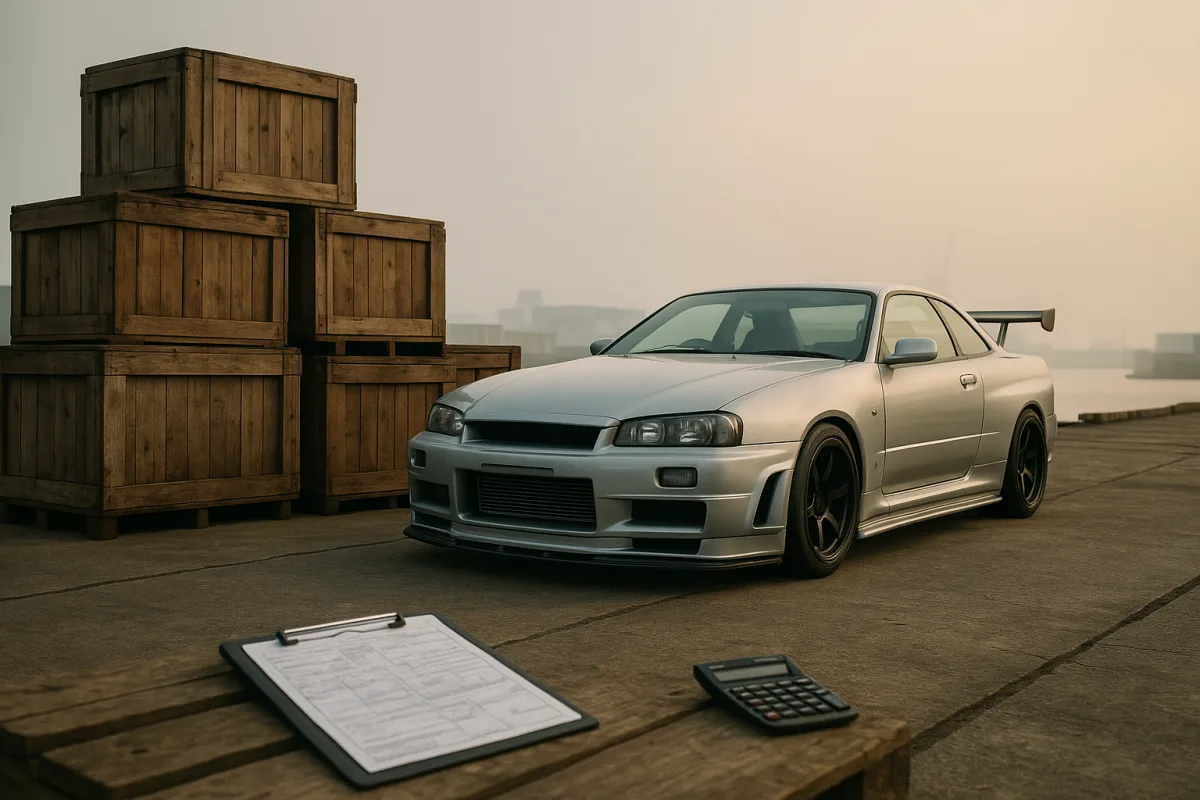
The number that decides whether a JDM import makes sense
The car you want is advertised in Japan at what looks like a bargain price. Then the landed-cost calculation begins: purchase price, shipping, duty, VAT, registration, compliance work, insurance, and the first round of age-related repairs.
That calculation explains both the boom in imported Japanese cars and the disappointments. A Nissan Skyline, Mitsubishi Lancer Evolution, or Honda Integra Type R can be rare, clean, and legal, yet still become expensive before it reaches your driveway.
Autocar reports that roughly 40,000 used cars are imported from Japan into the UK each year. Its appeal is broader than Japanese performance cars, including European models originally sold in Japan, because buyers often find better condition than comparable domestic examples.
Japanese ownership patterns help explain the attraction. Autocar points to strict and costly Shaken inspections, which can cost as much as £2,000, along with roads that are generally less exposed to winter salt than British roads.
That does not mean every Japanese import is pristine. It means the starting pool can contain unusually clean examples, often retired earlier than an equivalent British car. You still need to establish what has happened since its last Japanese inspection.
For enthusiasts, the calculation begins with forbidden-fruit cars. Jalopnik identifies the Nissan Skyline GT-R, Mazda RX-7 FD, Nissan Silvia S15 Spec-R, Mitsubishi Lancer Evolution, Subaru Impreza WRX STI, Honda Civic Type R EK9, and Toyota Chaser Tourer V among the cars attracting American attention.
The United States has its own important number: 25 years. Federal rules allow vehicles at least 25 years old to be imported without meeting the Federal Motor Vehicle Safety Standards that apply to newer vehicles. [4][5]
That rolling anniversary creates sudden demand for cars built around the millennium. Models become eligible one production month at a time, and a car that was once an unreachable Japanese-market oddity becomes an importable used vehicle.
Jalopnik notes that the R34 Skyline, R32, and R33 occupy three of the four leading positions in JDMBuySell’s watched-vehicle ranking. Those are search and inquiry measures, not import-registration totals, but they show where buyer attention is concentrated.
British buyers do not face the American 25-year rule in the same way. The central issue in Great Britain is whether you can register the car legally, insure it properly, and carry its full tax burden without turning a promising purchase into a financial trap.
Start with the price in Japan, not the price on the road
An auction or exporter price is the first number, not the final number. It may cover the vehicle only, or it may include auction fees and inland transport to port. You need an itemized invoice before comparing it with a UK-registered car.
Japanese-market Skyline GT-R R34 prices are estimated at roughly £40,000 to £180,000 before the full importing process, depending on condition, specification, rarity, and provenance. Finished UK retail prices can reach about £100,000 to £180,000. [8]
Those broad ranges tell you something important. The import process has fixed charges, but the market also rewards the right chassis, trim, mileage, color, originality, service history, and auction grade. Two apparently similar cars can produce dramatically different bills.
Autocar’s Neil Howe, of Bristol-based specialist Winterstoke Motor Company and the British Independent Motor Trade Association, says a weak yen has encouraged more traders into the market. Greater competition has pushed vehicle prices upward, while shipping pressures have also raised transport costs.
For cars above £15,000, Howe says Japanese imports can be slightly cheaper than UK equivalents. Below that level, he says prices tend to be similar because the imported cars are often in better condition.
That is a useful warning against the fantasy of a cheap, perfect JDM car. A clean example is often priced as a clean example. The saving, if one exists, may be against a scarce UK car with worse rust, unclear mileage, or modifications.
Shipping is the first unavoidable add-on
Shipping from Japan to the UK is commonly estimated at £1,200 to £2,500, depending on route, port, transport method, and market conditions. [1][9] That figure generally gets the car to the UK port, not onto your driveway with registration completed.
You may also face port handling, customs-agent charges, storage if paperwork is delayed, and transport from the arrival port. A shipping quote without a clear list of inclusions is not enough to build a buying budget.
Container shipping can offer better protection and allow parts to travel with the car, but it can cost more. Roll-on/roll-off shipping is often cheaper, although the car is moved and stored as a vehicle rather than sealed inside a container.
We would pay for clear documentation before saving a few hundred pounds on freight. The cost of a delayed shipment, disputed condition, or missing paperwork can quickly exceed the headline saving from the lowest shipping quote.
Duty and VAT compound the bill
Import duty is normally 10% of the customs value, which includes the car’s value and shipping cost. VAT is then charged at 20% on the car, shipping, and duty together. [1][9] VAT is charged on top of duty.
The UK-Japan Comprehensive Economic Partnership Agreement can theoretically reduce duty to zero for qualifying Japanese-origin cars. In practice, used-car buyers may struggle to obtain acceptable proof of origin, so budget for 10% unless the exporter can prove otherwise. [1]
Here is how the compounding works. Suppose you buy a car for £40,000 and shipping costs £1,800. The customs value is £41,800, so 10% duty is £4,180. VAT is then 20% of £45,980, adding £9,196.
Before registration, inspection, repairs, insurance, or delivery within Britain, that £40,000 car has become £55,176. The £15,176 increase includes £1,800 shipping, £4,180 duty, and £9,196 VAT, all based on the standard duty assumption. [1][9]
A 30-year-old vehicle in original condition may qualify as a historic vehicle, with no customs duty and reduced 5% VAT. [1] Do not assume age alone earns that rate, because originality and classification rules decide eligibility.
This is why the 25-year American threshold and the 30-year British historic-vehicle treatment produce different buyer behavior. A car can be newly importable to the United States while still attracting the ordinary British duty and VAT structure.
Registration is not a formality
Great Britain requires imported vehicles to meet applicable type-approval requirements before registration. Japanese-market cars are not EU-registered vehicles, so an Individual Vehicle Approval, or IVA, process may be required, with modifications needed to pass. [1][2]
Published estimates put DVLA registration fees around £55 to £200, while the IVA test itself is listed at £199 before any corrective work. [1] Those fees cover administration and testing, not headlight conversions, speedometer changes, tires, repairs, or repeat inspections.
A Japanese-market car may need a rear fog light, a compliant speedometer display, lighting alterations, or other work before it can pass. The exact requirement depends on the car and its condition, so no responsible importer should promise a universal conversion price.
Northern Ireland is different. It follows EU type-approval rules rather than Great Britain’s system, so a route that works for a buyer in England, Scotland, or Wales may not suit a buyer registering the same car in Northern Ireland. [2]
Autocar says that, where a car has been correctly registered, finance and insurance can be straightforward. That is fair as far as it goes, but mainstream lenders and insurers do not always treat an imported, modified, right-hand-drive performance car like a local Golf GTI.
The cost after the port matters more than the auction grade
Specialist insurance is often necessary for JDM imports, particularly turbocharged performance cars with limited UK claims data and expensive body or mechanical parts. Published estimates for Skyline GT-R insurance range from about £700 to £5,000 annually, depending heavily on driver and model. [11]
That range is too wide to use as a personal quote, but it tells you to obtain insurance pricing before buying. A young driver in a high-theft area can find the car affordable to import and impossible to insure comfortably.
Financing can be equally narrow. Specialist lenders may understand an imported chassis number, nonstandard valuation, and limited parts supply, while mainstream lenders may not. [2] Cash buyers avoid the finance problem, not the insurance or repair problem.
Maintenance is where the clean Japanese import can lose its advantage. Engineer Fix warns that older imports carry age-related wear and can have incomplete maintenance histories, even if the bodywork is tidy and the mileage appears low. [6]
Annual specialist servicing for higher-end imported performance cars is estimated from £1,500 to £6,000, while a full tire replacement can run £1,200 to £2,500 for some fitments. [3] Those figures are estimates, not a guarantee for every model.
The expensive failures are usually not exotic in principle. Turbos wear, cooling systems age, rubber bushes split, fuel systems corrode internally, and electronics develop faults. What changes the bill is access to correct parts and a workshop familiar with the platform.
A Skyline GT-R’s RB26DETT, an RX-7 FD’s rotary engine, or an Evo’s 4G63 can reward a committed owner. They also punish deferred servicing, questionable tuning, and generic repairs. The Japanese auction grade cannot tell you how well an imported car was modified later.
Jalopnik highlights why buyers accept these risks. The S15 Spec-R combines a turbocharged 2.0-liter SR20DET, six-speed manual, limited-slip differential, and rear-wheel drive. A 1999 example sold on Bring a Trailer in 2024 for $44,490 after attracting more than 500 watchers.
The Honda Civic Type R EK9 offers another version of the appeal: a 182-horsepower, 1.595-liter naturally aspirated engine, close-ratio manual gearbox, limited-slip differential, and seam-welded chassis. Jalopnik reports imported examples selling in the mid-$30,000 range.
We would choose the less glamorous car with original panels, readable Japanese service records, an understandable auction sheet, and a specialist inspection. Skip the heavily modified bargain, especially if the seller cannot explain the engine management, turbo, suspension, and previous repair work.
A JDM import can be a better car than the domestic alternative, but only after you have priced the whole chain. The car is the exciting part. Duty, VAT, approval, insurance, tires, parts, and maintenance decide whether you get to keep enjoying it.
Frequently Asked Questions
What are the total costs of importing Japanese performance cars to the UK?
Total costs include the purchase price in Japan, shipping (£1,200 to £2,500), 10% import duty (unless proof of Japanese origin is provided), 20% VAT on the combined value, duty, and shipping, plus registration fees (£55-£200), IVA testing (£199), compliance modifications, insurance, and initial repairs. These additional expenses often exceed the auction price and can make the final cost significantly higher than the initial purchase price.
How does UK import duty and VAT affect Japanese performance car prices?
Import duty in Great Britain is generally 10% of the car’s value unless the exporter can prove Japanese origin under the UK-Japan trade agreement, which is difficult for used cars. VAT at 20% is charged on the sum of the vehicle price, shipping, and duty. These taxes substantially increase the landed cost of Japanese imports beyond the purchase price.
Which Japanese performance cars are popular imports in 2026?
Popular Japanese performance imports include the Nissan Skyline GT-R (R32, R33, R34), Mazda RX-7 FD, Nissan Silvia S15 Spec-R, Mitsubishi Lancer Evolution, Subaru Impreza WRX STI, Honda Civic Type R EK9, and Toyota Chaser Tourer V. These models attract significant interest due to their rarity and performance heritage.
What should I budget for when importing a used Japanese performance car?
You should budget for the purchase price, shipping costs, import duty, VAT, registration and compliance testing fees, insurance premiums, and potential repairs or maintenance. Insurance and servicing can be costly due to parts scarcity and specialist requirements, with servicing costs ranging from £1,500 to £6,000 annually for some models.
How does the 25-year import rule affect Japanese car imports in the US?
The 25-year import rule allows vehicles at least 25 years old to be imported into the US without meeting Federal Motor Vehicle Safety Standards and EPA regulations. This rule opens the market to Japanese cars built around the year 2000, such as the Nissan Skyline GT-R R34 and Honda NSX, which become legal for import as they reach the 25-year threshold.
How we researched this
This article was assembled from 2 published articles, 12 cited references.
Nothing here is based on hands-on testing. Where a figure or finding appears, it belongs to the source cited beside it, and the writing says so rather than implying otherwise. Every source is listed below so you can check it.
Sources
Rise of the JDM import: Japanese used cars are booming in the UK, Autocar
9 Of The Most Popular Japanese Performance Cars To Import (And Why Enthusiasts Love Them), Jalopnik
Import a Car from Japan to the UK in 2026: Cost, Duty, VAT | Used Car Japan Agent
The Real Running Costs of a Modern Supercar, Explained | Cool Supercars
25-Year Import Rule Explained: Which JDM Cars Are Legal to | Project JDM
Are JDM Cars Reliable? The Truth About Imported Vehicles - Engineer Fix
UK's most and least reliable used cars by MOT data (2004 to 2026) | CarBuyerIQ
Best JDM Cars to Import to UK: Right-Hand Drive Japanese Icons 2026 - Samurai Motors JDM
Japanese car import cost and road tax calculator · JDM History
Related Articles
Used and Classic Car Market Highlights: Key Models and Costs
Explore used and classic car market highlights, including top models, ownership costs, and buying tips for enthusiasts and collectors.
EV Incentives and Market Challenges in 2026
Explore 2026 EV incentives, market challenges, and new models including California rebates, UK leasing, and used EV ownership risks.

Luxury Exotic Car Market Trends and Ownership Insights 2026
Explore 2026 luxury exotic car market trends, auction prices, and ownership costs to make informed buying decisions.

Affordable Used Cars Buying Guide
Explore our affordable used cars buying guide with practical tips on ownership costs, maintenance, financing, and choosing the right vehicle for your