
Tesla Cybercab Brake-by-Wire System and Safety Controversy
Explore Tesla Cybercab's brake-by-wire system, its safety features, and the controversy over replacing hydraulic brakes with electric actuators.
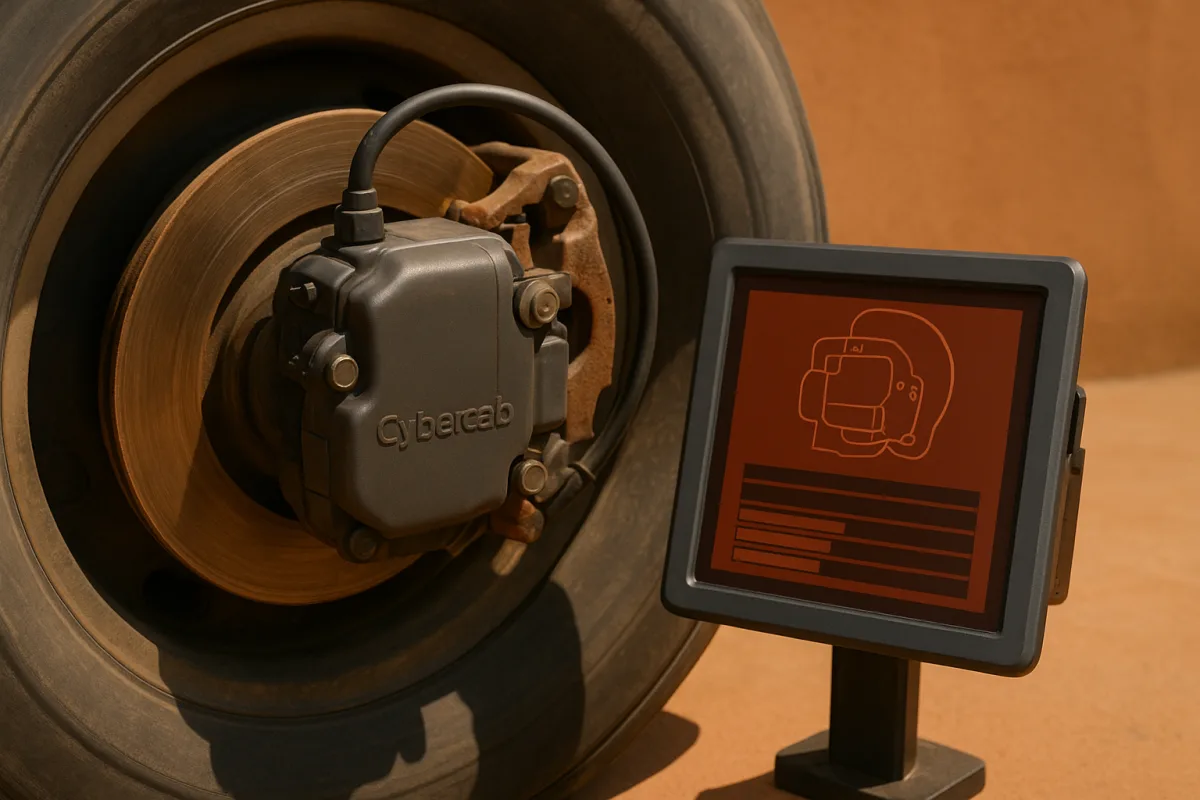
The important Cybercab question is not autonomy. It is braking without hydraulics
The headline-grabbing bit of Tesla’s Cybercab is obvious: no steering wheel, no accelerator pedal and no brake pedal. But the more consequential engineering change sits behind the wheels. This taxi has no conventional hydraulic brake circuit either. [6]
That means no brake-fluid reservoir, no master cylinder under the bonnet and no rigid lines or flexible hoses taking pressure to four calipers. Tesla has replaced that familiar system with dry brake-by-wire, an electrically commanded mechanical braking arrangement. [6]
For someone used to owning normal cars, hydraulic brakes are reassuring partly because they are comprehensible. A pedal moves a piston, pressure travels through fluid, and the calipers squeeze discs. Faults tend to have physical symptoms: a soft pedal, fluid loss, corrosion, a seized caliper.
Cybercab removes much of that hardware, and with it some routine maintenance. Yet it transfers the critical question from pipes and seals to electrical actuators, sensors, wiring, software and whatever redundancy Tesla has engineered behind them. That is where the controversy properly begins.
How ordinary hydraulic brakes actually work
In a conventional car, pressing the brake pedal pushes a rod into the master cylinder. The master cylinder pressurises brake fluid, which cannot be compressed in normal operation, so force travels through pipes and hoses to each wheel’s caliper.
The caliper pistons then clamp friction pads onto the rotating brake disc. More pedal pressure generally means more hydraulic pressure and therefore more clamping force. ABS and stability control can modulate individual wheels, but the underlying force is still hydraulic.
Most modern cars add electronics to this basic setup. Anti-lock braking, traction control, automatic emergency braking and regenerative braking in EVs all use sensors and electronic control units. But the final friction brake force normally still comes from hydraulics.
This distinction matters because plenty of cars already have what owners casually call brake-by-wire. Some use electronic pedal simulation and an electrically driven hydraulic pump, while retaining fluid, brake lines and a hydraulic fallback. Cybercab appears to go further. [6]
The Tesla setup is described as having an electronically controlled actuator at each caliper. Rather than building pressure centrally and distributing it through fluid, the vehicle computer commands each corner to apply braking force directly to its own rotor. [6]
What Cybercab’s dry brake-by-wire system changes
With no driver’s foot on a pedal, Cybercab does not need a pedal box, vacuum assistance, a master cylinder or a conventional hydraulic circuit. Tesla also has no steering column to package, because the two-seat taxi has no manual steering control. [6]
At a basic level, the vehicle’s automated-driving computer decides it needs to slow down. It first uses electric motor regeneration where possible, converting kinetic energy into electricity and feeding it back into the battery. Mechanical friction brakes handle the remainder.
That is broadly how most EVs behave, although ordinary EVs still retain a driver-operated hydraulic system. The Cybercab’s difference is that its software can directly request specific braking force at each wheel through each electronic caliper actuator. [6]
There are potential benefits. An individual actuator can be commanded independently, allowing the control system to vary force wheel by wheel. That could help stability when grip differs across the road surface, such as when one side is wet or dusty. [6]
Removing hydraulic parts could also simplify assembly. There are fewer fluid components to fill, bleed, inspect and route around the car. For a vehicle intended to spend its life doing repetitive urban mileage, reducing parts count is commercially attractive.
It is worth resisting the temptation to call that automatically more reliable. Deleting brake lines eliminates one family of faults, including leaks, corrosion and contaminated fluid. It creates another family: actuator faults, connector corrosion, software errors, sensor disagreement and electrical power problems.
The missing specification is more important than the missing brake fluid
Tesla has not publicly disclosed detailed actuator performance figures, safety certification information, redundancy architecture or the Cybercab’s fail-safe behaviour during a power loss. That is the largest unknown in this story, not a reason to assume failure or safety.
A properly engineered system can be fault tolerant. It might have independent power supplies, duplicated controllers, separated wiring paths, actuator self-checks and a strategy that preserves braking even after a component fault. But those are possibilities, not published Cybercab specifications.
That difference matters in ownership terms. On a conventional taxi, a fleet operator can inspect brake fluid, replace aged hoses, measure pads and discs, and diagnose a sticky caliper with familiar tools. The Cybercab may still need pads and discs, but diagnosis becomes more specialised.
The Drive reported that the Cybercab retains brake discs and calipers, only without the master cylinder and brake lines. [6] Friction material will therefore still wear, particularly in city operation, although strong regenerative braking could reduce the frequency of mechanical brake use.
Low friction-brake use has its own ordinary-car caveat. Pads can last a long time on EVs, but discs exposed to weather can corrode when rarely used hard. We do not know Tesla’s service strategy, inspection interval or replacement pricing for Cybercab caliper actuators.
That is why Tesla’s operating-cost claim needs treating carefully. The company projects 20 to 30 cents per vehicle-mile at full autonomous scale, crediting the missing driver and simplified vehicle design. [3] A target cost is not the same thing as an audited operating result.
The meaningful 60,000-mile questions are unanswered: actuator replacement cost, diagnostic labour, collision repairability, tyre wear, battery degradation, cleaning, downtime and insurance. No public long-term Cybercab maintenance data exists because the fleet has only just begun paid operation.
Why the NHTSA investigation is about certification
NHTSA’s current action is often described as an investigation into a car with no steering wheel. That is true, but incomplete. The agency is examining Tesla’s self-certification process and the technical basis on which it claimed compliance with applicable federal safety standards. [1]
In the United States, manufacturers generally self-certify that a vehicle complies with Federal Motor Vehicle Safety Standards, known as FMVSS. NHTSA does not normally grant a pre-sale approval stamp for every vehicle design, then discover problems only afterwards. [1]
That system works more smoothly when the vehicle resembles the kind of car the rules anticipated. A human-driven car has a steering wheel, pedals, mirrors, gear-selection controls and a driver position. Cybercab is designed around the proposition that none are required.
NHTSA says it will consider how far Tesla’s certification depends on deciding that particular FMVSS requirements are inapplicable to Cybercab. [1] Put plainly, Tesla’s argument may be that rules written for a human driver do not apply to a vehicle with no human driver.
The regulator has not yet concluded that Tesla broke the rules. The audit is about whether Tesla’s interpretation holds up, and whether the underlying technical material supports it. That is an important distinction for anyone reading “probe” as an immediate ban. [4]
Federal standards are also changing, but they have not finished changing. A June 2026 proposal would remove the manual brake-pedal requirement for vehicles designed exclusively for automated driving systems, while other proposals address displays and occupant protection. [2][7]
A proposal is not the same as a settled rule, and that timing is awkward for Tesla. Cybercab is trying to operate in the gap between regulations drafted for human drivers and a future framework written specifically for driverless vehicles.
Austin rides are a deployment, not proof of a finished product
Tesla began charging for Cybercab rides in Austin, Texas, on September 3, 2026. [5] The service currently uses 45 Cybercabs, within a reported Texas autonomous fleet of 420 vehicles, rather than a nationwide rollout or a retail launch. [5]
The vehicle is a two-seat taxi with bench-style seating, a central screen and doors controlled through the cabin interface. Tesla says it can take luggage, golf clubs and scooters, but its layout plainly suits one or two adult passengers better than families. [5]
There are operational limits that a normal taxi buyer would notice quickly. Passengers must be at least 18, so children cannot use it, and the windows cannot fully open. Tesla has not publicly explained the window limitation. [9]
An InsideEVs report on an early passenger video found the ride calm and uneventful on a filmed Austin route, with smooth pull-away and a compliant speed-bump response. [6] That is encouraging, but it is not durability evidence or a comprehensive safety validation.
The same report rightly noted that one geofenced journey does not establish performance in heavy rain, roadworks, dense pedestrian traffic or more hostile urban conditions. [6] A taxi earns confidence through thousands of ordinary, boring miles, including the awkward ones.
What this means for buyers, riders and fleet operators
There is currently no Cybercab to buy in the United States. Tesla has not announced consumer sales, a final retail price, delivery timing or a configurator. Elon Musk has indicated a target below $30,000 before 2027, but that remains an intention, not a transaction. [10]
That means there is no used market, no independent repair history and no meaningful residual-value data. Anyone discussing Cybercab as a cheap private EV today is talking about a possible future product, not something available at a dealer.
For riders in Austin, the practical decision is simpler. The attraction is a driverless ride in a purpose-built two-seater, but the service remains geographically limited and under federal scrutiny. Its lack of controls means passengers cannot take over if they feel uneasy.
For Tesla and any eventual fleet customer, the arithmetic depends on uptime rather than just component count. An actuator that lasts indefinitely is cheaper than fluid servicing. An actuator that requires expensive replacement, proprietary diagnostics or frequent calibration can erase those savings quickly.
Cybercab’s all-electric braking arrangement is not inherently irrational. In a low-speed autonomous EV, individual electric caliper control fits the architecture neatly. But the sensible owner-minded response is to separate the elegant idea from the evidence still missing.
Tesla has shown that Cybercab can carry paying passengers in Austin. [5] It has not yet shown the public the technical proof behind brake-system fail-safes, nor the maintenance record needed to support its low-cost promise. Until it does, the brake lines are not the concern. The unanswered questions behind their absence are.
Frequently Asked Questions
How does Tesla Cybercab's brake-by-wire system work?
The Cybercab uses an electric brake-by-wire system with an actuator at each wheel, replacing the traditional hydraulic brake circuit. Instead of hydraulic pressure traveling through fluid lines, the vehicle’s computer commands each actuator to apply braking force directly to its rotor. This system integrates with electric motor regeneration and allows software-controlled, wheel-specific braking.
What safety concerns exist with Tesla Cybercab's braking system?
Tesla has not published detailed data on the redundancy or fail-safe performance of the brake-by-wire system, including how it behaves during power loss. The National Highway Traffic Safety Administration (NHTSA) is investigating whether Tesla correctly self-certified the Cybercab’s compliance with federal safety standards, given its unconventional braking design and lack of manual controls.
What are the benefits of Tesla Cybercab's electric brake actuators?
Electric actuators eliminate the need for hydraulic fluid, pipes, and a master cylinder, potentially reducing maintenance related to leaks, corrosion, and fluid contamination. The system also allows independent control of each wheel’s braking force, which could improve vehicle stability on surfaces with varying grip.
How does Tesla Cybercab differ from traditional hydraulic brakes?
Traditional brakes use a master cylinder and hydraulic fluid to transmit pedal force to calipers, while the Cybercab uses individual electric actuators at each wheel controlled by software. It lacks a brake pedal, fluid reservoir, and hydraulic lines, relying entirely on electronic commands to apply mechanical braking force.
What maintenance challenges does Tesla Cybercab's braking system present?
While removing hydraulic components reduces issues like fluid leaks and corrosion, the Cybercab’s system introduces new potential faults related to actuators, sensors, wiring, and software. The long-term reliability and maintenance requirements of these electric components remain unproven, with no public data on repair or service needs.
How we researched this
This article was assembled from 8 published articles, 11 cited references.
Nothing here is based on hands-on testing. Where a figure or finding appears, it belongs to the source cited beside it, and the writing says so rather than implying otherwise. Every source is listed below so you can check it.
Sources
Tesla Cybercab Isn’t Just Missing a Steering Wheel. It Doesn’t Even Have Brake Lines — The Drive
The Tesla Cybercab Is Already Being Investigated For Not Having A Steering Wheel — InsideEVs
Tesla Offers Rides In A Car With No Wheel Or Pedals, So Naturally The Feds Showed Up — CarScoops
Watch Tesla’s Cybercab Carry Passengers Through Austin. It’s Almost Boring — InsideEVs
The Tesla Cybercab Has No Brake Lines Or Brake Fluid. Here’s How It Stops — InsideEVs
NHTSA Opens Investigation into Tesla Cybercab Self-Certification | NHTSA
Feds open probe into Musk's steering-wheel-free taxis a day after he began offering rides in them
Elon Musk's Tesla launches Cybercab autonomous taxi in Austin - The Washington Post
The Cybercab Has No Brake Fluid. Every Caliper Gets Its Own Actuator. — TeslAnt
New NHTSA draft rule eases FMVSS 102 for ADS‑only vehicles - TeslaMagz
No little kids allowed, and other new info about Tesla's Cybercab | TechCrunch
Related Articles
2026 Honda CRV and CRV Trail Sport Review: Off-Road Style and Refined Hybrid Performance
Savagegeese reviews the 2026 Honda CRV and CRV Trail Sport, highlighting the Trail Sport's off-road aesthetics and the CRV's refined hybrid drivetrain. The midcycle update maintains the CRV's competitive edge in the midsize SUV market.
2025 Lexus GX 550 Overt Trail Plus Review: Off-Road Adventure Await
Explore the 2025 Lexus GX 550 Overt Trail Plus in this review. Discover its off-road capabilities, interior design, and future adventures with the team.
Unleashing the Power: C8 Corvette ZR1X Performance Breakdown
Uncover the groundbreaking technology and performance of the C8 Corvette ZR1X in this thrilling episode of Savagegeese. From its 1250 horsepower output to its sub-2-second 0-60 time, this hypercar is a game-changer on the road. Explore the innovative chassis, advanced braking system, and electric motor strategy that make the ZR1X a true marvel of automotive engineering.

Mazda CX-50 Turbo Long-Term Review: Reliability, Handling, and Value
savagegeese reviews the Mazda CX-50 Turbo after a year, praising its reliability and handling while critiquing its ride quality and lack of refinement compared to competitors. They discuss the drivetrain, fuel efficiency, and overall value proposition of the vehicle.