
2027 Jeep Cherokee Trailhawk vs PaxPower Silverado Jackal Comparison
Compare the 2027 Jeep Cherokee Trailhawk and PaxPower Silverado Jackal off-road trucks for performance, features, and ownership costs.
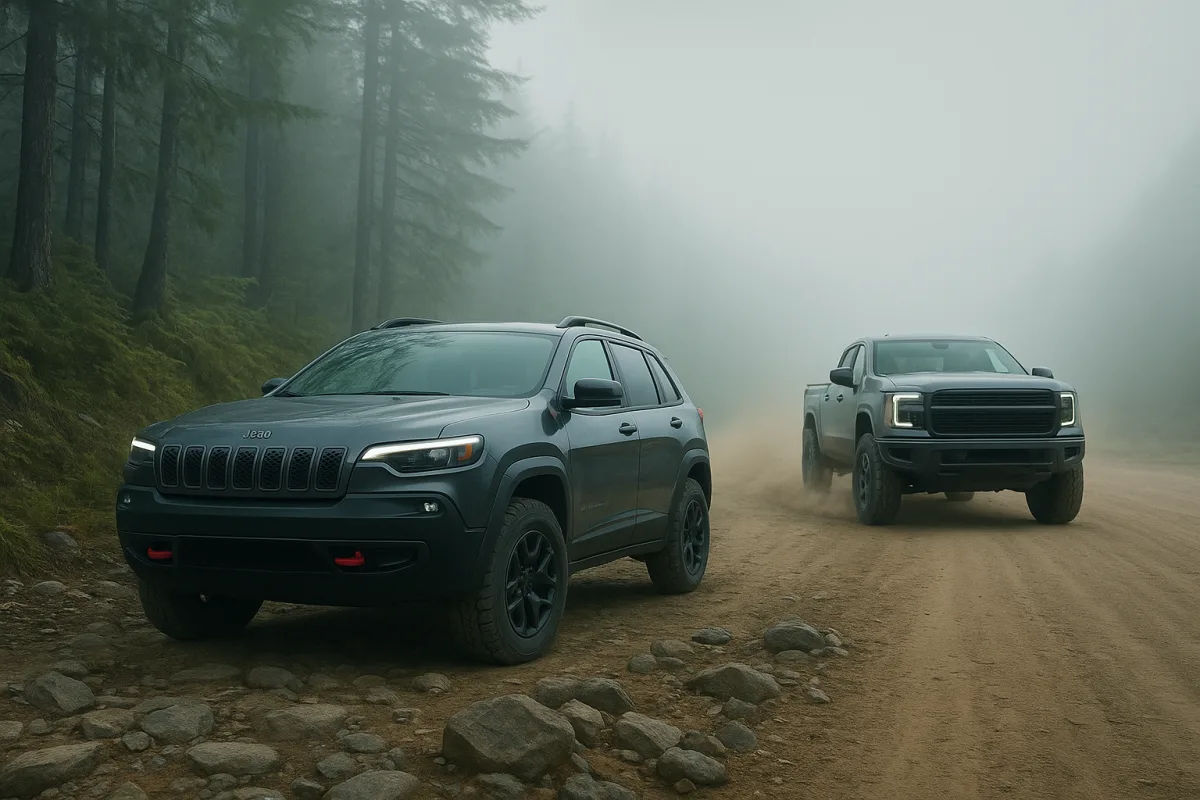
The 4 Low button changes the Cherokee’s case
The button marked 4 Low is the detail to look for in the 2027 Jeep Cherokee Trailhawk. The regular Cherokee hybrid struggled off pavement in The Fast Lane Car’s testing, while this version adds the gearing and traction hardware that rugged crossovers often lack.
The other truck is not a factory Silverado trim. PaxPower, a Houston pickup and SUV tuner, turns the redesigned 2027 Chevrolet Silverado into the Jackal, a wide-body desert runner intended to occupy the space Chevrolet leaves between the ZR2 and Ford’s Raptor models.
These are not close substitutes in size, price, or mission. Still, they answer the same need, getting farther down rough ground without immediately turning back, and both reveal how much hardware matters beyond aggressive tires and a rugged-looking bumper.
Our choice is the Cherokee Trailhawk for most owners. It costs far less, fits trails and parking spaces better, and its key off-road parts come from Jeep rather than a post-sale conversion. The Jackal is the thrilling but expensive answer for wide-open country.
Head-to-head comparison
| Criteria | 2027 Jeep Cherokee Trailhawk | 2027 Chevrolet Silverado Jackal by PaxPower |
|---|---|---|
| What it is | Factory Trailhawk version of Jeep’s compact hybrid crossover | Aftermarket desert-runner conversion based on a 2027 Chevrolet Silverado |
| Price | Starts around $44,000 according to The Fast Lane Car, while Motor1 reported $44,625.[2] | Approximately $95,000 naturally aspirated or $110,000 supercharged, including a base donor truck and conversion, according to The Drive |
| Powertrain | 1.6-liter turbo hybrid, 210 horsepower | 5.7-liter or 6.6-liter gasoline V8, with optional superchargers |
| Output | 210 horsepower | PaxPower forecasts 675 horsepower from the 5.7-liter and 725 horsepower from the 6.6-liter |
| Low-speed off-road hardware | Two-speed transfer case, 2.92:1 low range, 37.5:1 crawl ratio, electronic rear locker | Long-travel suspension, wider stance, larger wheels and tires, with upgrades available individually |
| Clearance and geometry | 9.0 inches of clearance, 28.8-degree approach, 21.9-degree breakover, 31.8-degree departure angles, 24-inch water fording depth[1] | PaxPower has not published comparable clearance, angle, crawl-ratio, or water-fording figures |
| High-speed desert use | Likely limited by compact-crossover proportions, hybrid output, and unproven real-world trail results | Built specifically for desert running, with long-travel suspension and wide-body hardware |
| Towing | 3,500 pounds with the trailering package[1] | Silverado-based truck, but PaxPower has not published Jackal-specific tow ratings |
| Fuel economy | Up to 39 city, 35 highway, and 37 combined mpg | No Jackal fuel-economy figure published |
| Ownership risk | Factory warranty structure, including five years or 60,000 miles for the powertrain and eight years or 100,000 miles for the hybrid battery[[3]](https://www.jeepportsmouth.com/2027-jeep-cherokee-maintenance-service-nh.htm "Cherokee Maintenance & Service | Jeep Portsmouth") |
| Best for | Tight trails, wet weather, camping, commuting, and owners who keep a vehicle beyond its initial novelty | Desert terrain, high-speed dirt, V8 power, large loads, and buyers prepared for a six-figure truck |
Price and what your money actually buys
The Cherokee Trailhawk begins around $44,000 in The Fast Lane Car’s report, while Motor1 put the starting price at $44,625.[2] Either figure buys a completed factory vehicle, although options, destination charges, taxes, registration, and financing remain extra.
The Jackal’s approximately $95,000 naturally aspirated and $110,000 supercharged figures include a base Silverado donor truck and the PaxPower conversion, The Drive reports. They do not mean every finished Jackal costs that amount, because trim choice and options can move it sharply upward.
A basic 2027 Silverado Work Truck starts at $41,395 including its $2,795 destination charge. PaxPower’s Jackal package on a ZR2 starts at $79,995, while the SPORT package adds roughly $9,950 and full wide-body, lifted builds reach the quoted $95,000 to $110,000 range.
That makes the starting Jackal roughly twice the Cherokee’s money before you add High Country luxury equipment, the 725-horsepower engine package, insurance, or accessories. The price gap is not a minor trim-level difference. It changes what you can afford to repair.
PaxPower says buyers can supply a Silverado through a Chevrolet dealer or have the company obtain one, and The Drive reports that financing may be bundled through GM Financial or other lenders. No specific Jackal financing program has been announced, however.
Modified trucks can make lenders cautious because the loan includes conversion work with uncertain resale value. Get pre-approval from several lenders before placing an order, and check whether the lender recognizes the complete conversion value, not only the stock Silverado’s book value.
Engines, gearing, and where each truck earns its keep
The Cherokee’s 1.6-liter turbocharged hybrid makes 210 horsepower. That figure sounds modest beside the Silverado, but horsepower is not the central Trailhawk story, because wheel control at walking speed matters much more on a loose, steep climb.
Jeep gives the Trailhawk a two-speed power transfer unit with a 2.92:1 low range, producing a claimed 37.5:1 crawl ratio.[1] The electronic rear locker should help when one rear tire unloads or spins on loose rock.
The Fast Lane Car correctly identified the significance of that setup. Its presenters noted that ground clearance alone cannot compensate for crossover gearing that demands deep throttle and momentum on climbs, adding heat and reducing precision when the trail gets steep.
A 37.5:1 crawl ratio is not Wrangler Rubicon territory. The Fast Lane Car compared it with a Wrangler ratio in the 70-to-1 range. Still, it separates this Trailhawk from many soft-road crossovers with terrain modes but no true low-range reduction.
PaxPower takes the opposite route. Its Jackal conversion targets speed and suspension travel, then offers supercharging for Chevrolet’s next-generation 5.7-liter and 6.6-liter V8s. Claimed output rises to 675 horsepower or 725 horsepower, respectively, according to The Drive.
The Drive says PaxPower chose those tunes with drivability and long-term durability in mind, not peak output alone. That is encouraging, but it is still a tuner’s forecast rather than a published long-term durability record at 60,000 or 100,000 miles.
For tight, technical ground, we would take low range and a rear locker over 725 horsepower every time. For dunes, long washboard roads, and broad desert two-tracks, the Jackal’s power and long-travel suspension are the point of the vehicle.
Clearance, trail geometry, and the limits of published numbers
Jeep lists 9.0 inches of ground clearance, including a one-inch lift, along with approach, breakover, and departure angles of 28.8, 21.9, and 31.8 degrees.[1] It also claims 24 inches of water-fording capability.[1]
Those are useful figures because the Cherokee’s wheelbase and body overhangs will determine whether you drag the bumper or center the vehicle on a ridge. The breakover figure deserves particular attention on crests and rocky humps.
But published specifications are not an off-road test. No independent real-world comparison between the 2027 Trailhawk and the previous KL-generation Cherokee Trailhawk is available, so nobody can yet say that Jeep’s new hardware delivers a measurable trail improvement.
The previous KL Trailhawk had a strong reputation for compact-crossover capability, even if its nine-speed automatic raised reliability concerns. The Fast Lane Car called it notably capable for its era, while warning that the new Cherokee’s standard version did not impress off road.
PaxPower describes the Jackal through its long-travel suspension, wide stance, larger wheels and tires, and integrated LED light bar. It has not published directly comparable clearance, approach, departure, breakover, water-fording, or crawl-ratio figures for the finished truck.
That omission limits direct comparison. The Jackal may be the more capable vehicle across open desert, but its published information does not establish how it handles deep water, narrow ledges, slow rocks, or the kind of obstacle where vehicle width becomes the limiting factor.
Daily driving, hauling, and fuel stops
The Trailhawk is the everyday choice on paper. Jeep rates the hybrid at up to 39 mpg city, 35 highway, and 37 combined, figures that should make a meaningful difference for anyone using it as a commuter between weekend trail trips.
Those are manufacturer figures, and your result will change with cold weather, tire choice, speed, cargo, and off-road use. Still, the Cherokee begins from an efficiency advantage that no 675-horsepower or 725-horsepower supercharged V8 conversion is likely to match.
The Trailhawk can tow 3,500 pounds with its trailering package.[1] That covers a small utility trailer, dirt bikes, or a compact camping trailer, but it does not make the Cherokee a replacement for a full-size pickup and its bed.
The Silverado starts with the advantages you expect: full-size dimensions, a pickup bed, V8 power, and a chassis built around truck work. Yet PaxPower has not published a Jackal-specific tow rating, so do not assume suspension changes preserve every factory towing limit.
Larger tires, altered suspension geometry, more heat, and vastly higher output can all affect how a modified truck behaves under a heavy trailer. Ask PaxPower what rating applies to your exact donor trim, engine, wheel-tire combination, and finished build.
Service, warranty, insurance, and the 60,000-mile question
Jeep’s standard coverage gives the Trailhawk a clearer ownership structure: five years or 60,000 miles on the powertrain, plus eight years or 100,000 miles for the hybrid battery.[3] Published maintenance-cost and reliability data for this new powertrain are not yet available.
That means the Trailhawk remains an unknown in one important way. Its hybrid system, turbo engine, two-speed transfer unit, and electronic locker add complexity, and owners should follow Jeep’s maintenance schedule once it publishes the model-specific service requirements.
The Jackal has a different ownership problem. You need to establish which work is covered by Chevrolet, which is covered by PaxPower, who approves repairs, and whether a local dealer will work on a supercharged, lifted, wide-body truck.
Federal rules require modified vehicles to continue meeting applicable safety standards and to carry alteration labeling when required. State rules also vary on ride height, lighting, and structural modifications, so confirm compliance where you register and use the truck.
Tell your insurer about every Jackal modification before taking delivery. Supercharger, suspension, wheel-tire, body, and lighting upgrades can raise premiums, and ordinary coverage may not automatically replace the conversion hardware after a collision, theft, or rollover.
The Cherokee is hardly risk-free, particularly before long-term hybrid reliability evidence exists. But a factory-built Trailhawk is far easier to insure, finance, service, and sell than a six-figure conversion whose value depends on the buyer understanding exactly what was done.
Who each option suits
The 2027 Jeep Cherokee Trailhawk suits the owner who sees rutted forest roads, snow, muddy campsites, rocky trailheads, and weekday traffic in the same month. We would buy it for its low range, rear locker, compact footprint, claimed efficiency, and manageable entry price.
It falls down for anyone expecting Wrangler-level rock crawling, full-size towing, or serious high-speed desert running. The claimed hardware is promising, but wait for independent off-road testing before assuming it surpasses the old KL Trailhawk on real trails.
The PaxPower Silverado Jackal suits the V8 loyalist who wants a Silverado with Raptor-style desert intent, major power, long-travel suspension, and a much more dramatic stance than Chevrolet sells from the factory. It is the emotional choice, and potentially the spectacular one.
It falls down on price, fuel use, physical size, unknown Jackal-specific towing figures, and ownership complexity. We would skip the supercharged version unless you have confirmed financing, insurance, local service support, and written warranty responsibilities before the order is placed.
Frequently Asked Questions
How does the 2027 Jeep Cherokee Trailhawk perform off-road compared to the PaxPower Silverado Jackal?
The Jeep Cherokee Trailhawk offers factory-installed off-road hardware such as a two-speed transfer case, rear locker, 9 inches of ground clearance, and a 37.5:1 crawl ratio, making it well-suited for forest roads, snow, and rocky trails. The PaxPower Silverado Jackal, by contrast, is designed for high-speed desert running with long-travel suspension and a wide stance but lacks published crawl ratio or clearance figures. Independent comparative testing between the two is not available, so performance differences are based on their intended uses and hardware.
What are the key differences between the Jeep Cherokee Trailhawk and the PaxPower Silverado Jackal?
The Cherokee Trailhawk is a factory-built compact hybrid crossover priced around $44,000, featuring a 1.6-liter turbo hybrid engine with 210 horsepower and off-road gear like a 2.92:1 low range and electronic rear locker. The PaxPower Silverado Jackal is a heavily modified full-size pickup starting near $95,000 to $110,000, with V8 engines producing up to 725 horsepower, long-travel suspension, and a wide-body design for desert terrain. The Trailhawk focuses on versatility and daily usability, while the Jackal emphasizes specialized high-speed off-road performance.
Which off-road truck is better for tight trails and daily use?
The 2027 Jeep Cherokee Trailhawk is better suited for tight trails and daily driving due to its smaller size, factory-installed off-road hardware, and hybrid powertrain offering up to 37 mpg combined fuel economy. It fits parking spaces more easily and carries a factory warranty. The PaxPower Silverado Jackal’s large size, high price, and specialized desert setup make it less practical for narrow trails and everyday use.
What are the ownership risks and costs of the PaxPower Silverado Jackal?
Owning a PaxPower Silverado Jackal involves higher costs and risks including a price tag of $95,000 to $110,000, potential insurance complications due to aftermarket modifications, uncertain warranty coverage, and financing challenges. Buyers should seek pre-approval from multiple lenders and confirm insurance and warranty terms before purchase. Maintenance and repair costs may also be higher and less predictable than for factory vehicles.
How do the off-road capabilities of the 2027 Jeep Cherokee Trailhawk and PaxPower Silverado Jackal compare?
The Jeep Cherokee Trailhawk offers proven low-speed off-road hardware such as a 37.5:1 crawl ratio, locking rear differential, and 9 inches of ground clearance, making it capable on technical trails, water crossings, and rough terrain. The PaxPower Silverado Jackal focuses on high-speed desert performance with long-travel suspension and a wide stance but lacks published low-speed crawl ratios or clearance specs. Each vehicle excels in different off-road environments rather than directly competing in the same conditions.
How we researched this
This article was assembled from 1 video source, 1 published article, 3 cited references.
Nothing here is based on hands-on testing. Where a figure or finding appears, it belongs to the source cited beside it, and the writing says so rather than implying otherwise. Every source is listed below so you can check it.
Sources
The Jeep Cherokee Struggles Off-Road - Does This Change Everything? 2027 Trailhawk Review!, The Fast Lane Car
Yup, the 2027 Chevy Silverado Looks Sick as a Desert Running Raptor-Rival, The Drive
2027 Jeep Cherokee Trailhawk First Look: Back With More Off-Road Capability
The Jeep Cherokee Trailhawk Has Real Off-Road Chops For $44,625
Watch Off-Road Truck Comparisons and Reviews on Youtube
Related Articles
2027 New SUV and Pickup Models: Features and Ownership Guide
Explore 2027 new SUV and pickup models with insights on performance, ownership costs, maintenance, and driving experience.
2027 BMW 3 Series M350 vs i3
Compare the 2027 BMW 3 Series M350 and i3 models on performance, ownership costs, and market challenges to find which suits your needs best.
Jeep Wrangler Rubicon vs Family SUVs
Compare Jeep Wrangler Rubicon with Hyundai Palisade and Honda Pilot for off-road capability, clearance, maintenance, and real-world use.
Electric and Hybrid Trucks and SUVs
Explore the latest electric and hybrid trucks and SUVs, including Ford Maverick, Slate, and Fathom models, with insights on performance and ownership.