
Brabus 900 Rocket Edition Cabrio Modifications and Ownership
Explore the Brabus 900 Rocket Edition Cabrio modifications, structural changes, and ownership insights beyond the Mercedes-AMG G63 base.
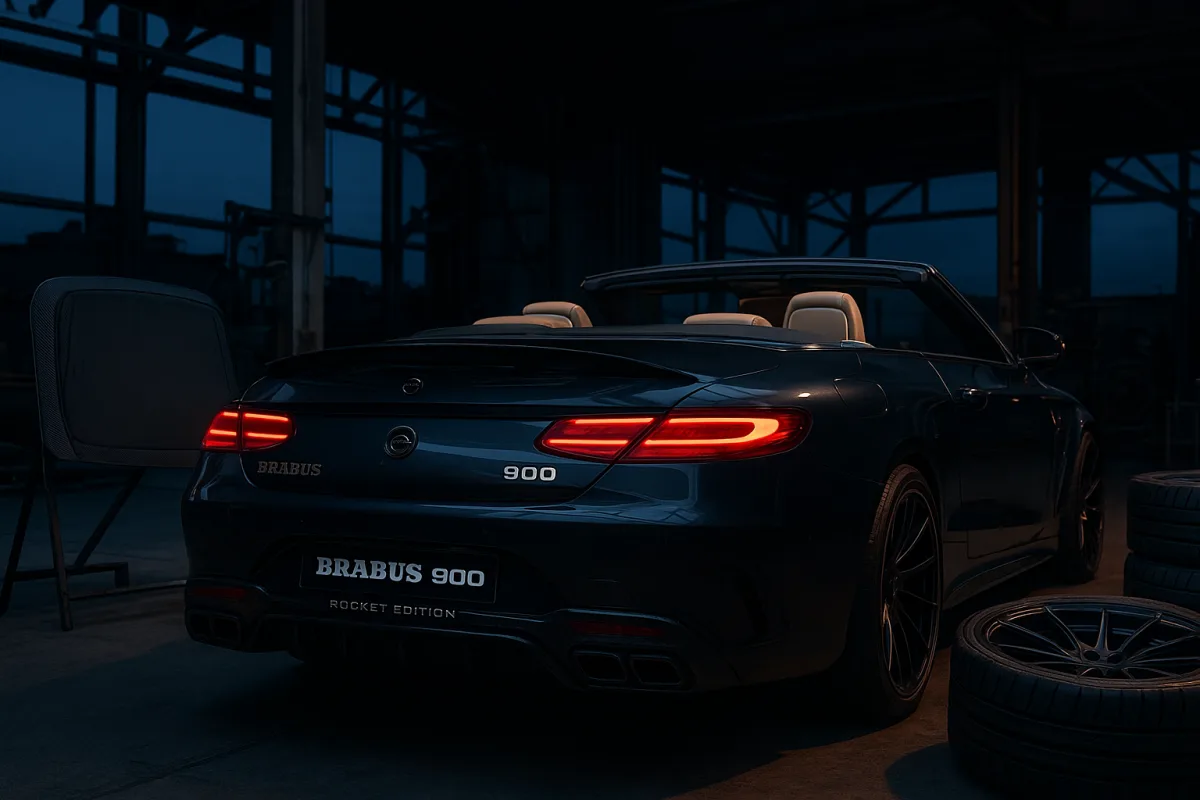
Brabus 900 Rocket Edition Cabrio: What Really Changes When You Remove a G63’s Roof
The important modification is not the extra power
The Brabus 900 Rocket Edition Cabrio begins as a Mercedes-AMG G63 of the current W465 generation, then loses the feature that makes a G-Class body unusually rigid: its fixed metal roof. Brabus announced the conversion in September 2026.[3]
That sounds obvious, but roof removal is the central engineering issue. A 900 PS twin-turbo V8, large wheels and carbon trim are expensive additions, yet a four-door convertible only works properly if the shell resists twisting without relying on its roof.
A factory G-Class roof is not merely weather protection. It closes the top of the body structure, helping the windscreen pillars, rear pillars, side panels and floor act as a connected box rather than several structures flexing independently.
With the roof in place, a bump acting on one front wheel can be distributed through the whole body. Without it, the windscreen frame and door apertures can move relative to each other, which is where scuttle shake, rattles and water leaks begin.
That is why chopping a roof from a tall, heavy SUV creates a different problem from fitting a body kit. A G-Class also has long, square door openings, a high centre of gravity and considerable suspension travel, all of which make body movement more noticeable.
What Brabus has added back into the structure
Brabus says the 900 Rocket Edition Cabrio conversion required more than 500 newly developed components, covering its two-piece powered fabric roof and the body reinforcement work beneath it.[3] That figure is useful because it indicates a re-engineering job, not a simple coachbuilt roof cut.
The visible elements include a carbon-fibre roof bow above the front seats and a steel roll bar positioned behind the rear doors. Brabus calls that rear hoop the C-BOW, wrapping it in exposed carbon fibre rather than trying to disguise it.[1]
The roof bow gives the front section of the opening some form and support. More importantly, the steel C-BOW provides a rigid cross-car structure behind the passenger compartment, helping to tie the sides together where the original roof once did.
Neither component alone makes a convertible body stiff. The strength comes from how those parts connect to reinforced windscreen pillars, side structures and floor sections. Brabus says it has extensively reinforced the body, but it has not published torsional-rigidity figures against the standard G63.[1]
That missing number matters. A manufacturer can measure torsional stiffness by fixing one end of a body shell and applying a twisting load at the other, then recording how many degrees the structure deflects per unit of force.
Without those test results, there is no sensible way to say whether the roofless Brabus matches the fixed-roof G63, or how close it gets. Brabus claims rigidity comparable to the regular vehicle, but prospective owners should treat that as a manufacturer statement rather than independently verified data.[1]
The two-piece electrically operated soft top opens or closes in 20 seconds and includes a heated glass rear window.[3] The rear roof section stows behind the rear seats beneath a dedicated cover, which is necessary because an SUV roof cannot simply fold into the space available above a conventional boot.
Rigidity is an ownership issue, not a showroom statistic
The real test of this work will not be one smooth Monaco waterfront drive. It will be years of uneven roads, kerb approaches, temperature cycles and repeated roof operation, all of which work against seals, joints, trim fasteners and alignment.
A rigid convertible tends to keep its door gaps, window seals and roof latches consistent. A flexible one can develop wind noise, water ingress and doors that need extra force to close after the body is resting on an uneven surface.
Brabus subjects each completed Cabrio to more than ten hours of water testing in a climate chamber before delivery.[1] That is a meaningful pre-delivery check for immediate leaks, but it is not evidence of ten-year seal durability or long-term corrosion resistance.
There is no published durability record for this conversion, no independent comparison with a standard Mercedes-AMG G63, and no bespoke maintenance schedule in the available material. An owner should not assume a normal Mercedes dealer service interval answers every Brabus-specific requirement.
The sensible ownership plan would involve both a Mercedes-AMG service relationship and a direct line to Brabus or its authorised network. The powertrain still has a G63 basis, but roof motors, fabric, latches, carbon pieces and structural conversion parts are specialist items.
That is also why accident repair could become more consequential than on a regular G63. Damage around the windscreen frame, C-BOW, roof mechanism or modified quarter structure may require a repairer able to follow Brabus procedures and source its parts.
Why 900 PS does not mean 900 PS reaches the road
Brabus enlarges the AMG 4.0-litre twin-turbo V8 to 4.5 litres, using forged pistons, new connecting rods, a billet crankshaft and upgraded turbochargers. The engine is rated at 900 PS, or approximately 888 hp, with 1,250 Nm of peak engine torque.[1]
The conversion does not send all 1,250 Nm to the wheels. Brabus electronically limits in-vehicle torque to 1,050 Nm, or 774 lb-ft, despite the engine’s higher headline figure.[1] That distinction is the most revealing mechanical detail in the specification.
Torque limitation is generally managed through engine calibration. The control system can reduce boost pressure, alter throttle opening, retard ignition or manage transmission torque requests in lower gears, at certain speeds, or when it detects conditions likely to overload components.
The aim is not modesty. It is protection for the transmission, driveshafts, differentials, tyre contact patches and the vehicle’s ability to remain controllable. A tall convertible SUV on 24-inch wheels has less use for an uncontrolled torque spike than a dyno graph suggests.
Brabus claims 0-100 km/h in 3.7 seconds, then limits top speed to 240 km/h, or 149 mph.[3] The cap reflects the tyre specification and the realities of aerodynamic lift, body motion and stability in a high-riding roofless vehicle.
The Rocket Cabrio wears 295/30 ZR24 front tyres and 345/25 ZR24 rears on forged Monoblock II wheels.[3] Those very short sidewalls may sharpen steering response, but they also leave little cushioning from potholes and increase the consequences of wheel damage.
Brabus also uses RideControl coilovers developed with KW, allowing a ride-height reduction of up to 45 mm, or 1.8 inches.[1] Lowering can reduce body roll and improve appearance, but it does not repeal the G-Class’s weight, width or practical vulnerability on poor roads.
The price is only the start of the ownership calculation
CarScoops reports an export price of €890,740 before German VAT for the shown vehicle.[1] Motor1’s reported tax-inclusive German figure was €1,059,980, although the final amount will depend on destination, tax treatment, specification and import arrangements.
That purchase price does not create a known maintenance budget. Brabus has not published routine servicing prices, tyre replacement prices, fuel-consumption figures or insurance premiums for the 900 Rocket Edition Cabrio, so any precise annual-cost estimate would be made up.
The tyres alone should be treated as a specialist consumable rather than an ordinary G63 expense. Their unusual 24-inch dimensions, high-speed capability and wide rear section suggest a costly replacement set, but there is no verified price or replacement interval available.
Brake, suspension and drivetrain wear are similarly uncertain. It is reasonable to expect substantial costs from a 900 PS, 2.5-tonne-class luxury conversion, but it is not responsible to borrow a standard G63 bill and present it as a Brabus ownership figure.
Insurance will need attention before delivery, not after it. The vehicle combines a seven-figure declared value, significant performance modifications, a roof conversion and tiny production volume, all of which can make mainstream insurers reluctant or require a specialist agreed-value policy.
Finance may be equally narrow. The independent research found specialist European supercar finance rates broadly ranging from 5.5 to 8.5 percent APR, while conventional lenders can be reluctant to finance modified ultra-luxury vehicles with uncertain resale evidence.
Rarity needs a clarification before anyone signs
There is a significant discrepancy over production numbers. Brabus’s official announcement says the 900 Rocket Edition Cabrio is limited to ten vehicles worldwide.[3] CarScoops and duPont REGISTRY News, however, reported a 50-unit limit.[1][4]
For a buyer, the official Brabus figure should carry more weight, but it is worth obtaining written confirmation on the specific car’s build number and total planned series. Rarity can affect insurance valuation, collector interest and the practical availability of replacement parts.
A blockchain-based Digital Product Passport accompanies each car, recording authenticity, ownership history and specification details.[1] That may help provenance, but it cannot establish future market value, nor does it remove the need for invoices, repair records and insurer-approved appraisals.
The more basic question is whether the buyer wants a collectible conversion or an easy vehicle to use regularly. The Brabus 900 Rocket Edition Cabrio suits the former far more clearly than the latter, because its appeal rests on rarity and engineering theatre.
Mercedes-Benz is preparing a factory G-Class Cabriolet for future production, according to Motor1’s reporting. A factory model may eventually offer clearer homologation, servicing and warranty arrangements, though it will not replicate the Brabus car’s 4.5-litre engine or ten-unit claimed scarcity.
Frequently Asked Questions
What structural modifications are made in the Brabus 900 Rocket Edition Cabrio?
The conversion involves more than 500 newly developed components, including a two-piece powered fabric roof, a carbon-fibre roof bow above the front seats, and a steel roll bar called the C-BOW behind the rear doors. These parts connect to reinforced windscreen pillars, side structures, and floor sections to compensate for the removed fixed metal roof and maintain body rigidity.
How does removing the roof affect the Brabus G63's rigidity?
Removing the fixed metal roof eliminates a key structural element that helps the G-Class body resist twisting forces. Without the roof, the windscreen frame and door apertures can move independently, potentially causing scuttle shake, rattles, and water leaks. Brabus addresses this by extensively reinforcing the body and adding structural components, but no independent torsional-rigidity data is available to confirm how closely it matches the standard G63.
What are the torque limits on the Brabus 900 Rocket Edition Cabrio?
Although the engine produces around 1,250 Nm of torque, the Brabus 900 Rocket Edition Cabrio is electronically restricted to 1,050 Nm. This limit is intended to protect the driveline and tires from excessive stress.
What should owners know about maintaining a Brabus 900 Rocket Edition Cabrio?
There is no long-term maintenance cost data available for this model, but owners should expect substantial expenses due to bespoke components and high-performance parts. Tires are large and specialized, likely costly to replace, and insurance premiums are expected to be high given the vehicle’s rarity and modifications. The vehicle also requires specialist repairs and registration approvals, which can add complexity and cost.
How does the Brabus 900 Rocket Edition Cabrio differ from a standard Mercedes-AMG G63?
Besides the removal of the fixed metal roof replaced by a bespoke two-piece soft top, the Cabrio features over 500 new components for structural reinforcement, including a carbon-fibre roof bow and a steel roll bar (C-BOW). The engine is tuned to 900 PS with an electronically limited torque of 1,050 Nm. The extensive bodywork and roof conversion make it a bespoke low-volume vehicle, not just a tuned G63.
How we researched this
This article was assembled from 2 published articles, 4 cited references.
Nothing here is based on hands-on testing. Where a figure or finding appears, it belongs to the source cited beside it, and the writing says so rather than implying otherwise. Every source is listed below so you can check it.
Sources
Brabus Rips The Roof Off The G 63, Creates 888 HP Cabrio — Motor1
Brabus Chops The Roof Off The G63 And Gives It 900 HP — CarScoops
Brabus Chops The Roof Off The G63 And Gives It 900 HP | Carscoops
2027 Brabus 900 Rocket Edition Cabrio Packs 900 HP - DailyRevs
BRABUS 900 ROCKET EDITION CABRIO- based on Mercedes-AMG G 63 (W 465) - Latest News - Brand | BRABUS
BRABUS Unveils New G-Wagon-Based 900 ROCKET EDITION CABRIO – duPont REGISTRY News
Related Articles

Mercedes-AMG CLE 646 Ownership
Explore Mercedes-AMG CLE 646 ownership, including performance, maintenance, costs, and the driving experience of this exclusive V8 coupe.

Rare Exotic Car Ownership Stories and Auction Insights
Explore rare exotic car ownership stories, auction values, and key risks for collectors and enthusiasts considering these unique vehicles.
R34 GT-R Performance Build: Import, Mods & Ownership Tips
Learn key tips for R34 GT-R performance builds, from import and insurance to carbon bodywork and specialist labor budgeting.
Exotic Car Ownership and Modifications
Explore exotic car ownership and modifications, including costs, challenges, and real-world examples of high-performance exotic cars.