
Ford Product Strategy 2026
Explore Ford's 2026 product strategy, badge use, ownership costs, and challenges with Mustang, Bronco, and the upcoming Ranger model.
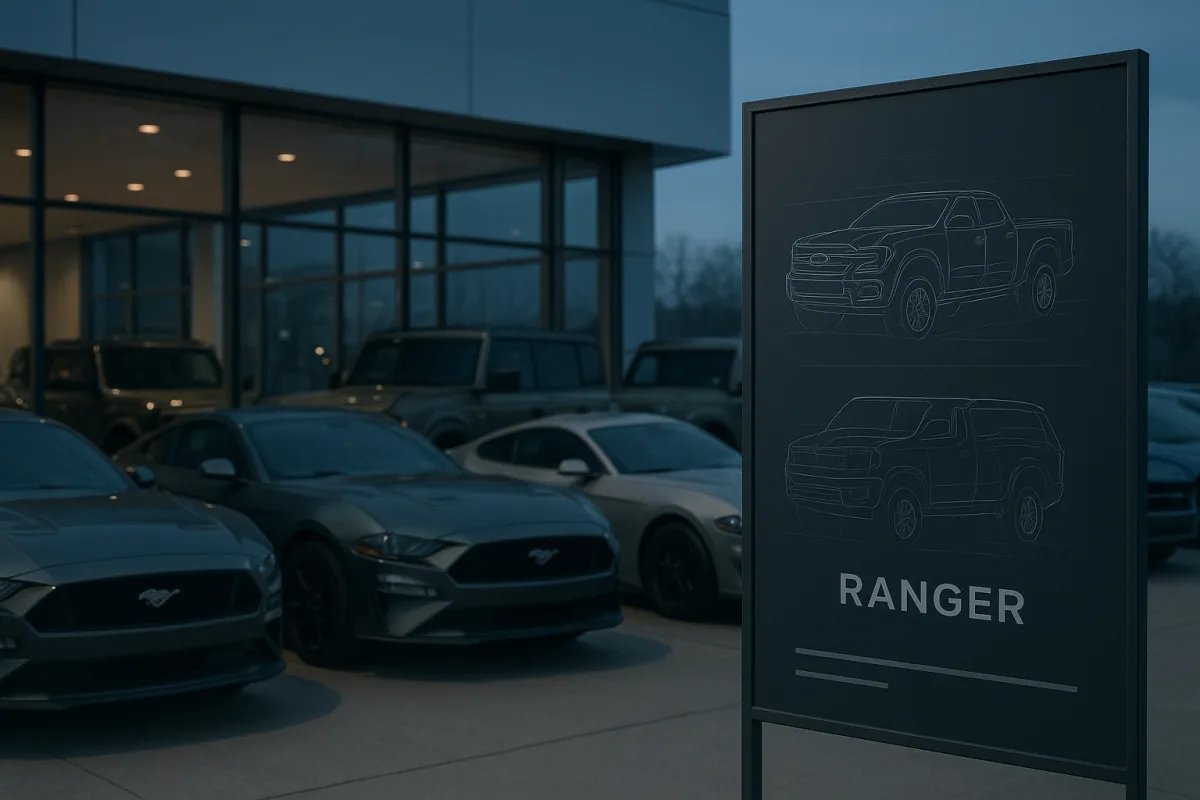
Ford’s strategy is really about amortising confidence
Regular Car Reviews frames Ford as a company with two big ideas, Mustang and Bronco. That is a fair provocation, but it misses the more useful ownership-level question: what does Ford gain by stretching a familiar badge across more vehicles?
The answer is not nostalgia alone. Developing a genuinely new model costs an enormous amount before the first customer gets keys, including engineering, crash certification, emissions work, tooling, supplier contracts, dealer training and warranty reserves. A recognised name reduces the risk of recovering that investment.
Ford’s stated plan is to refresh 80 percent of its American portfolio by volume by 2029, according to reporting cited by Regular Car Reviews. That wording matters. It does not mean 80 percent of model names will be new, nor that 80 percent of Ford dealers will receive fresh vehicles.
“By volume” means Ford is prioritising vehicles that shift in substantial numbers. In practice, that points toward F-Series pickups, Ranger, Maverick, Bronco, Explorer and the commercial Transit range, rather than filling every abandoned niche with a separate, clean-sheet car.
This is the central idea worth unpacking: Ford is attempting to spread the fixed cost of engineering across high-volume platforms and profitable variants. The customer sees a Bronco special edition or a Ranger Raptor. Ford sees shared structures, shared suppliers and a larger pool of buyers.
A nameplate becomes especially valuable when it can carry several price points. The Bronco can serve as a regular four-wheel-drive SUV, a Bronco Sport crossover, a more expensive Bronco Raptor and a range of appearance packages without Ford having to teach customers what “Bronco” means.
Mustang works similarly, although its limits are clearer. Ford presently sells the 2026 EcoBoost Fastback, GT Fastback and Dark Horse Fastback, with the published lineup spanning approximately $33,490 to $64,080. [1] The EcoBoost suits the buyer wanting Mustang shape without V8 fuel use, the GT suits V8 traditionalists, and the Dark Horse targets track-minded buyers.
The 2026 Mustang Dark Horse SC adds another rung for buyers wanting more performance than the standard Dark Horse, while occupying some of the territory once associated with the Shelby GT500. That is conventional product planning, not automatically cynical badge engineering.
Ford’s sales numbers support the approach. Mustang sales rose 22 percent during the first half of 2026 to 28,725 vehicles, and Ford says it outsold the nearest non-premium sports-car competitor seven to one. [11] A badge doing that job earns further investment.
Large Ford SUVs, including Bronco, Explorer and Expedition, rose 10.1 percent in the same period, reportedly their strongest first-half result in 25 years. [11] There is no evidence in the supplied reporting that Ford’s Mustang and Bronco concentration has weakened broader brand competitiveness.
A four-door Mustang is not a product until Ford says it is
The weak point in this strategy is perception. When every new idea seems to become a Mustang or Bronco, Ford risks looking as though it is marketing old emotional associations rather than building a coherent replacement for the Focus, Fusion and Taurus.
Ford stopped North American sedan production after winding down the Focus in 2018, Taurus in 2019 and Fusion in 2020. Regular Car Reviews rightly identifies the awkwardness of potentially returning to a four-door car under the Mustang name rather than reviving a dedicated sedan badge.
But buyers should separate dealer-event rumours from an orderable vehicle. Ford has not confirmed a four-door Mustang as of September 2026, and there are no official specifications, engine details, release date or base price. The current Mustang catalogue remains two-door only. [1]
That means claims of hybrid V8 power, Porsche Panamera-like space, sub-four-second acceleration and a sub-$40,000 starting price are not useful shopping information. They may describe an internal discussion, an early proposal, or nothing that reaches a showroom.
There is a sensible business case for a four-door Mustang if one arrives. Ford would be trying to sell a higher-margin, emotionally recognisable fastback to buyers who need rear doors. Yet calling it Mustang would not solve the practical questions of rear-seat access, ride quality, insurance and depreciation.
Those practical questions can quickly overwhelm the brochure appeal. Kelley Blue Book projects a 2026 Mustang five-year ownership cost of $57,051, including $40,916 in out-of-pocket spending, although its insurance and maintenance assumptions deserve checking against an individual driver’s location and specification. [7]
Kelley Blue Book’s published figures include Mustang maintenance averaging $1,561 annually, or $7,805 across five years. [7] That is a useful reminder that the GT or Dark Horse buyer is not merely choosing a V8 soundtrack, but higher consumable and insurance exposure.
The insurance number supplied in the research, roughly $17,300 annually, cannot sensibly coexist with the cited five-year ownership total. It should not be used as a budgeting figure without a direct insurer quote. That inconsistency is exactly why projected ownership tables need scrutiny.
Depreciation is similarly trim-dependent. Edmunds places 2026 Mustang trade-in values between $26,951 and $58,060, with an outstanding-condition Dark Horse coupe appraised at $54,797. [8] That spread reflects how much condition, mileage and specification matter after the excitement of ordering fades.
The Bronco has a different ownership argument. CarResaleValue estimates 2026 Bronco depreciation at 4.5 percent, while Ridekick puts fair market value near $60,650 and median resale around $51,196. [9] [10] Those are estimates, not guarantees, but they suggest stronger residual support than many niche vehicles.
Ford ownership costs for Bronco are less well documented than Mustang costs. The supplied research estimates five-year depreciation and fuel at $35,224, but gives no comparable maintenance figure. [9] A prospective owner should not assume Bronco servicing matches Mustang servicing simply because both wear Ford badges.
The next Ranger shows what Ford is actually spending money on
The next Ranger is more revealing than the Mustang-sedan rumour because Ford has confirmed development work. CarScoops reports that roughly 1,500 engineers in Australia are working on the successor, despite the current Ranger only arriving late in 2021.
That sounds like early work because it is early work. Pickups and commercial vehicles have long lives, and their replacements must be engineered years ahead. Ford needs time to decide what remains common with Bronco, which markets receive which engines, and how electrification affects payload and towing.
The current Ranger, Bronco and Everest share elements of Ford’s T6-derived architecture. A successor could evolve that ladder-frame base or start more extensively afresh. The difference determines supplier investment, crash development, body tooling and how easily Ford can retain established engines and suspension layouts.
Ford Australia’s role is not guaranteed merely because it has developed Ranger generations before. CarScoops reports Ford chief executive Jim Farley has described Australia as among the world’s most expensive places for engineers, while Ford and the Australian government discuss the hub’s long-term future.
That is where product strategy becomes less glamorous than a heritage badge. The next Ranger must be good enough to compete with the Toyota Hilux while being cheap enough to engineer, build and warrant globally. Australian expertise has value, but Ford must decide whether it justifies Australian cost.
The likely product ladder is easy to understand. A regular Ranger suits private owners and fleets needing a midsize pickup. The Ranger Raptor suits buyers prioritising off-road speed and suspension capability. Ranger Super Duty versions suit commercial users needing greater work capacity. Prices for the successor have not been announced.
Electrification is another cost decision, rather than a simple technical upgrade. The present Ranger family already spans diesel, petrol and plug-in hybrid options in different markets, while CarScoops notes the absence of a mild-hybrid diesel or conventional self-charging hybrid equivalent to some rivals.
A full battery-electric Ranger may eventually appear, but it would require Ford to balance battery cost, charging capability, payload loss and towing range. Those are not abstract concerns for a pickup buyer who loads tools every weekday or tows a caravan into areas without dependable chargers.
Supply disruption matters more than concept sketches
Ford also has immediate production work to sort out. The research brief identifies uneven aluminium supply after multiple fires at Novelis’s Oswego plant in late 2025, adding cost and disruption without providing a public figure for Ranger volume or price impact.
There was also a September 2026 recall affecting Rangers built from April 21 through September 3, 2026. Potentially counterfeit capacitors could cause infotainment and rear-view camera failures, a modern fault that matters because the camera is a safety system, not just a convenience screen. [3]
A late-September F-150 halt at Dearborn Truck Plant also demonstrated how quickly wider Ford production pressure can complicate planning. [4] The supplied research says there may be indirect Ranger effects, but no published evidence quantifies lost Ranger output, delayed deliveries or higher transaction prices.
That distinction matters. It is reasonable to say Ford faces supply and production risk. It is not reasonable to claim the next Ranger is delayed, or that a buyer will pay a specific premium, when Ford has not released those details.
The same discipline applies to software. CarScoops reports Rivian recalled 98,828 R1T pickups, R1S SUVs and newly delivered R2 SUVs because an electronic stability-control warning could obscure the reversing camera image. Most affected vehicles received an over-the-air remedy before the recall notice.
Ford’s Ranger capacitor issue and Rivian’s R1T, R1S and R2 software recall are different failures, but both show the present-day ownership reality. A truck’s long-term dependability now depends on electronics suppliers, camera compliance and software support as much as engines, differentials and suspension bushes.
For financing, buyers should also read the terms rather than focus solely on the monthly figure. The One Big Beautiful Bill Act permits up to $10,000 of qualifying vehicle-loan interest deductions for eligible passenger vehicles under 14,000 lb GVWR, for loans after December 31, 2024, subject to the final rules effective November 9, 2026.
That deduction may help some Ranger buyers, but it does not make a pickup cheaper at the dealer. Interest must first be paid, eligibility must be met, and the vehicle’s final GVWR matters. Businesses may also investigate Section 179 rules for qualifying vehicles above 6,000 lb GVWR.
Ford’s challenge, then, is not that Mustang and Bronco are bad ideas. They are strong ones. The challenge is ensuring the next Ranger, its factories and its supply base deliver the less glamorous dependability that keeps buyers returning after the badge appeal has worn off.
Frequently Asked Questions
What is Ford's current product strategy in 2026?
Ford is focusing on refreshing 80 percent of its American portfolio by volume by 2029, prioritizing high-volume vehicles like F-Series pickups, Ranger, Maverick, Bronco, Explorer, and Transit. The strategy involves amortizing engineering and development costs across shared platforms and leveraging strong nameplates like Mustang and Bronco to maintain sales growth and profitability.
Why does Ford use Mustang and Bronco badges extensively?
Ford uses the Mustang and Bronco badges because they help reduce the risk and cost of developing new models by spreading fixed engineering expenses across multiple variants. These badges carry strong customer recognition, allowing Ford to offer a range of price points and special editions while maintaining brand appeal and sales momentum.
What challenges does Ford face with the next Ranger model?
The next Ranger involves a complex, long-cycle engineering program affected by factors such as Australian engineering costs, emissions regulations, supplier capacity, and factory stability. Production has also been disrupted by aluminum supply issues due to plant fires, a recall related to counterfeit capacitors, and a production halt at the Dearborn Truck Plant, leading to delays and increased costs.
Is a four-door Mustang confirmed by Ford?
No, Ford has not confirmed a four-door Mustang as of September 2026. The current Mustang lineup consists only of two-door fastbacks, and there are no official specifications, release dates, or pricing for a four-door model. Rumors about such a vehicle remain unsubstantiated and should not be considered reliable shopping information.
How do Mustang and Bronco ownership costs compare?
Kelley Blue Book estimates the five-year ownership cost of a 2026 Mustang at about $57,051, including $40,916 in out-of-pocket expenses and annual maintenance averaging $1,561. While specific Bronco ownership costs are not detailed in the article, Mustang ownership involves higher consumable and insurance costs, especially for V8 and performance variants.
How we researched this
This article was assembled from 1 video source, 2 published articles, 11 cited references.
Nothing here is based on hands-on testing. Where a figure or finding appears, it belongs to the source cited beside it, and the writing says so rather than implying otherwise. Every source is listed below so you can check it.
Sources
Ford Only Has Two Ideas (The Roman Report) — Regular Car Reviews
Ford Ranger Successor Is Under Development — CarScoops
Rivian Has Already Issued The First Recall For The R2 — CarScoops
Ford F-Series Production Woes Help Blue Oval's Chief Rivals | Ford Authority
Fords Reinvention Begins With Fewer Vehicles And Less Complexity - Global Financial Market Review
Ford Large SUVs, F-Series Fuel H1 2026 Growth; Bronco, Maverick Hybrid Set Records
Watch Ford's Current Product Strategy and Challenges on Youtube
Related Articles
Automaker Challenges and Market Shifts Explained
Explore key automaker challenges and market shifts, including fixed costs, factory capacity, and dealer network impacts on profitability.
Exotic Car Restoration Stories and Ownership Insights
Explore exotic car restoration stories, ownership challenges, and costs for high-performance rebuild projects like Ferrari and Lamborghini.
Electric Vehicle Pricing and Ownership Costs Explained
Explore electric vehicle pricing, ownership costs, tax credit impacts, and key maintenance tips to make informed EV buying decisions.
Electric and Hybrid SUV Comparison
Compare electric and hybrid SUVs with a detailed look at Tesla Model Y and Toyota RAV4 PHEV performance, ownership, maintenance, and driving experience.