
Ford Vault Heritage Collection: Insights on Cars and History
Explore the Ford Vault Heritage Collection with insights on rare vehicles, performance highlights, and Ford's automotive history.
The quick list
Best overall: Early Bronco U260 design study, for anyone who wants to see how the modern Bronco’s revival began.
Best value: 2000 Ford Contour SVT, for owners who care about a real, serviceable performance Ford rather than an untouchable concept.
Best for small spaces: 2005 Ford SYNus, for fans of compact cars and genuinely strange design.
Best performance story: 1966 Ford GT40 trio, for Le Mans history and Ford’s defining racing achievement.
Best concept-car rabbit hole: 2003 Ford Model U, for anyone interested in alternative fuels, compact pickups, and ideas Ford left behind.
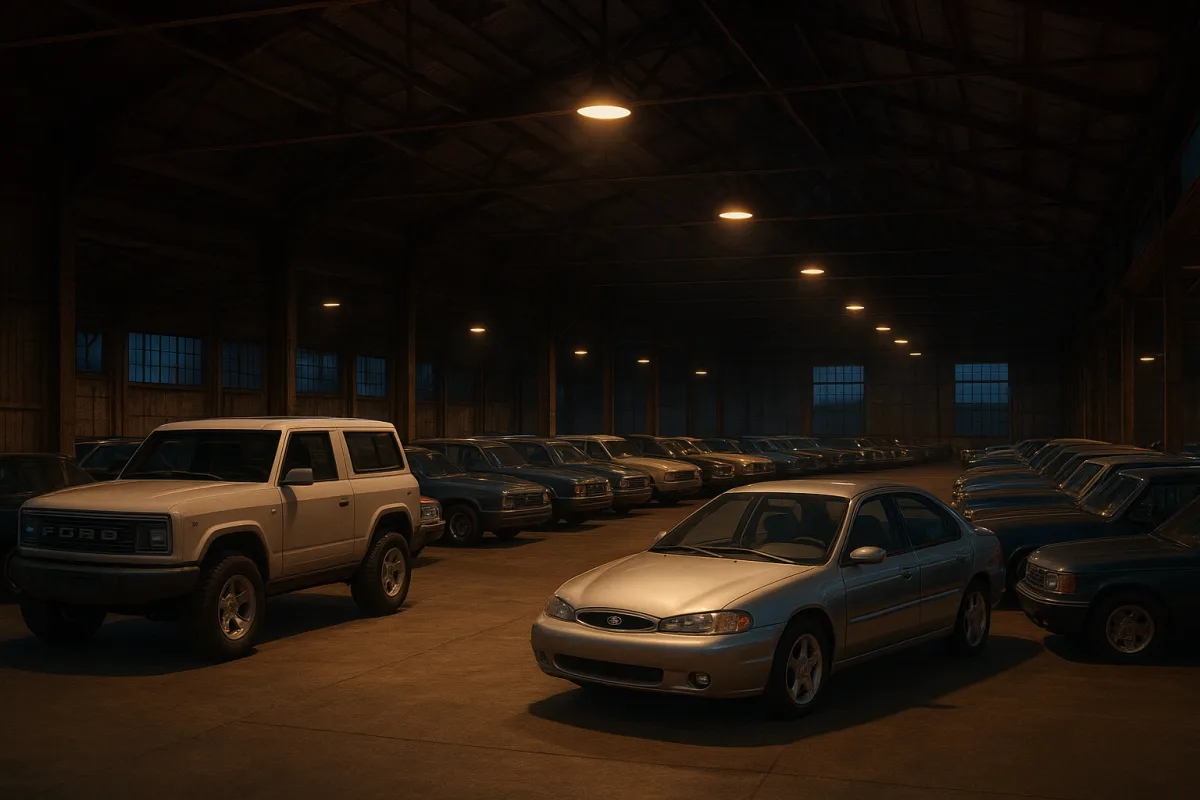
The green, right-hand-drive 1910 Model T sets the tone immediately: this is not a room full of only red Mustangs and winning race cars. Ford’s new Vault gathers production cars, styling models, development mules, race cars, and one-off concepts that normally disappear into storage.
The building is in Romulus, Michigan, and Ford moved the Heritage Fleet there in November 2026 after a temporary display at Ford World Headquarters in Dearborn. The collection occupies a repurposed 79,000-square-foot fulfillment center and includes 125 vehicles. [1][6]
You cannot currently buy a ticket and walk in. Ford has limited access to employees and selected guests while it works with Romulus on rezoning and building-code requirements for public museum use, and no opening timetable has been published. [1][2]
That makes this less a guide to planning a weekend museum trip than a guide to knowing what deserves your attention when public access arrives. There is no admission price, exhibit map, opening schedule, or public parking arrangement to compare yet.
What the Vault is, and what it is not
Motor1 describes the collection as Ford Motor Company’s own history, not a replacement for The Henry Ford museum. That shows in the cars selected: alongside familiar production vehicles are studio models, engineering experiments, dealership-era artifacts, signage, an arcade machine, and vehicles preserved because somebody ignored the instruction to destroy them.
Ford started formally curating the Heritage Fleet in 2024. The effort reportedly began after Ford CEO Jim Farley saw the company’s collection in England, then Ford archivists, design staff, and racing personnel began locating cars held in garages, warehouses, studios, and storage areas.
The result is not a lineup arranged by market value. It is a lineup arranged around the messy way vehicles actually get developed, canceled, raced, stored, and occasionally rescued from the crusher.
Ford’s V10-powered New Edge Mustang mule is the perfect example. Engineers first installed a 5.4-liter V8 in a Mustang development car, then later fitted a naturally aspirated V10 while evaluating powertrain possibilities for the 2005 Ford GT.
Ford ultimately used a supercharged V8 in the production GT, but the mule survived. Nick Terzes, Ford Racing’s heritage business manager, told Motor1 that the car had been moved among groups and hidden from view instead of scrapped.
It remains a working engineering object, too. Ford later fitted a new powertrain control module and wiring harness, reportedly allowing the V10 Mustang to make more power. That is a better preservation story than simply putting an important car under a cover.
Comparison table: the vehicles to prioritize
| Vehicle or group | Era | Size or layout | Powertrain | Why it matters | Cost or access reality |
|---|---|---|---|---|---|
| Early Bronco U260 study | 1999 | Ranger-based off-road SUV proposal, incomplete interior | No published production powertrain | Early attempt to revive Bronco, 22 years before the 2021 production return | Not for sale, no public Vault admission announced |
| 2000 Contour SVT | 2000 | Four-door sport sedan | Ford has not published Vault-specific mechanical details | Production Ford with 123 miles and original window sticker | Not for sale; Edmunds listed 2024 trade-in values of $111 to $350 for ordinary examples [[4]](https://www.edmunds.com/ford/contour-svt/2000/appraisal-value/ "2000 Ford Contour SVT Value - $111-$350 |
| Ford SYNus | 2005 | 158-inch compact, two-door urban concept | 134-hp 2.0-liter four-cylinder, five-speed manual | A compact “urban sanctuary” with vault-like styling | Not for sale, no public Vault admission announced |
| Ford Model U | 2003 | Small pickup with retractable rear section and canvas roof | Supercharged 2.3-liter hydrogen four-cylinder, electrified automatic | Ford’s early compact pickup and alternative-fuel experiment | Not for sale, no public Vault admission announced |
| Ford GT40 trio | 1966 | Mid-engine endurance race cars | Race-spec GT40 powertrains not detailed by Ford here | First, second, and third at the 1966 Le Mans finish | Displayed temporarily, then expected to leave the Vault |
| Ford Reflex | 2006 | Compact 2+1 coupe, rear-hinged butterfly doors | Diesel-electric hybrid, rear electric motor for AWD | Early hybrid packaging, child-seat integration, claimed 65 mpg | Not for sale, no public Vault admission announced |
| Super Chief | 2006 | Luxury pickup with coach doors and wood-lined bed | Supercharged 6.8-liter V10, gasoline, E85, or hydrogen | Full-size truck luxury and multi-fuel ambition | Not for sale, no public Vault admission announced |
Best overall: the Bronco study explains the current Bronco
The 1999 U260 Bronco study is the exhibit we would make time for first. Moray Callum led the proposal for a Ranger-based next-generation Bronco only three years after Ford ended the original model in 1996.
It did not reach production. Car and Driver reports that the surviving vehicle is essentially an exterior styling prototype, while Motor1 says the display model lacks a finished interior beyond visible headrest tops and a steering wheel.
That unfinished state is why it is compelling. You can see Ford testing the proportions that make an off-road SUV work visually: upright glass, short overhangs, broad shoulders, and a shape that reads as durable before a wheel turns.
The trade-off is that it cannot answer ownership questions. There is no published engine, curb weight, tow rating, service schedule, or production specification because Ford never made it into a complete road vehicle.
Ford returned to the Bronco idea with a 2004 Detroit auto-show concept, also in the Heritage Fleet, but production did not resume until the 2021 model year. The U260 is the less polished, more revealing artifact.
Best value: the Contour SVT is the Ford people could have owned
The maroon 2000 Contour SVT is perhaps the Vault’s most relatable oddity. It has just 123 miles, its original window sticker remains attached, and it represents a performance sedan from a Ford lineup that no longer exists.
It is also a reminder that preservation and market value are different things. Edmunds put the trade-in range for a normal 2000 Contour SVT at $111 to $350 in 2024, though that figure says little about a 123-mile factory-preserved car. [4]
For an owner with a used Contour SVT, the care burden is mundane rather than exotic. General maintenance guidance calls for oil changes every 5,000 to 7,500 miles, transmission service every 30,000 to 60,000 miles, and coolant service every 30,000 to 50,000 miles. [3]
Age changes the equation for this particular car. Low miles do not preserve rubber hoses, seals, brake fluid, tires, or cooling-system components indefinitely, and Ford has not published any maintenance cost or preservation budget for the Vault fleet.
This is why the Contour belongs beside a GT40 in a Ford collection. The GT40 is a legend. The Contour SVT represents the much rarer experience of a manufacturer putting a performance car into ordinary dealer showrooms, then watching it vanish from roads.
Best for small spaces: the SYNus is compact, not practical
The 2005 SYNus looks like a bank vault designed by somebody who had seen an armored truck and a sneaker catalog on the same day. Its thin windows, slab-sided body, rear-door wheel handle, and severe surfaces still look unlike anything Ford sells.
Car and Driver reports it is only 158 inches long, which is the key number. Photos make it look heavy and imposing, but it is a genuinely compact vehicle with a 134-hp 2.0-liter four-cylinder and a five-speed manual transmission.
Its claimed mission was “Urban Sanctuary,” with the name pronounced “sin-you-ehs.” Ford combined “synthesis” and “US,” then designed a car intended to feel protective in a crowded city.
The trade-off is visibility. The narrow glass and armored styling made a memorable show car, but the same features would have made parking, lane changes, and everyday outward sightlines a concern if Ford had pursued production.
Best concept-car rabbit hole: Model U, Reflex, and Super Chief
The 2003 Model U is the concept that feels closest to a missing production opportunity. It was a small pickup that could transform into an SUV through a retractable rear section, with a retractable canvas roof and soy-based exterior panels.
Its supercharged 2.3-liter four-cylinder could burn hydrogen, and an electrified automatic transmission supported Ford’s claimed 45-mpg figure. It also carried features that were unusual for 2003, including a head-up display, adaptive headlights, and automatic emergency braking.
Ford’s claim needs context because it was never subjected to production-car ownership. There is no published durability record for the hydrogen-combustion setup, no service schedule, and no evidence that the retractable body arrangement could have survived years of weather and hard use.
The 2006 Reflex took a different route. Its diesel-electric hybrid system used lithium-ion batteries and an electric motor at the rear axle, giving it all-wheel drive and a claimed 65 mpg, with a claimed 0-60 mph time of 7.0 seconds.
Its 2+1 cabin used a single rear “love seat,” plus an integrated child seat and dashboard baby-camera monitor. That is forward-looking packaging, but not necessarily family-car packaging, since one rear seat limits its utility the moment a second passenger needs space.
The Super Chief sits at the other end of Ford’s concept spectrum. This luxury truck used a supercharged 6.8-liter V10 called Tri-Flex, capable of running on gas, E85, or hydrogen, under a locomotive-inspired body with coach doors.
Brown leather, brushed aluminum, American walnut, a glass roof, and a wood-lined bed made it a vision of luxury pickup ownership before upscale trucks became mainstream. Its big drawback is obvious: it is an aspiration vehicle, not a blueprint for affordable running costs.
The race cars and the designs that escaped the crusher
Ford’s three 1966 Le Mans GT40 finishers are the marquee cars. The black No. 2 Shelby American GT40 driven by Bruce McLaren was declared winner after Ford arranged for the three leading cars to cross together, ahead of Ken Miles in the blue-and-red No. 2.
Car and Driver reports that those GT40s will not remain at the Vault beyond their short display period. If they are present during an eventual public opening, they are the cars to see first because their stay is explicitly temporary.
The 1963 Cougar II is another rare piece, a Shelby Cobra underneath a wedge-shaped fiberglass fastback designed by Ford styling chief Eugene Bordinat. Ford claimed its more aerodynamic body could reach 170 mph, 10 mph beyond a standard 260 V8 Cobra.
Unlike many Ford-owned objects in the building, the Cougar II is on loan from the Detroit Historical Society. Jay Leno’s 1934 Ford pickup and four Michigan State Police cars, dating back to 1957, are also borrowed elements in the collection.
That borrowing matters for future visits. Ford has indicated the Vault may use loan vehicles for rotating displays, so a later public museum is unlikely to be a frozen 125-car snapshot.
Who each option suits
The Bronco U260 study suits the current Bronco owner. You will see the earlier Ranger-based thinking behind Ford’s eventual return to the nameplate, including the gap between a styling buck and a production-ready truck.
The Contour SVT suits the keeper of an overlooked Ford. It connects directly to the reality of maintaining an aging sport sedan, where service intervals and aging components matter more than a pristine odometer reading.
The SYNus suits design enthusiasts with limited patience for nostalgia. It is small, weird, and ambitious, and it proves Ford’s archives contain more than familiar pony cars and full-size trucks.
The Model U and Reflex suit anyone interested in abandoned future-Ford ideas. Both show that Ford explored hybridization, alternative fuels, advanced safety equipment, and flexible interiors long before those ideas became commonplace.
The Super Chief suits truck-history fans. It captures the point when pickups were becoming personal luxury vehicles, though its wood, leather, hydrogen capability, and V10 excess were never going to become a cheap work-truck formula.
The GT40s and Cougar II suit the reader who wants landmark machinery. They are the dramatic choices, but we would not let them overshadow the Contour, Focus prototype, and Bronco study, which better explain how Ford’s ordinary cars got made.
Frequently Asked Questions
What vehicles are in the Ford Vault Heritage Collection?
The Ford Vault houses 125 vehicles including production cars, styling models, development mules, race cars, and one-off concepts. Notable examples are the 1910 British right-hand-drive Model T, the 1966 Ford GT40 Le Mans finishers, the 2000 Contour SVT, the early Bronco U260 study, and various concept cars like the Model U and SYNus.
How does the Ford Vault showcase Ford's automotive history?
The Vault presents Ford’s history through a mix of everyday production vehicles, engineering experiments, and concept cars. It highlights how Ford’s design and engineering evolved, featuring cars that were driven, tested, and sometimes nearly scrapped, rather than focusing solely on market value or race winners.
What are the key performance cars in the Ford Heritage Fleet?
Key performance vehicles include the trio of 1966 Ford GT40 race cars that finished first, second, and third at Le Mans, along with the V10-powered New Edge Mustang development mule. The 2000 Contour SVT is also important as a low-mileage, real-world performance sedan.
Can the public visit the Ford Vault Heritage Collection?
Currently, the Vault is not open to the public. Access is limited to Ford employees and select guests while Ford works with the city of Romulus on rezoning and building-code compliance for future public museum use. No opening date has been announced.
What maintenance insights are available for cars in the Ford Vault?
Some vehicles, like the V10 Mustang mule, remain working engineering objects with updated components such as a new powertrain control module and wiring harness. This approach preserves the cars as functional machines rather than static displays, offering insight into Ford’s engineering processes.
How we researched this
This article was assembled from 2 published articles, 6 cited references.
Nothing here is based on hands-on testing. Where a figure or finding appears, it belongs to the source cited beside it, and the writing says so rather than implying otherwise. Every source is listed below so you can check it.
Sources
We Explored the Ford Vault, the New Home of Ford’s Heritage Fleet, Car and Driver
Ford Hid These Rare Cars For Decades. Now You Can Seem Them All In One Place, Motor1
Ford throws open the doors to its new Vault, unveiling 125 rare historic vehicles
Ford Heritage Fleet Vault: Official Museum Plans and Location
Spotlight: The Evolution of Ford Mustang #29 | Made-in-US Blog
Related Articles
Tesla Roadster Performance Reality Check and Cultural Impact
Explore the Tesla Roadster's true performance, thruster tech, ownership realities, and its cultural impact beyond the hype.
Performance and Racing Culture
Explore performance and racing culture, including drag, drift, no-prep events, and ownership costs for race car projects.
High-Performance Exotic Car Ownership
Explore high-performance exotic car ownership costs, maintenance, modifications, and financing to make informed decisions about your dream vehicle.
Exotic Car Ownership and Modifications
Explore exotic car ownership and modifications, including costs, challenges, and real-world examples of high-performance exotic cars.