
Race Car Builds and Engine Swaps: Best Projects Compared
Explore race car builds and engine swaps with detailed comparisons of performance, cost, and value for high-performance projects.
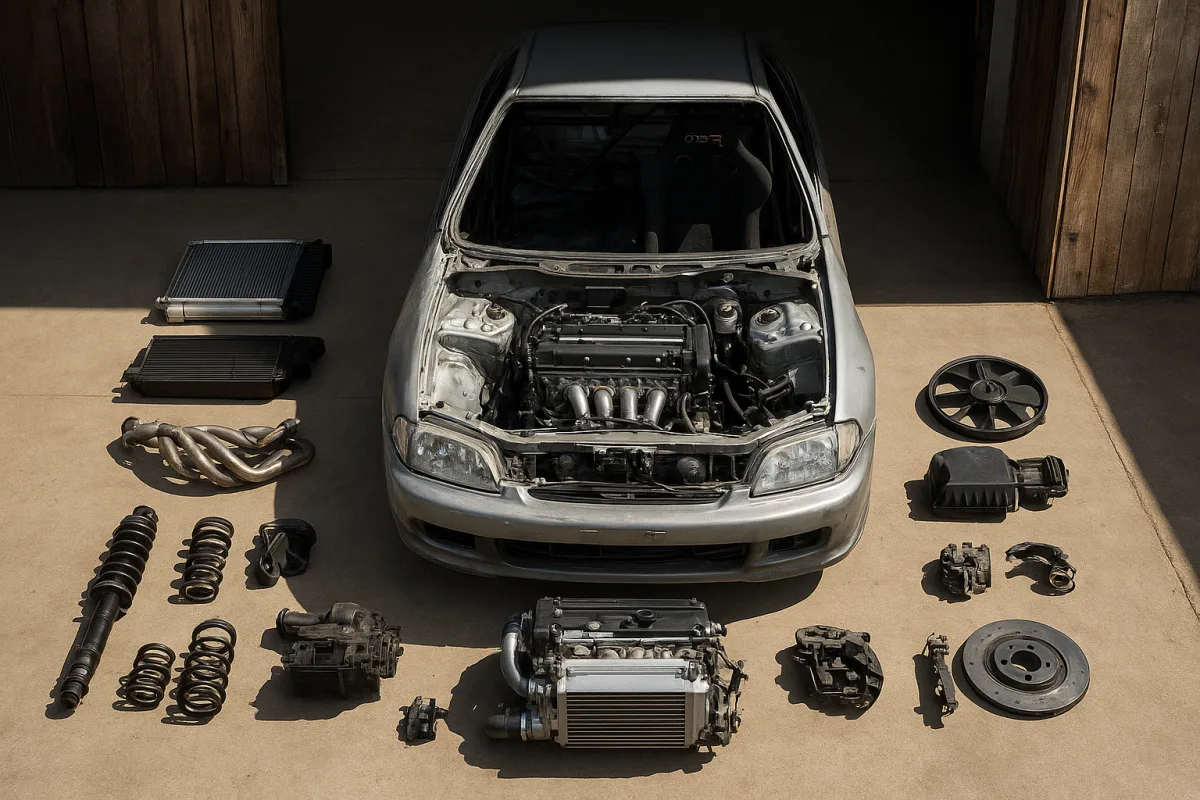
Race Car Builds and Engine Swaps: Which Extreme Project Is Actually Worth Taking On?
The quick list
- Best overall: throtl’s 2026 Honda Prelude Type R, for the builder who wants a convincing factory-plus Honda with track hardware and a real interior.
- Best value: Nivlac57’s GM 4.2-liter Atlas inline-six formula, for grassroots racers who want modern engine architecture without LS-swap predictability.
- Best for exotic-car commitment: throtl’s twin-turbo manual Lamborghini Murciélago, for an owner with specialist support, deep reserves, and no expectation of easy resale.
- Best for an all-out drag program: Rob Dahm’s 12-rotor powertrain project, for a team willing to engineer the chassis around the engine from scratch.
- Best finished-car alternative: Chevrolet’s C8 Corvette Stingray Z51, for the driver who wants huge straight-line pace without becoming the development department.
You are deciding whether to build something no one else has, or buy performance that already works. The difference shows up long after the reveal, when a sensor fails, a tire wrinkles under load, or the insurer asks for receipts.
The five approaches here are dramatically different. One combines late-model Honda hardware into a newer chassis, one turns an unloved truck engine into a race-car staple, and one puts an exotic V12 through a rewrite of nearly every system around it.
| Option | Core layout | Reported power or performance | Cost picture | Main trade-off | Best use |
|---|---|---|---|---|---|
| throtl Prelude Type R | 2026 Prelude with crashed FL5 Civic Type R components | Pure Turbo, PRL intake manifold, injectors, fuel pump, intercooler, radiator, and oil cooling | No total published | Extensive fabrication and donor-car dependence | Road, show, and track build |
| Nivlac57 Atlas 4.2 | Front-engine GM inline-six swap formula | 4.2 liters, factory output around 300 hp | No published build price | Limited off-the-shelf support compared with LS engines | Grassroots drag, autocross, and oddball swaps |
| throtl Murciélago | Mid-engine 6.5-liter V12, manual conversion, twin turbos | LP640 V12 rated at 640 hp before turbocharging | Likely above €100,000 in conversion work, inferred rather than quoted | Cost, heat, wiring, legality, resale risk | High-budget exhibition and occasional competition |
| Rob Dahm 12-rotor | Purpose-built rotary drag powertrain | No output figure published | No complete cost published | Chassis design and safety requirements dominate | Dedicated drag development |
| C8 Corvette Z51 | Mid-engine 6.7-liter naturally aspirated V8, eight-speed dual-clutch | 0-60 mph in 2.7 seconds, 11.0 seconds at 124 mph, as reported by Ideal | Around $79,000 for a 1LT with Z51, before tax, registration, options, and running costs | Less personal and less mechanically unusual | Fast road and track-day car |
Best overall: throtl’s Prelude Type R
The throtl Prelude Type R is the most rounded build because it starts with a clear answer to an obvious gap in Honda’s lineup. The team combined a stock 2026 Honda Prelude with a crashed FL5 Civic Type R.
This is not presented as an engine-only conversion. It is an attempt to make the 2026 or 2027 Prelude Type R Honda never offered, using much of the FL5’s hardware, interior pieces, steering-column parts, carpet, rear seating, and Type R visual language.
The performance hardware is substantial: a Pure Turbo upgrade, PRL carbon-fiber intake manifold, upgraded injectors and fuel pump, a PRL intercooler, and CSF radiator and oil coolers. That is the right supporting cast for a boosted track build.
Cooling is where many show-car swaps lose the plot. throtl reshaped the FL5 front bumper into the Prelude body to create room for intercooler airflow, then added vents intended to feed the CSF oil cooler.
The bodywork is unusually disciplined. SOS Custom joined FL5 bumper sections with Prelude sections, retained the rear camera and plate-light functions, then widened and modified an FL5 rear wing because its mounting points were reportedly 10 inches wider than the Prelude’s.
That level of integration makes it our pick. You still need donor parts, fabrication ability, tuning support, and a plan for replacement parts, but the end goal remains recognizable: a compact Honda performance coupe you can park, service, and drive.
We would avoid copying it piece for piece unless you have a complete crashed FL5. Buying separate control modules, interior pieces, cooling parts, suspension components, and wiring turns an apparently straightforward donor build into a slow and expensive scavenger hunt.
Best value: Nivlac57’s GM 4.2-liter Atlas inline-six
Nivlac57’s preferred engine is GM’s Atlas 4.2-liter inline-six, fitted from 2002 through 2009 in the Chevrolet TrailBlazer. It made roughly 300 hp from the factory, but arrived in SUVs, not cars that made its potential obvious.
For a swap candidate, its basic numbers are compelling. The aluminum-block, aluminum-head engine uses dual overhead cams, a 93-mm bore, a 102-mm stroke, and a factory main girdle, all in a relatively light modern inline-six package.
Calvin and Andrew of Nivlac57 told 1320video that nine of their 16 or 17 projects had used, or still used, the 4.2. Their interest comes from grassroots racing, including the Grassroots Motorsports Challenge, where odd engineering can beat a bigger budget.
This is the engine for someone bored by the automatic LS recommendation. The Atlas has enormous intake ports and a robust block design, but Nivlac57 also identifies its weaker exhaust-port design, so you should budget for turbo-manifold and exhaust development.
It is also a better fit for a front-engine project than an exotic or compact transverse chassis. An inline-six is long, and the packaging will decide whether the build is enjoyable or becomes a repeated exercise in moving the radiator and firewall.
There is no published all-in cost for the Nivlac57 cars, which is a warning against calling any junkyard-engine build cheap. The engine may be inexpensive, but mounts, ECU calibration, transmission choice, driveshaft, fuel system, cooling, and safety equipment are where budgets disappear.
Still, this is where we would start if the goal is to build your own competition car. You get a distinctive engine, understandable architecture, and room to develop it without risking a six-figure exotic every time you change a hose.
Best for exotic-car commitment: throtl’s twin-turbo manual Murciélago
throtl’s Murciélago is the opposite approach. The team began with a non-LP640 Lamborghini Murciélago, installed an LP640 6.5-liter V12, converted it to manual operation, added twin turbos, and discarded the original wiring for a Haltech Nexus R5 standalone ECU.
That means the engine, transmission, cooling, intercooling, oiling, fuel delivery, air suspension, bodywork, and electrical system all became active projects. The build uses a water-to-air intercooler, front heat exchanger, long coolant plumbing runs, and a custom engine harness.
The manual shift gate is the emotional center of the car, and throtl is right that a gated V12 supercar offers something modern paddles do not. Financially, though, the manual conversion is where romance meets a very hard invoice.
McComas Automotive says just 88 manual LP640 coupes and eight roadsters came to the United States. A conversion may make the car more engaging for its owner, but it does not make it equivalent to a factory manual, and it can hurt resale value. [2]
No total cost or timeline has been published for throtl’s conversion. An informed estimate places the combined engine, manual, turbo, and support-system work above €100,000, and that excludes the donor car, body kit, wheels, paint, insurance, and inevitable rework.
Maintenance does not pause because the car is modified. CarChecker quotes annual LP640 service costs of €6,500 to €14,500 and says a clutch replacement requiring engine removal can reach €15,000. [3]
Other Lamborghini maintenance estimates are lower but still serious, with annual service at $850 to $1,500, intermediate service at $1,500 to $2,500, and major service at $3,500 to $6,000. Performance tires can cost $3,000 to $5,000 a set. [5]
Build documentation matters here. Mainstream lenders commonly finance only the stock vehicle value, while specialty financing depends on documentation and insurance evidence. [6] Standard policies can also exclude aftermarket parts unless you add customized-parts coverage or obtain an agreed-value policy. [7]
There is a legal layer, too. The EPA rescinded its 2009 greenhouse-gas Endangerment Finding on February 12, 2026, removing federal greenhouse-gas standards for new motor vehicles and engines. [1] That does not authorize emissions-equipment tampering, which remains prohibited under the Clean Air Act. [4]
We would not build this as a first exotic project. We would buy the best standard Murciélago we could afford, learn its baseline cooling and electrical behavior, then decide whether the turbo system and manual conversion are worth giving up originality.
Best for an all-out drag program: Rob Dahm’s 12-rotor
Rob Dahm’s 12-rotor project delivers the most important lesson in the roundup: sometimes the correct performance upgrade is stopping. Dahm cut up the existing dragster chassis because its geometry, alignment, engine placement, and tire clearance were no longer acceptable.
He modeled the original chassis after a Top Fuel dragster, but identified multiple compounding problems. The engine was not centered, tube placement was off, the chassis had shifted, and rear-tire growth under load would create clearance concerns.
That is not cosmetic perfectionism. A dragster with a 12-rotor engine, huge turbo hardware, and tires that wrinkle and grow at speed cannot be built around “close enough” tube work.
Dahm retained components including the engine, transmission, seat, wheels, and smaller hardware, then cleared the space for a new direction. He has not published a power figure, total cost, finished chassis specification, or a final vehicle plan.
This makes it the least copyable project here, but also the most honest. The build is a reminder that extreme power demands accurate chassis engineering, not only an extreme engine and an optimistic fabrication schedule.
We would follow this example only with a proper design process first: define tire size, suspension or solid-axle geometry, wheelbase, driver position, containment, and service access before making engine mounts. The engine deserves a chassis designed around its load paths.
The C8 benchmark: what finished performance looks like
The 2027 Corvette Stingray Z51 is not a swap or race-car build, but it belongs here because it exposes how much performance you can already buy. Ideal reports its 6.7-liter, 535-hp V8 reaches 60 mph in 2.7 seconds.
Ideal also reports an 11.0-second quarter-mile at 124 mph, compared with 11.2 seconds at 122 mph for a 2020 C8 Z51. That makes the Corvette quicker than most projects before they have completed their first reliable calibration.
The trade-offs are real. Ideal reports a 3,702-pound curb weight, 55 pounds above the 2020 car, and an EPA rating of 18 mpg combined, 15 city, and 25 highway, each one mpg lower than the older model.
The Z51’s shorter 5.56:1 final drive, added cooling openings, and extra aero reportedly cut top speed to 183 mph. The base Stingray is claimed to reach 200 mph, making the track package 17 mph slower flat out but better suited to repeated hard use.
This is the car to buy if you want to spend weekends driving, not fabricating. At approximately $79,000 for a 1LT with Z51, as Ideal reports, it leaves money for tires, brakes, track instruction, and repairs that a custom build will consume early.
Who each option suits
The Prelude Type R suits the experienced Honda builder who wants a car that looks and functions as a coherent product. It asks for fabrication skill, donor-car access, and careful calibration, but it gives you a usable cabin and sensible cooling strategy.
The Atlas 4.2 suits the budget-conscious racer who wants an unusual engine without taking on exotic-car overhead. It is the best starting point for a home-built drag, autocross, or time-attack project, provided you solve packaging before buying parts.
The twin-turbo manual Murciélago suits the owner who views the car as a personal statement, not an investment. You need specialist labor, meticulous documentation, custom insurance, and a reserve fund large enough to cover a major failure without sidelining the car indefinitely.
The 12-rotor program suits a professional-level drag-racing effort with engineering discipline. It is for the builder who accepts that scrapping an unsafe or inaccurate chassis can be cheaper than trying to rescue it after power exposes every compromise.
The C8 suits the reader who wants the destination, not the build thread. We would buy the Corvette for dependable access to enormous performance, then build the Atlas-powered oddball separately if the point is learning, creating, and owning something nobody else has.
Frequently Asked Questions
What are the best engines for race car builds and swaps?
The throtl Prelude Type R uses a turbocharged Honda setup combining FL5 Civic Type R components for a balanced, track-ready build. Nivlac57 favors the GM 4.2-liter Atlas inline-six for a lightweight, durable, and modern grassroots race engine. For exotic builds, the twin-turbo 6.5-liter V12 in the Lamborghini Murciélago offers high power but requires extensive modification.
How much does a high-performance engine swap cost?
A twin-turbo manual swap with an LP640 engine upgrade in a Lamborghini Murciélago likely exceeds €100,000 in parts and labor, based on expert estimates. The C8 Corvette Z51 costs about $79,000 before taxes and options, serving as a more affordable performance benchmark. Costs for other swaps like the Atlas 4.2 or Prelude Type R are not published but can vary widely depending on fabrication and donor parts.
What are the pros and cons of different race car engine swaps?
The throtl Prelude Type R offers a highly integrated build with good cooling and factory-like usability but requires extensive fabrication and donor parts. The GM Atlas inline-six is durable and modern but has limited off-the-shelf support and requires custom exhaust development. Exotic swaps like the Murciélago’s V12 demand deep financial resources and specialist support, with high maintenance and resale challenges.
Which race car build offers the best value for performance?
The Chevrolet C8 Corvette Stingray Z51 provides excellent straight-line performance with a 0-60 mph time of 2.7 seconds and an 11.0-second quarter-mile at 124 mph. It costs roughly $79,000 before additional expenses, making it a practical choice for drivers seeking high performance without the complexity of custom builds.
What challenges come with exotic car engine swaps?
Exotic swaps, such as the twin-turbo manual Lamborghini Murciélago, involve high costs exceeding €100,000, complex wiring, heat management, and legal hurdles. Maintenance is expensive, with annual servicing up to €14,500 and clutch replacements around €15,000. These projects also carry resale risks and require specialist knowledge and support.
How we researched this
This article was assembled from 5 video sources across 4 channels, 10 cited references.
Nothing here is based on hands-on testing. Where a figure or finding appears, it belongs to the source cited beside it, and the writing says so rather than implying otherwise. Every source is listed below so you can check it.
Sources
Building a Twin Turbo Lamborghini Murciélago -- IT'S COMPLETE!, throtl
The 12 Rotor Dragster is no more, Rob Dahm
These Guys Build FAST Cars with UNWANTED Engines.. (Nivlac57 - Talkin' Shift EP 29), 1320video
Engine Swap Laws: EPA, Emissions, and Penalties - LegalClarity
Financing Options for Heavily Modified Vehicles | CarJourney
How to Get Modified Car Insurance for Customized Cars - ValuePenguin
Cars That Appreciate in Value: Best Car Investments | DriveIndex
Watch Race Car Builds and High-Performance Engine Swaps on Youtube
Also from the sources
Related Articles

Gintani Podcast Debut: A Journey Through Cars and Family Bonds
Join the Gintani brothers on their debut podcast episode as they discuss diverse guest plans and reminisce about their automotive journey, from RMS to cherished cars like the Histoal Blue 97 M3. Experience their passion for cars and family bonds in this engaging conversation.

Gintani: Unveiling a Legacy of Performance and Jewelry Mastery
Explore the captivating history of Gintani, an aftermarket performance company in LA, led by Alex Merin. From family roots in Istanbul to jewelry ventures and Red Carpet Events, discover the legacy behind Sierra Jewelry and the iconic St M Jewelry Center in Downtown LA.

Porsche Week Updates, Exotic Spark Plug Maintenance, and Ferrari 812 Superfast Sale
Gintani delves into Porsche Week updates, spark plug maintenance in exotics, and the sale of Alex's Ferrari 812 Superfast. Don't miss out on the rare V12 engine and custom features of this stunning machine.

Gintani's Heartfelt Gesture and Exciting Projects Ahead
Gintani surprises Alex with a custom sign, unveiling Paul Walker's e92 M3 rebuild. Exciting projects ahead include V10 builds and a Ferrari F8 transformation. Anticipate enhanced production capabilities and a state-of-the-art dyno room for precision testing.