
Toyota GR Celica Rally1 Returns as 2027 Rally Car
Discover the Toyota GR Celica Rally1's 2027 WRC return, specs, and what it means for buyers and fans of Toyota rally cars.
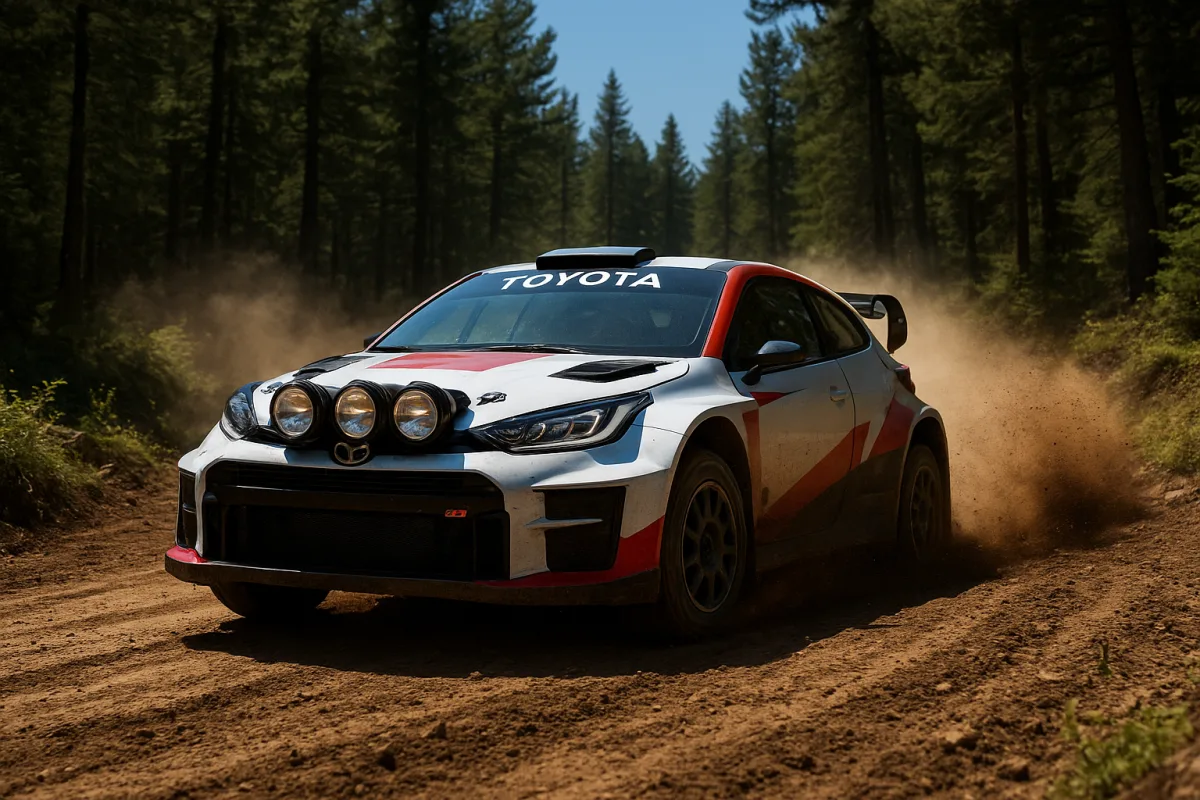
2027 Toyota GR Celica Rally1: What Toyota’s Rally Revival Means for Buyers and Fans
The quick list
Best overall for WRC fans: Toyota GR Celica Rally1, for readers who want the Celica name back in top-class rallying in 2027.
Best established road-car benchmark: Toyota GR Yaris, for buyers in markets where it is sold who want a current turbocharged, all-wheel-drive Toyota performance car.
Best choice for waiting: A future road-going GR Celica, for enthusiasts who can wait without treating Toyota’s rally announcement as a production-car order book.
Toyota’s announcement gives you a clear choice if you are following WRC in 2027. You can back the returning Celica badge in Rally1, or follow Toyota Gazoo Racing’s GR Yaris. What you cannot yet do is compare two showroom cars.
The GR Celica Rally1 is confirmed for the 2027 World Rally Championship, beginning at the Monte Carlo Rally. Toyota will run it beside the GR Yaris Rally1, fielding the two cars through separate factory teams in the championship’s top Rally1 category. [1][2]
That is a meaningful motorsport return. Toyota’s Celica rally history includes the Group A GT-Four era, and the new car gives the company a second recognizable shape on WRC stages. But for an owner, the important news is what has not been announced.
Toyota has not published a production Celica, a price, a trim walk, a power output, a service schedule, or a delivery date. The rally car is real. The road car remains an expectation, not a confirmed product. [1][2]
The 2027 Celica versus the cars around it
The GR Celica Rally1 will not be a bespoke mechanical alternative to the GR Yaris Rally1. WRC27 rules move Rally1 toward a common FIA-developed tubular safety-cell chassis, while teams use turbocharged 1.6-liter inline-four engines adapted from Rally2 hardware. [3][4]
Toyota has said the Celica and Yaris will therefore be essentially the same underneath their bodywork. The Celica’s engine will sit up front, but Toyota has not released horsepower, torque, weight, gearing, suspension geometry, or aerodynamic figures. [1]
That leaves body design, packaging, cooling requirements, aerodynamic development, and setup work as the visible areas where Toyota can differentiate its two Rally1 entries. It also means you should ignore claims that one has a major engine advantage over the other.
| Option | What it is | Engine and layout | Price | Size and body | What you gain | What you give up |
|---|---|---|---|---|---|---|
| Toyota GR Celica Rally1 | 2027 factory Rally1 race car | Front-mounted turbocharged 1.6-liter inline-four, WRC27 control chassis | Not for public sale | Celica-specific rally bodywork, exact dimensions unpublished | The returning Celica name in top-level WRC | No road-car purchase option, no ownership data, no published output [1][3] |
| Toyota GR Yaris Rally1 | 2027 factory Rally1 race car | Same WRC27 engine and control-chassis concept as Celica | Not for public sale | GR Yaris bodywork, exact Rally1 dimensions unpublished | Existing Toyota WRC identity and shared underlying hardware | Less novelty, and no road-car equivalence to its Rally1 machine [1][3] |
| 2026 Toyota GR Yaris | Production performance hatch in selected markets | Turbocharged 1.6-liter four-cylinder, all-wheel drive, manual or automatic depending on market | RM315,600 to RM325,600 in Malaysia, 199,900 to 209,900 PLN in Poland, A$55,490 to A$67,490 in Australia | Compact hatchback | A real, currently sold Toyota rally-flavored road car | No confirmed U.S. offer, and prices are high before local taxes and ownership costs [5][[6]](https://www.toyota.pl/swiat-toyoty/nowosci/toyota-gr-yaris-z-roku-modelowego-2026-w-dwoch-wersjach-wyposazenia "GR Yaris z roku modelowego 2026 od 199 900 zł |
| Future road-going GR Celica | Unconfirmed possible production sports car | Unknown | Unknown | Unknown | Potential Celica ownership, if Toyota builds it | No timeline, specifications, price, or service information [1][2] |
The €345,000 WRC27 Rally1 cost cap applies to building the competition car, not to a future road-going Celica or a retail transaction. It is a regulation aimed at reducing the barrier for manufacturers and independent teams, not a clue to what a Celica coupe might cost you. [4]
Why the shared hardware matters
Previous generations of rallying often encouraged manufacturers to build closely related road cars because homologation drove the competition formula. WRC27 changes that relationship. Teams may run a Rally1 car without a matching showroom model. [1][3]
For Toyota, that allows the Celica badge to return to the sport before a production Celica exists. It also means the rally car’s presence does not tell you whether the eventual road version will be a front-engine coupe, a mid-engine car, a hybrid, or something else entirely.
Car and Driver reported that rumors have pointed in several directions. One possibility is a front-engine arrangement closer to earlier Celicas, while another involves a developing mid-engine architecture also linked with a possible MR2 revival. Toyota has confirmed neither road-car path. [1]
Tomoya Takahashi, head of Gazoo Racing, previously said the prospective mid-engine platform was at the first of four development stages. Car and Driver reported that the platform was not expected to be ready until close to 2030, which is a long way from a 2027 rally debut. [1]
That gap is why we would not read the GR Celica Rally1’s debut as a promise of a 2027 or 2028 production model. Toyota can place a Celica body over WRC27’s regulated hardware while taking much longer to engineer, certify, and launch a road car.
The GR Yaris is the only ownership reference, with limits
The closest current Toyota comparison is the GR Yaris, not because it is mechanically identical to the Rally1 cars, but because it is Toyota’s available small turbocharged all-wheel-drive performance car in several overseas markets.
In Malaysia, the 2026 GR Yaris is listed at RM315,600 with a six-speed manual and RM325,600 with an eight-speed automatic. Both use a 1.6-liter turbocharged engine rated at 296 horsepower in that market. [5]
Toyota Poland lists the 2026 GR Yaris from 199,900 PLN to 209,900 PLN, with a stated 280 horsepower. Australian pricing runs from A$55,490 to A$67,490 depending on trim and transmission. These are local-market list prices, not U.S. pricing or out-the-door totals. [6][10]
Each quoted figure covers the car as configured for that market. The published prices do not establish your local taxes, registration, financing, insurance, dealer charges, transport, or optional-equipment bill, and Toyota has not announced a U.S. GR Yaris price.
The variation between the Malaysian 296-hp figure and Poland’s 280-hp figure also shows why enthusiasts should avoid treating one country’s brochure as a universal specification sheet. Market versions can differ, and a future Celica’s figures have not been released anywhere. [5][6]
What could ownership look like, eventually?
There is no Celica maintenance schedule because there is no production Celica. There are also no real-world long-term reliability reports, parts prices, insurance quotes, or warranty terms. Anyone presenting a five-year ownership estimate today is filling gaps with guesses.
The GR Corolla offers only an indirect benchmark for Toyota’s current high-output turbocharged performance hardware. Carlyle lists typical GR Corolla oil changes at $80 to $140 every 5,000 miles and air-filter service at $120 to $220 around 15,000 miles. [8]
Its listed 30,000-mile differential-fluid inspection runs from $260 to $460, while spark plugs and coolant around 100,000 miles are estimated at $350 to $650. Those figures are for the GR Corolla, not a prediction of what a Celica will cost. [8]
Carlyle also identifies engine-stress failures, differential overheating, intake-valve carbon buildup, turbocharger wear, and clutch wear as concerns to watch on the GR Corolla. A future Celica may use different hardware, calibration, cooling, and warranty coverage, so none can be carried over as a known Celica fault. [8]
Still, those are the systems we would examine first when Toyota eventually reveals a production model. A serious turbocharged all-wheel-drive performance car asks more of its oil, transmission, clutch, differential, tires, and cooling system than a regular commuter Toyota.
The smart move will be to wait for the details that affect year-six ownership: oil-change intervals, spark-plug access, turbo warranty coverage, differential-service requirements, brake and tire sizes, replacement-part pricing, and whether Toyota specifies frequent inspection after track use.
The rally car is not the road car
A GR Celica Rally1 will use a FIA-defined racing structure and sustainable fuel under WRC27 rules. It is built to survive impacts, jumps, ruts, rapid service work, and stage competition, all within a tightly regulated formula. [3][4]
A road Celica would face another set of demands. It would need crash certification, emissions compliance, production tooling, dealer support, warranty coverage, and a price that makes sense beside the GR86, Supra’s successor if Toyota offers one, and other sports cars.
The rally car’s control chassis also means its shape should not be mistaken for a preview of a production platform. Camouflaged prototypes may show design themes, but Toyota has not said how much, if any, rally-car bodywork will reach a road-going Celica. [1]
This is where the returning nameplate differs from a normal new-model launch. There is a car to watch in 2027, but no deposit, dealer allocation, or configuration decision for you to make. The decision is whether to wait.
Who each option suits
Toyota GR Celica Rally1 suits the WRC enthusiast who wants Toyota to restore the Celica name to international rallying. It is the emotional choice, and the one to follow if the 1990s GT-Four era is the part of Celica history that matters most to you.
Toyota GR Yaris Rally1 suits the established Toyota WRC supporter who prefers the current championship identity. Mechanically, its 2027 Rally1 specification will be closely related to the Celica’s, so the difference is likely to be bodywork, team presentation, and development direction. [1][3]
The road-going GR Yaris suits buyers who need a car now and live in a market where Toyota sells it. It is expensive for a compact hatch, but it has a published price, power figure, drivetrain, dealer network, and actual maintenance record. [5][6][8][10]
A future production Celica suits patient enthusiasts with no deadline. We would wait only if you are content to keep your present car for several more years and can accept that Toyota has not promised the final layout, powertrain, price, or arrival date.
Frequently Asked Questions
What is the Toyota GR Celica Rally1?
The Toyota GR Celica Rally1 is a factory competition car confirmed to compete in the 2027 World Rally Championship under the Rally1 category. It features a front-mounted turbocharged 1.6-liter inline-four engine and shares the WRC27 control chassis and fundamental mechanical architecture with the GR Yaris Rally1. The car marks the return of the Celica name to top-level rallying but is designed solely for competition use.
Will Toyota release a road-going GR Celica?
As of now, Toyota has not announced any plans for a road-going GR Celica. There is no confirmed production model, price, release date, or U.S. availability. Any renderings or speculations about a production Celica remain unconfirmed and should be treated as such.
How does the GR Celica Rally1 compare to the GR Yaris Rally1?
Both cars share the same WRC27 control chassis and turbocharged 1.6-liter inline-four engine architecture, making their fundamental mechanical specifications closely aligned. Differences lie mainly in body design, packaging, cooling, aerodynamics, and setup, with the Celica featuring unique rally bodywork. Toyota has not released detailed performance or technical comparisons between the two.
What are the specs of the 2027 Toyota GR Celica Rally1?
Detailed specifications such as horsepower, torque, weight, gearing, suspension geometry, and aerodynamic figures for the GR Celica Rally1 have not been published. It uses a front-mounted turbocharged 1.6-liter inline-four engine homologated under WRC27 regulations and a FIA-developed tubular safety-cell chassis, but exact performance numbers remain undisclosed.
Is the Toyota GR Celica Rally1 available for purchase?
No, the GR Celica Rally1 is not available for public purchase. It is a factory rally car built specifically for competition in the World Rally Championship and is not offered as a production or road-legal vehicle.
How we researched this
This article was assembled from 4 published articles, 10 cited references.
Nothing here is based on hands-on testing. Where a figure or finding appears, it belongs to the source cited beside it, and the writing says so rather than implying otherwise. Every source is listed below so you can check it.
Sources
Ford’s Frostwarden Bronco Is a One-Off Rescue Vehicle with 1200 HP, Car and Driver
Shaq Bought This Rolls-Royce Phantom On A Whim. Now It's Up For Sale, Motor1
Toyota Confirms the Celica’s Return as a Rally Race Car for 2027, Car and Driver
Toyota Confirms the Celica’s Return as a Rally Race Car for 2027
Toyota Confirms New GR Celica By Announcing 2027 World Rally Championship Car
Toyota GR Corolla maintenance schedule, costs & known repairs - Carlyle
Related Articles
2027 Mitsubishi Pajero Revival: Launch, Specs & Availability
Discover the 2027 Mitsubishi Pajero revival with launch dates, specs, pricing, and market availability including Australia and Asia.
2027 Ford Mustang Mach-E Trail: Updates and New Trim Details
Explore the 2027 Ford Mustang Mach-E Trail updates, pricing, battery changes, and how the new Trail trim compares to other models.
2028 Dodge Charger Hellcat Return: What We Know So Far
Explore the 2028 Dodge Charger Hellcat return, rumored specs, ownership costs, and what to expect from this upcoming muscle car.
2027 New SUV and Pickup Models: Features and Ownership Guide
Explore 2027 new SUV and pickup models with insights on performance, ownership costs, maintenance, and driving experience.