
Ford GT41 Le Mans Hypercar: Key Specs and Racing Return
Discover the Ford GT41 Le Mans Hypercar's specs, hybrid system, and 2027 racing debut in the World Endurance Championship.
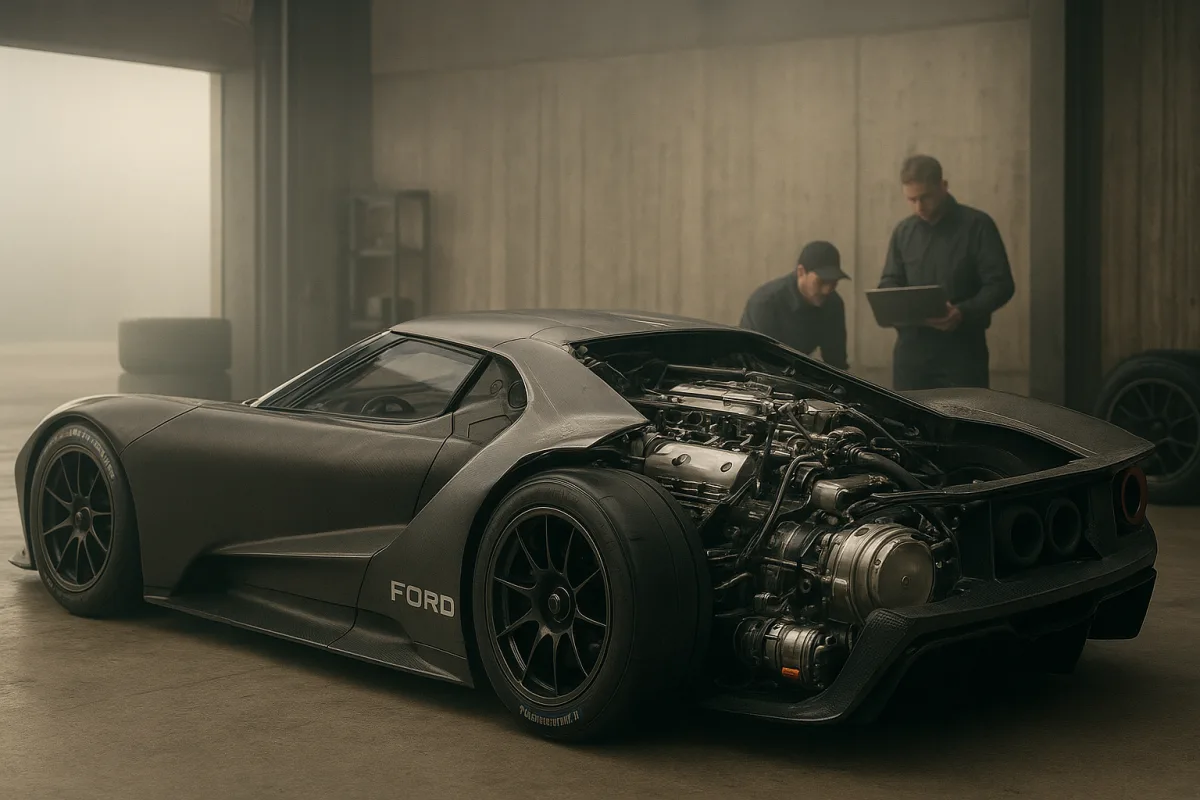
One fixed power ceiling, and a great deal riding on it
Ford revealed the GT41 during the Thanksgiving Day Detroit Lions game in 2026, putting its new Le Mans contender before a huge American audience. The car carries a name intended to recall the GT40, Ford’s four-time Le Mans winner of the 1960s. [3]
The name comes from the top-mounted intake’s height, roughly 41 inches above the ground. Ford’s own quoted dimension is 41.7 inches, but GT41 was apparently close enough, and much better sounding than GT41.7. [1][3]
Under that blue camouflage is Ford’s first return to Le Mans’ top class in decades. The target is an overall victory, not a class win like the Ford GT achieved in 2016. [3]
The central fact of this project is also the one that can look least dramatic on a spec sheet: the GT41 is not free to use all the power its 5.4-liter V8 can make. Neither is Ferrari, Toyota, Porsche, Cadillac, or anybody else.
LMDh, short for Le Mans Daytona hybrid, is a rule set meant to keep the top class competitive without requiring every manufacturer to fund a wholly unique hybrid system. Ford buys into a common architecture, then tries to extract an advantage through its engine, aerodynamic package, software, calibration, drivers, and execution. [2][5]
The GT41’s combined output is capped at approximately 500 kW, or 671 hp, under Balance of Performance rules. That limit includes the V8 and the hybrid contribution, so an engine producing more power on a dyno does not automatically make a quicker GT41 in race trim. [1]
That is the key to understanding the car. Ford’s engine is a major point of corporate pride, but Le Mans will reward how the whole powertrain behaves over 24 hours, across traffic, tire degradation, changing weather, braking zones, and fuel-saving phases.
What LMDh standardization gives Ford
The GT41 is built to LMDh regulations around an Oreca chassis. Oreca also supplies the basic architecture used by Acura, Alpine, and Genesis, which means Ford begins with a proven base instead of spending years designing a prototype tub from scratch. [5]
It uses the mandated hybrid hardware: a Bosch motor-generator unit, electronic controls, and a battery system supplied through the LMDh package. The electric machine is mounted at the transmission, adding torque to the rear wheels through the same driveline as the internal-combustion engine. [2][4]
Ford’s Xtrac seven-speed transmission sends that combined power rearward. The hybrid system is not a front-axle, all-wheel-drive arrangement, so the GT41 still asks its rear tires to handle acceleration, braking stability, and corner-exit traction. [4]
A 50-kW electric contribution is about 67 hp. In isolation, that does not sound huge beside a 5.4-liter V8 turning toward a reported 9000-rpm redline, but it has a serious job: filling torque where the engine is least effective and recovering energy otherwise lost as heat under braking. [2]
The motor-generator becomes a generator when the driver brakes. It takes kinetic energy from the rear driveline, turns it into electricity, and stores it in the battery for later deployment, subject to the control strategy and the power limit. [2]
That means the GT41’s software must constantly decide what to do with energy. Spend it all leaving a slow corner and you may gain track position, but arrive at the next braking phase with less battery capacity to recover energy and less electrical assistance available later.
Le Mans makes this unusually difficult. The Circuit de la Sarthe combines long, full-throttle runs with heavy braking zones, quick direction changes, slow chicanes, and traffic from other classes. The car must be fast on the Mulsanne Straight, then predictable when braking from those speeds. [3]
Ford program head Dan Sayers told Hagerty that Aragón was selected because its high-speed running and heavy braking sections reproduce important aspects of Le Mans without access to the French circuit, much of which uses public roads outside race week.
A quick single lap can flatter a powertrain calibration. A 24-hour race exposes the compromises, because the team needs the hybrid system to harvest, store, cool, deploy, and repeat without tripping over a temperature limit, a battery state-of-charge target, or a drivability problem.
Why Ford built the V8 itself
The GT41’s electric elements are common LMDh hardware, but its naturally aspirated 5.4-liter V8 is Ford’s own work. It begins with production Ford engine architecture, based around the Coyote family used in the Mustang and F-150, then becomes a dedicated endurance-racing engine. [1][5]
Ford Racing says the block is taken from the Essex Engine Plant in Windsor, Ontario, and the racing engine is assembled, tested, and calibrated in Dearborn. The internal parts, cooling, electronics, calibration, and operating strategy are substantially different from anything in a road Mustang. [5]
This matters because the engine does more than produce horsepower. It must survive hours at sustained load, work smoothly with the hybrid motor, fit the cooling and aerodynamic package, and remain predictable enough that drivers can put power down on worn tires at 3 a.m.
A naturally aspirated V8 also gives Ford a particular response and sound, but the team cannot chase drama at the expense of durability. Ford has not published an engine-only power figure, because the race-relevant number is the regulated combined output at the wheels. [1]
MotorTrend reports that Balance of Performance can alter the permitted output before and during the season. Ford may arrive with a strong engine, then find its usable power, energy deployment, or weight adjusted to keep the category closely matched. [1]
That is why the V8’s value is broader than peak output. The winning engine can be the one with cleaner throttle response, lower fuel use, better cooling margin, more dependable sensors, or a calibration that lets the driver attack curbs and traffic without upsetting the rear tires.
Ford Racing chief Mark Rushbrook has described the engine as the heart of the program. The company has also emphasized that it controls the engine design, development, calibration, software, and low-voltage systems in-house, instead of handing the full effort to an outside race operation. [5]
There is a benefit and a risk. Ford can shorten the path between an issue in testing and an engineer changing a part or calibration in Dearborn, but it also owns every failure. A supplier cannot absorb the blame when a cooling line, control setting, or component life proves inadequate.
The 30-hour test tells the real story
Ford’s compressed development schedule is the concern behind every polished launch image. Hagerty reported that a new endurance race car commonly needs two or three years of engineering, while Ford has been pushing the GT41 toward competition in about 18 months.
The GT41 began track testing in August 2026, then completed extensive European running before moving to North America. Race Tech Magazine reported that the first shakedown took place at Circuit Paul Ricard on August 5, followed by fuller testing from August 17. [5]
At MotorLand Aragón in Spain, Ford ran a major endurance test with two cars present. One car was used primarily for controls development, while the other took on the long-distance run, where the V8, hybrid system, cooling, gearbox, suspension, and electronics had to work together. [3]
Hagerty reported the test as 30 hours, while later reporting summarized a 36-hour Aragón endurance test. Ford has publicly highlighted more than 8,885 miles of testing across six European tests, but the exact cumulative endurance-test configuration has not been fully detailed. [4][5]
The significant failure was an unscheduled engine change at 2:30 a.m., caused by a cooling-system problem. The car still accumulated more than 24 hours of running, which is encouraging, but it also demonstrates why a V8’s headline character means little if its supporting systems cannot survive. [3]
A Le Mans engine change costs more than time in the garage. It can disrupt the team’s pit sequence, force drivers to recover lost track position in traffic, and make the remaining powertrain components work harder while chasing the leaders.
Ford has named Logan Sargeant, Matt Campbell, Mike Rockenfeller, Nick Yelloly, Tom Blomqvist, and Sebastian Priaulx to its two-car program, with Tom Dillmann as reserve. Rockenfeller brings an overall Le Mans victory, while Campbell arrives after winning the IMSA GTP title with Porsche Penske Motorsport. [3]
The drivers are part of the hybrid system’s outcome. They must brake consistently enough for energy recovery, manage wheelspin that wastes tire life and electrical deployment, and provide feedback precise enough for engineers to distinguish a software issue from a mechanical one.
Costs, pressure, and what Ford must beat
Ford has not disclosed the GT41 program’s budget, engine rebuild cost, spare-parts spend, or per-race operating cost. That is normal for a factory program, but it means any confident total-cost estimate would be speculation.
The published 2026 Le Mans regulations provide only a floor for entry-related spending. The manufacturer entry fee was €538,000, the competitor fee €143,500, the technical deposit €48,000, and the Le Mans test-day and race entry fee €65,000 per car. [3]
Together, those listed charges come to €794,500 per car. They exclude the expensive parts you can picture filling a race transporter: chassis spares, engines, hybrid components, gearboxes, carbon-fiber bodywork, tires, fuel, freight, data systems, and the people who run them.
Ford will field two GT41s in all nine 2027 World Endurance Championship rounds. The campaign begins in Qatar in March, and Le Mans is scheduled as the fifth round on June 12, with the season finishing in Bahrain in November. [3]
The competition will include manufacturers with mature programs and deep operational knowledge: Ferrari, Toyota, Porsche, Cadillac, BMW, Alpine, Aston Martin, Genesis, McLaren, and others. Ferrari won Le Mans outright in 2023, 2024, and 2025, so Ford’s old rival remains a current benchmark. [3]
We would not judge the GT41 by whether it wins its first Le Mans. Ford’s real measure in 2027 is whether both cars run reliably, preserve tires, execute hybrid energy use cleanly, and remain competitive through the full WEC season.
A Mustang-rooted V8 is a strong story. A controlled 671-hp hybrid powertrain that completes 24 hard hours faster than everyone else is the achievement Ford actually needs.
Frequently Asked Questions
What are the key features of the Ford GT41 Le Mans Hypercar?
The Ford GT41 features a 5.4-liter naturally aspirated V8 engine paired with a standardized hybrid system, producing a combined output capped at approximately 671 hp under Balance of Performance rules. It is built on an Oreca chassis and uses a seven-speed Xtrac transmission to send power to the rear wheels. The car’s design recalls the GT40 and includes a top-mounted intake about 41 inches above the ground.
How does the Ford GT41's hybrid system work?
The GT41 uses a Bosch motor-generator unit integrated at the transmission, adding about 67 hp to the rear wheels. During braking, the system recovers kinetic energy by converting it into electricity stored in a battery for later use. This hybrid system is standardized across all LMDh competitors and helps fill torque gaps and improve energy efficiency.
What engine powers the Ford GT41 Le Mans Hypercar?
The GT41 is powered by a 5.4-liter naturally aspirated V8 engine developed and assembled by Ford in Dearborn. This engine is based on production architecture but heavily modified for racing durability and integration with the hybrid system. It operates at a high redline near 9,000 rpm.
When will the Ford GT41 debut in the World Endurance Championship?
Ford has entered two GT41 cars for the full nine-round 2027 World Endurance Championship season. The debut race is scheduled for March 2027 in Qatar, followed by the 24 Hours of Le Mans on June 12, 2027.
How does the Ford GT41 comply with LMDh regulations?
The GT41 complies with LMDh rules by using a common hybrid system supplied by Bosch, an Oreca chassis shared with other manufacturers, and a combined power output capped at 671 hp. The hybrid motor is connected to the rear driveline, and the car meets intake height and bodywork restrictions set by the regulations. This approach balances cost control with competitive performance.
How we researched this
This article was assembled from 7 published articles, 9 cited references.
Nothing here is based on hands-on testing. Where a figure or finding appears, it belongs to the source cited beside it, and the writing says so rather than implying otherwise. Every source is listed below so you can check it.
Sources
Ford’s Next Le Mans Dream Is Finally Here: Meet the GT41, Car and Driver
Ford reveals GT41 Le Mans hypercar - but can it beat Ferrari again?, Autocar
One More Than GT40: The Ford GT41 Le Mans Hypercar Is Finally Here, Road & Track
The Race Car Ford’s Building for Le Mans Is “95 Percent” Complete, and It Has a Name, Hagerty
Ford GT41 Hypercar Marks Brand's Return To The Top Class Of Le Mans, CarScoops
Ford Returns To The 24 Hours Of Le Mans With The 2027 GT41, Jalopnik
2027 Ford GT41 Le Mans Hypercar: What We Know About Ford’s New 5.4-Liter V-8 Racer
Ford Racing unveils the Ford GT41 to race at the 2027 24 Hours of Le Mans
Related Articles
Dodge Return to NASCAR: Charger Debuts in 2027 Season
Learn about Dodge's 2027 NASCAR return with Kaulig Racing, Charger body, engine partnerships, and driver lineup for the Daytona 500 debut.
Audi RS6 Sedan Return and 2027 Performance SUV Updates
Explore the Audi RS6 Sedan return, hybrid performance, ownership costs, and updates on Audi’s 2027 performance SUVs like the SQ7 and SQ5.
2027 Ford Mustang Dark Horse SC Performance and Rivalries
Explore the 2027 Ford Mustang Dark Horse SC's performance, ownership insights, and how it stacks up against American muscle rivals.

2027 Toyota GRMN Corolla vs Hyundai Tucson Hybrid Performance
Compare the 2027 Toyota GRMN Corolla and Hyundai Tucson Hybrid on performance, hybrid updates, and driving experience to find the right fit for you.