
Audi RS6 Sedan Return and 2027 Performance SUV Updates
Explore the Audi RS6 Sedan return, hybrid performance, ownership costs, and updates on Audi’s 2027 performance SUVs like the SQ7 and SQ5.
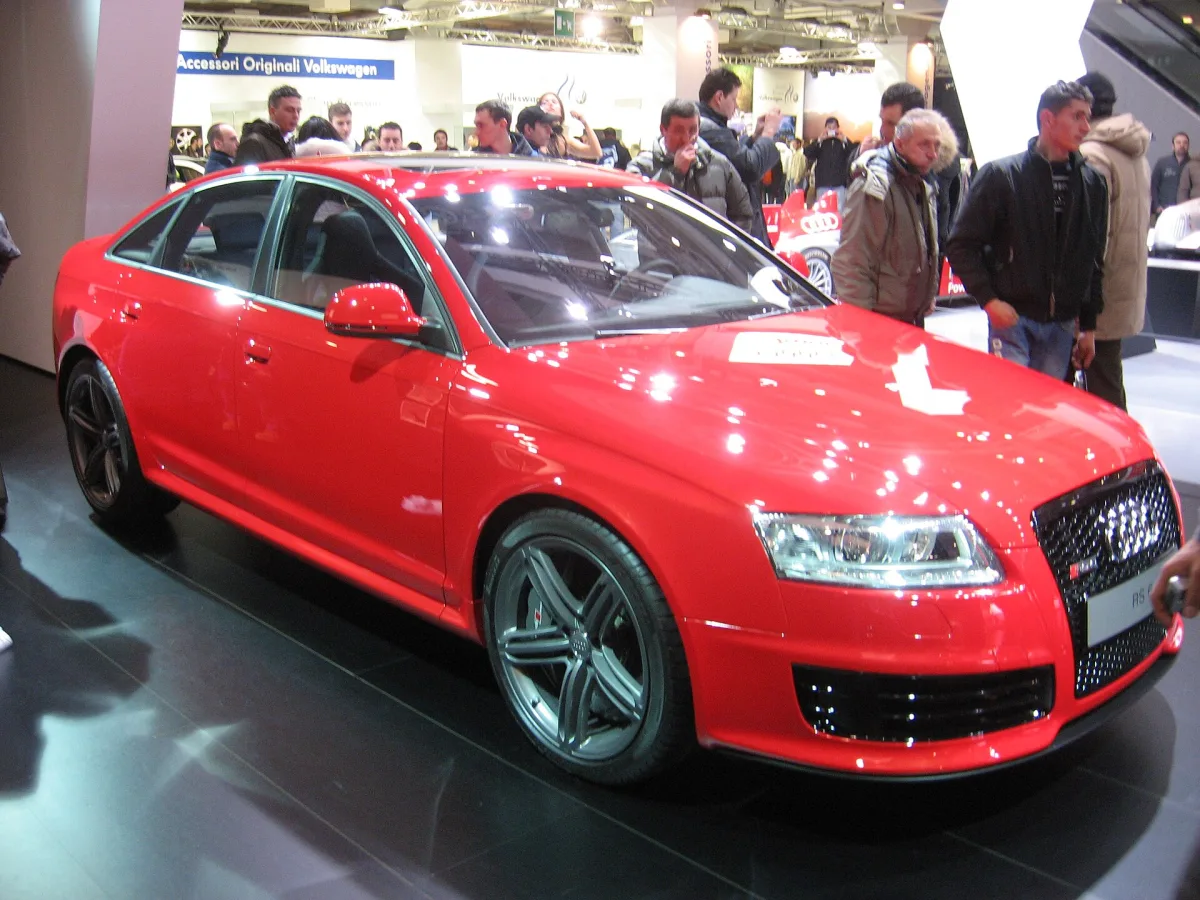
Photo: Luc106, Public domain, via Wikimedia Commons
The RS6 sedan has returned to development testing
In late 2026, camouflaged Audi RS6 sedan prototypes were circulating at the Nürburgring with wide fenders, oval exhaust outlets, and high-voltage warning labels. Road Torque and Gumtree each reported the sedan body style and electrified test hardware. [1][2]
That body shape is the main news. The last RS6 sedan was the C6-generation car, whose V10 era ended in 2011, while the later C7 and C8 RS6 generations came only as Avants in most markets. [1]
CarScoops also reported a more production-ready RS6 sedan prototype after an earlier sighting a year before, noting changed wheels and finished-looking oval tailpipes. Its expected 2027 global arrival remains a report, not an Audi launch announcement. [1]
Audi has not published a release date, power figure, torque figure, battery capacity, electric range, curb weight, or U.S. order guide for the sedan. The prototype evidence is solid; the detailed specification story is still thin.
The sedan seems aimed squarely at the BMW M5, itself a plug-in hybrid performance sedan, but Audi’s old formula of a large V8, quattro traction, and long-distance comfort has to work under tighter emissions rules. That is why this car is appearing now.
Electrification is no longer optional at this end of Audi
U.S. Advanced Clean Cars II rules push manufacturers toward greater zero-emission sales, while Europe’s Green Deal and Fit for 55 CO2 targets penalize high-emissions fleets. A plug-in hybrid RS6 gives Audi a route to retain a combustion engine while improving its regulatory position. [1]
The yellow windshield sticker seen on the Nürburgring cars is the clearest physical evidence of that direction. It confirms high-voltage equipment in the development vehicle, but it cannot tell you whether the production car uses a V6 or V8. [2]
Reports have suggested either an upgraded twin-turbo 2.9-liter V6 hybrid arrangement or a twin-turbo 4.0-liter V8 hybrid. Neither layout, nor any claimed horsepower total, has been confirmed by Audi, so published comparisons with the BMW M5’s 717 horsepower are projections. [1]
Audi’s recent hybrid RS cars show the likely operating idea: electric torque to fill the gap before turbochargers are fully awake, then a combustion engine carrying the load at speed. TechRadar found the RS5 plug-in hybrid’s electrically assisted response changed its view of PHEV performance cars. [4]
That tells you less about the coming RS6’s output than about its likely character. A hybrid RS6 should be quicker to respond in the first few feet, but it will also bring a battery, charging hardware, cooling circuits, and software into a car already packed with expensive systems.
Price it like an RS6, not like a discounted A6
Audi has not announced U.S. RS6 sedan pricing. The nearest reference point is the 2026 RS6 Avant Performance, listed at $130,700 before destination and gas-guzzler tax, or $133,395 including those charges. [3]
That figure includes the vehicle and listed destination-related charges. It leaves out sales tax, registration, insurance, financing, accessories, extended coverage, and the steep tire and brake bills that usually arrive long before the car feels old.
A sedan could start near that $130,000 mark if Audi positions it beside the Avant, but there is no reason to assume it will be cheaper. Hybrid hardware, new chassis electronics, and a more expensive BMW M5 competitor can all move the number upward.
Kelley Blue Book estimates five-year ownership cost for a 2026 RS6 at $153,587, including depreciation and out-of-pocket expenses. [6] That number is not a service invoice, but it is a good warning against treating the purchase price as the whole commitment.
The ownership picture after 60,000 miles is less clear for the electrified sedan. No published service-cost history exists yet, and no one can responsibly quote a battery replacement bill without an Audi battery specification, warranty, or parts pricing.
The existing RS6 gives a rough ownership baseline
Previous RS6 ownership guides place annual maintenance around $1,200 to $2,500, with attention points commonly appearing at 10,000-, 20,000-, 40,000-, and 60,000-mile intervals. [5] Those figures are a baseline for a complex fast Audi, not a forecast for the hybrid sedan.
At 60,000 miles, we would expect tires, brake wear, adaptive suspension condition, cooling-system health, and complete transmission and differential service records to matter more than a clean-looking cabin. These cars can conceal expensive neglect behind a very polished exterior.
A plug-in hybrid may reduce some combustion-engine wear if it spends meaningful time on electric running. It also adds high-voltage cooling, charging equipment, battery controls, and integration faults that an older V8-only RS6 does not have.
We would skip the first used RS6 sedan without full dealer-level diagnostic records and remaining hybrid-system warranty. The better project is likely a later car with documented charging behavior, software campaigns completed, and a pre-purchase inspection from an Audi specialist.
Audi’s SUVs are becoming the more defined performance products
While the RS6 sedan remains heavily camouflaged, Audi’s performance SUV direction is much clearer. The 2026 SQ5 uses a 3.0-liter turbocharged V6 with 362 horsepower, a seven-speed dual-clutch transmission, and available sport-tuned adaptive air suspension. [9]
Car and Driver’s SQ5 coverage describes a cabin dominated by screens but still retaining some physical buttons and switches. For an owner, that matters because climate, drive-mode, and chassis adjustments are functions you use repeatedly, not options you admire on delivery day.
The 2027 SQ5 continues the 362-horsepower formula, but Audi has consolidated the range around a single Premium trim level. Autoblog lists the turbo V6, 48-volt mild-hybrid system, and seven-speed dual-clutch gearbox as the core specification. [9]
That makes the SQ5 the restrained choice of this group. It has enough power for a quick daily driver, but it avoids the V8 heat load, tire costs, and fuel consumption that come with the larger SQ7 and eventual RS6.
The SQ7 has gained serious pace without dropping its core job
The 2026 SQ7 uses a twin-turbocharged 4.0-liter V8 producing 500 horsepower and 568 pound-feet of torque. Edmunds lists a 7,700-pound maximum tow rating, 21-inch wheels, Matrix LED headlights, adaptive air suspension, and rear-wheel steering. [7]
For 2027, MotorTrend reports a substantial increase to 591 horsepower and 590 pound-feet, with a claimed 0-60 mph time of 3.7 seconds. [8] That is a major change in a seven-seat SUV, even if sprint times remain less important than heat management and stopping costs.
The 2027 SQ7 also gets rear-biased quattro all-wheel drive, an electronically controlled locking rear differential, adaptive air suspension, and an optional 30-millimeter sport lowering setup. [8] Those are useful hardware changes, not merely another wheel design and larger touchscreen.
Inside, the updated SQ7 uses a curved OLED display arrangement and can be ordered with captain’s chairs. [8] If you routinely carry adults in the third row or tow, its layout and 7,700-pound rating make a stronger case than the RS6 sedan’s lower, tighter body.
The tradeoff is clear in the consumables. A 591-horsepower V8 SUV on 21-inch or larger tires can turn a set of performance rubber, brake pads, and rotors into a recurring four-figure event, especially if it tows or runs hard while loaded.
What this means for your own Audi plan
Audi is separating its fast-car lineup into three distinct jobs. The future RS6 sedan is the electrified flagship for drivers who want the lowest body and longest-distance pace, the SQ7 is the fast family and towing machine, and the SQ5 is the lower-risk daily option.
We would not wait for the RS6 sedan if you need a car within the next year and intend to keep it past warranty. Its powertrain, price, range, and maintenance picture are still unpublished, while the SQ7 and SQ5 specifications are already far more defined. [8][9]
If the sedan is the car you want, wait for Audi’s battery warranty, service schedule, curb weight, and U.S. pricing before treating a deposit as a plan. Ask whether routine hybrid-system checks are included, and get every charge, destination fee, and tax in writing.
For a long-term keeper, we would favor the SQ5 when towing and a third row are not required. Its 362-horsepower V6 setup is still complicated, but it asks less of its tires, brakes, fuel budget, and cooling system than the V8 SQ7 or a future hybrid RS6.
Frequently Asked Questions
When will the Audi RS6 Sedan return to production?
Camouflaged prototypes of the Audi RS6 sedan were spotted testing in late 2026, with reports suggesting a possible global arrival in 2027. However, Audi has not officially announced a release date or confirmed production plans.
What are the expected performance specs of the 2027 Audi RS6 Sedan?
Audi has not confirmed horsepower, torque, battery size, or electric range for the 2027 RS6 sedan. Prototype testing indicates a plug-in hybrid powertrain, likely combining a turbocharged engine with electric assistance, but specific performance figures remain unverified.
How does the new Audi RS6 Sedan compare to the BMW M5?
The RS6 sedan appears aimed directly at competing with the BMW M5, which is also a plug-in hybrid performance sedan. While the M5 is rated at 717 horsepower, Audi has not confirmed comparable power numbers for the RS6, so direct comparisons remain speculative.
What hybrid technology will the Audi RS6 Sedan use?
The RS6 sedan is expected to feature a plug-in hybrid system with high-voltage equipment. Reports suggest either a twin-turbo 2.9-liter V6 or a twin-turbo 4.0-liter V8 paired with electric motors, following Audi’s recent hybrid RS models that use electric torque to supplement turbocharged engines.
What are the estimated ownership and maintenance costs for the RS6 Sedan?
Previous RS6 models have annual maintenance costs ranging from $1,200 to $2,500, with major service intervals at 10,000 to 60,000 miles. Kelley Blue Book estimates five-year ownership costs for a 2026 RS6 at about $153,587, including depreciation and expenses. The electrified RS6 sedan’s exact costs are unknown but may include additional battery-related maintenance beyond typical RS6 upkeep.
How we researched this
This article was assembled from 3 published articles, 9 cited references.
Nothing here is based on hands-on testing. Where a figure or finding appears, it belongs to the source cited beside it, and the writing says so rather than implying otherwise. Every source is listed below so you can check it.
Sources
View Photos of the 2026 Audi SQ5, Car and Driver
Why are new drivers involved in a quarter of serious crashes?, Autocar
Audi Is Bringing Back The RS6 Sedan To Fight The BMW M5, CarScoops
2026 Audi RS 6 Avant performance: Queens Buyers Guide | Audi Queens
I've driven the hybrid Audi RS 5 - and it's completely changed what I think of plug-in hybrids
Audi Rs6 Avant Maintenance Costs: What to Expect Over the Years | Everyday Audi
2027 Audi Q7/SQ7 First Drive: More Power, Better Tech, Less Black Plastic
2027 Audi SQ5 / SQ5 Sportback Review, Specs, Pricing, and Warranty - Autoblog
Related Articles
2027 Electric and Hybrid SUVs: Trends, Costs, and Ownership
Explore 2027 electric and hybrid SUV trends, ownership costs, and maintenance insights to help you choose the right SUV for your needs.
Hybrid Large SUVs: GM’s Plans and What Buyers Should Know
Explore GM’s hybrid large SUVs plans, costs, and ownership insights for 2027. Learn what buyers need to know before choosing a hybrid large SUV.
2026 Ferrari Purosangue vs 2027 Lamborghini Temerario Review
Compare the 2026 Ferrari Purosangue and 2027 Lamborghini Temerario in performance, handling, practicality, and ownership in this detailed review.
2027 BMW 3 Series M350 vs i3
Compare the 2027 BMW 3 Series M350 and i3 models on performance, ownership costs, and market challenges to find which suits your needs best.