
Honda Passport Baja Trophy Truck and Off-Road Innovations
Explore the Honda Passport Baja Trophy Truck's hybrid powertrain, fuel system, and off-road racing innovations in this detailed overview.
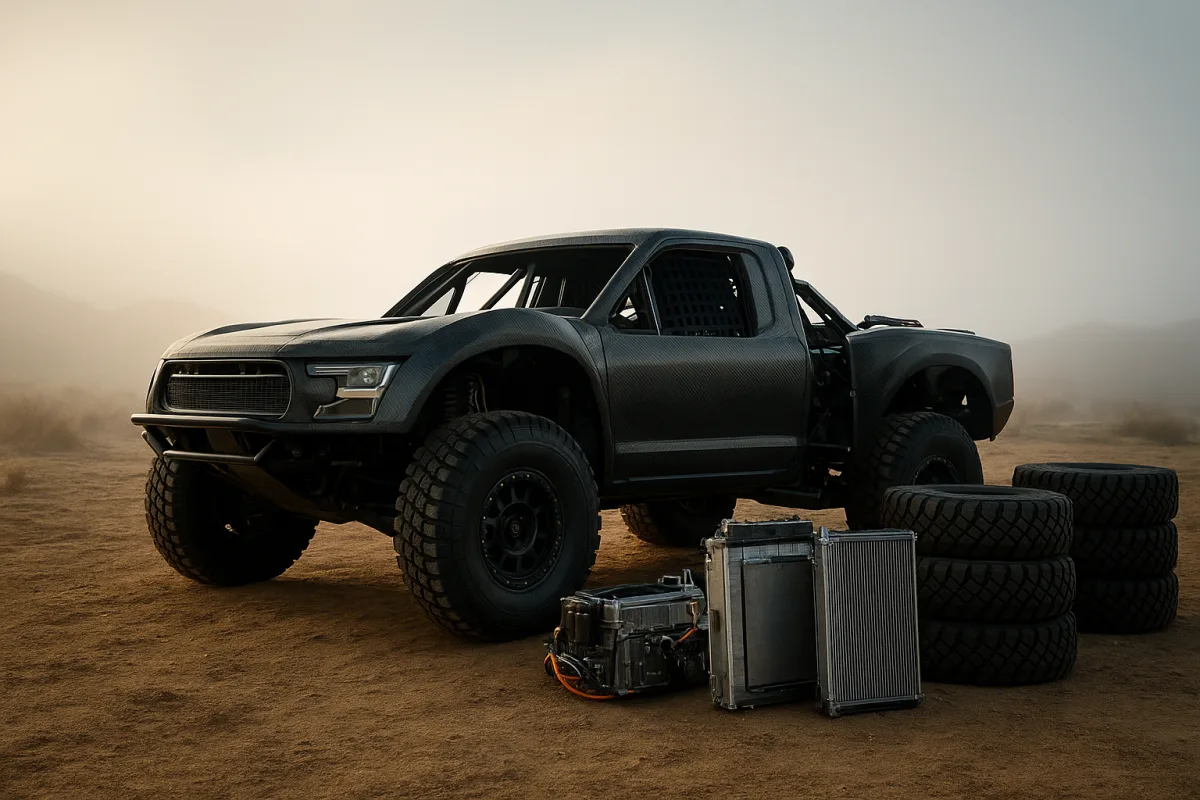
The important number is not 1,300 hp, it is 145 gallons
Honda’s Passport Baja Spec Trophy Truck arrives with the sort of number that makes easy headlines: more than 1,300 horsepower from a twin-turbocharged 2.4-liter V6 and an 800-volt hybrid system. Honda Racing Corporation is aiming it at SCORE’s top Trophy Truck class. [4]
That output is extraordinary for the category, particularly because conventional frontrunning Trophy Trucks generally use naturally aspirated 9.0-liter V8 engines. Honda’s alternative is smaller, turbocharged, electrified and much more dependent on software. [2]
But the detail worth dwelling on is the 145-gallon carbon-Kevlar fuel cell mounted centrally in the truck. Honda has not built an electric desert racer with a petrol engine as a backup. It has built a petrol desert racer whose hybrid system may make fuel and power delivery work harder. [2][4]
A full 145-gallon tank represents roughly 899 pounds of gasoline, using the commonly quoted 6.2 pounds per gallon. As that fuel burns away, the truck’s weight distribution changes dramatically unless the tank and fixed components are positioned carefully. [2]
That is the problem Honda is trying to solve. In a Baja race, outright peak power is useful, but repeatable balance is often more valuable. A truck that becomes nervous, traction-limited or hard on tyres halfway through a stint can lose minutes quickly.
Why fuel load changes the way a Trophy Truck drives
On a road-going Passport, a driver might notice a near-empty tank only when the low-fuel warning appears. In a Trophy Truck, the difference between a full cell and a nearly empty one can change suspension response, braking stability and the effort needed to hold a line.
Honda and Mason Motorsports have placed the 145-gallon safety cell near the center of the truck, while locating fixed-mass components, including the battery, coolers and fluid systems, farther rearward. The stated aim is consistent balance and a lower center of gravity. [2][4]
The logic is straightforward. Fuel is a consumable mass, while a hybrid battery is not. If both sat far behind the rear axle, the truck would begin a stage rear-heavy and could become comparatively nose-heavy as fuel disappeared.
Put the fuel cell near the vehicle’s center of mass, and its changing weight has less leverage over pitch and yaw. In practical terms, that should make the truck less different at the end of a fuel stint than it would be with a tank hung far rearward.
That does not make a 145-gallon load disappear. It simply gives the chassis engineers a fighting chance. A desert truck still needs springs, dampers, bump control and tyre pressures that can cope with nearly 900 pounds of fuel variation.
Honda’s long-travel layout has 25 inches of front wheel travel and 32 inches at the rear, using Fox dampers and Toyo tyres. Those figures sound like race-car trivia, but the travel is what lets the tyres remain in contact with rough ground. [2]
More wheel travel alone does not create grip. The spring and damping rates must control a truck that lands heavily, brakes over washboard surfaces and accelerates through deep ruts, while its fuel load steadily declines. That tuning work determines whether horsepower becomes forward motion.
What the hybrid system is actually for
Honda has disclosed an 800-volt hybrid system, a carbon-fiber battery enclosure and Formula 1-style pouch cells. It has not disclosed battery capacity, motor output, usable state-of-charge window or the proportion of the 1,300-plus horsepower supplied electrically. [2][4]
That missing information matters. “1,300 horsepower” is a combined peak claim, not a promise that the truck can make that output continuously across the Baja 1000. There is no independent race data because the truck has not competed.
The likely benefit of hybridization is not silent running through Mexico, nor meaningful all-electric range. It is the ability to store and release energy quickly, then use that energy where the combustion engine and tyres can make best use of it.
In a conventional V8 Trophy Truck, the engine’s output rises and falls with revs, throttle position, gear selection, altitude, intake temperature and driver restraint. A hybrid system can add another torque source, one controlled far more rapidly than a turbocharged engine alone.
That can help fill the gap while turbochargers build boost. More importantly, it can allow Honda’s control systems to meter torque rather than simply deliver everything the engine can produce whenever the driver asks for it.
Honda says the Passport Baja Spec uses adaptive traction control, brake-by-wire on both axles and AI-assisted power deployment. The company has not explained the algorithms, so it would be wrong to pretend this means autonomous driving or a self-driving Trophy Truck. [2][4]
In this context, “AI power deployment” appears to mean software coordinating battery energy, engine output, traction information and chassis behavior. The driver still chooses throttle, braking and line. The system’s job is to decide how aggressively to honor those requests.
Imagine a rear tyre repeatedly unloading over closely spaced bumps. Giving it the full combined output may spin it violently, overheat it and send shock loads through the rear driveline. Restricting torque briefly may be faster over the next mile.
That is the central promise of the Passport’s hybrid hardware. It could make a 1,300-hp truck more usable than an equally powerful conventional truck, particularly on changing surfaces where wheelspin costs traction, tyre life and driver confidence.
The driveline is as important as the battery
The engine sits behind the cab, and the truck uses a Mason-developed five-speed transmission with a transfer case ahead of the engine. Power reaches all four wheels, but the rear axle arrangement is not a conventional differential-and-axle-housing design. [2]
Instead, Honda’s description includes separate rear driveshafts and angled gearsets at each rear wheel. The front uses portal gearsets at the hubs. Both arrangements are intended to keep vulnerable driveline hardware away from rocks and deep ruts. [2]
Portal gears also raise the axle centerline relative to the wheel hub, improving ground clearance without needing absurdly tall tyres. The trade-off is extra rotating hardware and another set of gears that must survive heat, shock loads and contamination.
This is where a spec sheet stops being useful. An unusual driveline can offer more clearance and potentially more individual wheel control, but it also creates more parts, more seals, more gear oil and more potential heat-management work.
Honda has not published rebuild intervals for the transmission, portal hubs, rear gearsets, turbos, battery system or motors. Neither Honda nor SCORE has produced real-season maintenance data because the Passport Baja Spec remains pre-competition. [2][4]
That absence is normal for a new racing program, but it matters for anyone calling the hybrid system cheaper or more durable than a big V8. It may save fuel stops, but it may also demand specialist electrical diagnostics and high-voltage safety procedures.
The real race is finishing at speed
A Baja 1000 is not decided by a dyno sheet. It is decided by heat, dust, vibration, punctures, navigation, co-driver communication, service access, fuel strategy and whether the truck can keep moving after a hard impact.
Honda’s 2.4-liter V6 is related to the engine used in Acura’s ARX-06 GTP endurance prototype, a useful starting point because that program has survived major circuit races. Baja is still a very different durability test. [2][4]
An IMSA prototype runs on prepared circuits with predictable surfaces, scheduled pit work and controlled cooling airflow. A Trophy Truck hits unseen holes, inhales fine dust, runs behind competitors and can spend long periods at high load with much less predictable airflow.
The Passport Baja Spec’s carbon-fiber body includes channels behind the front wheels and airflow management around the cab, intended to feed cooling systems and reduce drag. That is race engineering, not styling decoration, because cooling can determine whether a stage ends early. [2][4]
Honda has scheduled the truck’s competitive debut for the 2027 SCORE Baja 500, before pursuing the 2027 Baja 1000 overall win. SCORE’s published regulations had not yet established specific hybrid Trophy Truck rules as of late October 2026. [2][4]
That regulatory uncertainty is worth watching. Honda calls this the first hybrid Trophy Truck entry in SCORE’s premier category, but the hardware will need to satisfy safety, inspection and recovery requirements that are more complicated than those of a conventional V8 truck. [4]
The Passport name is useful marketing, but there is no meaningful mechanical relationship with the production SUV beyond styling cues. This is a bespoke race vehicle on a Mason Motorsports chassis, not a future dealer accessory package. [2][4]
I have not driven it, nobody outside the program has raced it, and no sensible ownership-cost estimate exists yet. The interesting innovation is not simply that Honda found 1,300 horsepower, but that it is attempting to spend that power intelligently over hundreds of brutal miles.
Frequently Asked Questions
What are the key features of the Honda Passport Baja Trophy Truck?
The Honda Passport Baja Trophy Truck is a purpose-built Mason Motorsports Trophy Truck featuring a carbon-fiber body and a hybrid powertrain. It produces over 1,300 horsepower from a twin-turbocharged 2.4-liter V6 combined with an 800-volt hybrid system. The truck is designed specifically for SCORE’s top Trophy Truck class and incorporates advanced suspension components like Fox dampers and Toyo tires with significant wheel travel.
How does the Honda Passport Baja Trophy Truck's hybrid system work?
The 800-volt hybrid system in the Passport Baja Trophy Truck functions primarily as an energy-management tool rather than providing electric driving range. It helps manage power delivery and fuel efficiency during desert racing but does not replace the need for a large fuel supply. Details such as battery capacity and electric motor output have not been published.
Why is the 145-gallon fuel cell important in the Honda Passport Baja Trophy Truck?
The 145-gallon carbon-Kevlar fuel cell is crucial because desert racing requires carrying a large amount of fuel, and the truck is not designed to run purely on electric power. Positioned near the center of the truck, the fuel cell helps maintain consistent weight distribution as fuel is consumed, reducing the impact on handling and balance throughout a race stage.
How does fuel load affect the handling of the Honda Passport Baja Trophy Truck?
As the 145-gallon fuel load decreases during a race, the truck’s weight distribution changes significantly, which can affect suspension response, braking stability, and steering effort. Honda and Mason Motorsports have strategically placed the fuel cell near the vehicle’s center of mass to minimize these effects, aiming to keep the truck’s handling more consistent despite the large variation in fuel weight.
How we researched this
This article was assembled from 1 video source, 5 published articles, 4 cited references.
Nothing here is based on hands-on testing. Where a figure or finding appears, it belongs to the source cited beside it, and the writing says so rather than implying otherwise. Every source is listed below so you can check it.
Sources
Ford Built a 4Runner Killer… And America Can't Have It — Ideal
View Photos of the Honda Passport Baja Spec Trophy Truck — Car and Driver
2027 BMW 3 Series First Drive: Same Cloth, Different Cut — Hagerty
Honda Is Taking On Baja With A 1,300-HP Hybrid Passport — Motor1
Honda Racing Unleashes A 1,300+ HP Hybrid Passport Trophy Truck — CarScoops
HRC’s 1300-HP Trophy Truck Is the Most Badass Honda Passport Ever — Car and Driver
The Honda Passport Baja Spec First Look: A 1,300-HP Hybrid V-6 Powered Dirt Devil
HRC US develops Passport Baja Spec Trophy Truck | Motor Racing Industry
Watch Honda Passport Baja Trophy Truck and Off-Road Racing Innovations on Youtube
Related Articles
Fuel Economy Regulation Rollback and Its Impact
Explore how the 2026 fuel economy regulation rollback affects automakers, vehicle design, and regulatory compliance.
Plug-in Hybrid Pickup Truck Comparison
Compare the Ford Ranger PHEV and BYD Shark plug-in hybrid pickups on performance, towing, off-road ability, and ownership considerations.
2027 Honda Passport TrailSport Off-Road Upgrade Review
Explore the 2027 Honda Passport TrailSport off-road upgrade, features, pricing, and how it compares to previous models and TrailSport Elite.
2027 Hyundai Tucson Redesign and Hybrid Powertrain Details
Explore the 2027 Hyundai Tucson redesign, hybrid powertrain, fuel economy, towing, and new features in this detailed overview.