
Monterey Car Week Ownership Costs and Exclusive Car Culture
Explore Monterey Car Week ownership costs, maintenance, and the diverse exclusive car culture behind the event.
What Monterey Car Week is really for, and what it costs to join in
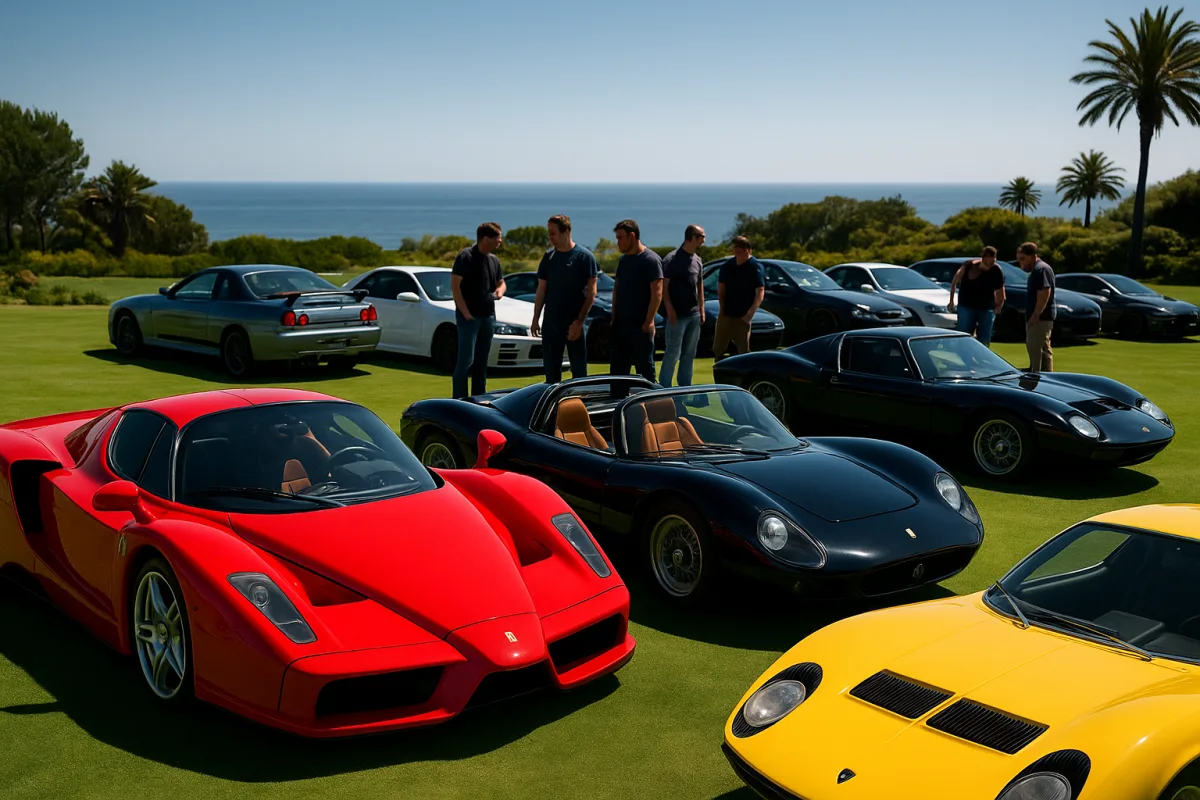
The useful question is not whether Monterey Car Week is exclusive. It plainly is. The question is what sort of enthusiast you want to be within it: the person buying an eight-figure blue-chip car, the owner taking a genuinely usable supercar on the coastal roads, the Japanese-car collector who has watched the market catch up with their interests, or the spectator who wants access without pretending a private mansion invitation is purchasable at a published rate.
That distinction matters because Monterey compresses several very different car cultures into one peninsula. The 2026 Broad Arrow Quail auction sold a 2003 Ferrari Enzo for $10.675 million, a 2025 Bugatti Mistral Roadster for $8.805 million and a 1968 Lamborghini Miura P400 S for $4.075 million. At the same time, the Quail lawn and roads around Carmel were full of Skyline GT-Rs, Toyota Supras, Honda and Acura models, and modified older Japanese cars that were once bought because they were fun rather than because they belonged in a collection vault. [1]
The spectacle makes these worlds look adjacent. Ownership does not.
The blue-chip route: Enzo, Mistral, Miura and Veyron
If the aim is to buy a car that opens doors at the highest level of the collector market, the 2003 Ferrari Enzo is the clearest Monterey statement. Its $10.675 million result at Broad Arrow puts it well ahead of the other headline lots. [1] The Enzo suits the buyer who wants a known, broadly understood modern Ferrari collectible, with the kind of provenance and scarcity that can work at concours events, brand hospitality and serious collections.
It is also a fundamentally impractical way to buy driving pleasure. At this price level, the purchase is only the start. Specialist insurance for rare performance cars is commonly quoted at $5,000 to $12,000 per year, and general supercar maintenance estimates run from $2,000 to $6,500 annually before an unexpected fault, deferred recommissioning work, transport or a major service. Those maintenance estimates can double once warranty protection is gone. [5][7] A car like an Enzo is not a 60,000-mile proposition. It may be mechanically robust when used properly, but its value depends heavily on mileage, condition, history and originality.
The 2025 Bugatti Mistral Roadster, sold for $8.805 million, suits a different buyer: someone who wants the latest end-of-an-era Bugatti rather than a 2000s analogue hypercar. [1] It offers rarity and contemporary status, but its ownership equation is still more demanding than the auction hammer price suggests. The roadster format is appealing on the Monterey Peninsula, where low-speed cruising and short scenic runs are part of the event, but the lack of a roof is not necessarily a benefit for storage, security or long-distance touring.
The 2011 Bugatti Veyron Grand Sport is the more established alternative. Broad Arrow sold one for $3.305 million, and Hagerty noted that it had 8,595 miles, represented as one of 150 built. [1] The Veyron is cheaper to buy than the Mistral, but no sensible owner should mistake a lower acquisition cost for lower running costs. The Veyron’s W-16 layout, quad-turbo system and bespoke components mean it remains a seven-figure-machine with seven-figure consequences if it needs serious work. It suits the collector who wants a foundational modern hypercar and accepts that occasional use must be planned around specialist support.
The 1968 Lamborghini Miura P400 S is the romantic alternative. At $4.075 million, it is less expensive than the Enzo or Mistral, but it is not the low-risk choice. [1] It has a 3.9-litre V12 and a five-speed manual, and it is visually one of the defining mid-engined exotics. The trade-off is age. Even a well-restored Miura requires an owner who understands that old-car problems are not always predictable, and that parts availability, specialist knowledge and careful storage matter more than a glossy auction catalogue suggests.
For someone who wants old-school visual drama with a more modern operating environment, the 2017 Ferrari F12tdf sold for $3.635 million at the same sale. [1] It is still expensive enough to be a collection-grade Ferrari, but it is a more realistic car to use than a Miura or Enzo. That does not make it cheap to maintain, nor does it remove the risk of depreciation. Ownership-cost analyses cited in the Monterey market reporting suggest depreciation can account for 60 to 80 percent of five-year ownership cost on expensive cars. [5]
The usable-supercar route: Lamborghini Murciélago and Huracán
The Mr JWW channel’s Monterey trip makes a better case for the cars that actually get driven to Car Week. A 2003 Lamborghini Murciélago, a 2017 Lamborghini Huracán 580-2 and an Acura NSX were all used as road-trip cars rather than static exhibits. That is a more revealing use case than a launch-event drive, because Monterey adds traffic, heat, luggage, fuel stops, tight parking and the risk of somebody else making a mistake near a rare car.
The 2003 Lamborghini Murciélago is the most charismatic option of the three, but it is also the one to buy with the most caution. A standard 2003 Murciélago used a 6.2-litre V12 making 575 hp, weighed about 3,638 lb and was quoted at roughly 205 mph. [11][12] It is a wide, low, all-wheel-drive V12 coupe from the era when visibility, clutch wear, cooling-system condition and parts sourcing could become ownership issues rather than online talking points.
Mr JWW’s film features a Murciélago described by its owner as a GT1-style street conversion using Reiter Engineering race-derived parts. That specific 2003 conversion is not independently verified. The available research supports a different car, a one-off Reiter Engineering Murciélago R-GT road conversion shown in 2008, rather than a documented series of 2003 GT1 street conversions. The sensible reading is therefore that it may be a very serious custom build, but not to pay a premium as if its production numbers, history or engineering specification were established.
That matters if you are deciding between a factory car and a heavily modified one. A standard Murciélago is already difficult enough to insure and maintain. A unique wide-body conversion with bonded bodywork could be harder still to repair after even a modest parking or road accident. The channel’s owner makes exactly that practical point: damage to a one-off front end could mean rebuilding parts that are effectively irreplaceable. This is the car for the buyer who values theatre, accepts risk and has access to a specialist workshop, not for someone seeking carefree weekend motoring.
The 2017 Lamborghini Huracán 580-2 is the more sensible road car. It is rear-wheel drive rather than all-wheel drive, and the owner featured by Mr JWW described it as a basic 580-2 with cosmetic and exhaust changes, showing 55,000 miles. That mileage is important. It demonstrates that not every Monterey Lamborghini is a 500-mile ornament.
The owner estimated about $25,000 in a year excluding finance payments, including a $10,000 transmission-related bill and spending on a hood and colour changes. That is not a universal annual cost, and it is not a manufacturer figure. It is one owner’s account of a modified car. But it is more useful than pretending a used Huracán only needs fuel and tyres. A realistic budget must include tyres, insurance, servicing, cosmetic work and the occasional large repair. General estimates put performance-car tyres at $1,000 to $3,000 a year and fuel at $600 to $2,000, before any track use or unusually high mileage. [7]
The Huracán suits the owner who wants to drive to Monterey, not trailer a car there. It has enough age now for buyers to assess history, mileage and modification quality, while retaining a drivetrain and parts network more usable than a Murciélago’s.
The growing JDM route: culture, rarity and the danger of hype
The more interesting change at Monterey is not another limited-edition hypercar. It is that Japanese cars have become central rather than peripheral. The Quail’s Japanese GT display included a Toyota 2000GT, Subaru SVX, Mitsubishi Lancer Evolution V, Acura NSX Type S, Mitsubishi 3000GT, Nissan 240Z, R34 Skyline GT-Rs and an R33 Nismo 400R, according to Jalopnik. The Pebble Beach Concours also gave significant space to Japanese motorsport machinery.
That rise has been building since 2020, helped by the 25-year import rule, exchange-rate movements and the growing number of younger buyers who care about Japanese performance cars as much as older collectors care about Ferraris. [10] The result is that a clean, original Japanese car is no longer automatically the cheap way into Monterey.
The clearest example is the R33 Nissan Nismo 400R. Hagerty recorded a $857,500 Broad Arrow sale for number 20 of 44 built, with 57,808 miles. It had the 2.8-litre, 400-hp twin-turbo straight-six, titanium exhaust and five-speed manual. That is a huge number for an R33, but it is understandable when only 44 were made and relatively few have reached the United States. [1]
It suits the collector who wants a factory-sanctioned Japanese performance icon with genuine rarity. It does not suit someone who expects Nissan ownership costs. A 400R is not a normal Skyline GT-R with some Nismo badges. Accident repair, original parts, correct tyres, documentation and import history can all matter enormously to its value.
The Toyota TRD 3000GT Supra is the other useful comparison. Broad Arrow sold the only U.S.-market car converted to 3000GT specification for $582,500. [1] It is rarer in one sense than the 400R, but its appeal is more specialised. The 400R is a recognized top-tier GT-R. The TRD 3000GT is an obscure JGTC-inspired Supra, which is exactly why it appeals to the buyer who wants to own something other enthusiasts have to look up.
Then there is the HKS Zero-R, a far more modified proposition. Jalopnik reported that just four production examples survive from the 2003 run, following ten prototypes developed in 1993. The car used a 2.8-litre RB engine with HKS V-Cam variable valve timing, around 600 hp, no rear seats and a relocated fuel tank. No public Monterey sale price was cited for either Zero-R shown, so treat it as a collector-grade conversation piece rather than a priced alternative to the Nismo 400R.
The lesson is simple: rarity does not automatically mean liquidity. The 400R has comparable auction results. The Zero-R and heavily modified cars can be harder to value, harder to finance and more dependent on the next buyer sharing exactly your taste. Traditional lenders are already cautious about rare collector cars, even as specialist finance firms try to fill the gap for younger buyers. [5]
Access to the culture, without buying the car
Private manufacturer houses and mansion events are real, but they are not a normal product with a membership fee published online. Mr JWW’s reporting shows brands such as McLaren, Koenigsegg and Gordon Murray Automotive taking over private estates for selected clients. Entry is generally by invitation, and public information on qualification, club membership and cost is deliberately scarce.
Do not assume that buying a ticket to The Quail buys the same access. The Quail, Pebble Beach and Concorso Italiano are ticketed public-facing events, while the private houses operate on relationships and brand history. [2][3] There is no reliable public price list for the mansion events, so anyone claiming a simple cost of entry is guessing.
The accessible alternative is to attend the public events, watch the roads, visit the Monterey Motorsports Festival and seek out the Japanese-car programming that has grown around the week. Honda alone brought more than 20 motorsport machines to its 2026 heritage display. [8][9] That costs far less than a collector car, and it delivers the part of Car Week that matters most: seeing unusual cars used, discussed and occasionally driven hard enough to remind people why they were built.
Which route suits whom?
The 2003 Ferrari Enzo and 2025 Bugatti Mistral Roadster suit established collectors who want globally recognised, multi-million-dollar centrepieces, and who can absorb specialist running costs without treating them as a surprise.
The 1968 Lamborghini Miura P400 S suits the buyer who values historical importance and accepts vintage-car maintenance, restoration risk and careful limited use.
The 2011 Bugatti Veyron Grand Sport suits the collector who wants a landmark modern hypercar at a lower entry price than a Mistral, but not lower ownership complexity.
The 2003 Lamborghini Murciélago suits the V12 enthusiast prepared for genuine old-supercar compromise. Buy a documented standard car unless the history and construction of a conversion can be independently verified.
The 2017 Lamborghini Huracán 580-2 suits the owner who actually wants to drive to Monterey, accept five-figure annual surprises and put meaningful mileage on the odometer.
The Nissan Nismo 400R and Toyota TRD 3000GT Supra suit the collector who believes Japanese performance cars now belong on the same lawns as European exotics, but understands that rarity, import paperwork and originality drive the price.
And the ticketed events suit nearly everyone else. Monterey Car Week is at its best when it makes the gap between auction price and ownership reality visible, rather than when it convinces people those are the same thing.
Frequently Asked Questions
What are the ownership costs of cars at Monterey Car Week?
Ownership costs for high-end collector cars at Monterey Car Week include specialist insurance typically ranging from $5,000 to $12,000 annually and maintenance expenses between $2,000 and $6,500 per year before unexpected repairs. Depreciation can account for 60 to 80 percent of the total five-year ownership cost. Additional expenses may include climate-controlled storage, tires, and fuel.
How much does it cost to maintain a supercar bought at Monterey Car Week?
Maintaining a supercar can cost between $2,000 and $6,500 annually, with costs potentially doubling after warranty expiration. These figures cover routine upkeep but do not include unexpected faults or major servicing, which can significantly increase expenses.
What types of car cultures are present at Monterey Car Week?
Monterey Car Week brings together diverse car cultures, including buyers of eight-figure blue-chip collector cars, owners who drive supercars on scenic coastal roads, Japanese-car enthusiasts with models like Skyline GT-Rs and Toyota Supras, and spectators who attend events without private invitations. These cultures coexist but differ greatly in ownership experience and vehicle use.
Which cars are practical to drive during Monterey Car Week?
Cars like the 2003 Lamborghini Murciélago, 2017 Lamborghini Huracán 580-2, and Acura NSX are examples of supercars that owners actually drive to and during Monterey Car Week. These vehicles are more suited to the event’s traffic, parking challenges, and scenic runs compared to rarer collector cars that are typically preserved and rarely driven.
Sources
Adam LZ Vs. Monterey Car Week — Adam LZ
Test: You Can Feel the 1994 Acura Integra LS in Your Fingertips — Car and Driver
12 Important Cars from the 2026 Broad Arrow Quail Auction — Hagerty
There Were So Many Awesome JDM Cars At Monterey Car Week, And One Of The Rarest Was A Ferrari — Jalopnik
Mitsubishi Is Finally Making A Pickup For America, But Not On Its Own — CarScoops
2026 Broad Arrow Monterey Sale (Auction Results) - Classic Car Auctions
Monterey Car Week 2026: Schedule, Auctions, Tickets & Shipping
We report from the world's most moneyed automotive event, Monterey Car Week 2026
Monterey Car Week: A Half-Billion Dollar Shift in the Collec | The Latin Standard
CHP Is Catching Supercars At Monterey Car Week Like They’re Pokémon | Carscoops
2003 Lamborghini Murcielago Review, Pricing, and Specs | CARFAX
2003 Lamborghini Murcielago Specs, Dimensions & Colors | Cars.com
Watch Monterey Car Week and Exclusive Car Culture on Youtube
Also from the sources
Related Articles
High-Performance Exotic Car Ownership
Explore high-performance exotic car ownership costs, maintenance, modifications, and financing to make informed decisions about your dream vehicle.

Mercedes-AMG CLE 646 Ownership
Explore Mercedes-AMG CLE 646 ownership, including performance, maintenance, costs, and the driving experience of this exclusive V8 coupe.
Used Luxury and Sports Cars Reliability and Ownership Guide
Explore reliability, ownership experiences, and costs of used luxury and sports cars under $40K to make informed buying decisions.

Exotic Car Ownership Experience: Challenges and Insights
Explore the exotic car ownership experience, including maintenance, modifications, insurance, and financing for high-performance vehicles.