
R34 GT-R Performance Build: Import, Mods & Ownership Tips
Learn key tips for R34 GT-R performance builds, from import and insurance to carbon bodywork and specialist labor budgeting.
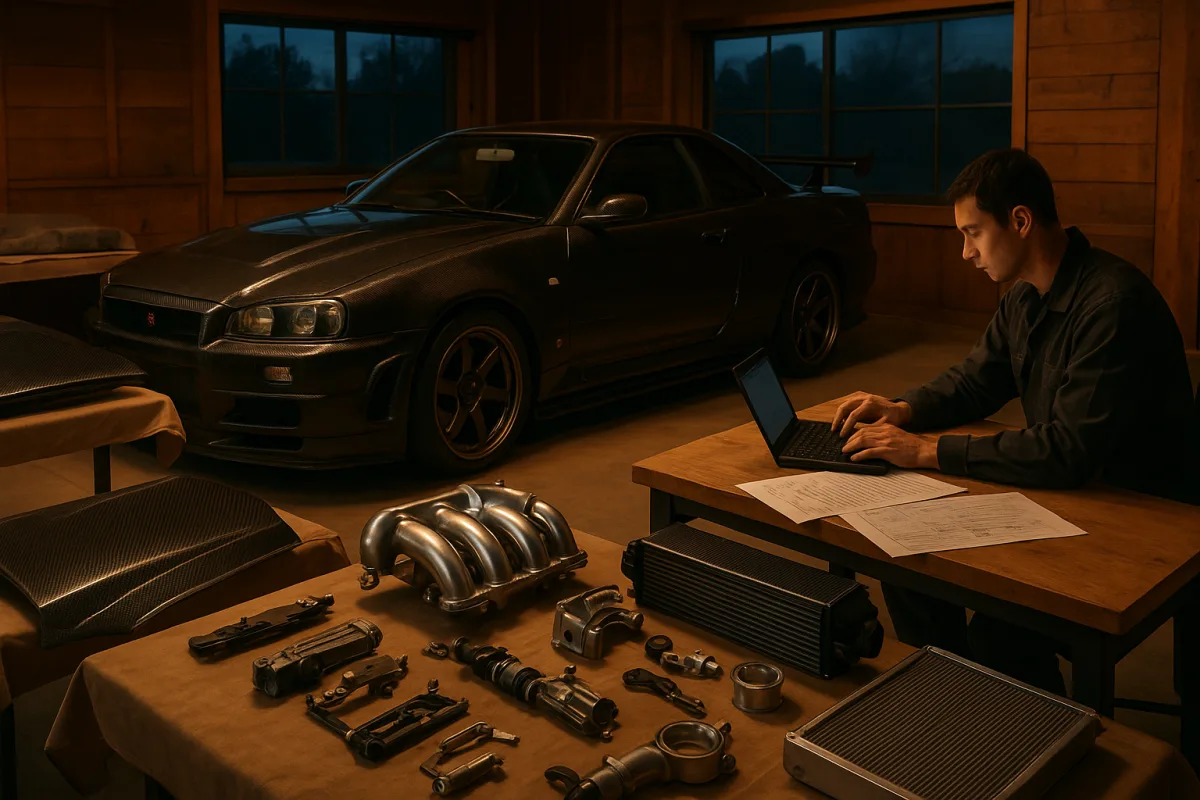
Start with the car, not the carbon catalogue
The seductive part of a performance build is easy to understand. A carbon Z-Tune-style nose, a four-rotor exhaust note or a 632 big block makes a car feel transformed before it turns a wheel. Ownership starts somewhere less glamorous: paperwork, condition and parts support.
Tj Hunt’s white Nissan Skyline R34 GT-R purchase from Toprank illustrates the sensible starting point. The car was presented with roughly 50,000 miles, a mostly stock interior, clean strut towers, intact VIN stickers, factory-style exterior trim and only modest existing modifications.
That matters more than whether it already wears the right bumper. On a 1999-on R34 GT-R, the United States’ 25-year import rule has made legal import possible since 2024, but legality at the federal level is not the same as painless registration or insurance. [2]
Do not confuse a normal 25-year import with a Show and Display car. Show and Display imports are restricted to 2,500 annual miles and are intended for exhibitions and limited use, not as an excuse to commute in a modified Skyline. [2]
Before sending a deposit, ask for the export certificate, import documents, title history, odometer evidence, auction sheet where available and photographs taken before the car was cleaned for sale. A tidy engine bay can be genuine, but it can also conceal recent detailing.
The R34 GT-R’s RB26DETT is not a cheap engine to “sort later.” Tj Hunt noted the familiar squeaky accessory belt on the drive home, a minor issue on its own, but old belts, tensioners, hoses and rubber bushes accumulate into the expensive part of ownership.
A car that rides quietly, does not rattle and has a complete interior is usually the better base than a cheaper one already fitted with unknown coilovers, anonymous exhaust hardware and brittle carbon trim. Reversing someone else’s shortcuts costs twice.
Sort finance, insurance and registration before modifying it
Traditional car lenders often dislike imported Japanese performance cars, particularly modified examples. Their age, limited valuation data, right-hand-drive configuration and uncertain collateral status can exclude them from normal finance products. [2]
Specialist classic-car lenders, unsecured personal loans and credit-union loans are potential routes, while a HELOC can offer lower borrowing costs but puts the borrower’s home at risk. Reported HELOC rates are around 6 to 9 percent variable, not a fixed-cost solution. [2]
Do not assume a particular importer will finance your car simply because it sells imported stock. Public research identifies specialist finance possibilities generally, but does not establish a specific Toprank finance programme or terms for a given buyer. [2]
Insurance is the next unpleasant surprise. Heavily modified JDM imports can attract higher premiums, agreed-value documentation requirements and limited insurer choice because they were not originally certified to US FMVSS and emissions standards. [2]
Photograph the car before work begins, retain invoices and list serial numbers on expensive components. Insurers cannot reliably value a rare R34 GT-R with discontinued Nismo pieces, custom carbon bodywork and a rebuilt RB26 from a standard valuation guide.
California readers should separate registration concerns from new-car policy headlines. The state’s ACC II zero-emission sales mandate applies to new vehicles sold after January 1, 2026, not existing imported or already registered cars. [2]
That does not remove California emissions, inspection or direct-import compliance questions. Confirm the rules with the relevant state agencies and your insurer before fitting a standalone ECU, deleting emissions equipment or turning a road car into something only comfortable on trailers.
Choose carbon bodywork based on fitment and finish expectations
The original Nismo Z-Tune dry-carbon R34 GT-R front bumper, part number 62020-RSR46-01, is out of production, extremely scarce and has no official Nismo reissue programme in 2026. That is why original parts command irrational money when they surface. [1]
Tj Hunt’s R34 carbon conversion shows why replicas exist. The featured All Street bumper retained mounting provisions for original badges, indicators and trim, and the builders reported a clean trial fit without trimming. That is promising, but not a universal guarantee.
Ask the supplier whether the panel is dry carbon, wet carbon or fibreglass with a cosmetic carbon layer. Also ask whether factory grilles, lamps, undertrays, bumper supports, fasteners and fender liners transfer directly. Those parts decide whether a panel actually fits.
For an R34 GT-R owner seeking a made-to-order dry-carbon Z-Tune-style bumper, Carbonetics lists one at $5,500 with a stated six-to-eight-week lead time. That price is for the bumper, not paint, shipping, import charges, installation or replacement factory trim. [1]
AeroLuxe Auto Boutique’s Spec-ZTN carbon bumper is the lower advertised-price option at $3,000, but it is listed sold out and available only by pre-order with a similar lead time. It suits a buyer willing to wait and verify the current production position. [1]
Stratec Systems lists a dry-carbon Z-Tune-style R34 bumper at RM14,374, with shipping details unclear. It suits an owner prepared to obtain a freight quote and currency conversion before comparing it with US suppliers, rather than assuming the listing is the final cost. [1]
None of those prices include body-shop preparation. This is the part enthusiasts often overlook. A carbon panel can be light and structurally sound yet still need edge finishing, mounting adjustment, clearcoat work, paint or wrap to match the rest of the car.
Adam LZ’s StreetHunter Supra bumper is the useful cautionary example. The lightweight integrated bumper, lip and flare assembly was intended to be painted or wrapped, rather than judged as flawless exposed carbon, and reportedly reduced front-end weight from 28 pounds to 10 pounds.
That 18-pound reduction is meaningful because it comes from the nose of the car, but it was only possible because the piece combined several components into one. It also created practical jobs: grille provision, badge placement and checking how much structure remained visible.
Do not order carbon simply because it saves weight. Decide whether the car is a road car, time-attack car, drift car or static show build. A painted lightweight panel is often the rational option for a road-driven car, particularly one exposed to stone chips.
Do not redesign the powerband from the internet
Adam LZ’s four-rotor Toyota Supra project makes the right case for controlled testing. The build had already made more than 600 horsepower on M5 fuel, but its sharply peaky delivery was judged unsuitable for sustained drifting, where usable response matters.
The team compared a four-inch exhaust with a three-and-a-half-inch system, then tested a new collector with a two-and-a-half-inch merge against the existing three-and-a-half-inch version. The smaller exhaust tubing itself showed no meaningful power loss in their comparison.
The smaller collector was different. It was expected to improve mid-range scavenging, yet the dyno result fell away hard above roughly 7,000 rpm. The original larger collector went back on because it better matched the engine’s actual airflow demand.
That result lines up with the general rule, not a universal formula: smaller exhaust sections can improve low-speed gas velocity and response, while excessive restriction increases backpressure and can limit high-rpm flow. [4]
The practical lesson is to define the use case first. A drift car needs a broad, repeatable torque curve and adequate clearance. A drag car may accept a narrow powerband. A road car needs tolerable cabin noise, heat control and ground clearance.
Do not claim an exhaust change “made torque” unless it has been measured. Log ambient temperature, fuel, boost or throttle position, ignition timing and dyno type. Adam LZ’s crew explicitly noted humidity and possible residual fuel as variables in their baseline.
Intake runner length belongs in the same test plan. The four-rotor team explored different trumpet lengths and runner extensions specifically to move the torque peak by estimated rpm ranges, then planned dyno testing instead of treating those estimates as final results.
If your exhaust repeatedly deforms, cracks or drags, fix brackets and clearance before changing pipe diameter. The Supra project itself linked some problems to insufficient bracketry, heat and drift abuse, which no collector calculation can solve.
Plan the big-block installation as a complete vehicle system
Hoonigan’s 632 cubic-inch “Mother 632 Pomero” project is a useful reminder that a dyno-proven engine does not equal a drivable car. The claimed output was 1,189 hp, but the installation immediately exposed steering, cooling, fuel and transmission problems.
The first hard interference was the oil pan. Its deeper front sump contacted the steering rack. Lowering the rack by half an inch looked like a quick answer, but the builders stopped when it compromised steering geometry and chose to remake the mounts.
That is the correct decision. Never move a steering rack, alter tie-rod pickup points or modify suspension mounting merely to clear an engine without measuring bump steer, rack travel, steering-shaft angles and suspension geometry through full compression and rebound.
The build also needed a transmission cooler, larger cooling capacity, heat insulation, revised fan strategy, brake-line work, alternator mounting and battery cables. Those are not finishing details. On a 1,000-mile trip, they are what separates a drive from a recovery truck.
The fuel system tells the same story. Hoonigan planned a separate street-fuel tank and race-fuel system after seeing how rapidly the engine drained its cell on the dyno. A high-output engine’s range, pump capacity and heat management must be calculated together.
There is no documented 2026 ownership-cost dataset for a street-driven 1,189 hp 632 build, so anybody quoting a neat annual figure is guessing. Consumer vehicle averages, such as GMC’s reported $744 annual maintenance average, are irrelevant beside a custom race-derived engine. [3]
Budget instead for frequent inspection, fluid changes based on actual use, fuel-system servicing, sensor replacement, drivetrain wear and specialist diagnosis. The correct contingency is not a few hundred dollars for routine servicing, but thousands held back for inevitable fabrication and troubleshooting.
Rob Dahm’s four-rotor RX-7 carbon-body project offers one final lesson. Even the tool used to make the body panels required structural repair, squaring, bed levelling, electrical planning and repeated test prints after forklift damage before it could produce reliable large components.
That is custom-car ownership in miniature. The exciting component is rarely the limiting factor. The build succeeds when its mounting points, wiring, cooling, fuel delivery, geometry, legal status and spare-parts plan are treated as seriously as the carbon weave or dyno sheet.
Frequently Asked Questions
What should I consider before importing an R34 GT-R for a performance build?
Start by selecting the cleanest, most documented R34 GT-R you can afford, prioritizing condition and paperwork over cosmetic modifications. Verify export certificates, import documents, title history, odometer records, and pre-sale photos to avoid hidden issues. Remember that federal import legality does not guarantee smooth registration or insurance, so research state-specific rules and insurer policies before purchase.
How do carbon fiber body panels affect R34 GT-R modifications?
Carbon fiber panels, especially replicas of rare parts like the Nismo Z-Tune bumper, often require trimming, paint, or wrapping unless the maker guarantees finish quality and UV protection. Treat exposed carbon parts as display items unless mounting hardware and repair support are explicitly provided. Availability and prices vary widely, and original dry-carbon panels are scarce and expensive.
What are the challenges of insuring and registering a modified R34 GT-R?
Modified R34 GT-Rs can face higher insurance premiums and limited insurer options due to non-compliance with US safety and emissions standards. Insurers often require detailed agreed-value documentation, including photos, invoices, and serial numbers of custom parts. Registration rules vary by state and may involve emissions inspections or restrictions on modifications like standalone ECUs.
How to budget for specialist labor and downtime when building an R34 GT-R?
Specialist labor for imported JDM cars can cost $150 to $200 per hour, and parts shipments from overseas may take two to three weeks. Budget as much for downtime and labor as for parts, since delays and complex installations are common. Planning for these factors helps avoid unexpected costs and extended project timelines.
What engine and drivetrain planning is needed for a high-horsepower R34 GT-R build?
For high-horsepower builds, such as a 1,189 hp big-block engine, plan cooling, fuel capacity, steering geometry, and drivetrain layout before installation to avoid interference issues. When upgrading to high-rpm engines like four-rotors, test exhaust and intake modifications together on a dyno under consistent conditions, focusing on torque curves rather than peak horsepower numbers.
How we researched this
This article was assembled from 5 video sources across 4 channels, 4 cited references.
Nothing here is based on hands-on testing. Where a figure or finding appears, it belongs to the source cited beside it, and the writing says so rather than implying otherwise. Every source is listed below so you can check it.
Sources
Building a Carbon Fiber R34 GTR! — Tj Hunt
I BOUGHT ANOTHER JDM LEGEND! — Tj Hunt
We can FINALLY make our Carbon Fiber Body for the 4 Rotor RX-7! — Rob Dahm
Our 1,189hp Big Block Finally Finds its Home — Hoonigan
Best JDM Cars to Import in 2026: R34 GT-R, Supra & More | Project JDM
How Exhaust Pipe Diameter Affects Engine Performance and Efficiency | Auto Exhaust Guide
Watch New Performance Builds and Modifications on Youtube
Also from the sources
Related Articles
Carbon Fiber Performance Builds
Learn how to plan carbon fiber performance builds with fitment tips, cost insights, and insurance advice for lightweight car modifications.
High-Performance Car Builds
Explore high-performance car builds, comparing drift setups, exotic mods, costs, and ownership challenges in this detailed guide.
Exotic Car Ownership and Modifications
Explore exotic car ownership and modifications, including costs, challenges, and real-world examples of high-performance exotic cars.
Exotic Car Restoration Stories and Ownership Insights
Explore exotic car restoration stories, ownership challenges, and costs for high-performance rebuild projects like Ferrari and Lamborghini.