
Unique Supercar Ownership Challenges
Explore unique supercar ownership challenges, including maintenance, auctions, and custom builds for rare exotic cars.
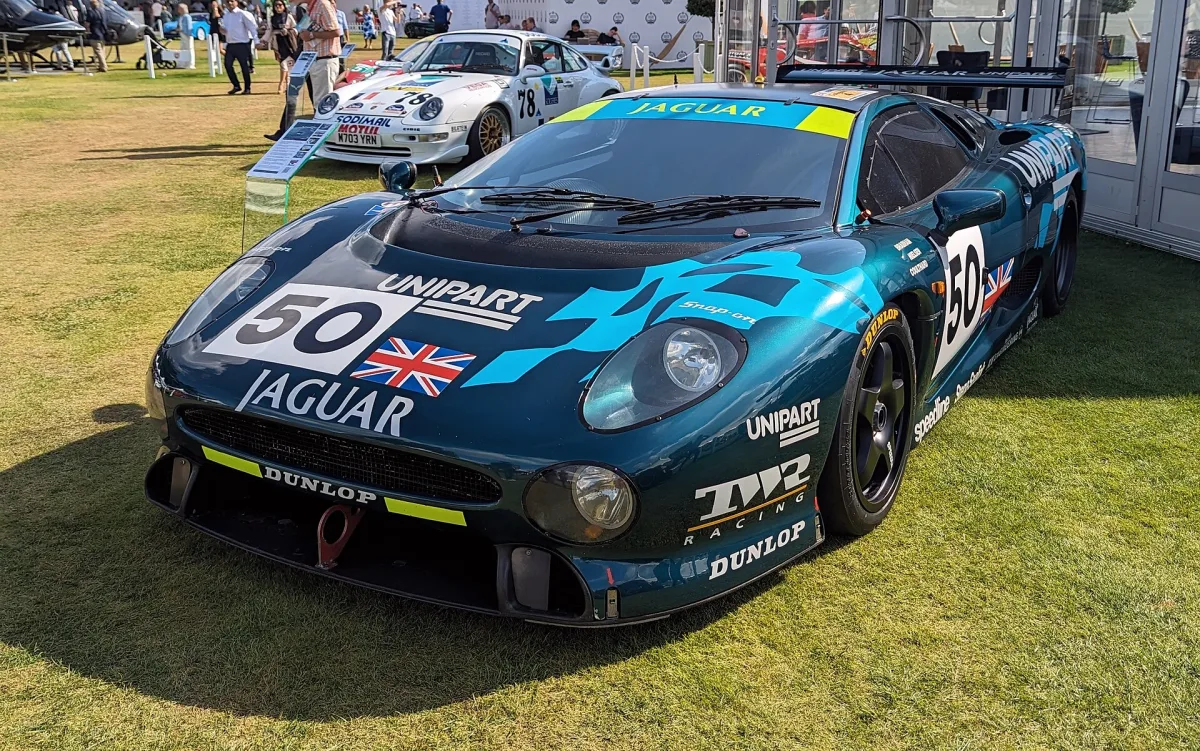
Photo: Calreyn88, CC BY 4.0, via Wikimedia Commons
The quick list
Best overall: Chip Foose 1955 Chevrolet 210 Delray, for the owner who wants a sentimental classic rebuilt to cruise regularly, with modern V8 power and familiar service parts.
Best modern exotic build: S-Klub LA McLaren CLK 750S, for the collector who wants CLK GTR theater with McLaren 750S usability and accepts that resale value has no established benchmark.
Best track-day machine: Ferrari 488 Challenge Evo, for the owner who wants a purpose-built Ferrari race car and can keep street registration secondary to track use.
Best headline collectible: Jaguar XJ220C-LM chassis 002, for the buyer who wants a road-plated former Le Mans GT contender and can afford a roughly $5.95 million entry price.
Four ways to spend serious car money
A 3D-printed CLK GTR front clip joined to a McLaren 750S makes the choice unusually clear. You can buy provenance, build a one-off, restore a memory, or acquire a race car that happens to have license plates.
These four cars share show-floor drama, but they are fundamentally different ownership propositions. One has a Chevrolet small-block-derived V8 and a rebuilt frame, one has a modern carbon-bodied McLaren underneath, one is a Ferrari customer race car, and one began life on the 1993 Le Mans grid.
| Option | Reported price | Layout and power | What makes it unusual | Road-use position | Main ownership trade-off |
|---|---|---|---|---|---|
| McLaren CLK 750S | No published sale price | McLaren 750S chassis, CLK GTR-inspired 3D-printed front and rear body sections | Built in 48 days, retains McLaren doors, roof, electronics, and front lift | Street-driven, with original McLaren functions retained | No market comparables, bespoke body repairs and resale are uncertain |
| Chip Foose 1955 Chevrolet 210 Delray | Not published | Chevrolet LS3 V8, ZF automatic, boxed rear frame and relocated leaf springs | Fire-loss restoration using a donor Delray, custom Foose styling | Built as an easy daily cruiser | Restoration-quality workmanship costs heavily if repairs are needed |
| Ferrari 488 Challenge Evo | Purchase price not published | Mid-engine Ferrari race car, track-oriented traction-control settings | Factory Challenge race-car controls, pit limiter, race calibration | Gintani intends to register its example for street use | Race-car tires, clearance, noise, and setup do not suit ordinary errands |
| Jaguar XJ220C-LM chassis 002 | £4,499,990, roughly $5.95 million | 3.5-liter twin-turbo V6, 850 hp | 1993 Le Mans GT-class finisher, later disqualified on paperwork | UK-road registered with race livery intact | Extremely expensive, specialized race-car maintenance and limited parts support |
The McLaren CLK 750S: the best-looking compromise
The S-Klub LA McLaren CLK 750S starts with a brand-new McLaren 750S, selected because its wheelbase matched the original Mercedes-Benz CLK GTR’s. A CLK GTR owner’s neighbor scanned the rare Mercedes, then supplied the resulting body design to the shop.
Larry Chen reports that the car uses 3D-printed bodywork, with a new front clip and rear section blended into the McLaren’s original center structure. The shop retained the McLaren doors because they are easier to enter through, and retained the roof scoop because it already suited the design.
It is a hybrid, not a replica. The body joins preserve original McLaren sections around the doors and rear quarters, while the rear wing mounts to the chassis and the car keeps its front camera, parking sensors, and front-lift system.
That retained functionality is why this is the strongest modern-build proposition here. The McLaren reportedly had no fault codes after the conversion, and the front lift makes far more sense on the street than the show stance seen at SEMA 2026.
The project took 48 days, which is impressive but also a warning for anyone commissioning something similar. A shop can make the panels fit, retain electronics, and finish a show car quickly, but future damage repair depends on that shop’s files, skills, and willingness to support it.
No established sale price exists for this specific McLaren-CLK GTR hybrid, and no comparable market data exists for a 3D-printed CLK GTR body mounted on a 750S. A genuine CLK GTR has a collector market built on rarity and homologation history, while this car has value only if the next buyer loves this exact interpretation.
The reported $400,000 figure covered the underlying McLaren 750S purchase, according to Larry Chen, not the scanning, printed bodywork, paint, upholstery, wheels, labor, or future repairs. That is why calling it a $400,000 CLK GTR alternative would be misleading.
The Foose Delray: the one to keep driving
Ben Johnson’s Orbit Orange 1955 Chevrolet 210 Delray mattered because he had owned it since he was 16. The 2025 Eaton Fire destroyed it down to the frame, ending a decades-long relationship with a car tied to dates, Friday nights, and his first home.
Chip Foose and Coulson Autosports delivered its replacement at the 2026 Los Angeles Auto Show on November 19. Motor1 reports that the one-year project required another 1955 Delray donor car because almost none of Johnson’s original Chevrolet survived.
The team stripped the donor to bare metal, repaired corrosion and damage, boxed the rear frame, and relocated the leaf-spring suspension. It also rewired the car, rechromed its trim, and reused surviving original pieces where possible.
Under the hood sits a Chevrolet LS3 V8 connected to a ZF automatic transmission. That matters far more to a long-term owner than a period-correct engine would, because the stated goal was an easy daily cruiser rather than a static restoration.
Foose specified a yellow body color darker than Johnson’s original orange, a contrasting white roof, a custom stitched-leather cabin, a lowered suspension, and custom wheels based on an earlier Boyd Coddington design. This is a restoration with a personal story, not a factory-correct preservation exercise.
No build price was disclosed, but this is not a cheap template to reproduce. ClassicCarsArena places a driver-quality restoration at 500 to 1,000 labor hours and $45,000 to $100,000, while a street-show-level job typically runs 1,000 to 2,000 hours and $100,000 to $225,000. [6]
A fire-damaged car needing a donor shell, custom fabrication, electrical work, paint, upholstery, chrome, and a modern drivetrain can easily exceed those figures. The Delray is still the least intimidating long-term proposition because LS3 parts, Chevrolet suspension components, and automatic-transmission support are far easier to find than XJ220C race hardware.
The Ferrari 488 Challenge Evo: buy it for the track
Gintani’s newly acquired Ferrari 488 Challenge Evo is a proper customer race car, with a pit limiter, radio controls, display controls, turn signals, and separate traction-control adjustments. Its system divides the intervention point from the amount of intervention, using braking to manage wheelspin.
That level of adjustment tells you exactly what the car is for. The driver can select how much yaw occurs before intervention and how aggressively the car corrects it, a far more focused setup than the usual road-car manettino mode selector.
Gintani bought the Challenge Evo after considering other projects, including a Porsche 993 Turbo and a Ferrari 458 with a GT4 kit. The team’s stated reason was straightforward: it wanted a car to track without risking its street cars.
That is the logic we would follow. The channel plans to register the Challenge Evo for street use and considered fitting a KW hydraulic-lift system, but a track Ferrari on public roads still brings low clearance, race-oriented tires, high noise, and a limited margin for potholes or traffic.
Its purchase price was not disclosed, nor were annual operating costs. Before financing any rare Ferrari, get an agreed-value insurance quote that explicitly covers track use, transport, modifications, and replacement bodywork, because standard policies can exclude the activities that made you buy it.
Specialized lenders can offer collector-car loans up to $5 million, with terms extending to 180 months, according to MotorFi. [1] Those long terms can reduce monthly payments, but they do not reduce the cost of tires, brakes, transport, track support, or crash repairs.
The Jaguar XJ220C-LM: provenance with paperwork
The Jaguar XJ220C-LM is the opposite of the McLaren build. Where the 750S gains its appeal from imaginative fabrication, chassis 002 brings historic provenance that cannot be recreated, including its 1993 Le Mans entry as car number 50.
John Nielsen, David Brabham, and David Coulthard drove it to 15th overall and first across the line in the GT class. Officials later disqualified it because appeal paperwork reached the organizer but missed the French motorsport authority’s deadline, Motor1 reports.
Furlonger Specialist Cars has now registered the car for UK road use and listed it at £4,499,990, or approximately $5.95 million. That asking price includes the road-registered XJ220C-LM itself, with its race livery, plates, and largely intact competition hardware, but not taxes, shipping, import costs, insurance, or later mechanical work.
The 3.5-liter twin-turbocharged V6 produces 850 hp in race specification, compared with 542 hp for the road-going XJ220. Furlonger attributes the successful road-registration effort to the shared structure between the competition car and its road-car relative.
Do not assume that one UK registration makes a race car easy to plate elsewhere. The DVLA requires documentation and inspection for modified, reconstructed, and kit-built vehicles, and structural modifications require photographic and VIN evidence. A prospective buyer should confirm eligibility in the country where the car will live before money changes hands.
Insurance alone can be a substantial recurring cost. Supercar premiums can range from 0.8 percent to 6 percent of insured value annually, depending on the car, location, driver, mileage, and coverage terms. [2] On a $5.95 million Jaguar, that range illustrates why a specialist agreed-value policy is essential.
Who each option suits
The McLaren CLK 750S suits the collector who wants attention, modern drivability, and a car nobody else owns. We would only buy it with written support from the builder covering repair procedures, replacement panel files, paint details, and the retained McLaren components.
The Foose Delray suits the owner who values a car’s history but wants to use it. It has the best long-term service outlook here, and it is the one we would buy because an LS3, ZF automatic, boxed frame, and conventional suspension make ownership understandable.
The Ferrari 488 Challenge Evo suits the experienced track-day regular with enclosed transport, storage, and a Ferrari race-shop relationship. It is a poor substitute for a comfortable road Ferrari, but it makes far more sense than repeatedly exposing a prized road car to track-day heat cycles and curbing.
The Jaguar suits the buyer whose collection already has the infrastructure for a historic competition car. Its disputed Le Mans result, 850-hp engine, and road plates make it extraordinary, but its $5.95 million asking price buys a demanding artifact, not an easy exotic to exercise on Sunday mornings.
Frequently Asked Questions
What are the maintenance challenges of owning unique supercars?
Unique supercars like the Jaguar XJ220C-LM require specialized race-car maintenance and have limited parts support, making upkeep expensive and complex. Custom builds such as the McLaren CLK 750S hybrid depend heavily on the original builder for future repairs due to bespoke components like 3D-printed bodywork. Owners should expect unusually deep maintenance budgets and insurance costs.
How do auction prices affect rare exotic car ownership?
For rare exotic cars without comparable sales, such as the McLaren CLK 750S-based CLK GTR tribute, auction prices are uncertain and resale value depends largely on individual buyer preferences. Established collector markets exist for factory-original cars, but unique modern builds lack market benchmarks, making ownership riskier in terms of investment.
What should I know before buying a custom exotic car build?
Custom exotic builds may retain original chassis and electronics but often have bespoke bodywork or structural changes that complicate repairs and resale. The McLaren CLK 750S hybrid, for example, uses 3D-printed panels and retains some original features, but its value and future support depend on the builder’s files and willingness to assist. Buyers should be prepared for uncertain market value and specialized maintenance.
Are track-focused supercars practical for street use?
Track-focused cars like the Ferrari 488 Challenge Evo can be registered for street use but involve compromises such as race-car tires, low clearance, noise, and specialized setup that make everyday driving difficult. Many owners choose to trailer these cars to events rather than use them regularly on public roads.
What are the costs associated with restoring rare supercars?
Restoring rare cars, especially after severe damage like fire, can be very costly. Labor rates range from $85 to $225 per hour, with total restoration hours potentially exceeding 2,500 for concours-level quality, leading to costs above $200,000. Ongoing expenses include specialized insurance, fuel, maintenance, and proper storage.
How we researched this
This article was assembled from 2 video sources across 2 channels, 3 published articles, 7 cited references.
Nothing here is based on hands-on testing. Where a figure or finding appears, it belongs to the source cited beside it, and the writing says so rather than implying otherwise. Every source is listed below so you can check it.
Sources
3D Printed CLK GTR Body On A $400k McLaren 750s, Larry Chen
The Honda Avancier SUV Offers a Taste of CR-Vs, Pilots and Accords to Come, Road & Track
Chip Foose Rebuilds Fire-Destroyed 1955 Chevy With LS3 V8 And Custom Styling, Motor1
This Jaguar XJ220 Won At Le Mans. Now You Can Drive It On Public Roads, Motor1
How Much Does It Cost to Insure a Supercar? A Global Reference (2026), OBJAIS
Exotic Car Insurance: Costs, Coverage & Best Companies - InsureMojo
Luxury, Exotic and Classic Car Insurance: How To Get the Best Coverage
Watch Rare and Unique Supercar and Exotic Car Builds and Auctions on Youtube
Also from the sources
Related Articles
Rare Unique Car Builds: Custom Restorations and One-Offs
Explore rare unique car builds, custom restorations, and one-off exotic conversions with insights on ownership and insurance challenges.
Rare Exotic Car Ownership Builds: Stories, Costs & Choices
Explore rare exotic car ownership builds, restoration costs, and stories to help decide what to drive, preserve, or modify.
Exotic Car Restoration Stories and Ownership Insights
Explore exotic car restoration stories, ownership challenges, and costs for high-performance rebuild projects like Ferrari and Lamborghini.
Rare Exotic Car Ownership: Stories, Costs, and Restorations
Explore rare exotic car ownership stories, restoration costs, and maintenance insights for models like Ferrari, Porsche, and Toyota Supra.