
2027 Honda Civic Type R Enhancements
Discover the 2027 Honda Civic Type R enhancements including aerodynamic upgrades, performance features, and pricing details.
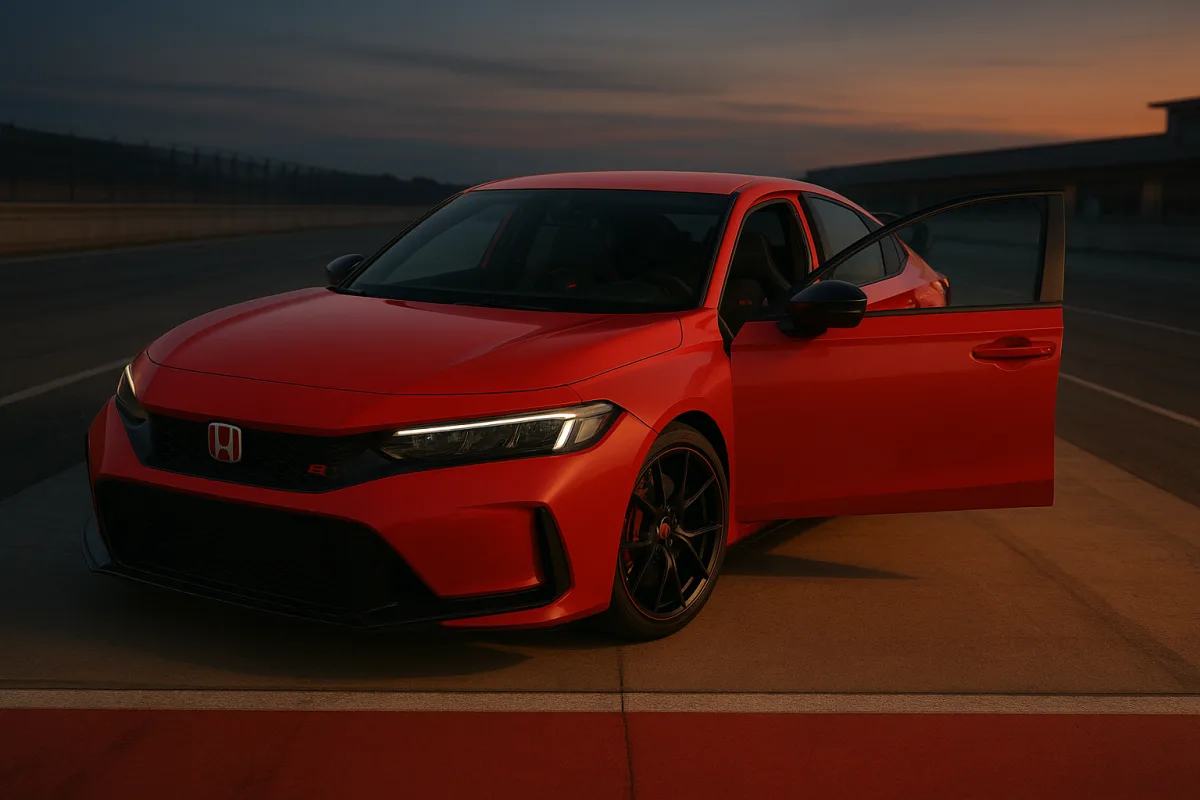
The important 2027 Type R upgrade is airflow, not horsepower
Honda has resisted the usual mid-cycle hot-hatch temptation. The 2027 Civic Type R keeps its 2.0-liter K20C turbocharged four-cylinder, six-speed manual gearbox, front-wheel drive and mechanical limited-slip differential, with 315 hp and 310 lb-ft unchanged. [6][9]
That may sound underwhelming beside the annual escalation of power figures elsewhere. It is also probably the sensible decision. The outgoing FL5 Type R was never short of usable power, and adding more would intensify traction limitations at the driven front wheels.
Instead, Honda has altered the front fascia, enlarged the grille opening and fitted a deeper front splitter. Honda says the package reduces turbulence, improves cooling airflow and produces more downforce, particularly under sustained track use. [6][7]
Those are three related claims, but they are not the same claim. “More downforce” is the headline, while cooling and turbulence control may matter more to an owner who actually attends track days or drives hard in hot weather.
I have not driven the 2027 model, and nobody can honestly offer a 60,000-mile report on it yet. What can be unpacked is the front-end aerodynamic system Honda keeps referring to, and why a modest-looking plastic extension may be useful.
What a front splitter actually does
A splitter is the horizontal lip extending forward from the lower edge of the bumper. At speed, it divides the air approaching the car: some passes above it into the grille and around the body, while some is directed beneath it.
The useful part is pressure difference. Air meeting the upright face of the bumper creates a relatively high-pressure area, while carefully managed airflow below the splitter can maintain lower pressure. That pressure imbalance pushes downward on the front of the car.
Downforce is simply aerodynamic load. It increases tire contact load without adding physical mass, so the front tires can resist sliding more effectively during fast cornering, braking and turn-in. It only becomes meaningful as speed rises.
That last point is why claims about a deeper splitter need perspective. You will not feel a dramatic new front axle at suburban speeds, and Honda has released no pounds, kilograms or newtons figure for the 2027 car’s added downforce. [6][7]
Without a published number, nobody can calculate the real effect at 60 mph, 100 mph or a track’s fastest corner. The honest description is that Honda has changed the aerodynamic balance, not that it has proved a particular performance gain.
A splitter also has a less glamorous job: keeping airflow orderly. Turbulent air is energy wasted in chaotic swirls. Reducing it can help the car feed air more predictably into the radiator opening and around the underside.
Why the bigger grille is tied to the splitter
A turbocharged engine makes heat in several places. Combustion heats the cylinder head and coolant, the turbocharger compresses intake air and raises its temperature, and oil works hard lubricating both engine and turbo under sustained load.
The radiator needs a pressure difference to move air through its core. High pressure at the grille opening and lower pressure behind the radiator encourage flow through the fins, carrying heat into the air leaving the engine bay.
Honda says the new fascia’s larger grille opening and reduced turbulence increase airflow velocity and improve cooling. [6] The important qualification is that a large hole alone is not automatically better, because airflow must still be managed after it enters.
If air enters the grille but encounters a congested engine bay, it can slow, recirculate or escape around the radiator rather than through it. Effective cooling is a system: inlet size, ducting, radiator resistance, underbody exits and underhood pressure all matter.
That is why the splitter and grille should be considered together. The splitter can influence the pressure field at the nose, while the grille admits cooling air. Honda is trying to improve both front-axle aero load and thermal control without changing the engine. [6]
For an owner, cooling is more relevant than it sounds. A car that holds coolant, intake-air and oil temperatures more consistently can sustain repeated hard laps with less power reduction, less heat soak and potentially less component stress.
That does not mean the 2027 Type R has acquired a new cooling capacity guarantee. Honda has not released comparative temperature data, radiator dimensions or track-test results, so prospective buyers should wait for independent instrumented testing before treating this as solved. [6][7]
The rest of the chassis work is about contact, not drama
Honda also retuned the adaptive dampers in +R mode. The stated aim is better road following with reduced bouncing and impact harshness, which sounds like a small change until you have lived with a stiffly sprung performance car. [6]
A damper controls suspension movement rather than supporting the car’s weight. Too little damping lets the body oscillate after a bump. Too much, particularly in rebound, can stop the wheel returning quickly enough to follow an uneven road.
When a wheel skips over a rough surface, grip falls because the tire is briefly unloaded. A more compliant +R calibration can therefore make the car both less tiring and faster over a bumpy road, even if it feels less theatrically hard.
Honda’s revised brake-pedal linkage follows the same logic. A yoke spring is intended to remove initial play, giving a firmer, more immediate pedal response before the hydraulic braking system builds significant pressure. [6][9]
It will not shorten braking distances by itself. Tires, brake temperature, pad compound, road surface and driver technique determine that. But reducing free play can make threshold braking easier to repeat, especially when the driver is trying to judge weight transfer precisely.
The automatic rev-matching system has also been recalibrated for quicker response on downshifts. [6] It blips the throttle as the clutch is released, raising engine speed to match the lower gear and reducing the driveline shock of a poorly timed manual downshift.
Purists can switch off assistance, but it is worth separating this from a faster gearbox. The Type R still uses a conventional six-speed manual. The software only coordinates engine speed, it does not change the gearset or the driver’s clutch work.
Cabin improvements matter more in January than on a spec sheet
The most overdue upgrade is three-stage heating for the Type R’s front bucket seats. Honda has also revised the seat perforation, added Ultrasuede to the upper door panels and instrument-panel area, and made an auto-dimming mirror standard. [6][9]
Heated seats do not make the Type R faster, but they alter whether an owner wants to use it on a cold commute. The old absence was hard to defend in a car already approaching $50,000.
Google built-in, Alexa integration and two USB-C ports arrive alongside the existing wireless phone charger. [6][9] These are useful conveniences, but they also add software-dependent features that deserve checking during ownership rather than taking for granted at delivery.
Meteorite Gray Metallic joins Championship White, Boost Blue Pearl and Sonic Gray Pearl. [6] Honda has also restyled the engine cover to resemble earlier Japanese-market Type Rs, though a plastic cover has no bearing on cooling capacity or service access.
Price, rivals and the ownership questions still unanswered
Honda lists the 2027 Civic Type R at $48,695 before destination, or $49,990 including its $1,295 destination charge. [6][9] That figure excludes sales tax, registration, finance charges, insurance, dealer-installed accessories and, importantly, dealer markups.
At that money, the Type R is dearer than the 2026 Volkswagen Golf R at $45,635. The Volkswagen suits buyers who want 315 hp, all-wheel-drive traction and an approximately 4.2-second 0-60 mph time, rather than Honda’s manual-only involvement. [3]
The Toyota GR Corolla began at $36,990 with 300 hp and an approximately 5.1-second 0-60 mph time. It suits the buyer wanting a cheaper, all-wheel-drive rally-flavored hatch, though it is not a like-for-like substitute in refinement or interior space. [3]
Hyundai’s Elantra N, listed at $32,250 with 276 hp and roughly a 5.0-second 0-60 mph time, suits someone who values performance per dollar and can accept a sedan rather than a hatchback. [3]
The Subaru WRX began at $30,100 with 271 hp and an approximately 5.4-second 0-60 mph time. It suits buyers needing all-weather all-wheel drive and a lower entry price, not necessarily those seeking the Type R’s focused front-drive chassis. [3]
Honda’s approximate 5.3-second 0-60 mph time is not the class headline, and that is fine. [3] The Type R’s argument remains the quality of its controls, manual gearbox and front-end precision, not winning a traffic-light comparison.
Fuel economy is still an estimate, not a 2027 fact. The mechanically similar 2023 Type R was EPA-rated at 22 mpg city, 28 highway and 24 combined, while a 75-mph highway test returned 30 mpg. [3][10]
Those older figures are a reasonable planning guide because the engine and transmission continue, but driving style will decide the actual bill. A turbocharged manual hatch driven gently on a motorway and one repeatedly run into boost on back roads are effectively different fuel consumers.
There is likewise no verified long-term failure pattern specific to the 2027 model. Buyers should avoid folding the 2017-2020 Honda and Acura fuel-pump recall into this car’s record, because that campaign does not directly cover the new Type R. [1]
The European Type R’s disappearance is also not a warning about American support. It is tied to Europe’s Euro 6e-bis emissions rules, which the current model does not meet, while U.S. requirements allow the Type R to continue here. [8][9]
Frequently Asked Questions
What are the key enhancements in the 2027 Honda Civic Type R?
The 2027 Civic Type R retains its 315-hp 2.0-liter K20C turbocharged four-cylinder engine, six-speed manual transmission, and mechanical limited-slip differential. Key upgrades focus on aerodynamics, including a redesigned front fascia, larger grille opening, and a deeper front splitter to improve airflow, cooling, and front-end downforce rather than increasing power.
How does the 2027 Civic Type R improve aerodynamics?
Honda has redesigned the front end with a deeper splitter and enlarged grille opening to reduce turbulence, improve cooling airflow, and generate more downforce at high speeds. These changes aim to enhance front-end stability and heat management, especially during sustained track use, although Honda has not published specific downforce figures.
What performance upgrades does the 2027 Honda Civic Type R have?
Performance upgrades center on sharper chassis detail and improved aerodynamics rather than increased engine output. The front splitter and grille revisions help with downforce and cooling, which can improve handling and stability at speed, but the engine and powertrain remain unchanged from the previous model.
Has the horsepower changed in the 2027 Civic Type R?
No, the horsepower remains the same at 315 hp from the 2.0-liter K20C turbocharged four-cylinder engine. Honda chose not to increase power to avoid traction limitations on the front-wheel-drive setup.
What new features come standard on the 2027 Honda Civic Type R?
The article does not provide specific details on new standard features beyond aerodynamic and chassis improvements. It does mention heated seats and more standard tech but does not elaborate further.
How we researched this
This article was assembled from 6 published articles, 10 cited references.
Nothing here is based on hands-on testing. Where a figure or finding appears, it belongs to the source cited beside it, and the writing says so rather than implying otherwise. Every source is listed below so you can check it.
Sources
The 2027 Honda Civic Type R Adds More Downforce, Better Cooling, and Heated Seats — Road & Track
View Photos of the 2027 Honda Civic Type R — Car and Driver
Honda Sharpens Civic Type R For 2027 — Hagerty
Ford Jumps Back Into WRC, Says Your Next Car Will Be Better For It — CarScoops
2027 Honda Civic Type R Adds Performance, Enhances Interior — Car and Driver
America’s Civic Type R Gets Even Sharper For 2027, Europe’s Gets The Bullet — CarScoops
Drive a Honda or Acura? Over 2.5 million cars are under recall due to fuel pump defect
2027 Honda Civic Type R Gets Handful of Meaningful Upgrades - Kelley Blue Book
2026 Honda Civic Type R Review: Expert Insights, Pricing, and Trims
2027 Honda Civic Type R Gets Performance and Interior Upgrades - PakWheels Blog
America’s Civic Type R Gets Even Sharper For 2027, Europe’s Gets The Bullet | Carscoops
2027 Honda Civic Type R Gets Better Cooling, Sharper Handling and Heated Seats - My Pro Street
Related Articles

Aston Martin DBX GT Suspension Updates for 2027 Performance
Discover the 2027 Aston Martin DBX GT suspension updates that enhance luxury and performance in this high-powered SUV.
2027 BMW 3 Series Review: Launch, Features & Performance
Explore the 2027 BMW 3 Series review covering launch details, design, M350 xDrive performance, and interior updates.

2027 Nissan Rogue Hybrid vs Toyota RAV4 Hybrid
Compare the 2027 Nissan Rogue Hybrid and Toyota RAV4 Hybrid on price, fuel economy, features, and ownership risks to find the right hybrid SUV for you.

Gintani Podcast Debut: A Journey Through Cars and Family Bonds
Join the Gintani brothers on their debut podcast episode as they discuss diverse guest plans and reminisce about their automotive journey, from RMS to cherished cars like the Histoal Blue 97 M3. Experience their passion for cars and family bonds in this engaging conversation.