
High-Performance Engine Builds
Explore high-performance engine builds and unique powertrains, focusing on fuel, drivetrain, chassis, and reliability for usable power.
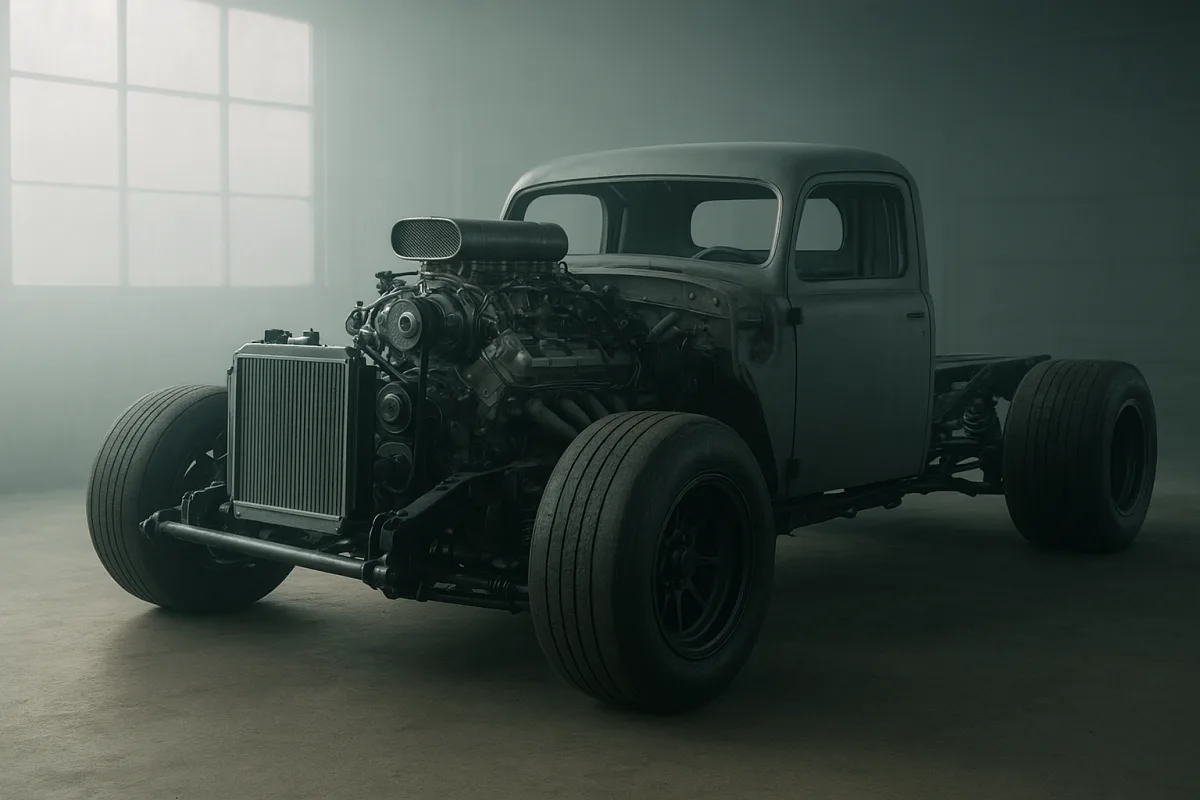
The power number is never the whole build
You are looking at a 1,200-hp Bronco, an 800-hp 1956 pickup, or a Miata carrying the visual mass of 13 rotary rotors. The headline number is exciting. It also tells you remarkably little about what the vehicle can repeatedly do.
Horsepower is the rate at which an engine can do work, while torque is the twisting force available at the crankshaft. Neither figure tells you whether the transmission survives a hard launch, the radiator holds temperature, or the tires can turn that force into forward motion.
That is the shared engineering problem behind Ford’s Frostwarden concept, Fat Fender Garage’s GT/FX restomod, and Rob Dahm’s extraordinary rotary Miata project. Big output only becomes usable power when the rest of the vehicle can absorb it.
For anyone considering a serious engine swap or custom build, this is where the money goes. The engine is the visible part, but the system around it decides whether you own a fast car, a show car, or a permanent project.
Ford’s 1,200-hp Bronco shows the first requirement: fuel
Ford unveiled its Frostwarden at the 2026 SEMA show, a four-door Bronco concept built around the new Megazilla 2.0 crate engine. It combines a 7.3-liter V-8 with a 3.0-liter Gen 6 Whipple supercharger. [7]
Ford rates Megazilla 2.0 at more than 1,200 horsepower and 1,000 pound-feet of torque on race fuel. Those are enormous figures for a crate engine, exceeding the 615 hp and 670 lb-ft claimed for Ford’s naturally aspirated Megazilla. [7]
The key words are “on race fuel.” Higher-output boosted engines need fuel with enough knock resistance to withstand increased cylinder pressure and temperature. Ford has not released verified horsepower or torque figures for pump gas, so nobody shopping the engine should assume the race-fuel headline applies at a normal gas station.
Ford changed more than the supercharger to get there. Megazilla 2.0 has a stronger block, supercharger-specific camshaft, upgraded pistons, larger injectors, and a revised belt drive and damper, all developed to live with forced induction. [7]
That list explains what a serious power increase costs. You do not bolt on a blower and keep every naturally aspirated component unchanged, because combustion pressure loads the block, pistons, crankshaft damper, belts, cooling system, and fuel system together.
The Frostwarden also makes clear that an engine has to meet its chassis at the same level. Its running gear includes Dana components, 74Weld portal axles, custom Bilstein dampers, 18-inch Weld beadlock wheels, and 42-inch BFGoodrich tires. [7]
Portal axles use gear reduction at the wheel ends, raising the axle centerline relative to the wheel hubs. That gives clearance and reduces some stress seen upstream in the driveline, but it also adds complexity, weight, and more components needing inspection.
Ford calls the Bronco an Arctic search-and-rescue concept, not a production trim. The company has not published fuel-consumption figures, ground-clearance data, approach and departure angles, articulation measurements, or off-road test results for Frostwarden. [7]
That leaves you with a striking engineering demonstration, not a proven 1,200-hp overlanding recommendation. Ford has also not released Megazilla 2.0 pricing, though the naturally aspirated Megazilla’s listed base price is $25,295, before installation, calibration, fuel system, cooling, transmission, and the rest of a vehicle. [7]
The drivetrain gets the engine’s torque before the tires do
An engine’s torque does not reach the tire contact patches unchanged. It passes through a torque converter or clutch, transmission, driveshafts, differentials, axle shafts, wheel hubs, and wheels, with gear ratios multiplying torque at several points.
This is why Frostwarden’s heavy-duty driveline hardware is not decorative. A 1,000-lb-ft engine can create much greater twisting force at the wheels in a low gear, especially when a transmission and axle gearing multiply the engine’s output.
The same principle appears in Fat Fender Garage’s GT/FX, a radically reworked 1956 Ford F-100 from the Arizona restoration and fabrication shop. Its third-generation 5.0-liter Coyote V-8 uses a 3.0-liter Whipple supercharger and is rated at 800 hp and 750 lb-ft. [4]
Fat Fender Garage pairs that engine with Ford’s 10R80 10-speed automatic transmission, driving the rear wheels through a custom chassis. The truck also uses a bespoke three-inch exhaust with Borla XR-1 Raceline mufflers, JMD resonators, and electric cutouts. [7]
A 10-speed automatic gives the builder many closely spaced ratios, which can keep a supercharged engine in a productive part of its rev range. It also creates a calibration challenge, because shift timing, converter behavior, throttle mapping, traction, and torque management all affect how the truck behaves.
The GT/FX has wide 315/35R-20 rear Toyo Proxes Sport 2 tires on HRE wheels, Wilwood six-piston front brakes, and four-piston rear brakes. Those are not supporting actors, they are part of the 800-hp claim becoming controllable motion. [4]
More tire helps only up to the point that compound, temperature, suspension geometry, road surface, and weight transfer permit it. A powerful rear-drive truck can still overwhelm its tires in lower gears, even with a very wide section width.
The chassis decides whether the number feels fast or frightening
Fat Fender Garage’s solution began below the body. The GT/FX rides on the company’s FF1 Performance Coilover chassis, not the original 1956 F-100 underpinnings, and its steel body was reshaped extensively to fit the new proportions. [4]
The cab was sectioned by two inches, the hood and roof were flattened, and the fenders were widened. The original grille remains, but nearly every other visible panel was reworked or fabricated for this truck. [6]
That matters because a 1950s truck body alone is not a modern performance platform. The engine can make 800 hp, but predictable braking, turn-in, bump control, and rear-wheel traction come from chassis stiffness, suspension location, damping, alignment, and weight distribution.
Fat Fender Garage says the project consumed more than 15,000 hours of design, engineering, and fabrication. [6] That number is the clearest warning for anyone who thinks the engine is the expensive part of a ground-up restomod.
No official GT/FX price has been announced. There is also no published financing program tied to this particular build, so any buyer looking to commission something comparable would need to discuss a staged build budget with the shop and arrange funding independently.
We would take the GT/FX approach if the aim is a vehicle you can actually use. It has an engine, transmission, brakes, tires, suspension, cooling, interior systems, and bodywork developed as one program, even if Fat Fender Garage’s supercar-handling language remains a claim rather than published test data.
A 13-rotor Miata shows why tolerances become the project
Rob Dahm’s Miata takes the opposite route, deliberately pushing rotary-engine scale into absurd territory. For its SEMA display, the project combined the visual presence of a 12-rotor drag-engine assembly with a running one-rotor engine underneath, creating a 13-rotor spectacle.
The attraction is obvious. A rotary engine produces power through rotating triangular rotors moving inside epitrochoid-shaped housings, without pistons reversing direction as in a conventional V-8 or four-cylinder engine.
The ownership reality is less theatrical. In Dahm’s one-rotor rebuild, clearances were measured in thousandths of an inch, including a bearing that had been roughly 0.002 inch out of round and rotor clearances ranging from 0.002 to 0.005 inch.
His replacement rotor was consistently about 0.002 inch narrower in a contact area, and he aimed for roughly 0.004 inch bearing clearance. Those microscopic dimensions affect oil film thickness, heat management, contact between moving parts, and the chance of a seal or bearing problem.
This is the core lesson of a rotary build. A small change that would be invisible in a general walkaround can decide compression, sealing, and durability. The parts may look simple, but the measurements are unforgiving.
Dahm also found warped apex-seal tips and used 4,000-grit sandpaper to flatten them, seeking to address even 60-psi compression readings. His working theory centered on localized heat at the corner seal area, where cooling and lubrication are particularly difficult.
Apex seals sit at the rotor tips and seal each combustion chamber against the housing. Side seals and corner seals complete the arrangement, so a leak or distortion at one small edge can reduce compression and make the engine harder to start, weaker, or inconsistent.
A multi-rotor build has no maintenance playbook
There is no meaningful reliability database for a 13-rotor road vehicle. It is too rare, too bespoke, and too dependent on one-off fabrication, calibration, cooling layout, seals, materials, and the person who assembled it.
A Mazda 13B is the closest available reference point, but it is only a rough one. Stock 13B rebuilds are commonly quoted around $3,000 to $5,000, while race-oriented builds can reach $20,000, depending on parts and specification. [2]
Rotary ownership commonly involves apex-seal wear, oil use, and close attention to cooling. One 13B guide cites oil consumption around 12 to 16 liters per 100 kilometers, though actual use depends heavily on engine condition, tuning, and how the car is driven. [3]
Compression testing is part of keeping a rotary honest. Healthy 13B rotor faces are often cited around 90 to 110 psi, though the correct test method, cranking speed, gauge, altitude, and engine temperature all influence the reading you see. [4]
A 13-rotor engine compounds the exposure. More rotors mean more housings, seals, oil-control parts, ignition needs, fuel delivery demands, cooling paths, and potential mismatch between cylinders, or in this case rotor chambers.
That does not make the project pointless. It makes it a specialist fabrication exercise where you budget for monitoring, teardown, replacement parts, and expert labor long before you budget for horsepower per dollar.
Registration and insurance are part of making power usable
A custom vehicle only becomes yours to drive regularly when it can be registered, insured, and legally operated where you live. This is an area where a 13-rotor Miata is likely to be far more demanding than a catalog crate-engine installation.
The EPA explains that imported vehicles and engines may need to meet federal emissions requirements, with Independent Commercial Importers involved in some compliance pathways. [1] A radically modified vehicle can create similarly complicated questions about emissions equipment, engine changes, and documentation.
Federal safety requirements and state registration rules add another layer, and those rules differ substantially by location. Before committing money to a major custom powertrain, you should speak with your state DMV, a specialist inspection shop, and an insurer familiar with modified and collector vehicles.
Insurance is difficult because a one-off engine has no standard valuation, replacement-parts catalog, repair-time guide, or predictable claims history. A specialty broker may find coverage, but the declared value and evidence of workmanship will matter.
The engine number gets the attention. The vehicle system, paperwork, service access, and repair plan determine whether you can enjoy it after the show lights go out.
Frequently Asked Questions
What are the key components of a high-performance engine build?
A high-performance engine build involves more than just the engine itself. It requires upgraded internal components such as pistons, camshafts, and fuel injectors designed to handle increased combustion pressures. Additionally, the fuel system, cooling system, drivetrain, tires, chassis, and calibration must all be developed or reinforced to reliably manage the engine’s power and torque output.
How does drivetrain and chassis affect engine performance?
The drivetrain and chassis determine whether an engine’s torque and horsepower can be effectively transferred to the road. Components like the transmission, differentials, axles, and wheels must be strong enough to handle the engine’s twisting forces, especially at low gears where torque multiplies. The chassis and suspension must also be engineered to maintain control and stability under high power loads.
What fuel requirements are needed for high-horsepower crate engines?
High-horsepower crate engines, such as Ford’s Megazilla 2.0, require race fuel with high knock resistance to safely withstand increased cylinder pressures and temperatures. Ford has not published verified power figures for pump gas, so these engines should not be assumed to perform at race-fuel levels when using regular gasoline.
Why is a strong drivetrain important for high-torque engines?
A strong drivetrain is essential because the torque produced by the engine is multiplied through the transmission and axle gearing before reaching the wheels. Without heavy-duty components, the drivetrain can fail under the extreme twisting forces generated by high-torque engines, making it critical to upgrade parts like transmissions, axles, and differentials to match engine output.
How do cooling and calibration impact engine build reliability?
Cooling systems must be upgraded to manage the increased heat generated by high-performance engines, preventing overheating and maintaining consistent operation. Calibration is equally important to ensure the engine runs efficiently and safely with the chosen fuel and hardware, optimizing performance while protecting components from damage.
How we researched this
This article was assembled from 2 video sources, 7 published articles, 7 cited references.
Nothing here is based on hands-on testing. Where a figure or finding appears, it belongs to the source cited beside it, and the writing says so rather than implying otherwise. Every source is listed below so you can check it.
Sources
We’re building the Turbo 1 Rotor Miata for SEMA! With a slight twist…, Rob Dahm
Unveiling the 13 ROTOR Miata at SEMA!! It runs… kinda, Rob Dahm
Bronco-Based Ford Frostwarden Debuts Ford’s Most Powerful Crate Engine, Hagerty
Fat Fender Garage’s GT/FX Pairs Sporty Looks with an 800-HP V-8, Car and Driver
The Ford Bronco Frostwarden Makes 1200 HP, Thanks to Its Megazilla 2.0 Supercharged V-8, Road & Track
Fat Fender's 800 HP Ford F-100 Is The Work Of Over 15,000 Hours, CarScoops
This 800-HP Ford Pickup Restomod Took 15,000 Hours To Build, Motor1
Fat Fender Garage’s GT/FX Pickup Supercharges ’50s Ford Style, Hagerty
Automakers Want Congress to Permanently Ban Chinese Cars From the U.S., Road & Track
13B Rotary Engine Reliability: How Long Does an RX7 Engine Really Last? - philsrotary
The Reality of Rotary Engine Reliability: Separating Myth from Measured Performance
13B Rotary Engine Guide: Specs, Variants and Reliability, JDM State Motors of NC
Upgrading Your 13b-rew for Daily Driving: Balancing Power and Reliability | Nashville Performance
Frostwarden Unleashes Megazilla 2.0, the Most Powerful Crate Engine Ever Created by an Automaker
Watch High-Performance Engine Builds and Unique Powertrains on Youtube
Also from the sources
Related Articles
Race Car Builds and Engine Swaps: Best Projects Compared
Explore race car builds and engine swaps with detailed comparisons of performance, cost, and value for high-performance projects.
Holden Monaro Barra Engine Build and 4 Rotor Supra Exhaust
Explore the Holden Monaro Barra engine build process and four rotor Supra exhaust testing, covering fitment, brakes, costs, and performance insights.
Transforming a 2025 Nissan Frontier Pro 4X with Nismo Upgrades
Watch throtl upgrade a 2025 Nissan Frontier Pro 4X with Nismo parts and expert help from Chris Forsber. From suspension to lighting, follow the transformation.
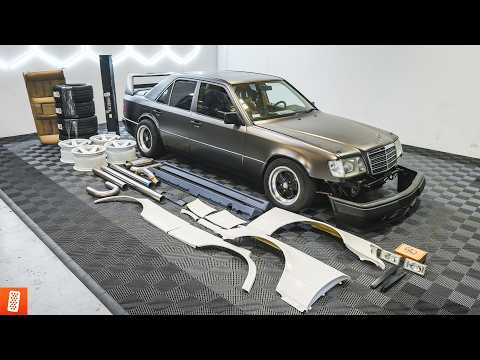
Abandoned Mercedes Rebuild: Custom Exhaust, Widebody Kit & 418 HP Dyno Run
Witness the epic transformation of an abandoned Mercedes with a 5.2 L Ford Voodoo crate engine. From a custom Magnaflow exhaust to a widebody kit and forged HRE wheels, this rebuild is a true showstopper. Feel the power of 418 wheel horsepower on the dyno and experience the thrill of smoky burnouts in this impressive rebuild journey by throtl.