
Toyota Scion KEI-01 U.S. Prospects and Market Overview
Explore Toyota Scion KEI-01 U.S. prospects, features, speed limits, and fleet sales plans for this low-speed kei truck.
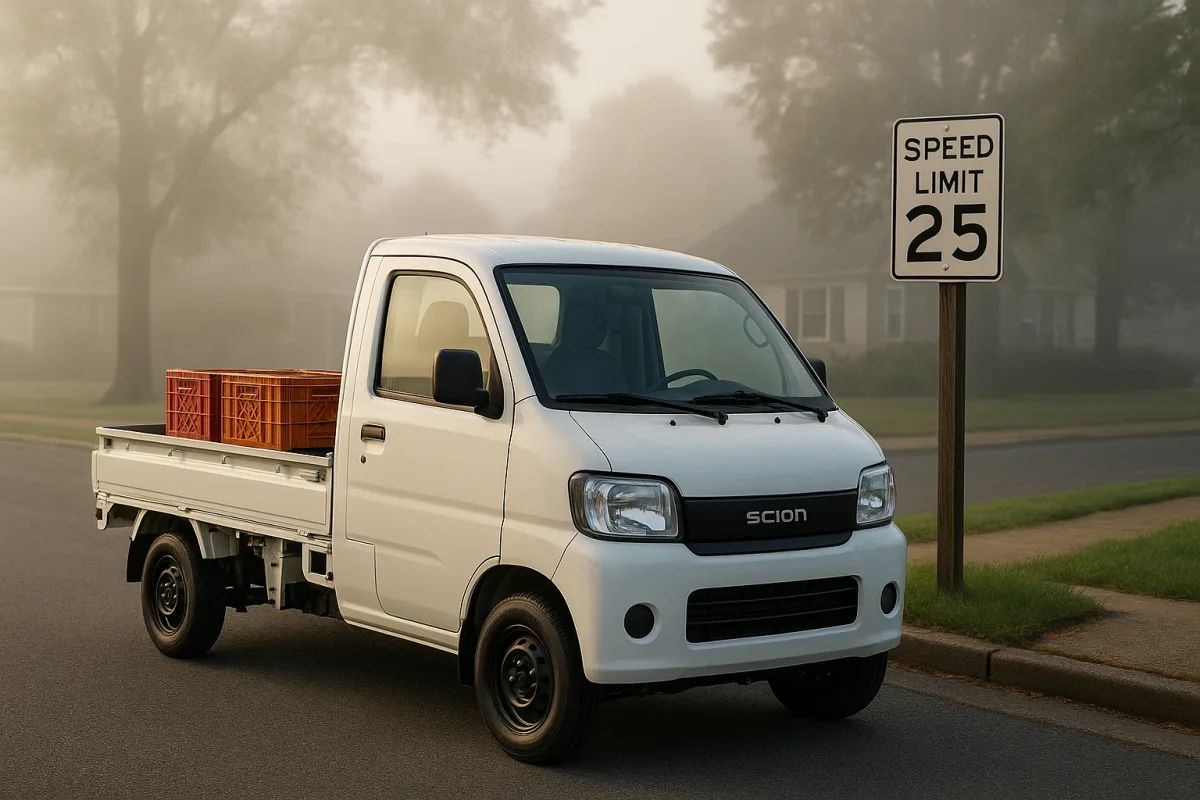
Check the roads between your driveway and the job site
The KEI-01’s 25-mph top speed is the first number to put on your route map. Toyota is positioning the pickup-bodied Scion as a low-speed vehicle, built to Federal Motor Vehicle Safety Standard No. 500 requirements. [6][11]
That makes it a very different machine from a Maverick, a used compact pickup, or even a conventional Japanese kei truck imported after 25 years. It can suit a campus, resort, warehouse district, neighborhood, industrial park, or large property.
It cannot safely solve a commute involving a 45-mph arterial, a highway entrance ramp, or fast rural two-lanes. A kei truck’s small footprint looks appealing beside a full-size pickup, but traffic does not become smaller around it.
Low-speed vehicles are generally restricted to roads with posted limits of 35 mph or below, although state and local rules determine where they may actually operate. Some jurisdictions allow them only on streets marked 25 mph. [5]
Start with your state DMV, then call the city or county responsible for roads around your home or business. Ask specifically about registration, title requirements, license plates, insurance, right-hand-drive vehicles, and permitted road speeds.
Do this before calling a dealer. A vehicle can meet federal low-speed-vehicle rules and still face a patchwork of state registration and operational restrictions. [4][5]
Separate the KEI-01 from the kei-truck fantasy
Toyota’s KEI-01 is a new American-built low-speed vehicle, not a gray-market Daihatsu Hijet or Suzuki Carry that happens to wear Toyota-related branding. TheStraightPipes found the displayed truck was right-hand drive, automatic-only for North America, and fitted with air conditioning and heat.
Toyota has said production will begin at Toyota Motor Manufacturing Indiana in the second half of 2027. The company is investing $34 million and expects the project to create about 50 jobs. [11]
Initial sales are aimed at fleet customers through a limited dealer network. Toyota has not confirmed that an individual buyer will be able to order one, nor has it announced a retail trim lineup. [3][11]
That fleet-first approach makes sense for the vehicle’s limitations. A grounds crew can run a predictable local route and charge costs to a business, while a household needs one vehicle to cover school runs, rain, groceries, doctor visits, and faster roads.
The original Scion brand was built around distinctive entry-level vehicles and a simplified buying process. Ideal notes that Scion’s former Pure Price program was no-haggle dealer pricing, not manufacturer-direct sales, and a revived badge does not erase state franchise laws.
Do not assume a new Scion means direct ordering, fixed pricing, or no dealer add-ons. Toyota has not announced how KEI-01 transactions will work beyond its limited fleet-sales plan. [11]
Match the truck to the load, not its appearance
A short wheelbase, fold-down bed sides, and low cargo floor are why kei trucks attract people who haul mulch, tools, landscaping supplies, bicycles, and furniture. Those features make loading easier than lifting every item over a tall modern pickup bedside.
TheStraightPipes reported a 600-pound payload for the KEI-01 prototype and showed three drop-down bed sides, a spare tire, rear leaf springs, and tie-down points. That is enough for light local work, not an invitation to substitute it for a half-ton truck.
Toyota describes the KEI-01 as four-wheel drive, with a 660cc three-cylinder gas engine and CVT automatic transmission. It is not electric, even though its low-speed role overlaps with electric carts and neighborhood EVs. [6][11]
Toyota has not published horsepower or torque. Similar 660cc turbocharged three-cylinder engines can produce about 50 horsepower, but that is an estimate, not a KEI-01 specification. [6]
Do not assume it can tow because it has a hitch point or sturdy-looking leaf springs. Toyota has not published a towing rating. Without a factory rating, trailer-brake guidance, or cooling details, we would not plan a business around towing.
The cab deserves a physical test before you sign anything. TheStraightPipes found more room than in a typical imported kei truck, including storage above the windshield, but the driver remains on the right and the vehicle remains very narrow.
Right-hand drive is manageable on local routes, particularly for curbside work, but it changes overtaking sightlines and toll, drive-through, gate, and parking-garage routines. It will feel familiar to no American-market Toyota buyer until they spend time in it.
Put a real price on the unannounced sticker
Toyota has announced no KEI-01 price. There is also no official maintenance schedule, warranty term, insurance quote, fuel-economy rating, or total-cost-of-ownership figure for the American truck. [11]
TheStraightPipes speculated about roughly $18,000 in U.S. dollars based on the vehicle shown, while Ideal argued a useful small truck would need to begin near $20,000 to make sense. Neither figure is a Toyota price.
Use those numbers only to set a walk-away threshold, not a savings target. At $15,000, a locally useful truck could occupy a distinct space; near $30,000, it faces used compact pickups, new crossovers, and larger work vehicles.
A low sticker price would not make ownership automatically cheap. Fuel is only one portion of vehicle ownership, with insurance, financing, repairs, depreciation, registration, and taxes frequently carrying more weight over time. [7]
Ask for an out-the-door quote that separates vehicle price, destination, dealer documentation fees, accessories, sales tax, registration, and any fleet-service agreement. The KEI-01 has no announced consumer pricing, so do not accept a vague “competitive” promise as a number.
Toyota’s Indiana production avoids the basic problem of importing a completed light truck subject to the long-standing 25 percent U.S. truck tariff. It does not remove the cost of federal compliance, limited-volume production, dealer support, or warranty coverage. [1]
Arrange insurance and financing before delivery
Kei trucks can be awkward to finance because lenders struggle with uncommon vehicle identification, limited valuation data, and uncertain resale values. Specialized sellers note that unsecured personal loans may be easier to obtain, though often at higher interest rates. [8][9]
Toyota backing may make the KEI-01 easier to insure and finance than an imported 1990s truck, but Toyota has not announced any dedicated program. Do not assume your bank or insurer will treat it like a Corolla.
Call at least three insurers with the exact VIN, once available, and ask whether they will write liability, collision, comprehensive, and agreed-value coverage. Standard policies may offer limited coverage or decline unfamiliar kei-style vehicles altogether. [8]
Ask each insurer whether operation is restricted by road type, mileage, driver age, business use, or garaging location. A cheap policy that excludes your normal route or paid work is not a cheap policy.
Older imported kei trucks show why resale planning matters. Median asking prices for roughly 25-year-old examples are around $8,800, while newer off-road-oriented trucks can be listed near $21,800, a very wide spread. [8]
The KEI-01 will have no established used market at launch. If you finance one, keep the term short enough that you are not carrying a large balance against an unproven resale value.
Plan maintenance around access, not assumptions
The KEI-01’s 660cc engine sits beneath the cab area, and TheStraightPipes showed that reaching the oil dipstick involved lifting the seat and working a fairly awkward latch. Inspect that process yourself if your staff will check fluids daily.
A small engine does not mean it can skip maintenance. It will spend its working life moving a tall, boxy vehicle at full local speed, often with payload, air conditioning, stop-start use, and multiple drivers.
Before deployment, get Toyota’s written maintenance schedule for oil, CVT fluid, differentials, cooling system, brakes, tires, and four-wheel-drive components. Toyota has not yet published those intervals for the KEI-01. [11]
Also ask which dealer will stock routine parts and who handles collision repairs. A local manufacturing plant does not guarantee that every Toyota dealer will have body panels, glass, suspension components, or trained technicians on its shelf.
The truck’s 12-inch wheels may keep replacement tires affordable, but check tire availability before choosing a location-dependent fleet. Keep one mounted spare, verify its age at every service, and confirm whether the dealer can source matching tires quickly.
We would specify basic equipment first: air conditioning, heat, durable seat material, usable tie-downs, a spare tire, and straightforward fleet telematics if Toyota offers it. Skip cosmetic accessories until the truck’s support network and uptime record are established.
Wait for proof before treating it as a consumer breakthrough
The KEI-01 arrives as American buyers continue to favor larger vehicles, while smaller electric mobility products such as e-bikes, golf carts, and low-speed vehicles gain visibility. That does not guarantee demand for a gas-powered, right-hand-drive kei truck. [1][10]
The appeal is clear on a contained route. A 25-mph four-wheel-drive truck with a low bed and compact dimensions can move supplies through spaces where a full-size pickup is expensive, inconvenient, and physically oversized.
The compromise is equally clear once the route leaves those spaces. A 25-mph limit, right-hand-drive layout, fleet-first availability, unknown pricing, and unproven consumer support make the KEI-01 a specialized work tool.
We would buy one only after three things happen: your state confirms legal use on every required road, Toyota publishes a price and warranty that keep the total below larger alternatives, and fleet owners establish a reliable service record.
Until then, the KEI-01 is promising because Toyota is attempting an American-built low-speed kei-style truck, not because it has already delivered the cheap, highway-capable small pickup many buyers want.
Frequently Asked Questions
What are the U.S. prospects for the Toyota Scion KEI-01?
The KEI-01 will be produced in Indiana starting in the second half of 2027, with Toyota investing $34 million and creating about 50 jobs. Initial sales will focus on fleet customers through a limited dealer network, and retail availability or consumer demand remains uncertain. The vehicle’s low-speed classification and right-hand-drive configuration limit its broader market appeal.
Is the Scion KEI-01 suitable for private ownership in the U.S.?
Currently, Toyota has not confirmed if individual buyers will be able to purchase the KEI-01. Given its 25-mph speed limit and classification as a low-speed vehicle, it is better suited for predictable local routes typical of fleet use rather than the varied demands of private ownership. Prospective private buyers should wait for more information on pricing, reliability, and state registration rules.
What are the speed and road restrictions for the KEI-01 in the U.S.?
The KEI-01 is limited to a top speed of 25 mph and is designed to meet Federal Motor Vehicle Safety Standard No. 500 for low-speed vehicles. It is generally restricted to roads with speed limits of 35 mph or less, and some states or localities may only allow it on streets posted at 25 mph or below. Road access and registration rules vary widely by jurisdiction.
How does Toyota plan to sell the KEI-01 in the U.S. market?
Toyota plans to initially sell the KEI-01 to fleet customers through a limited dealer network. There is no announced retail trim lineup, pricing, or consumer financing program, and it is unclear if or when the vehicle will be available for private buyers. Sales are fleet-focused to match the vehicle’s operational limitations.
What are the key features and limitations of the Scion KEI-01?
The KEI-01 features a 660cc three-cylinder gasoline engine, CVT automatic transmission, four-wheel drive, and a pickup-style bed with fold-down sides and a 600-pound payload capacity. It is right-hand drive and built as a low-speed vehicle limited to 25 mph, making it suitable for local, low-speed work environments but not for highway or fast road use.
How we researched this
This article was assembled from 2 video sources across 2 channels, 11 cited references.
Nothing here is based on hands-on testing. Where a figure or finding appears, it belongs to the source cited beside it, and the writing says so rather than implying otherwise. Every source is listed below so you can check it.
Sources
It’s OK to be KEI in the USA! Scion by Toyota KEI-01, TheStraightPipes
Toyota Revives The Scion Brand In The U.S. With A Right-Hand-Drive Kei Truck
Can You Drive a Right-Hand Drive Car in the US? - LegalClarity
Kei Truck Legality in the US: Federal and State | JDMBUYSELL
Scion KEI-01 Kei Truck: 25 MPH Limit, Specs and 2027 US Launch, Amanda Newer
True Cost of Car Ownership: Fuel Is Only 16% of It - True Driving Cost
EVs remain a niche choice in the US, according to survey - Ars Technica
Watch Toyota's New Scion Kei-01 and Kei Truck U.S. Prospects on Youtube
Also from the sources
Related Articles
Polestar US Sales Ban Explained
Learn why Polestar faces a US sales ban starting 2027 due to connected vehicle rules and how it differs from Volvo's approval.
New Midsize Pickup Trucks and Off-Road Builds Guide
Explore new midsize pickup trucks and learn how to build them for off-road use with expert tips on factory features and modifications.
Car Ownership Costs and Residual Value Explained
Learn how car ownership costs relate to residual value and depreciation to make smarter buying and selling decisions.
Ford Fathom EV Home Power Generator: Features and Costs
Learn how the Ford Fathom EV works as a home power generator, its built-in inverter, setup costs, and backup power capabilities.