
Turbo Kit Installation Costs and Common Myths Explained
Learn about turbo kit installation costs, supporting mods, and myths to get reliable performance and avoid surprises in your turbo build.
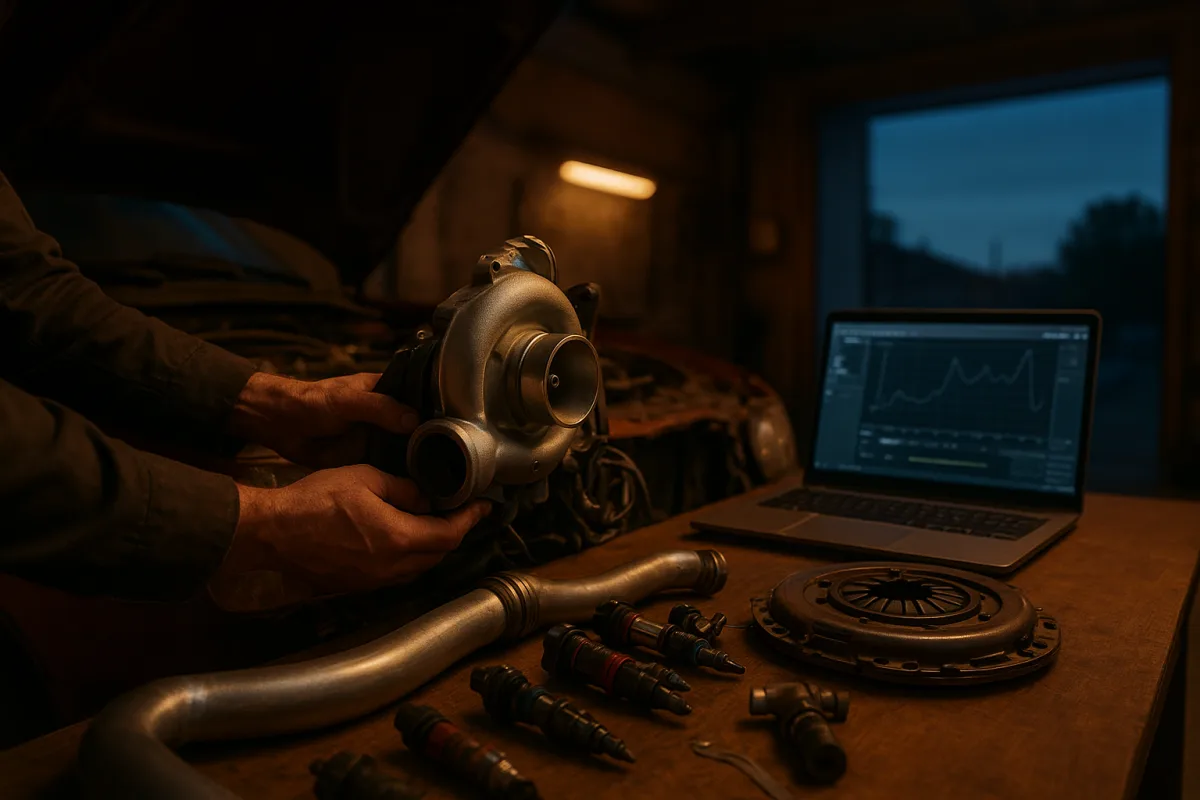
The turbo kit price is the least useful number
The seductive number in turbo tuning is the kit price. It is easy to compare one box of parts with another, then decide the cheaper one is a bargain or the expensive one is “quality.” Ownership starts when the boxes are open.
Donut’s HiLow build put the contrast in unusually plain terms: one 25-year-old Nissan turbo setup cost $7,800, while the more expensive route reached $14,000. Neither figure meant simply bolting on a turbocharger and driving away.
Both cars needed the systems around the turbo addressed. Donut fitted injectors, fuel pumps, fuel-pressure regulation, larger intercoolers, radiators, exhaust parts, clutches, engine mounts and tuning support because boost multiplies demands throughout the drivetrain.
That is the core point worth understanding properly. A turbo does not make horsepower in isolation. It increases the mass of air entering the cylinders, so every component needed to fuel, cool, seal and transmit that power becomes relevant.
A cheap kit can make very good power. An expensive kit can be a waste of money. But a car with the wrong injectors, weak fuel pump, leaking charge pipes or an unsuitable calibration is not a budget build. It is an unfinished one.
What “supporting modifications” actually mean
Start with airflow. The compressor side of a turbo pulls in air and compresses it before it reaches the engine. Compressing air heats it, and hot intake air is less dense and more prone to detonation under load.
That is why intercooler size, pipe routing, hose quality and clamps matter. In Donut’s cheaper build, a substantial boost leak was found where charge piping had moved and rubbed. The result was not merely less power, but an engine receiving airflow the ECU had not expected.
A boost leak is the sort of fault that makes internet power claims meaningless. The turbo may be capable of a number on paper, but a loose coupler, distorted pipe or poor weld can make the car slow, inconsistent and difficult to tune.
Then comes fueling. More air requires more fuel, delivered consistently at sufficient pressure. Donut replaced the Nissan’s original 440cc injectors with 740cc DeatschWerks injectors and paired them with a higher-flow pump, because the stock system could not safely match the extra air.
The cheap and expensive builds used different pumps, 255 litres per hour for the ISR unit and 340 litres per hour for the DeatschWerks part. Those figures alone do not declare a winner, because injector size, fuel pressure, fuel type and target power all determine required flow.
This is where a tuner earns their money. The ECU needs to know how the injectors behave, how much air the engine is receiving, what boost target is appropriate, and how ignition timing must change with load and intake temperature.
A bad tune can destroy an otherwise sensible parts list. The independent cost research puts ECU calibration at roughly $600 to $3,200, which is a wide range, but it is more honest than pretending a generic map is equivalent to bespoke calibration.
Cooling is similarly unglamorous until a car overheats in traffic. A thicker radiator may help, but only if airflow through it remains good, the fans work, the thermostat and water pump are healthy, and the engine’s existing cooling passages are not clogged.
Donut compared an ISR aluminium radiator with a Koyorad unit and made the fair point that a logo alone does not cool an engine. Still, fitment, fan-shroud compatibility and core construction matter more than a simplistic “aluminium is aluminium” argument suggests.
On a 25-year-old car, I would also want the baseline checked before ordering shiny parts. A compression test, leak-down test, oil-pressure reading, cooling-system pressure test and inspection of old vacuum lines tell you whether the engine is a candidate for boost.
None of those tests makes an exciting social-media post. They are also cheaper than discovering cracked ringlands, tired valve seals or weak oil pressure after the turbo system has made every existing fault work harder.
The turbo itself: journal bearing versus ball bearing
The visible centerpiece is still the turbocharger. Exhaust gas spins a turbine wheel, which is linked by a shaft to the compressor wheel. The compressor forces more air into the intake, allowing the engine to burn more fuel and produce more torque.
That shaft needs support while spinning at extraordinary speed in extreme heat. A conventional journal-bearing turbo rides on a pressurised film of engine oil inside sleeve-style bearings. It is a proven, relatively affordable arrangement and is usually more straightforward to rebuild.
A ball-bearing turbo uses small ball bearings in a cartridge rather than relying solely on the oil film. Reduced friction can improve transient response, meaning the turbo responds sooner when the driver reapplies throttle, rather than necessarily producing a radically higher peak number.
The research briefing estimates ball-bearing versions at a $500 to $900 premium over equivalent journal-bearing units and says spool can improve by up to 15 percent. “Up to” matters, because turbine sizing, manifold design, boost control and engine displacement decide what a driver feels.
There is no universal rule that ball bearing equals reliable and journal bearing equals cheap rubbish. Ball-bearing turbos can handle hard use well, but they cost more and deserve clean oil, correct oil pressure and correct feed and drain plumbing.
Journal-bearing turbos are less glamorous, but their lower purchase price and rebuildability can suit an older street car. The money saved only counts as savings if it is spent on essentials such as a competent tune, proper lines and decent charge-pipe hardware.
Donut’s expensive build retained air conditioning by using a stock-location arrangement, while the cheaper top-mount layout conflicted with the A/C line. That is a perfect example of the real calculation: a lower parts price can demand a permanent sacrifice in daily usability.
The same build required trimming parts of the car for intercooler installation. There is nothing automatically wrong with fabrication, but buyers should distinguish between a designed, reversible installation and a conversion that turns future servicing into a custom project.
Why the drivetrain decides whether the build feels good
Turbo torque exposes weak clutches quickly. Donut’s high-budget Nissan used a $1,660 twin-disc clutch rated for 650 lb-ft, while the other car used a more aggressive six-puck single-disc arrangement.
A twin-disc clutch increases friction area without necessarily requiring a brutally heavy pedal. That makes sense when torque targets are high and the car still sees road use, although it adds cost, complexity and often some driveline noise.
A puck clutch can be cheaper and hold substantial torque, but it may be abrupt in traffic. This is why “it holds the power” is not enough of a verdict for a street car that will do grocery runs, commutes and hot-weather stop-start driving.
The independent research places clutch upgrades around $500 to $1,500, with transmission work potentially adding $1,000 to $3,000. Those are not guaranteed costs, but they explain why a nominally affordable turbo project often spreads into the rest of the driveline.
Motor mounts deserve the same practical treatment. Donut used polyurethane mounts on one car and Cusco double-bushed mounts on the other to limit engine movement. Less movement can protect piping and sharpen shifting, but it also sends more vibration into the cabin.
That trade-off is often missing from modification discussions. A part can be technically better for controlling an engine under boost and still make a long motorway journey worse. Cars are not race cars merely because the catalogue says “motorsport.”
Cheap modification myths beyond the turbo
Ideal’s criticism of exposed cone-filter “cold-air intakes” is fair. Replacing a sealed factory airbox that draws outside air with a filter sitting near the exhaust manifold can increase induction noise while feeding the engine warmer under-bonnet air.
That does not mean every intake is pointless. A correctly designed, sealed intake can support a modified engine when the original system becomes restrictive. The issue is claiming a sound change and a sharper throttle sensation as measured power.
Poorly designed intakes also carry real risks: water ingestion, disrupted airflow-meter readings, air leaks and debris entry. The research briefing finds no reliable data quantifying their impact on resale value, so claims that an intake definitely helps or ruins value are speculation.
Crackle tunes are an even clearer case of buying theatre. Ideal explains that aggressive overrun maps can alter fueling and ignition timing so combustion continues in the exhaust, creating bangs but adding heat stress to catalysts, turbos and exhaust components.
A carefully calibrated factory overrun strategy is not the same thing as an aftermarket map designed to pop on every lift of the throttle. For a modified older turbo car, extra exhaust temperature is a poor bargain when replacement parts are already expensive.
Lowering springs and coilovers follow the same pattern. Ideal is right that suspension travel, bump steer, roll-centre correction, damping and alignment determine handling, not simply how little gap exists between tyre and arch.
An old car on correctly chosen dampers, sensible spring rates, good alignment and decent tyres will generally be more useful than one on bargain coilovers sitting on its bump stops. The latter may feel dramatic, which is not evidence that it grips.
Budget for ownership, not the reveal photo
The broad independent estimate for a turbo conversion, roughly $4,000 to more than $25,000, is believable precisely because it includes the parts enthusiasts forget. Turbo units alone can run from about $400 to $900 reconditioned, or $1,200 to $2,500 new.[3]
Installation labour varies wildly with the car and the kit. A straightforward job may be quoted at $500 to $1,500, while complex work rises quickly when exhaust fabrication, oil-return routing, intercooler piping and fault-finding are involved.
Set aside money for gaskets, fluids, filters, heat shielding, clamps, hoses, sensors and hardware. The research briefing estimates those consumables at $100 to $450, but an older car with seized fasteners or hidden previous damage can exceed that easily.[3]
Insurance belongs in the budget too. Standard policies may limit coverage for aftermarket equipment, while custom-parts-and-equipment endorsements can be needed to insure a turbo conversion properly.[1] Some insurers exclude performance modifications, and undeclared parts can complicate or reduce a claim.[2]
Keep receipts, photographs, dyno sheets, tuning invoices and an accurate parts list. That documentation helps establish value for insurance and helps a future buyer understand whether the car was thoughtfully assembled or merely modified until it ran.
The useful version of a turbo build is not the one with the biggest claimed number. It is the one whose owner can explain its fuel system, cooling capacity, calibration, service history, insurance status and compromises without needing to change the subject.
Frequently Asked Questions
What are the true costs involved in installing a turbo kit?
The turbo kit price is only the starting point. On an older car, additional expenses typically include upgrading fuel delivery (injectors, pumps), cooling systems (radiators, intercoolers), clutch capacity, oil control, and ECU calibration. These supporting modifications can turn a nominal $7,800 kit into a five-figure project, as every part of the drivetrain must handle increased demands.
How do supporting modifications affect turbo kit performance?
Supporting modifications like proper intercooler sizing, quality charge pipes, fuel injectors, and fuel pumps are essential to realize the turbo’s potential. For example, a boost leak caused by poor pipe fitment can reduce power and cause inconsistent engine behavior. ECU calibration is also critical to manage air-fuel ratios and ignition timing, with costs ranging from $600 to $3,200 for a bespoke tune.
Is a ball bearing turbo worth the extra cost?
Ball bearing turbos cost about $500 to $900 more than journal bearing turbos and can improve spool time by up to 15 percent, offering better throttle response. However, this advantage depends on the entire system being well installed and maintained, including clean oil supply and proper plumbing. Journal bearing turbos remain a cost-effective, rebuildable option, especially if budget or maintenance simplicity is a priority.
What common myths exist about turbo tuning and reliability?
Common myths include the belief that loud intakes, crackle tunes, or aggressively lowered suspension inherently improve reliability or performance. In reality, these features are often for show and do not guarantee durability or power gains without a complete, well-engineered package. Additionally, a bad tune can ruin otherwise sensible hardware choices, highlighting the importance of professional calibration.
How does a turbo conversion impact car insurance coverage?
Standard comprehensive insurance policies often exclude or limit coverage for aftermarket turbo kits and modifications. It is important to disclose any turbo conversion to the insurer before a claim arises and to budget for specialist coverage or a Custom Parts and Equipment endorsement. Failure to disclose modifications can lead to denied or reduced claims, and some insurers may exclude performance modifications altogether.
How we researched this
This article was assembled from 2 video sources across 2 channels, 3 cited references.
Nothing here is based on hands-on testing. Where a figure or finding appears, it belongs to the source cited beside it, and the writing says so rather than implying otherwise. Every source is listed below so you can check it.
Sources
Watch Car Modification Trends and Myths on Youtube
Also from the sources
Related Articles
Holden Monaro Barra Engine Build and 4 Rotor Supra Exhaust
Explore the Holden Monaro Barra engine build process and four rotor Supra exhaust testing, covering fitment, brakes, costs, and performance insights.
R34 GT-R Performance Build: Import, Mods & Ownership Tips
Learn key tips for R34 GT-R performance builds, from import and insurance to carbon bodywork and specialist labor budgeting.
Carbon Fiber Performance Builds
Learn how to plan carbon fiber performance builds with fitment tips, cost insights, and insurance advice for lightweight car modifications.
Exotic Car Ownership and Modifications
Explore exotic car ownership and modifications, including costs, challenges, and real-world examples of high-performance exotic cars.